


 Call Us



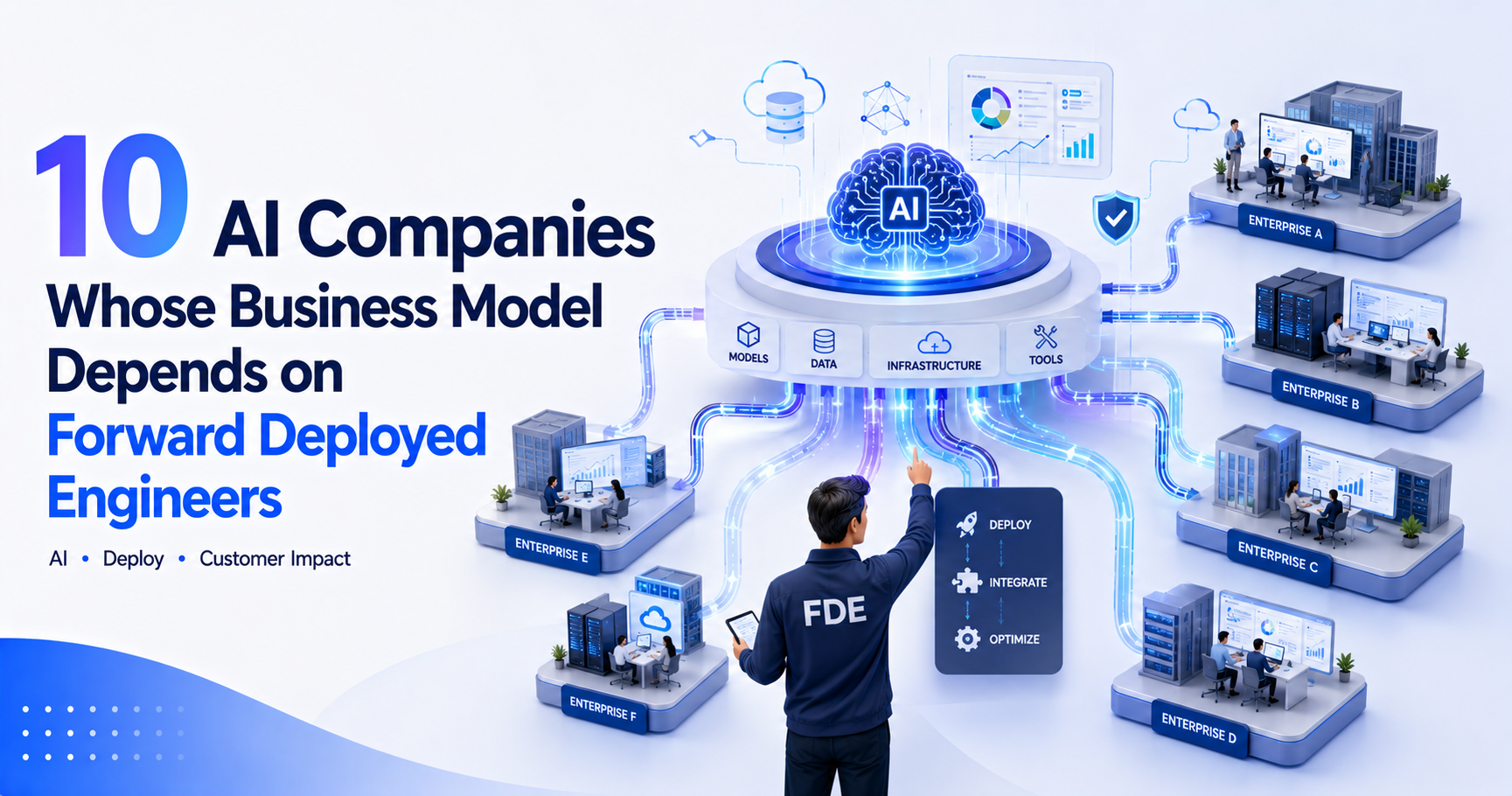
Most articles about forward deployed engineers describe the job. This one explains the market, because the more revealing question is not what the role is but why a whole class of AI companies cannot function without it. For these businesses, forward deployed engineers are not a support function but a load-bearing part of the model, the reason their technology reaches production at all. Understanding which companies are built this way, and why, tells you more about where the role is heading than any job description, because it shows the commercial logic that created the demand. This piece looks at ten AI companies whose business models depend on forward deployed engineers, and what that dependence reveals.
The commercial angle matters for anyone considering the role, because a job that a company's business model depends on is a job with durable demand and real leverage. Building the capability these companies rely on, through the Forward Deployed Engineering Program, positions you at the centre of their models rather than at the edge.
Key Highlights
- For a class of AI companies, forward deployed engineers are load-bearing, the reason their technology reaches production, not a support function.
- These companies exist because capable AI does not deploy itself into enterprises, and someone has to bridge the gap for the model to generate revenue.
- The pattern spans frontier labs, the originator Palantir, and vertical AI startups solving the deployment problem in specific industries.
- The dependence reveals the commercial logic of the role: the value of the technology is only realised when it is deployed, and deployment is the forward deployed engineer's job.
- A role that a business model depends on carries durable demand and real leverage, which is worth understanding before you choose the path.
Why some AI companies cannot function without the role
Before naming the companies, it is worth understanding the pattern that unites them, because it explains the dependence. These companies sell, or are built on, capable AI technology, and they have discovered that capable technology does not translate into value on its own. A powerful model or platform delivers nothing until it is actually deployed and working inside a customer's specific environment, and that deployment is hard, specific, and human. If nobody does it, the technology impresses in a demo and generates no revenue.
This turns forward deployed engineers from a nice-to-have into a necessity. For these companies, the forward deployed engineer is the bridge between having capable technology and generating value from it, which means the role is load-bearing in the business model rather than peripheral to it. Remove the forward deployed function and the technology stops reaching production, the customers stop realising value, and the revenue stops following. This is a very different position from a support function that could be cut in a downturn, and it is why these companies invest so heavily in the role. The dependence follows directly from the reason enterprise AI pilots stall: the gap between capable technology and real deployment is where the value is won or lost, and forward deployed engineers are the ones who win it.
The frontier labs: OpenAI and Anthropic
The clearest examples are the frontier AI labs, whose enormous model capability is worthless to an enterprise until someone makes it deliver inside that enterprise. OpenAI built a dedicated forward deployed function because it discovered that its powerful models did not automatically produce enterprise value, and that customers needed engineers embedded with them to customise the models against their data and build the systems that turn capability into results. The forward deployed function is how OpenAI converts model capability into deployed enterprise value, which is central to its enterprise business.
Anthropic built its version, framed as the Applied AI Engineer role and backed by substantial investment, for the same reason. A capable model is not an enterprise solution, and Anthropic needs applied engineers to bridge that gap inside customers, or the enterprise value of its models goes unrealised. For both labs, the forward deployed function is not a side activity but a core part of how they turn frontier research into enterprise revenue. That a company as technically formidable as a frontier lab depends this heavily on the role is the strongest possible evidence that capable technology alone is insufficient, and that deployment is where the value is realised. The three lab models differ in their details, but they share this fundamental dependence.
Palantir: the model built on the role
Palantir is the purest example, because the forward deployed engineer is not just important to its business, it is the foundation of it. Palantir built its entire approach around embedding engineers with customers to make its software deliver value, and that model became the company's signature and the source of its reputation and results. The forward deployed function is not something Palantir added to its business, it is close to being the business, the mechanism by which its software produces value in the demanding, high-stakes environments it serves.
This is why Palantir is the reference for the whole pattern. It discovered, earlier than anyone, that powerful software fails to deliver inside real organisations unless engineers embed to make it work, and it built a company around that insight. The forward deployed model drove Palantir's results by ensuring its technology actually delivered where generic software would have failed. Every other company on this list is, in a sense, following the path Palantir cut, discovering the same dependence and building the same function. Understanding how Palantir created and depended on the role is understanding the origin of the whole pattern, and it is why Palantir remains the archetype of a business model built on forward deployed engineering.
The vertical AI startups solving deployment in one industry
The most numerous examples are vertical AI startups, companies building AI for a specific industry, whose models depend on forward deployed engineers to get their technology into customers. Sierra, building customer-service AI agents, depends on forward deployed engineers to embed its agents into customers' operations, because a customer-service agent only generates value when it is actually working inside a company's real support flows. Cresta, focused on AI for contact centres, similarly depends on the role to make its systems deliver inside real contact-centre environments.
Harvey, building AI for legal work, depends on forward deployed engineers to deploy its technology inside law firms and legal teams, a domain where the gap between a capable model and a usable, trusted system is especially wide. Glean, building enterprise search and work assistants, depends on the role to make its technology work across the messy reality of a large organisation's information. Scale AI, providing data and infrastructure for AI, depends on forward deployed talent to help customers actually build and deploy on top of it. In each case, the startup's technology is only valuable when deployed into the specific, messy reality of its target industry, and forward deployed engineers are how that deployment happens. For these vertical startups, the role is existential, which is why they hire for it aggressively and why it sits at the centre of their models.
What the dependence reveals about the role
Step back from the individual companies and the pattern reveals something important about the forward deployed role itself, which is worth internalising if you are considering the path. The reason so many AI companies depend on the role is that the value of AI technology is realised at deployment, not at creation. Building a capable model or platform is necessary but not sufficient, the value only materialises when the technology is working inside a real customer, and getting it there is the forward deployed engineer's job.
This means forward deployed engineers sit at the exact point where value is realised in the AI economy, which is a powerful position. The technology may be built by researchers and product teams, but it generates no revenue until it is deployed, and deployment is where forward deployed engineers work. That is why their role is load-bearing in these business models, and why the demand for them has grown alongside AI capability rather than being satisfied by it. For an individual, this is a strong signal: a role that sits at the point of value realisation, that entire business models depend on, is a role with durable demand and real leverage. It is the opposite of a peripheral function, which is worth weighing when you consider whether to pursue the role honestly.
What this means for the durability of the role
A natural worry about any role tied to a technology boom is whether it will last, and the dependence pattern is actually strong evidence that this role is durable rather than a bubble, which is worth understanding if you are betting a career on it. A role that companies adopt as a fashion can be dropped when the fashion fades. A role that business models structurally depend on is far stickier, because dropping it would break the business, not just trim a cost. The fact that forward deployed engineers are load-bearing for so many companies means the role is embedded in how these businesses work, not layered on top as a discretionary extra.
The deeper reason for durability is that the problem the role solves is not going away. As long as there is a gap between capable AI and its deployment into specific, messy organisations, someone has to bridge it, and that gap does not close on its own as models improve, because the difficulty is in the specific customer's reality rather than the technology. If anything, more capable AI widens the gap in the short term by making more possible, which sustains demand for the people who can realise that possibility inside real organisations. This structural durability is a strong argument for the role as a career foundation, distinct from the hype, and it is worth weighing alongside the honest costs of the role. A role that entire business models depend on, solving a problem that persists, is about as durable a bet as technology offers.
The pattern is spreading beyond AI-native companies
An important extension of the pattern is that the dependence on forward deployed engineers is spreading from AI-native companies to traditional enterprises building their own AI, which broadens the opportunity considerably. As established companies across every industry try to deploy AI, they encounter the same gap between capability and reality that the AI-native companies face, and they too discover they need people who can bridge it. This means the demand for forward deployed skills is not confined to the AI companies on this list but is spreading across the whole economy as AI adoption widens.
For an individual, this spread is significant, because it means the forward deployed skill set is valuable far beyond the AI-native companies that first depended on it. A traditional bank, manufacturer, or retailer trying to deploy AI needs the same deployment capability, whether they build an internal forward deployed team or hire the skills through partners. The pattern that started with Palantir and spread to the AI labs and vertical startups is now spreading to the broader enterprise economy, which vastly expands where forward deployed skills are needed and valued. This is why building the capability is such a durable investment, and why the industries hiring for it span far beyond the technology sector into the whole economy. The dependence that defines these ten companies is becoming a dependence across the enterprise world, and building the capability through the Forward Deployed Engineering Program positions you for that far broader demand.
The ten companies at a glance
To fix the pattern, here is how the ten companies depend on the role.
| Company | Type | Why the role is load-bearing |
| OpenAI | Frontier lab | Converts model capability into deployed enterprise value |
| Anthropic | Frontier lab | Applied engineers bridge models to enterprise reality |
| Palantir | Originator | The forward deployed model is close to being the business |
| Scale AI | Data and infrastructure | Helps customers build and deploy on its infrastructure |
| Sierra | Vertical AI | Embeds customer-service agents into real operations |
| Cresta | Vertical AI | Makes contact-centre AI work in real environments |
| Harvey | Vertical AI | Deploys legal AI inside firms and legal teams |
| Glean | Vertical AI | Makes enterprise search work across messy organisations |
| Databricks | Data platform | Turns customer data into deployed AI solutions |
| Snowflake | Data platform | Makes the data cloud deliver real AI value |
Read the table to see the breadth of the pattern. It spans frontier labs, the originator, vertical startups, and data platforms, which is a remarkably wide range of company types all depending on the same role. The common thread is that each turns capable technology into realised value through deployment, and forward deployed engineers are how they do it.
The pattern also carries a lesson for how to think about your own value: position yourself at the point where value is realised rather than where it is merely created. In the AI economy, capability is increasingly abundant while the ability to deploy it into specific, messy organisations is scarce, which is exactly why forward deployed engineers are load-bearing for so many businesses. Building your career around that scarce, high-leverage point, rather than around a capability that may commoditise, is a strategic choice that the dependence pattern strongly recommends.
The through-line worth carrying away is that in a world where building capable AI is increasingly accessible, the scarce and valuable skill is making that capability deliver inside a specific, messy organisation, which is precisely why so many business models are built on the people who can do it. That scarcity is unlikely to fade soon, because the difficulty lives in the endless variety of real organisations rather than in the technology.
The bottom line
A whole class of AI companies depends on forward deployed engineers not as a support function but as a load-bearing part of the business model, the reason their technology reaches production and generates value at all. The pattern spans frontier labs like OpenAI and Anthropic, the originator Palantir whose entire model is built on the role, vertical AI startups like Sierra, Cresta, Harvey, and Glean solving deployment in specific industries, and data platforms like Databricks and Snowflake. In every case, the technology is only valuable when deployed, and forward deployed engineers are how it gets deployed.
This dependence reveals the deeper truth about the role: the value of AI is realised at deployment, not creation, and forward deployed engineers sit at the exact point where that value is realised. That is why so many business models depend on them, and why the role carries durable demand and real leverage rather than the vulnerability of a peripheral function. For anyone weighing the path, that position at the centre of the value chain is worth understanding, and building the capability these companies depend on, through the Forward Deployed Engineering Program, places you where the demand is most durable.
Building for durable demand
A role that entire business models depend on, solving a problem that keeps recurring as AI adoption spreads, is about as durable a career bet as technology offers. Building the capability these companies rely on, through agentic AI foundations and hands-on engineering with agents, positions you at the point where value is realised in the AI economy rather than at the edge. As the dependence spreads from AI-native companies to the broader enterprise world, the engineers who can bridge capable AI and real deployment become valuable far beyond the ten companies here, across the whole economy that is now trying to make AI deliver.








 Lowest-Price Challenge











 Personalized Path


.webp)


 USA
USA  Canada
 India
India UK
UK Australia
 Singapore


