


 Call Us



Most comparisons of these two roles line up their duties in two columns and leave you to guess which fits. That misses what the decision actually is. Choosing between a forward deployed engineer role and a conventional software engineer role is not about which has the longer list of responsibilities. It is about a set of specific trades: what you give up on one side to gain something on the other. This piece lays out those trades plainly, so you can decide against your own life and temperament rather than against a feature list.
Both are strong careers in 2026. The forward deployed role is riding an extraordinary demand curve, and the traditional software engineering track remains the backbone of the industry. The right choice depends on what you want your weeks to feel like and what you want your skills to become. If the forward deployed side appeals once you see the trades clearly, the Forward Deployed Engineering Program builds the specific capabilities it demands.
Key Highlights
- The core trade is stability for variety. A software engineer role offers a predictable location and deeper focus, while a forward deployed role offers constant change, heavy travel, and direct customer exposure.
- Forward deployed engineers build against unfamiliar systems and hard constraints without internal scaffolding, which stretches range, while software engineers build depth on systems they own over time.
- The forward deployed role currently carries a scarcity premium in pay and demand, but with a less settled career ladder than the established software engineering track.
- Skill trajectories diverge: forward deployment builds breadth plus customer insight, traditional engineering builds depth plus system mastery, and neither is strictly better.
- The decision should be made against your temperament and life circumstances, not against the salary headline, because the wrong fit is expensive in ways money does not fix.
The one trade underneath all the others
Strip the comparison down and a single trade sits underneath the rest: stability for variety. The software engineer works, for the most part, from one place, on a bounded set of systems, with a rhythm that repeats. The forward deployed engineer works from wherever the customer is, on whatever the customer needs, with a rhythm that resets every engagement. Almost every other difference between the two roles flows from this one.
If you value a settled base, a predictable week, and the deep satisfaction of getting better and better at a system you know intimately, the software engineering side of this trade is where you belong. If the thought of the same codebase for three years feels like slow suffocation and the idea of a new hard problem every quarter energises you, the forward deployed side is calling. Neither preference is more mature or more ambitious than the other. They are different appetites, and the entire decision is really about which one is yours.
What the day-to-day actually feels like
The lived experience of these two roles diverges more than the job descriptions suggest. A software engineer's day is mostly building: writing code, reviewing it, designing systems, and collaborating with a team that shares context with you. Interruptions exist, but the centre of gravity is the work itself, done with people who speak your language and know your systems.
A forward deployed engineer's day is building plus everything around building. You are writing code, but you are also in the customer's world, learning how they operate, managing a relationship, navigating their politics, and translating between what they say they want and what they actually need. The engineering is real, but it is wrapped in context that a traditional role filters out for you. Some engineers find that wrapping energising, because it connects their work to visible impact. Others find it draining, because it takes time and attention away from the craft they love. Knowing which kind of engineer you are is worth more than any salary comparison.
The skill trade: breadth versus depth
Over several years, these two roles build genuinely different engineers, and the difference is worth understanding before you commit, because skills compound and the direction matters.
The software engineer tends to build depth. Working on the same systems over time, they develop mastery: a deep understanding of an architecture, the ability to make subtle high-leverage changes, and the pattern recognition that only comes from living with a system's failures. That depth is valuable and durable, and it is what senior product and platform careers are built on.
The forward deployed engineer tends to build breadth plus a rare second axis. They see many systems rather than one, which develops range and adaptability, and they accumulate deep firsthand knowledge of how customers actually adopt and break technology. That customer insight is unusual among engineers and is exactly what product, architecture, and founding roles prize. The modern forward deployed engineer also builds directly on the applied AI frontier, working with intelligent agents, retrieval systems, and production AI, which is one of the fastest-appreciating skill sets available. Neither trajectory dominates. Depth wins some futures, breadth-plus-insight wins others.
The pay and demand trade
Compensation is where the forward deployed role currently looks most attractive, and it is worth being precise about why. Reporting drawn from Indeed data by Business Insider in May 2026 put year-on-year growth in forward deployed postings at roughly 729 percent, with advertised base pay commonly ranging from 170,000 to over 200,000 US dollars, and named Anthropic, OpenAI, Palantir, Stripe, and Google Cloud among those hiring. That is a scarcity premium: the role pays well partly because the people who can do it are genuinely hard to find.
But a premium driven by scarcity comes with a trade of its own. Established software engineering has decades of settled career structure, well-understood levels, and predictable progression. The forward deployed role, riding a demand spike, has a less settled ladder and more uncertainty about what the next rung looks like. So the trade is not simply more money for the forward deployed role. It is a scarcity premium and a steeper demand curve in exchange for less structural certainty. For salary specifics across regions and seniority, the detailed compensation picture deserves its own treatment rather than a headline number here.
The impact trade, and how visible your work is
There is a difference in how the two roles connect you to impact, and it matters more to job satisfaction than most people predict before they experience it. A software engineer's impact is usually mediated. You build something, it ships, and somewhere downstream a user benefits, but you rarely see that moment directly. The satisfaction is real but abstract, felt through metrics and release notes rather than faces.
A forward deployed engineer's impact is immediate and visible. You build something for a specific customer and you watch them use it, sometimes in the same room. When it works, the person whose problem you solved tells you so directly, and that feedback loop is unusually motivating for people wired to want it. The trade is that the same visibility applies when things go wrong. A failure is not an abstract dip in a dashboard, it is a disappointed customer in front of you. Some engineers are energised by that directness and find mediated impact hollow by comparison. Others find the exposure stressful and prefer the buffer a product role provides. Neither reaction is wrong, but knowing which one is yours predicts your happiness in these roles better than the salary does, and it is the kind of thing a forward deployed engineer webinar can help you feel out before you commit.
The risk trade nobody mentions
There is a quieter trade around career risk, and it cuts in both directions. The software engineering path carries the risk of commoditisation. It is a well-trodden route with a large global supply of practitioners, which means competition is intense and differentiation is hard. The forward deployed path carries a different risk: the role is newer, the title has been diluted, and it is possible to end up in a version that drifts away from real engineering into coordination, quietly eroding your technical value while your title improves.
Put plainly, the software engineer risks being one of many, and the forward deployed engineer risks being in the wrong version of a role that shares a name with a better one. Both risks are manageable, but they require different defences. The software engineer differentiates through depth and reputation. The forward deployed engineer defends by screening hard for technical content and refusing to let the customer-facing motion crowd out the building. Knowing which risk you would rather manage is part of choosing well.
A side-by-side on the trades that matter
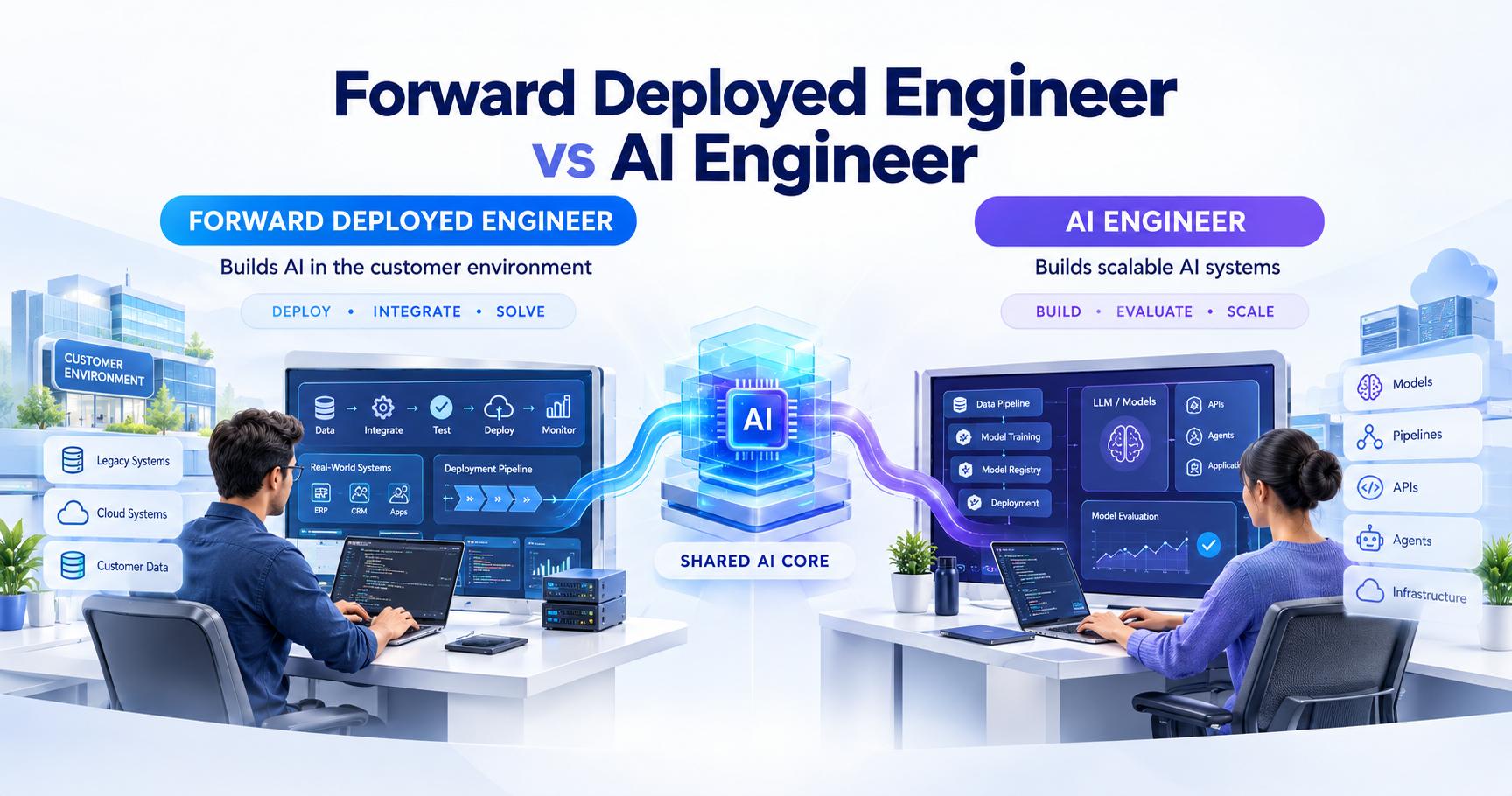
Here is the comparison as a set of trades rather than a feature list, which is the way the decision actually presents itself.
| Trade | Forward deployed engineer | Software engineer |
| Stability | Frequent travel, resetting rhythm | Settled base, repeating rhythm |
| Variety | New problem most engagements | Deeper on a bounded set of systems |
| Customer contact | Constant and direct | Filtered through product and support |
| Skill direction | Breadth plus customer insight | Depth plus system mastery |
| Pay near term | Scarcity premium, steep demand | Strong, more evenly distributed |
| Career ladder | Unsettled, still forming | Established and legible |
| Main career risk | Drift into coordination | Commoditisation among many |
| Best temperament | Thrives on change and people | Thrives on focus and depth |
Read the table as a mirror rather than a scoreboard. There is no winning column. There is only the column that matches how you want to work and what you want to become, and the honest answer to that is personal.
One caution about reading the table: do not let a single strong row decide everything. It is tempting to see the pay row, or the demand row, and let it override the rest, but the rows you will actually live with day to day are stability and daily texture, and those are the ones people most often discount in the moment and regret later. A high salary attached to a working life that does not suit you is not a good trade, however impressive it looks on paper. Weigh the whole column against the whole of your life, not one line of it against your ambition.
Where the two roles are heading, not just where they are
A choice between careers should account for trajectory, not only the present, because you are deciding where to be in five years as much as next month. Both of these roles are being reshaped by the same force that created the forward deployed surge, which is the spread of capable AI into real enterprises. That force pushes the two roles in interestingly different directions.
Traditional software engineering is being changed from the inside, as AI tools take on more of the routine building and raise the premium on judgement, architecture, and the ability to direct systems rather than hand-write every line. The role is not disappearing, but its centre of gravity is shifting toward higher-level design. Forward deployment is being changed by demand, as more enterprises discover that buying capable AI is not the same as deploying it, and that the gap between the two needs a person to stand in it. In other words, one role is being compressed toward its most valuable core while the other is expanding to meet a need that did not exist a few years ago. Neither trend is a reason to panic, but they do suggest that the forward deployed skill set, knowing howagentic AI differs from generative AI and how to make either work in a messy real environment, is appreciating quickly. If you are choosing partly on where the wind is blowing, that is worth weighing alongside the trades of temperament and stability.
How to make the call
The useful decision procedure is not to total up the columns but to weight them against your own life. Start with the stability trade, because it is the most consequential and the least reversible in the short term. If heavy travel is incompatible with your circumstances right now, that alone likely settles it toward the software engineering side, regardless of the pay premium, and no amount of interesting work will compensate for a fundamental clash with how you need to live. The travel is only one of several costs worth facing honestly before you choose the forward deployed side.
If the stability trade is acceptable either way, move to temperament and skills. Ask honestly whether you are energised or drained by customer contact, whether you crave variety or depth, and which future skill set you would rather have in five years. Then, and only then, let compensation and demand break any remaining tie. This order matters because the trades that are hardest to live with, travel and daily texture, are the ones people most often ignore in favour of the salary, and they are exactly the ones that determine whether you last. If the forward deployed side wins your genuine preference, the way to enter it well is to build the real capability it needs, whether through the Forward Deployed Engineering Programor by first grounding yourself in agentic AI foundations and the shift from writing code to shipping AI features.
Can you move between the two later
A fair question when facing this choice is how reversible it is. If you pick one and it turns out to be wrong, can you switch. The encouraging answer is that movement between these roles is very possible, but it is easier in one direction than the other, and knowing which helps you decide with less fear.
Moving from software engineering into forward deployment is relatively straightforward, because you arrive with the technical depth the role needs and simply add the customer-facing and ambiguity-absorbing skills on top. Many forward deployed engineers took exactly this path. Moving the other way, from forward deployment back into deep product engineering, is possible but requires more care, because you have to demonstrate that your technical depth stayed sharp rather than eroding into coordination during your embedded years. This asymmetry is a practical argument for protecting your engineering skills whatever role you are in, and it is why the forward deployed engineers who keep the most options open are the ones who never stop building. Keeping current with the underlying stack, for instance the foundations covered in how to become an AI engineer, is what keeps the return path open. The choice between these roles is real, but it is not a life sentence in either direction, and treating it as reversible takes some of the pressure off getting it perfect the first time.
The bottom line
Forward deployed engineer versus software engineer is not a contest of duties. It is a set of trades: stability for variety, depth for breadth-plus-insight, settled structure for a scarcity premium, and one kind of career risk for another. The forward deployed role offers extraordinary current demand, direct impact, and a rare skill combination, at the cost of heavy travel, an unsettled ladder, and the danger of landing in a diluted version. The software engineering role offers focus, depth, and a legible path, at the cost of less variety and stiffer competition.
The right answer is the column that fits your temperament and your life, decided in that order rather than by the salary line. If the forward deployed trades are the ones you want to make, invest in the capability that makes the genuine version of the role yours. The Forward Deployed Engineering Program is built for exactly that transition, and understanding what agentic AI is is a sensible first step before you commit either way.


_1789732210.png)





 Lowest-Price Challenge











 Personalized Path


.webp)


 USA
USA  Canada
  India
India  UK
UK  Australia
  Singapore


