


 Call Us




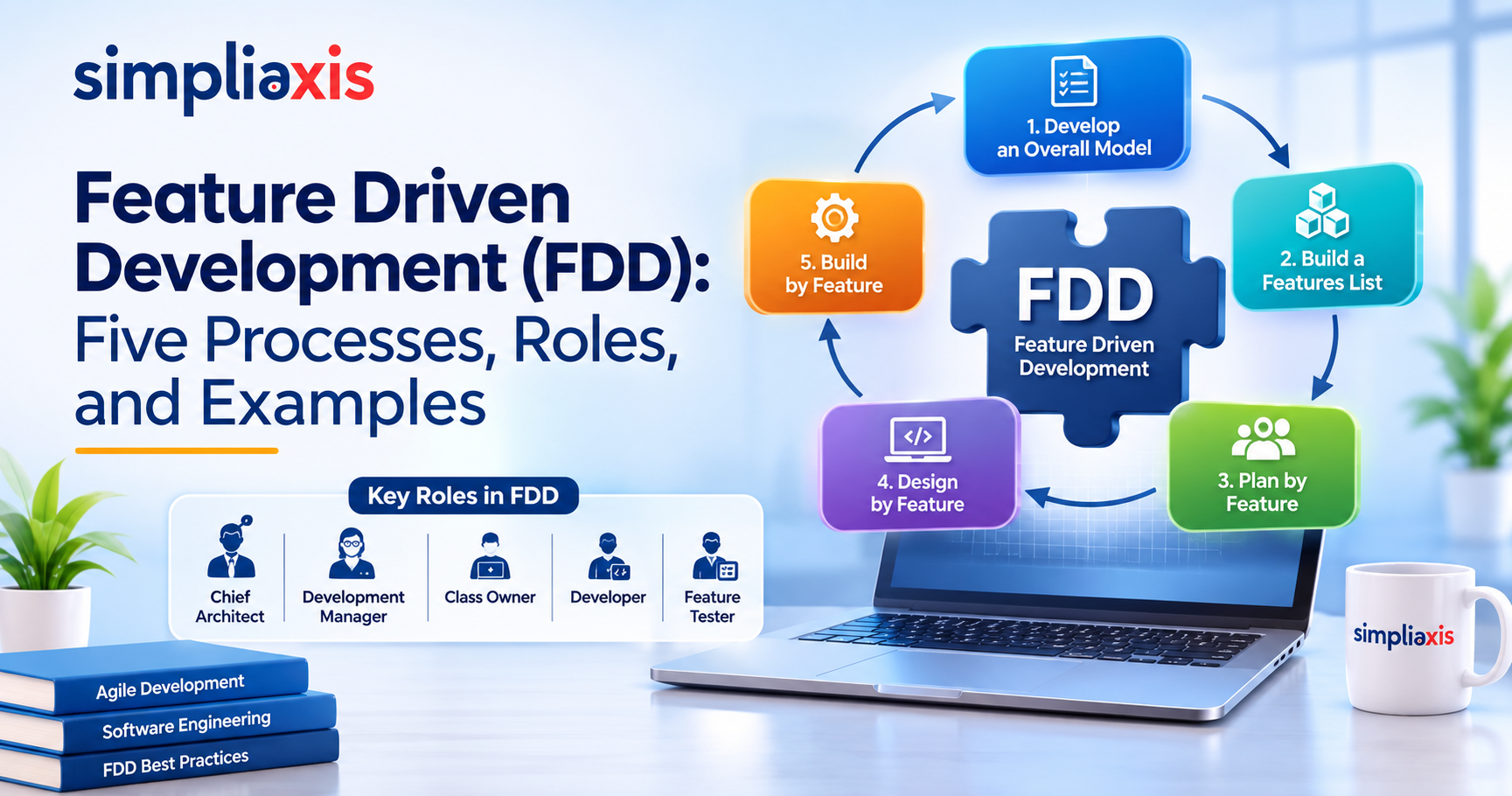
Feature-driven development (FDD) is an Agile software development methodology that delivers working software in small, client-valued features. Teams move through five processes: develop an overall model, build a features list, plan by feature, design by feature, and build by feature. Chief programmers lead small feature teams, class owners are accountable for the code, and progress is tracked feature by feature.
Introduction
Ask ten developers how a software project should be organized, and you will get ten different answers. Some want a thick plan before anyone writes a line of code. Others want to start on Monday and figure it out along the way. Feature-driven development (FDD) sits in a practical middle ground, and that is a big part of why it has stayed relevant for more than two decades.
FDD is one of thetypes of Agile methodologies that share the values in theManifesto for Agile Software Development. It keeps the short iterations and working software that Agile teams like but adds something many other agile frameworks leave loose: a shared model of the business domain and a disciplined, repeatable way of turning that model into features.
If you have ever worked on a project where nobody could say how much was actually finished, you will see the appeal. In FDD, a feature is either delivered, or it is not.
This guide walks through what FDD is, its five processes, the roles involved, a worked example, how it compares with Scrum and XP, and when it is (and is not) the rightsoftware development methodologyfor your team.
What Is Feature-Driven Development?
Feature-driven development is an iterative, feature-centred software development methodology. Instead of organizing work around long phases or open-ended tasks, FDD breaks a system into a list of small features that each deliver something a client would recognize as useful. The team then designs and builds those features in short cycles, one small batch at a time.
The approach grew out of a large project for a bank in Singapore in the late 1990s.Jeff De Luca led the effort and shaped the process, working with object-modelling expertPeter Coad, whose ideas on modelling and features became part of the method. It was later documented more widely in books by Coad, De Luca, and others, which is how most teams outside that original project first met it.
In plain terms, the feature-driven development model answers three questions: what are we building (the overall model), what are the pieces (the feature list), and who builds which piece and when (planning, design, and build by feature). Everything else in FDD supports those three answers.
Feature Driven Development in Software Engineering
From a software engineering point of view, FDD is a process model that combines object-oriented modelling with iterative delivery. It borrows engineering discipline that larger teams value: design and code inspections, clear ownership of classes, regular builds, and measurable progress reporting.
That discipline is what separates feature-driven development in software engineering from lighter approaches. It does not ask teams to abandon structure; it asks them to apply structure at the size of a feature rather than the size of a whole project.
What Counts as a Feature
In FDD, a feature is a small piece of functionality that matters to the client. It is written in a consistent pattern: an action, a result, and an object, such as "calculate the total of a sale" or "validate the password of a user."
Two rules of thumb keep features honest. First, a client should be able to understand why it matters, so "create database table" does not qualify. Second, it should take no more than about two weeks to design and build; anything larger gets split. If you are unsure how this differs from other planning units, this explainer onfeatures in Agile methodologyhelps.
Related features are grouped into feature sets, and feature sets roll up into major feature areas. That hierarchy is what makes large projects easier to plan and report on.
Feature Driven Development in Agile
Where does feature-driven development in Agile fit? FDD is considered an Agile method because it delivers working software in short iterations, values client-visible results, and keeps the process lightweight enough to adapt. TheAgile Alliance glossary is a useful reference for the shared terminology.
Where it differs is emphasis. Scrum focuses on a team's cadence and backlog. FDD focuses on the domain model and the feature list, and it is comfortable with a bit more up-front thinking. That makes it a natural fit for iterative development on larger codebases where several developers touch the same classes.
The Five Feature Driven Development Processes
The feature-driven development process is built from five sequential processes. The first two happen at the start of a project and shape everything after. The last three form a repeating loop: the team picks a small group of features, designs them, builds them, and then starts again with the next group. Together they turn a vague idea into a steady stream of finished features.
Here is the whole workflow at a glance:
Process | What happens | Key output |
1. Develop an overall model | Domain experts and developers build a shared model of the business area | Object model and notes |
2. Build a features list | The model is broken into small, client-valued features | Categorized feature list |
3. Plan by feature | Features are sequenced and assigned to chief programmers. | Development plan and owners |
4. Design by feature | A feature team designs a small batch of features. | Design package, inspected |
5. Build by feature | The team codes, tests, and promotes the features. | Completed, tested features |
Develop an Overall Model
Every FDD project starts with understanding the problem. In the first process, domain experts walk the development team through the business area: how orders flow, what a policy is, and who approves what. The team then splits into small groups to sketch models of parts of the domain.
This is domain object modeling: representing the real-world things your system cares about (customers, products, and invoices) as classes and relationships. Groups compare their versions. debate differences, and merge them into a single overall model. The chief architect usually guides this discussion.
The model does not need to be perfect. It needs to be good enough to give everyone a common vocabulary and a sound structure to refine later. The key output is that shared model, plus any notes and assumptions captured along the way.
Build a Features List
With the model in hand, the team lists what the system needs to do. Each function is written as a small feature, then grouped into feature sets and larger areas. A retail project might have a "Shopping Cart" feature set containing features such as "add a product to a cart" and "apply a discount code to an order."
This is where the feature list earns its keep. It becomes the single source of truth for scope, planning, and progress tracking. Because each item is small and client-valued, stakeholders can review it without needing a technical translator.
A common stumbling block is mixing up features with larger requirements and withuser stories. This comparison ofepic vs feature vs user storyclears up the differences. In FDD, if a feature looks like it will take longer than two weeks, split it.
Plan by Feature
Now the team turns the list into a plan. Feature sets are sequenced based on business priority, technical dependencies, and the workload of the people involved. The project manager, development manager, and chief programmers usually shape this together.
Each feature set is assigned to a chief programmer, and the classes in the model are assigned to class owners. That is how responsibility gets set early: everyone knows who leads each group of features and who is accountable for each piece of code.
The output is a realistic development plan with target dates for feature sets and named owners. Because the plan is built from small features rather than big phases, it is easier to estimate and easier to adjust when reality changes.
Design by Feature
From here the project enters the loop. A chief programmer picks a small group of features, often those that can be finished within about two weeks, and forms a feature team made up of the class owners whose classes will be touched.
The team starts with a short domain walkthrough, refines the object model for those features, and writes the design, often as sequence diagrams and class sketches. Then comes a step many teams love: a design inspection. Peers review the design before anyone writes code, catching problems when they are cheap to fix.
The output is an inspected design package, ready to build. If something major changes in the overall model, the team updates it so the shared picture stays accurate.
Build by Feature
In the last process, class owners write the code for their classes, test it at the unit level, and send it for a code inspection. Once the chief programmer is satisfied, the finished work is promoted to the main build.
A feature is only complete when it has passed inspection and joined the build. That strict definition is what makes FDD's progress reporting trustworthy. Teams often assign weights to the steps (for example, design and coding carry most of the weight) so that partial progress on a feature can be reported fairly.
When the feature set is done, the team goes back to Design by Feature with the next group. The loop continues until the feature list is empty.
How FDD Tracks Progress?
One of FDD's quiet strengths is that it measures progress without guesswork. Every feature passes through the same six milestones, and each milestone carries a weight that reflects the effort it usually represents. A commonly cited split looks like this:
Domain walkthrough: 1%
Design: 40%
Design inspection: 3%
Code: 45%
Code inspection: 10%
Promote to build: 1%
Teams can tune the weights to their own work, but the logic holds. A feature whose design has passed inspection counts as 44% complete; once it is coded, it reaches 89%. Nobody gets to call something "almost done."
Roll those percentages up to feature sets and major areas, and you get a status report a sponsor can read in minutes. Instead of "development is about 70% done," you can say "38 of 52 features are complete, and the checkout set is 80% through. "Because the numbers come from finished milestones, they are hard to inflate, and delays surface early, while there is still time to react.
Roles in FDD
FDD is explicit about who does what. That clarity is part of why the method scales, but it also means the roles matter more than they do in lighter frameworks. TheAgile Modeling essay on FDD describes the main roles in detail; here is a practical summary.
Role | Main responsibility | Scope of decision-making |
Project manager | Runs the project, budget, and reporting | Administrative and delivery decisions |
Chief architect | Guides the overall model and design | Overall architecture and modelling |
Development manager | Day-to-day development leadership | Resolves team and resource conflicts |
Chief programmer | Leads a feature team through design and build | Makes design and code decisions for their features |
Class owner | Designs and writes the code for their classes | Quality of their own classes |
Domain expert | Provides business knowledge | Clarifies requirements and rules |
Chief Architect and Chief Programmer
The chief architect is the person with the broadest technical view. They lead the early modelling sessions, protect the integrity of the overall design, and help settle technical disputes. Think of them as the keeper of the big picture.
The chief programmer is an experienced developer who leads a small team through the design-and-build loop. They select the features to work on, pull together the right class owners, run the inspections, and decide when a feature is ready to join the build. Good chief programmers are part technical lead, part coach. Teams building these skills often invest in formal learning; theCSD certification guide is one place to start, though no certification is needed to practice FDD.
Class Owners and Feature Teams
A class owner is a developer who is responsible for specific classes in the model. They design, code, and maintain those classes, which means that knowledge about each part of the system lives with a named person.
Because one feature usually touches several classes, a chief programmer assembles temporary feature teams from the relevant class owners. When the feature set is done, the team dissolves, and new ones form for the next set. This keeps teams small, focused, and flexible, while still giving each class a clear owner.
Supporting Roles Worth Knowing
Beyond the core roles, larger FDD projects often call on specialists. Common ones include domain managers who coordinate the domain experts, a release manager who keeps the schedule honest, and a language lawyer who knows the programming language and technology inside out. You may also see a build engineer who maintains the regular build, a toolsmith who creates small helper tools, and a system administrator. Testers, deployers, and technical writers join as the project demands.
In smaller teams, one person usually wears several of these hats. The goal is not to hire for every title; it is to make sure every responsibility has a clear owner.
Feature-Driven Development Example
Theory is easier to digest with a scenario, so let's follow a team building an online retail application.
Process 1: The team meets with the store's operations manager and merchandisers. Together they model the domain: customers, products, carts, orders, payments, and shipments. Small groups draw competing versions, then merge them into one overall model.
Process 2: The team converts the model into a feature list. They group features into feature sets such as Catalogue, Shopping Cart, Checkout, and Order Tracking and make sure each feature is written in the action-result-object pattern.
Process 3: The project manager and chief programmers sequence the work. The shopping cart goes first because it unlocks checkout. One chief programmer takes Shopping Cart, another takes Checkout, and classes such as Cart, Order, and Payment are assigned to class owners.
Processes 4 and 5: For the first two-week cycle, the Shopping Cart chief programmer forms a feature team with the owners of the Cart, Product, and Customer classes. They design the features, hold a design inspection, code, test, hold a code inspection, and promote the work to the build.
Sample Features List Table
Here is how part of the feature list might look. Teams can adapt this as a simple feature-driven development template in a spreadsheet or project tool.
Business area | Feature | Priority | Feature team lead | Status |
Shopping Cart | Add a product to a cart. | High | Chief programmer A | Complete |
Shopping Cart | Remove a product from a cart. | High | Chief programmer A | In design |
Shopping Cart | Apply a discount code to an order. | Medium | Chief programmer A | Not started |
Checkout | Calculate the total of an order. | High | Chief programmer B | In build |
Checkout | Validate the card details of a payment. | High | Chief programmer B | Not started |
Order Tracking | Show the delivery status of an order. | Medium | Chief programmer C | Not started |
Notice how readable it is. A store manager can glance at the table and know exactly what is done and what is coming, without needing to decode technical jargon.
What the Second Cycle Looks Like
Once the shopping cart is in the build, the loop starts again. The checkout chief programmer forms a new feature team from the owners of the Order, Payment, and Customer classes. The Customer class owner also sat on the first team, so the chief programmers agree on who needs that developer's time and when. That kind of negotiation is routine in FDD.
During the domain walkthrough, a payments expert mentions that refunds must be supported. Refunds were not in the original model. The team adds a Refund class, writes two new features, and updates the feature list. This is the process working as intended: the model and the list stay alive, and surprises are absorbed one small cycle at a time.
FDD vs Scrum vs XP: Comparison Table
FDD, Scrum, andExtreme Programming (XP)all belong to the Agile family, yet they feel quite different day to day. This table gives a quick side-by-side view.
Approach | Planning focus | Work organization | Roles | Delivery | Where it may fit |
FDD | Feature list built from a domain model | Feature teams formed per feature set | Chief architect, chief programmer, class owners | Features every one to two weeks | Larger, complex systems |
Scrum | Prioritised product backlog | Fixed-length sprints with one team | Product Owner, Scrum Master, Developers | Increment each sprint | Products with changing needs |
XP | User stories and release planning | Pair programming, continuous integration | Customer, programmers, coach | Very frequent small releases | Small teams wanting strong engineering practices |
The biggest difference is where each method puts its structure. Scrum structures time: the sprint is the heartbeat, and the backlog can change between sprints. XP structures engineering habits, such as test-driven development and pair programming. FDD structures the product itself, using the domain model and the feature list as its backbone.
FDD also assigns code ownership to individual class owners, while XP prefers collective ownership where anyone can change any code. Neither is universally better. They answer different problems, and some teams borrow from more than one. If you want to see how a related method compares, read this breakdown ofDSDM vs Scrum, another approach that puts structure around Agile delivery.
Can FDD Work with DevOps and CI/CD?
It can, and the fit is more natural than it first appears. FDD predates modern pipelines by years, but regular builds were part of the method from the start. Many teams map its practices onto today's tooling:
Promote to build and merge into the main branch once automated tests pass.
Code inspection becomes a pull request review.
Class ownership becomes code-owner rules in the repository.
Incomplete features can ship safely behind feature toggles until they are ready.
The result keeps FDD's structure while gaining the speed of automated testing and deployment. Treat this as an adaptation rather than an official part of the method, and adjust it to your own toolchain.
Advantages and Disadvantages of FDD
No method is perfect, and FDD is no exception. Weighing both sides honestly will save you from adopting it for the wrong reasons.
Advantages of FDD
Clear progress tracking: Because features are small and either done or not done, status reports reflect reality rather than optimism.
Scales to larger teams: Defined roles, class ownership, and a shared model help many developers work on the same system without stepping on each other.
Client-friendly language: Features are written in terms the business understands, so stakeholders can review scope without a translator.
Quality built in: Design and code inspections catch defects early, and regular builds keep the system integrated.
Reduced rework: The shared domain model gives everyone a common structure, so surprises appear earlier.
In practice, this means managers get predictable visibility, and developers get fewer arguments about "who owns what." The emphasis on short cycles also lines up with the benefits discussed in this piece onwhy Agile beats waterfall, where working increments replace long, sequential phases.
Disadvantages of FDD
Less suited to tiny projects: For a two-person team, the roles and inspections can feel like overhead.
Depends on strong leaders: Chief programmers and the chief architect carry a lot of weight; a weak one can slow everyone down.
Up-front modelling: The early modelling and feature list take time, which can frustrate teams that want to start coding immediately.
Individual code ownership: Class owners can become bottlenecks if they are unavailable.
Lighter on documentation guidance: FDD focuses on design and features, so teams may need to add their own practices for requirements and user documentation.
The practical takeaway: FDD rewards organisations that value structure and visibility, and it can frustrate teams that prefer a looser, more improvised style.
Common Mistakes Teams Make with FDD
Most FDD problems come from applying the method halfway. Watch for these:
Features that are too big: "Manage inventory" is an area, not a feature. If it cannot be finished in about two weeks, split it.
Skipping the domain experts: A model built only by developers tends to describe the code, not the business.
Treating the model as finished: The overall model is a starting point, and it should change as the team learns.
Turning class owners into silos: Ownership means accountability, not exclusive access. Others should still understand the code.
Dropping inspections under deadline pressure: Inspections are exactly what keeps quality steady when time gets tight.
None of these is hard to fix, but each is easier to prevent than to repair.
When to Use Feature-Driven Development
FDD tends to work best when a project has enough size and complexity that structure pays off. Consider it when:
The domain is rich and fairly stable, such as banking, insurance, logistics, or enterprise platforms.
Several developers will work on shared code and need clear ownership.
Stakeholders want regular, visible proof of progress rather than promises.
You have, or can develop, experienced chief programmers and a chief architect.
Requirements can be expressed as discrete, client-valued features.
It is a weaker choice for very small teams, experimental products where the problem itself keeps shifting, or organisations without any senior technical leadership. In those cases, Scrum,Kanban, or a lighter approach may be more comfortable.
It is also worth remembering that you do not have to adopt FDD wholesale. Many teams borrow their best ideas, such as feature lists, small inspected designs, and honest progress tracking, and combine them with other practices. If you are weighing several approaches, a quick way to sharpen your understanding is to test yourself with anAgile and Scrum practice test before deciding.
Project Fit Checklist
Use this list as a quick gut check. The more boxes you can tick, the stronger the case for FDD.
Our project is medium to large, with multiple developers.
The business domain is well understood or can be modeled early.
We can break requirements into small features of two weeks or less.
We have experienced technical leaders to act as chief programmers.
Stakeholders want clear, feature-by-feature progress reports.
We are comfortable with some up-front modelling and planning.
If you ticked four or more, FDD is worth a serious look. If you ticked two or fewer, consider a lighter option.
How to Start Using FDD in Your Team
If the checklist looks promising, a careful rollout beats a big-bang switch.
Pick a pilot: Choose one project, or one module, with a clear business owner and a team of roughly five to fifteen developers.
Name the key roles: Appoint a chief architect and one or two chief programmers, then assign class owners as the model takes shape.
Agree on the feature format: Settle on the action-result-object pattern and a size limit so everyone writes features the same way.
Write short inspection checklists: A one-page list of what reviewers look for in a design and in code keeps inspections quick and consistent.
Set up simple reporting: Decide how milestones will be recorded and who sees the feature-based status report each week.
Review after three cycles: Ask what slowed the team down, adjust the weights, roles, or feature sizes, and only then widen the rollout.
A pilot also gives you real numbers about speed and quality, which makes it much easier to win over sceptical colleagues.
Conclusion
Feature-driven development gives Agile teams something they sometimes lack: a shared model, a clear feature list, and a repeatable way to turn both into working software. Its five processes (develop an overall model, build a features list, plan by feature, design by feature, and build by feature) work together as a simple loop that keeps everyone aligned.
It will not suit every team. Small, fast-changing projects may find it heavy, while larger, structured ones often find it a breath of fresh air. The honest question is not "is FDD good?" but "does our project have the size, domain, and leadership that FDD rewards?"
If the answer is yes, start small. Model one part of your domain, write a first feature list, and run a single two-week cycle. You will learn more from that than from any article, including this one.
Build the Agile foundation behind every method
FDD, Scrum and XP each solve delivery problems in different ways, and teams choose well when they understand the principles all of them share. Agile and Scrum certification training gives you that grounding, with practical examples you can apply straight away. For developers who want to strengthen the engineering side, from inspections to clean, testable code,CSD® certification training is a natural next step.







 Lowest-Price Challenge













 Personalized Path





 USA
 Canada
 India
 UK
 Australia
 Singapore


