


 Call Us



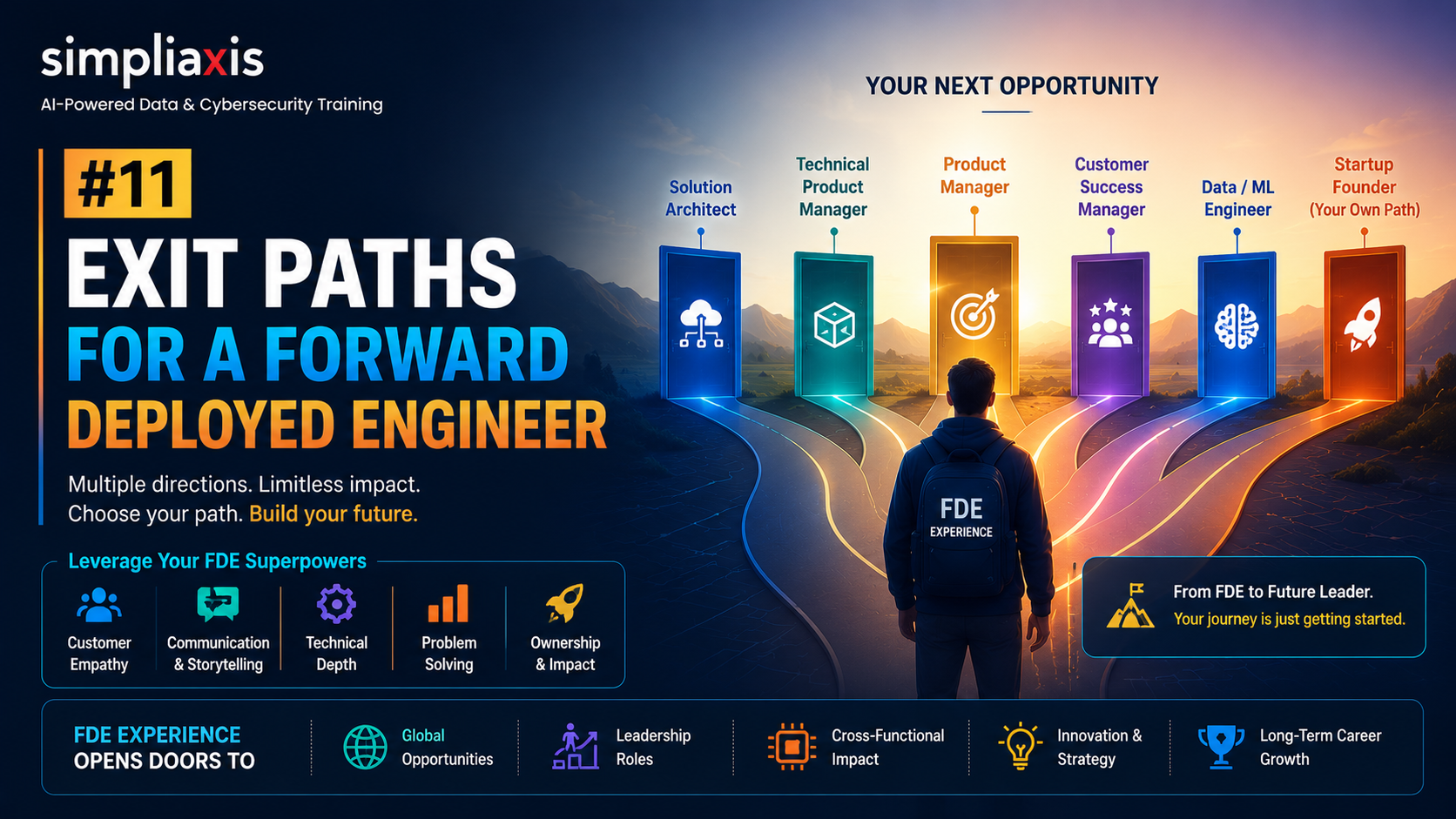
The question that quietly blocks many people from taking a forward deployed role is not whether they can get in but where it leads, and the fear of a dead end is worth answering directly. It is a legitimate concern, because the role is new enough that its onward paths are not well mapped, which makes it easy to imagine getting stuck. The reality is the opposite. Forward deployed engineering builds a rare combination of skills that opens an unusually wide set of doors, and the problem is not too few exits but choosing among many. This piece maps eleven paths a forward deployed engineer can move into, and why the role prepares you so well for each.
Understanding the exits matters because it reframes the role from a risky detour into a strong platform, which is the honest picture. The capability that opens all these doors is the same capability the role itself demands, and building it deliberately through the Forward Deployed Engineering Program is what makes both the role and its many exits available to you.
Key Highlights
- The fear that the forward deployed role is a dead end is understandable but wrong; it opens an unusually wide set of onward paths.
- The role builds a rare combination of deep technical skill and real customer and business understanding, which is exactly what many senior roles need.
- Technical exits include staff engineer, architect, and AI specialist roles, where the delivery experience makes for grounded judgement.
- Business-facing exits include product management, founding-engineer, and leadership roles, where the customer insight is a genuine advantage.
- The problem is not too few exits but choosing among many, which reframes the role from a risky detour into a strong platform.
Why the role opens so many doors
Before the specific paths, it helps to understand why forward deployed engineering leads to such a wide range of them, because the reason is the same across all eleven. The role builds an unusual combination: genuine technical depth from building real systems, plus deep firsthand understanding of how customers adopt technology and where the real value lies, plus the ability to operate in ambiguity and communicate across technical and non-technical worlds. Most roles build one or two of these. Forward deployed work builds all of them together, which is rare and broadly valuable.
This combination is precisely what many senior and adjacent roles need and struggle to find. A product manager who understands the technology deeply, an architect who knows what actually works in the field, a founder who has seen how real customers break real systems, all of these are more valuable than their single-skilled counterparts, and forward deployed work builds exactly that breadth. So the many exits are not a coincidence but a direct consequence of the unusual skill combination the role develops. This is also why the career trajectory of the role is better than its newness suggests, because the skills compound into options rather than dead-ending.
The deep technical paths
For those who want to stay close to building, forward deployed work leads naturally into senior technical roles, where the delivery experience makes for unusually grounded judgement. The staff or principal engineer path suits engineers who want to deepen technically while taking on broader technical leadership, and forward deployed experience is a strong foundation because having built many systems in messy real environments produces judgement about what actually works that purely internal engineers often lack. The field experience makes the technical leadership grounded rather than theoretical.
The AI or technical architect path suits engineers drawn to designing systems rather than only building them, and here the forward deployed background is a genuine advantage, because an architect who has personally deployed AI into many real environments designs with a realism that comes only from having lived the constraints. Where some architects design in the abstract, the former forward deployed engineer designs knowing exactly where real systems break. Both of these paths keep you technical while moving toward leadership or design, and both are strengthened rather than hindered by the delivery-heavy nature of forward deployed work, which builds the practical wisdom these senior technical roles depend on. The technical depth the role requires, grounded in agentic AI engineering, is what keeps these doors open.
The solutions and customer-facing paths
For engineers who value the customer-facing dimension of the role, several paths build on it directly. The solutions architect path is a natural move, since forward deployed work already involves understanding customer needs and designing solutions, and the deep delivery experience makes for architecture grounded in what actually works. The transition is short because so much of the skill set already overlaps, as the comparison between the two roles makes clear, and the forward deployed background gives an architect unusual credibility.
The customer engineering or professional services leadership path suits those who want to lead teams doing customer-facing technical work, and a former forward deployed engineer who has done the work themselves leads such teams with real authority, because they understand the challenges firsthand rather than from a distance. There is also the sales engineering leadership path for those who develop an interest in the commercial side, where the technical credibility and customer understanding transfer well. These paths build on the customer-facing strengths the role develops, turning the relationship and delivery skills into leadership of others doing similar work, which is a natural progression for engineers who found the customer dimension of the role energising rather than draining.
The product and founding paths
Some of the most compelling exits move away from pure engineering toward building products and companies, and here the forward deployed engineer's customer insight becomes a decisive advantage. The product management path is a strong fit, because a product manager who has watched many real customers struggle to adopt technology understands user needs and adoption barriers in a way that is hard to acquire otherwise. The forward deployed engineer has seen, repeatedly and up close, where products fail to meet reality, which is exactly the insight product management needs and often lacks.
The founding engineer path suits those who want the intensity and ownership of an early startup, and forward deployed experience is excellent preparation, because building in constrained, messy environments under pressure is much of what early-stage building demands. The technical founder path goes further, for those who want to start their own company, and here the combination the role builds, technical ability plus deep understanding of real customer problems, is close to ideal founder preparation, since the best startups solve real problems the founder deeply understands. Having embedded with many customers and seen their genuine pain points firsthand is a rare and valuable starting point for building a company, which is why some of the strongest technical founders come from exactly this kind of field-heavy background.
The leadership and advisory paths
The final group of exits moves toward leading people and advising organisations, where the breadth of the role pays off. The engineering management path suits those who want to lead engineers, and a former forward deployed engineer brings both technical credibility and an unusually strong grasp of how engineering connects to real customer value, which makes for grounded, business-aware leadership. Having delivered real outcomes for real customers gives an engineering leader a perspective that purely internal experience does not.
The independent consultant path suits those who want autonomy and variety, and the forward deployed skill set, embedding with clients, understanding their problems, and building solutions, transfers almost directly to high-end independent consulting, since it is essentially the same work done independently. Finally, the venture or technical partner path opens for some, because the deep understanding of how AI actually gets deployed and where it creates value is exactly the insight that investors and technical advisory roles prize, especially as so much investment flows toward AI. An engineer who genuinely understands the gap between AI capability and real deployment has a perspective that is scarce and valuable in advisory and investing contexts. These paths turn the role's breadth into influence over people, organisations, and capital, which is a natural culmination for those who want their impact to extend beyond their own building.
How to position yourself for the exit you want
Knowing the exits exist is useful, but positioning yourself for a specific one takes some deliberateness, and it is worth thinking about early rather than late. The general principle is that while forward deployed work builds a broad foundation, the specific exit you want is served by emphasising certain parts of the role over others during your time in it. An engineer aiming at a deep technical exit should push toward the hardest technical work and the most sophisticated systems, building the depth that a staff-engineer or architect role rewards. One aiming at product should pay particular attention to the customer and user dimension, building the product sense that comes from watching real adoption closely.
This does not mean neglecting the rest of the role, which would undermine the broad foundation that makes the exits possible in the first place. It means, within a role that builds everything, leaning slightly toward the capabilities your target exit values most, so that when you make the move you have both the broad base and the specific strength. An engineer who thinks about the destination while doing the role can shape their experience toward it without sacrificing the breadth, which is the best of both. This kind of intentional career shaping, informed by the honest trade-offs of the role, turns the role's many exits from a vague reassurance into a concrete plan, and it is far more effective than drifting and hoping the right door opens.
Why the exits keep getting better
A final point worth understanding is that the exits from forward deployed engineering are likely to improve over time rather than stay fixed, because the value of the capabilities the role builds is rising as AI reshapes the economy. The deep understanding of how AI actually gets deployed and creates value inside real organisations, which the role builds better than almost any other, is becoming more valuable, not less, as more of the economy grapples with exactly that challenge. An engineer with this understanding is increasingly sought after across technical, product, leadership, and advisory roles.
This means the platform the role provides is appreciating. The product roles, founding opportunities, leadership positions, and advisory paths that open to a former forward deployed engineer are all becoming more valuable as AI deployment becomes a central concern across industries, which makes the role an unusually well-timed platform to build from. The capabilities that once might have led to a solid set of exits now lead to an increasingly prized set, because the market is coming to value exactly what the role develops. This appreciation is a strong reason to see the role as a forward-looking career investment rather than a risky specialisation, and it connects to the broader point that the problem the role solves is central and durable. Building the capability through the Forward Deployed Engineering Program is therefore an investment in a platform whose value is rising.
The eleven paths at a glance
To fix the range, here are the eleven exits grouped by direction.
| Direction | Paths | What the role prepares you for |
| Deep technical | Staff or principal engineer, AI or technical architect | Grounded technical judgement from real delivery |
| Customer-facing | Solutions architect, customer engineering lead, sales engineering lead | Leading customer-facing technical work with authority |
| Product and founding | Product manager, founding engineer, technical founder | Building products and companies from real customer insight |
| Leadership and advisory | Engineering manager, consultant, venture or technical partner | Influence over people, organisations, and capital |
Read the table as evidence that the role is a platform rather than a dead end. The eleven paths span technical depth, customer-facing leadership, product and company building, and advisory influence, which is an unusually wide range for any single role to open. The breadth comes directly from the rare skill combination forward deployed work builds.
The exits compared to a standard engineering career
It is worth contrasting these exits with those of a standard software engineering career, because the comparison shows just how broad the forward deployed platform is. A traditional software engineer builds a strong but somewhat narrower set of exits, mostly along the technical and engineering-leadership axes, since that is what a role focused on internal building develops. Those are excellent paths, but they are concentrated in one direction, and moves into product, founding, or advisory roles, while possible, are less directly supported by the pure engineering background.
The forward deployed engineer, by building customer understanding and business insight alongside technical depth, opens the product, founding, and advisory paths far more directly, in addition to the technical ones. This is the practical payoff of the role's unusual breadth: it does not just match the exits of a standard engineering career, it extends them into directions that pure engineering does not naturally reach. An engineer choosing between a conventional path and the forward deployed one is, among other things, choosing between a strong-but-focused set of exits and a broader one, which is a real consideration for anyone who values keeping options open. The breadth is not free, since the role is demanding, but for those who want the widest possible set of future paths, it is a genuine advantage, and it is the same breadth that the comparison with a standard software engineering track explores from the other direction. Building that broad foundation through the Forward Deployed Engineering Program is what makes the wide set of exits genuinely available.
The bottom line
The fear that forward deployed engineering leads nowhere is understandable given how new the role is, but it is exactly wrong. The role builds a rare combination of technical depth, real customer and business understanding, and comfort with ambiguity, which opens an unusually wide set of doors: deep technical paths like staff engineer and architect, customer-facing paths like solutions architecture and services leadership, product and founding paths where customer insight is decisive, and leadership and advisory paths from engineering management to venture partner. The problem is not too few exits but choosing among many.
This reframes the role from a risky detour into a strong platform, one that keeps more options open than most specialised roles do. The capability that unlocks all these paths is the same capability the role itself demands, which means building it well serves you whether you stay in forward deployed work or eventually move on. Developing that capability through the Forward Deployed Engineering Program is what makes both the role and its many exits genuinely available to you, so the decision to enter is far less risky than the dead-end fear suggests.
For anyone still worried about the dead-end fear, the most reassuring frame is this: forward deployed engineering does not narrow you, it broadens you, building the rare combination of technical and business capability that the widest set of senior roles draws on. That breadth is exactly what the agentic AI practitioner path and applied engineering with agents develop, and it is why the role is better understood as a launchpad than a destination. Whatever you eventually want to do, the capabilities the role builds are likely to help you get there, which turns the fear of getting stuck into confidence about where you could go.
The role does not close doors, it opens them, and that reframing is the honest answer to anyone who hesitates over where forward deployed engineering leads.








 Lowest-Price Challenge











 Personalized Path


.webp)


 USA
USA  Canada
 India
India UK
UK Australia
 Singapore


