


 Call Us




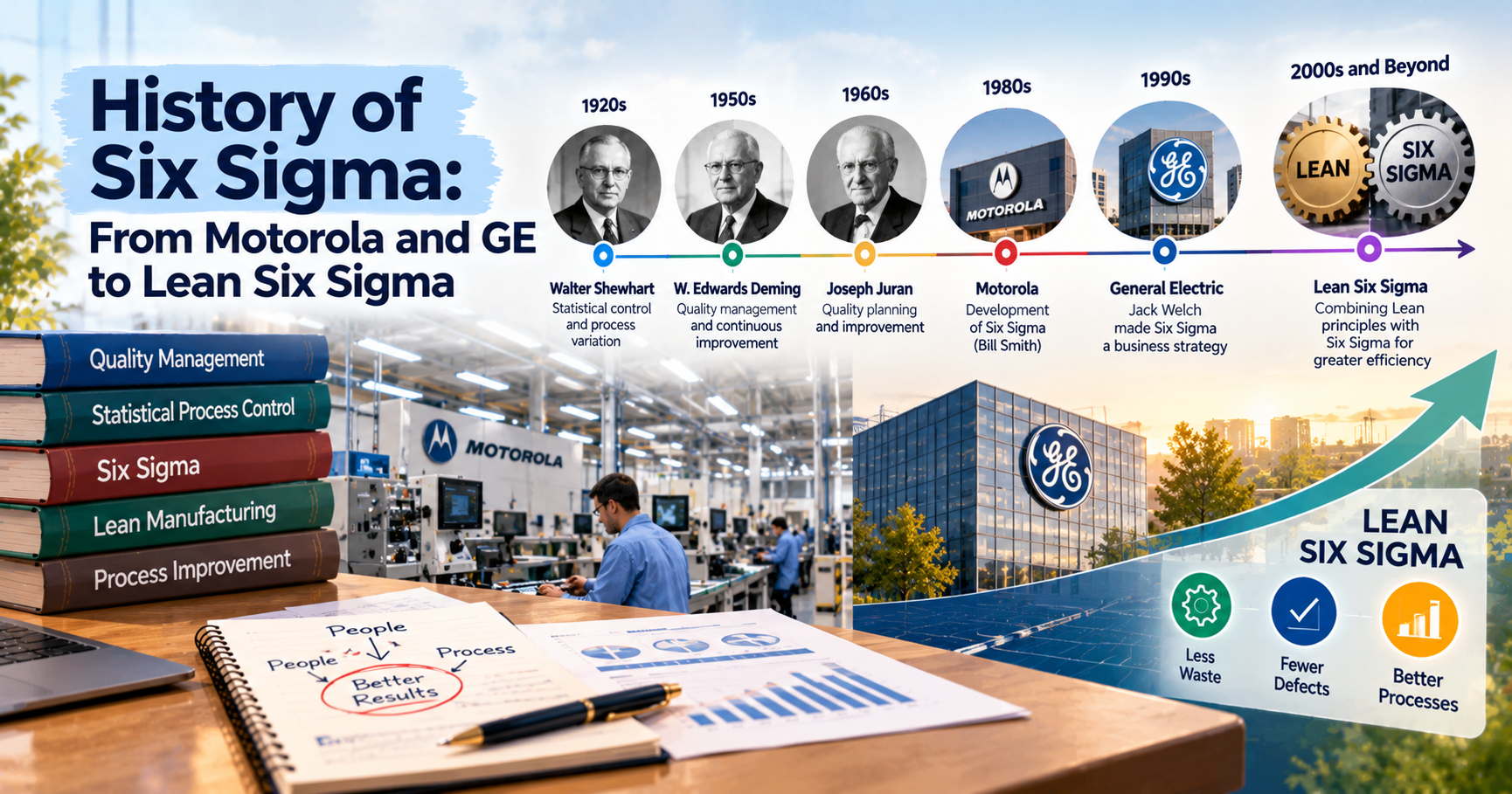
The history of Six Sigma started in the 1980s at Motorola when engineers were searching for better ways to eradicate product defects and improve quality. The approach was principally developed by Bill Smith, with encouragement from Motorola management. In the 1990s, companies like AlliedSignal and General Electric (GE) helped popularize Six Sigma across industries. Over time businesses began to combine it with Lean principles to create Lean Six Sigma, a methodology that aims to reduce defects, eliminate waste and improve how work is done.
Key Highlights of the History of Six Sigma
- 1980s: Motorola developed Six Sigma to improve product quality and reduce defects.
- Bill Smith: His work helped shape the original Six Sigma approach.
- 1988: Motorola received the Malcolm Baldrige National Quality Award for its quality management practices.
- 1990s: AlliedSignal and GE brought Six Sigma to more businesses.
- Jack Welch: The GE chief executive made Six Sigma a major part of the company's business strategy.
- Lean Six Sigma: Businesses began combining statistical quality improvement with Lean methods to reduce waste and improve processes.
- Today: Six Sigma is used in manufacturing, healthcare, finance, IT, and other service industries.
Introduction
Think about a product you bought that stopped working after a few days. Or imagine waiting several hours for a service that should have taken only a few minutes. These problems can frustrate customers and cost businesses time and money.
Many of these issues start with problems in the process itself. A small mistake repeated hundreds of times can lead to poor quality, wasted materials, delayed work, and unhappy customers.
This is where Six Sigma comes in.
The history of Six Sigma is closely linked to the search for better quality. It began as a way to reduce manufacturing defects, but it gradually became a wider approach to solving business problems. Instead of guessing what went wrong, teams use data to find the cause and make changes that can be measured.
The story involves several important names, including Bill Smith, Mikel Harry, Jack Welch, W. Edwards Deming, and Joseph Juran. Their work helped shape modern quality management.
To understand how the method developed, it helps to look at its early roots, Motorola's role, the growth of GE's programme, and the rise of Lean Six Sigma.
Roots of Six Sigma in Quality Management
Six Sigma did not appear out of nowhere. Its foundations came from decades of work on quality, process control, and reducing variation.
Before businesses adopted Six Sigma, quality checks often focused on finding faulty products after production. Over time, companies began to understand that preventing mistakes during production was more useful than finding them at the end.
The American Society for Quality's history of quality explains how quality management developed from basic inspection practices into broader methods for improving business processes.
Shewhart and Statistical Control
Walter A. Shewhart was an important figure in the early history of quality management.
During the 1920s, Shewhart worked on statistical methods that helped manufacturers understand changes in production processes. He showed that businesses could use data to identify unusual changes instead of relying only on inspection.
His work led to the development of control charts, which help teams see whether a process is stable or showing signs of a problem.
This idea became important to Six Sigma. A process may produce acceptable results most of the time, but small changes in materials, equipment, or working methods can cause defects.
By studying variation, businesses can find out what is going wrong and take action before the problem becomes bigger.
Deming and Juran
W. Edwards Deming helped spread statistical quality methods, particularly through his work with Japanese industries after World War II. He stressed that quality was not just the responsibility of workers. Management also had to improve the systems in which people worked.
Joseph Juran made another important contribution. He focused on quality planning, quality control, and quality improvement. His work helped businesses understand that quality needed proper planning and support from senior leaders.
Both thinkers influenced the way organisations approached total quality management.
Their ideas also helped establish a basic principle that remains important in Six Sigma today: when a process produces poor results, businesses should investigate the process rather than simply blame the person doing the work.
These ideas later supported the development of more structured methods for finding and fixing problems.
Toyota and Lean Influences
The history of Six Sigma also connects with developments in Japanese manufacturing, particularly the Toyota Production System.
After World War II, Toyota developed ways to improve production by reducing waste, keeping work moving, and building quality into the process. Its approach included just-in-time production, standardised work, and continuous improvement.
The focus was not only on making fewer mistakes. It was also about avoiding activities that did not add value for customers.
These ideas later became central to Lean thinking.
However, there is an important distinction in the Toyota Six Sigma history. Toyota is closely associated with Lean manufacturing, but Six Sigma was developed at Motorola. The two approaches have different origins, even though businesses later combined their methods.
The Toyota Production System overview explains how Toyota's approach focuses on reducing waste, improving flow, and maintaining quality.
Motorola Six Sigma History
The Motorola Six Sigma history is the starting point of the modern Six Sigma methodology.
During the 1970s and 1980s, Motorola faced growing pressure to improve its product quality and compete with other manufacturers. The company recognised that traditional quality checks were not enough to prevent all product failures.
Motorola needed a more reliable way to understand why defects happened and how to stop them from happening again.
This led to a stronger focus on statistical methods, process variation, and measurable quality goals.
Bill Smith and the 3.4 DPMO Target
Bill Smith, an engineer at Motorola, is widely credited with developing the Six Sigma concept in the 1980s. His work helped the company connect manufacturing defects with the processes that caused them.
Smith noticed that testing a finished product did not always reveal every problem that could appear when customers used it. A product could pass its final inspection and still fail later.
This raised an important question: why wait for defects to appear when the production process itself could be improved?
Smith helped Motorola focus on reducing variation and preventing defects earlier in the process. Mikel Harry also played a major role in developing and promoting the methodology.
Their work helped turn statistical quality control into a structured business improvement approach.
The name Six Sigma refers to a statistical measure of process variation. In its widely used performance benchmark, a Six Sigma process is associated with approximately 3.4 defects per million opportunities (DPMO), using the conventional 1.5-sigma shift assumption.
DPMO is one of the core Six Sigma metrics; it measures defects against the total number of opportunities for defects to occur. It allows businesses to compare processes with different volumes and levels of complexity.
For a simple explanation of the concept, read what is Six Sigma.
Motorola's approach encouraged teams to use data, identify the causes of poor performance, and measure the results of their improvements.
Malcolm Baldrige Award
Motorola’s quality efforts gained wider recognition when the company received the Malcolm Baldrige National Quality Award in 1988.
The award recognises organisations that demonstrate strong approaches to quality and performance. Motorola's achievement helped bring attention to its quality management practices and showed other businesses that a company-wide focus on quality could make a difference.
The award also helped spread interest in the methods Motorola had developed.
Businesses began looking beyond final product inspections. They wanted to understand how better processes could reduce costs, improve customer satisfaction, and support stronger business results.
This recognition became an important milestone in the history of Six Sigma.
Motorola's experience also showed that quality improvement required more than a few statistical tools. It needed leadership support, employee involvement, training, and a clear plan for putting improvements into practice.
Six Sigma at GE and AlliedSignal
Motorola established the foundation, but other companies helped Six Sigma reach a much wider audience.
AlliedSignal adopted Six Sigma under the leadership of Larry Bossidy during the 1990s. General Electric followed, using the methodology as part of a company-wide effort to improve performance.
These businesses helped shift the focus from manufacturing quality alone to wider business results.
Results and Criticism
AlliedSignal showed how Six Sigma could be used to improve operations and support financial goals. Its approach attracted attention from other business leaders, including Jack Welch at GE.
GE began adopting Six Sigma in the mid-1990s. Under Welch, the company invested heavily in training and projects designed to improve quality, reduce costs, and make business processes more reliable.
The results helped establish Six Sigma as a major business improvement method.
However, the approach also faced criticism.
Some organisations placed too much importance on meeting targets and reporting savings. Others created large training programmes without giving employees enough time or support to complete meaningful projects.
In some cases, teams focused on improving measurements rather than addressing the problems customers actually experienced.
These concerns showed that Six Sigma was not a quick fix. Its success depended on choosing the right problems, using data correctly, and making changes that improved real business outcomes.
Jack Welch and the Belt System
Jack Welch played a major role in popularising Six Sigma through GE.
Under his leadership, the company made Six Sigma a central part of its business strategy. Employees received training, teams worked on improvement projects, and managers were expected to pay attention to measurable results.
GE's approach helped connect quality improvement with everyday business decisions.
Another important part of Six Sigma's growth was its training structure. Organisations adopted different levels of expertise, commonly known as Six Sigma belts.
These include White Belt, Yellow Belt, Green Belt, Black Belt, and Master Black Belt. The exact structure and requirements vary between certification providers.
Each level serves a different purpose. Some employees need only a basic understanding of the method, while others manage projects or guide improvement programmes.
The belt system made it easier for businesses to assign responsibilities and build teams with different levels of knowledge.
If you want to understand the differences, read about Lean Six Sigma certification levels.
Six Sigma History Timeline
The six sigma history timeline shows how the method developed from early quality management ideas into a widely used business improvement approach.
| Year or Period | Milestone | Why It Matters |
| 1920s | Walter Shewhart develops statistical process control methods. | Helps establish the role of data in quality management. |
| 1950s onward | Deming and Juran influence quality improvement practices. | Encourages organisations to focus on processes and management responsibility. |
| 1950s and 1960s | Toyota develops and improves its production system. | Establishes important ideas behind Lean manufacturing. |
| 1980s | Motorola develops Six Sigma. | Creates a structured approach to reducing defects and variation. |
| 1988 | Motorola receives the Malcolm Baldrige National Quality Award. | Brings wider attention to its quality practices. |
| Early 1990s | AlliedSignal adopts Six Sigma. | Helps connect quality improvement with business performance. |
| Mid-1990s | GE begins its Six Sigma programme. | Makes the approach more widely known across industries. |
| Late 1990s onward | More companies adopt Six Sigma and combine it with Lean methods. | Expands its use beyond traditional manufacturing. |
| 2000s onward | Six Sigma becomes established in services and other sectors. | Supports improvements in customer service, healthcare, finance, and IT. |
| Today | Organisations combine established methods with digital tools and data analysis. | Makes process improvement more adaptable to modern business needs. |
This timeline gives a broad view of the method's development. The exact adoption dates can differ between historical accounts, especially when a company began testing an approach before formally launching its programme.
The Rise of Lean Six Sigma
As businesses used Six Sigma more widely, they began combining it with Lean methods.
This combination became known as Lean Six Sigma. It brings together two approaches that address different but related problems.
Six Sigma focuses on reducing defects and process variation. Lean focuses on removing waste, reducing delays, and improving the flow of work.
Together, they help organisations improve quality without ignoring speed, cost, or customer needs.
Merging Lean and Six Sigma
Imagine a company that takes ten days to complete a customer order. A closer look shows that the actual work takes only four days. The remaining time is spent waiting for approvals, searching for information, and correcting errors.
Lean methods can help identify and remove unnecessary waiting and movement. Six Sigma tools can help investigate why errors occur and how to prevent them.
This is a simple example of how both approaches can work together.
The history of Lean Six Sigma developed through the growing use of these complementary methods. Organisations saw that reducing defects was important, but it was also necessary to make processes faster and easier to manage.
The combined approach can help teams:
- Reduce errors and rework.
- Remove unnecessary steps.
- Improve turnaround times.
- Make better use of people and materials.
- Create more consistent customer experiences.
- Measure improvements using reliable data.
The Toyota Lean Six Sigma history is best understood as the meeting of two different quality improvement traditions, rather than the idea that Toyota created Six Sigma itself.
Toyota's production system helped shape Lean thinking, while Motorola developed Six Sigma. Their methods later came together in many organisations.
If you want a clearer comparison, read Lean Six Sigma vs Six Sigma.
Six Sigma Today
Six Sigma is no longer limited to factories and production lines. Its basic principles can be applied anywhere a process produces measurable results.
Businesses now use it to improve customer service, reduce errors in administrative work, manage delays, and make everyday operations more reliable.
The tools may look different from one industry to another, but the main idea remains the same: understand the problem before deciding how to fix it.
Six Sigma in Services and Healthcare
In a hospital, a team might use Six Sigma to understand why patient appointments are delayed. The problem could involve scheduling, paperwork, staff availability, or the way information moves between departments.
In a bank, a team might investigate why loan applications take longer than expected. In a customer service centre, it could examine why customers need to contact the support team several times to solve one issue.
These problems are different from manufacturing defects, but the same problem-solving principles can still help.
Teams collect data, identify the causes of delays or errors, test improvements, and monitor the results.
In healthcare, safety and patient needs must remain the priority. Process improvement methods should support clinical judgement and established safety standards, not replace them.
Digital and AI-Assisted Six Sigma
Technology is changing how businesses collect and study process data.
Digital dashboards can help teams track performance in real time. Automated systems can identify unusual patterns, while AI tools may help analyse large amounts of information and highlight possible causes of recurring problems.
For example, a manufacturing team might use sensor data to spot changes in machine performance before they lead to defects.
A service team might analyse support records to identify the most common reasons for customer complaints.
However, technology does not remove the need for careful thinking. Data can be incomplete, patterns can be misleading, and an AI-generated suggestion may not identify the actual cause of a problem.
Teams still need to check the evidence, involve people who understand the process, and measure whether a proposed change works.
The history of Six Sigma shows how the method has adapted to new business needs. Its tools may change, but the focus on evidence, process improvement, and customer satisfaction remains important.
Lessons From the History of Six Sigma
The development of Six Sigma offers useful lessons for businesses that want to improve their processes.
Leadership Commitment
Motorola, AlliedSignal, and GE show the importance of leadership support.
Employees need time, training, and access to the right information to improve their work. Managers must also be willing to address problems that involve different teams or departments.
Without this support, improvement projects can become extra work that employees struggle to complete.
Leaders should set clear goals, review results, and make sure successful changes become part of everyday work.
Overreliance on Belts
Six Sigma belts help organisations build skills, but a certificate alone does not guarantee good results.
A trained professional still needs to understand the process, ask useful questions, work with others, and check whether an improvement has made a real difference.
Businesses should not treat belt levels as a substitute for practical experience.
The best results come when people use their knowledge to solve actual problems rather than focusing only on completing training or earning a qualification.
Blending With Lean and Agile
Modern organisations often use several improvement methods together.
Lean can help remove waste, while Six Sigma can help reduce variation. Agile methods can support teams that need to deliver work in smaller steps, gather feedback, and adjust their plans as conditions change.
These approaches are not identical, and they do not need to replace one another.
A business should choose its methods based on the problem it needs to solve. The goal is to improve the work, not to follow a particular framework simply because it is popular.
Starting Your Six Sigma Journey
The history of Six Sigma shows that process improvement is a skill that develops through practice. You do not need to start with advanced statistical tools or lead a large project on your first day.
A good starting point is to understand how processes work, how defects are measured, and how teams use evidence to make decisions.
Choosing Your First Belt
Your starting level depends on your current role and what you want to do with Six Sigma.
A White Belt or Yellow Belt may suit someone who wants to understand the basic concepts and take part in improvement projects.
A Green Belt is a practical option for professionals who want to analyse processes and manage smaller projects alongside their regular responsibilities.
A Black Belt is generally suited to people who want to lead more complex projects and apply advanced improvement methods. Master Black Belts often provide expert guidance, training, and support across improvement programmes.
Before choosing a programme, check its syllabus, practical exercises, assessment requirements, and recognition within your industry.
Green Belt as the Practical Starting Point
For many working professionals, the Green Belt is a useful next step after understanding the basics.
It introduces tools for finding the causes of problems, measuring process performance, and checking whether improvements last.
The DMAIC process is central to many Six Sigma projects:
- Define: Identify the problem, the goal, and the people affected.
- Measure: Collect information about current performance.
- Analyze: Find the likely causes of the problem.
- Improve: Test and introduce suitable changes.
- Control: Monitor the process to make sure the improvement continues.
You can read more about the DMAIC process before beginning your training.
If you want structured training, consider the Lean Six Sigma Green Belt certification. You can also use the Lean Six Sigma Green Belt practice test to check your understanding and prepare for the assessment.
The right choice depends on your career goals, available time, and the type of projects you expect to handle. This Six Sigma career path guide can help you plan.
Conclusion
The history of Six Sigma began with a practical problem: how could businesses make their products more reliable and reduce defects?
Motorola helped answer that question by developing a structured approach based on data and process improvement. Bill Smith and Mikel Harry played important roles in shaping the method, while support from company leadership helped it grow.
AlliedSignal and GE later showed how Six Sigma could support wider business goals. As organisations began combining it with Lean principles, Lean Six Sigma offered a way to address both defects and waste.
Today, the method continues to change as businesses adopt new technologies and face different challenges.
Its main lesson is simple. Better results rarely come from fixing mistakes at the last minute. They come from understanding how work happens, finding the reasons behind problems, and making changes that last.









 Lowest-Price Challenge












 Personalized Path



.webp)


 USA
 Canada
 India
 UK
 Australia
 Singapore


