


 Call Us



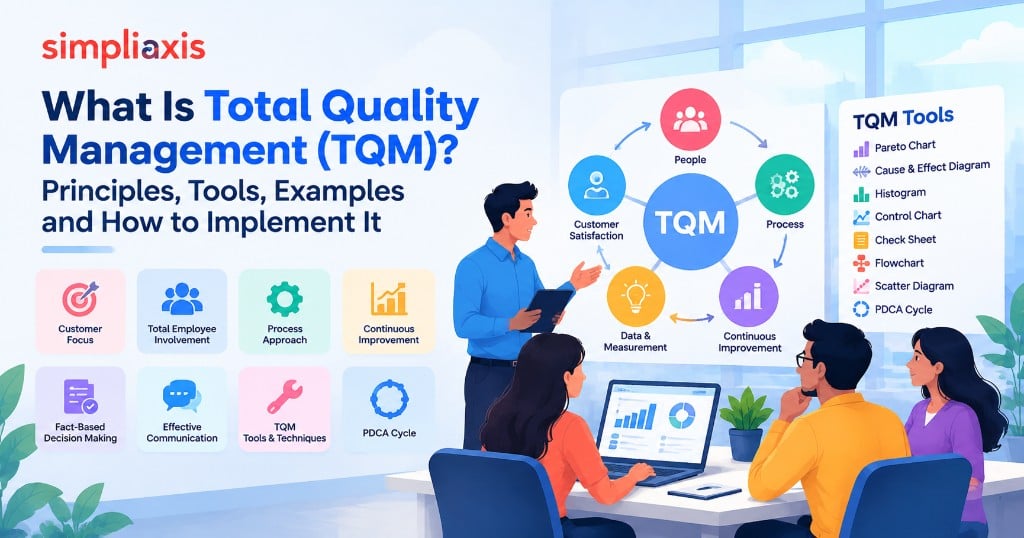
Total quality management (TQM) is a management approach in which every person in an organisation takes part in improving the quality of products, services and processes, with the aim of meeting or exceeding customer expectations. The word "total" matters: quality is not the job of a single inspection team, it is everyone's job, from leadership to the front line.
This guide explains what TQM is, the principles of TQM, the tools used, how to put the approach into practice, how it compares with Six Sigma, Lean and ISO 9001, and where it works well or fails.
Key Highlights of Total Quality Management
- TQM focuses on customer satisfaction through continuous improvement, with all employees involved.
- Its main principles are customer focus, total employee involvement, a process approach, an integrated system, fact-based decisions, continual improvement and strong communication.
- Common tools include the seven basic quality tools, the PDCA cycle and quality circles.
- TQM is a management philosophy, while Six Sigma is a data-driven problem-solving method and ISO 9001 is a certifiable standard.
- Success depends on leadership commitment and culture more than on tools.
What Is Total Quality Management? Definition, Meaning and Core Ideas
TQM is a long-term way of managing an organisation so that quality is built into every process, not checked at the end. It treats quality as a customer-defined outcome and improvement as a daily habit. The American Society for Quality (ASQ) describes total quality management as an approach based on all members of an organisation participating in improving processes, products, services and the culture they work in.
Three ideas sit at the centre:
- Customer focus. Quality is whatever the customer says it is, so you measure and manage against customer needs.
- Everyone is responsible. Leaders set direction, but every employee is expected to spot and fix problems in their own work.
- Continuous improvement. Small, regular improvements add up, and no process is ever "finished".
TQM grew out of the work of quality thinkers in the twentieth century and spread widely through manufacturing in the 1980s. It is used today in manufacturing, healthcare, education, services and software teams.
Who Created TQM? The Quality Thinkers Behind Deming, Juran, Crosby and Ishikawa
Several people shaped the ideas that make up TQM.
| Thinker | Known for | Key idea |
| W. Edwards Deming | 14 Points for Management, PDCA cycle | Quality comes from improving the system, and most problems are system problems, not people problems |
| Joseph Juran | Quality Trilogy | Quality planning, quality control and quality improvement, with a focus on fitness for use |
| Philip Crosby | Zero defects | Quality is conformance to requirements, and prevention is cheaper than correction |
| Kaoru Ishikawa | Cause-and-effect diagram, quality circles | Involve frontline teams in solving quality problems |
| Armand Feigenbaum | Total quality control | Quality is the responsibility of every function, not only the quality department |
You do not need to adopt any one thinker's whole system. TQM takes the common thread: prevention, involvement and continual improvement.
What Are the 8 Principles of TQM? A Plain-English Guide
Different sources list the principles of TQM slightly differently, but the following eight appear most often.
1. Customer focus
Start with what customers need and value, then design and improve processes to deliver it. Collect feedback, complaints and usage data, and treat them as inputs for improvement.
2. Total employee involvement
Everyone contributes ideas and takes ownership of quality. This includes training, empowerment and recognition. Quality circles, suggestion systems and cross-functional teams are common methods.
3. Process-centred approach
Results come from processes. Map them, find where they fail and improve the process, not just the output. Our guide to what process improvement is gives a good starting point, and process mapping shows how to draw the current state.
4. Integrated system
All functions, from purchasing to customer service, work towards shared quality goals. Quality is part of the operating system, not a separate department.
5. Strategic and systematic approach
Quality objectives are linked to the organisation's strategy and are planned and managed as part of it.
6. Continual improvement
Use repeated cycles of planning, doing, checking and acting to improve processes and results over time.
7. Fact-based decision making
Use data, such as defect rates, cycle times and customer scores, to decide what to improve and to check whether it worked. Trustworthy decisions need trustworthy data, which is why measurement system analysis matters.
8. Communication
Clear communication about goals, progress and results keeps people aligned and engaged.
The ISO 9001 standard lists seven quality management principles: customer focus, leadership, engagement of people, process approach, improvement, evidence-based decision making and relationship management. They overlap strongly with the TQM list above.
How Does the PDCA Cycle Drive Continuous Improvement in TQM?
The Plan-Do-Check-Act (PDCA) cycle, popularised by Deming, is the usual method for improvement in TQM. ASQ describes the PDCA cycle as a repeating four-step model for carrying out change.
1. Plan. Identify a problem or opportunity, analyse the cause and plan a change.
2. Do. Try the change on a small scale.
3. Check. Measure the result against what you expected.
4. Act. If it worked, standardise it. If not, learn and start the cycle again.
Because the cycle repeats, improvement never stops, which is the "continual" in continual improvement.
Which TQM Tools and Techniques Are Used? The Seven Basic Quality Tools
TQM uses simple tools that anyone can learn. The core set is often called the seven basic quality tools.
| Tool | What it does | Typical use |
| Check sheet | Collects data in a simple tally | Counting defect types on a line |
| Histogram | Shows the distribution of data | Seeing the spread of delivery times |
| Pareto chart | Ranks causes by frequency or impact | Finding the few causes behind most defects |
| Cause-and-effect (fishbone) diagram | Organises possible causes of a problem | Brainstorming reasons for late orders |
| Scatter diagram | Shows the relationship between two variables | Checking if temperature affects defects |
| Control chart | Tracks a process over time against limits | Spotting when a process is drifting |
| Flowchart | Maps process steps | Finding delays and handoffs (some lists use stratification instead) |
Other common techniques include quality circles (small voluntary groups that solve problems), benchmarking, the 5 Whys, 5S for workplace organisation and failure mode and effects analysis (FMEA). A Pareto analysis is especially useful at the start because it shows where effort will pay off most. For a wider set of methods, see our overview of Lean Six Sigma tools.
What Is the Cost of Quality? Prevention, Appraisal and Failure Costs
TQM argues that preventing defects costs less than finding and fixing them. The cost of quality model, associated with Crosby and Juran, splits the cost into four groups.
| Cost category | What it covers | Examples |
| Prevention | Spending to stop defects occurring | Training, process design, preventive maintenance |
| Appraisal | Spending to find defects | Inspection, testing, audits |
| Internal failure | Defects found before delivery | Scrap, rework, retesting |
| External failure | Defects found by the customer | Returns, warranty claims, lost customers, reputation damage |
The point of the model is the balance. A small increase in prevention spending can cut failure costs by much more, and external failures are usually the most expensive. Many organisations never measure these costs, so the first step is to start tracking them.
How to Implement TQM: A Step-by-Step Approach
TQM is a cultural change, so it takes time. A practical sequence looks like this.
1. Secure leadership commitment. Leaders must set quality goals, take part in reviews and support the change with time and resources.
2. Define quality from the customer's view. Gather feedback and agree on a few measures that matter to customers.
3. Map and select key processes. Choose processes with the biggest effect on customer satisfaction and cost.
4. Train and involve people. Teach basic quality tools and give teams authority to act on problems.
5. Start improvement projects with PDCA. Pick specific problems, measure the baseline and run small tests.
6. Measure and review. Track results on a simple scorecard and review them regularly.
7. Standardise and spread. Document what works and share it with other teams.
8. Recognise and sustain. Celebrate results, keep training and keep improving.
Roles matter at each step. Our guide to Six Sigma roles and responsibilities shows how sponsors, champions and project leads can share the work in a quality programme.
What Are the Benefits of TQM?
When applied well, TQM can bring:
- Higher customer satisfaction and fewer complaints
- Fewer defects, less rework and lower cost of poor quality
- More engaged employees who understand how their work affects customers
- Better teamwork across departments
- More reliable processes and clearer standards
- A culture that treats problems as chances to learn
These are potential benefits, not guarantees. Results depend on how consistently the organisation applies the approach.
What Are the Challenges and Limitations of TQM?
- Leadership gaps. Without visible commitment, TQM turns into a poster campaign.
- Slow results. Cultural change takes years, and leaders may lose patience.
- Training cost and time. Building skills across all staff takes investment.
- Resistance to change. People may see TQM as extra work or as criticism.
- Too much focus on tools. Collecting data without acting on it wastes effort.
- Weak link to strategy. If quality goals are not tied to business goals, support fades.
Many of these overlap with the typical Six Sigma implementation challenges, so lessons from one approach help the other.
What Are Some TQM Examples in Manufacturing, Healthcare, IT and Education?
These are illustrative examples of how TQM thinking shows up in different settings, not reports on named companies.
- TQM in manufacturing. A components plant tracks defects with check sheets, uses a Pareto chart to find that three defect types cause most scrap and forms a quality circle with operators to solve the biggest one. They test a fix using PDCA, confirm that scrap drops and update the work instruction.
- Healthcare. A hospital ward reviews medication errors, maps the process from prescription to administration and adds a double-check step at the point where most near misses occur. Staff on every shift contribute ideas.
- Software and IT services. A support team measures repeat tickets, finds that a handful of causes drive most of them and fixes the root causes with the development team. This reduces ticket volume and improves satisfaction.
- Education. A college collects student feedback each term, groups the main complaints and makes small changes to timetabling and assessment feedback, then checks the next survey for improvement.
TQM vs Six Sigma vs Lean vs ISO 9001: What Is the Difference?
These approaches overlap and are often combined, but they are not the same.
| Aspect | TQM | Six Sigma | Lean | ISO 9001 |
| Nature | Management philosophy | Data-driven problem-solving method | Waste-reduction approach | Certifiable quality management standard |
| Main focus | Customer satisfaction and culture | Reducing variation and defects | Removing waste and improving flow | Consistent processes and documented system |
| Scope | Whole organisation | Project by project | Value streams | Whole quality management system |
| Typical method | PDCA, quality circles, basic tools | DMAIC, statistical analysis | Value stream mapping, 5S, kanban | Requirements, audits, continual improvement |
| Outcome | Culture of continual improvement | Measured reduction in defects | Faster, leaner flow | Certification and a framework for quality |
In practice, an organisation might use TQM as its quality culture, Six Sigma for complex defect problems, Lean for flow and ISO 9001 for a structured system and certification. Our article on Lean Six Sigma vs Six Sigma explains the second and third in detail, and the guide to what Six Sigma is gives the basics.
TQM vs Quality Assurance vs Quality Control vs QMS: How Do They Relate?
Quality terms are often mixed up. This table separates them.
| Term | What it is | Focus | Example |
| TQM | Organisation-wide philosophy | Culture and continual improvement | Every team runs PDCA cycles on its own processes |
| Quality assurance (QA) | Process-focused activities | Preventing defects by building quality into processes | Process audits and standard work |
| Quality control (QC) | Product-focused activities | Finding defects in outputs | Inspection and testing |
| Quality management system (QMS) | Documented system of policies and processes | Consistency and compliance | An ISO 9001-aligned set of procedures |
The difference between prevention and detection is the key. TQM leans towards prevention, which is why it builds on QA more than on QC. Our article on quality assurance vs quality management gives more detail, and project quality management shows how the same ideas apply inside projects.
How Do You Measure TQM Success? Key Metrics and KPIs
Pick a small set of measures that reflect customers and processes.
| Area | Example measures |
| Customer | Satisfaction score, complaints, repeat business |
| Quality | Defect rate, first-pass yield, rework rate, cost of poor quality |
| Process | Cycle time, on-time delivery |
| People | Training completion, number of improvement ideas, employee engagement |
Review them regularly and ask what the data says about the next improvement. Our guide to commonly used Six Sigma metrics explains measures such as defects per million opportunities and process capability that many quality teams also track.
Is TQM Still Relevant? Quality Skills and Training Options
TQM ideas sit alongside Six Sigma skills in many quality and operations careers. The label is less fashionable than it was, but customer focus, employee involvement and continual improvement are built into Lean, Six Sigma, ISO 9001 and Agile practice. To see how Six Sigma supports quality goals, read why Six Sigma matters in quality management. If you want structured training, the programmes linked below build the core skills.
Conclusion
TQM is a culture as much as a method: put the customer first, involve everyone, improve processes continually and decide with facts. Start small with one process, one team and the PDCA cycle, and build from visible results. Combine it with Six Sigma, Lean and ISO 9001 where they fit, and keep leadership commitment at the centre.
Start with the fundamentals: Learn the core concepts of quality and process improvement with the Six Sigma fundamentals certification training.
Lead data-driven improvement: Build the skills to run DMAIC projects with the Lean Six Sigma Green Belt certification.






 Lowest-Price Challenge











 Personalized Path


.webp)


 USA
USA  Canada
 India
India UK
UK Australia
 Singapore


