


 Call Us




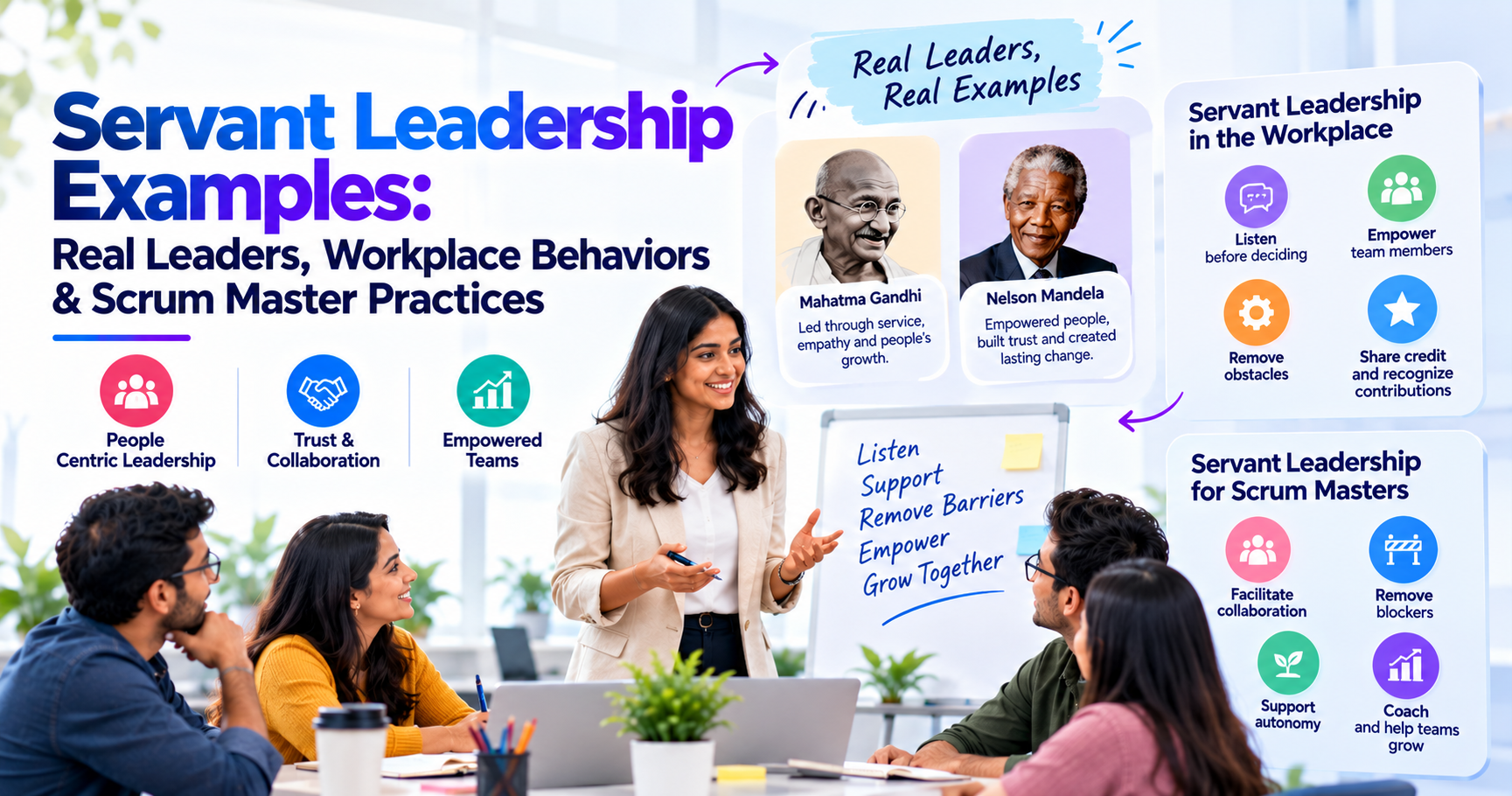
Servant leadership examples can teach leaders how to value people's growth, well-being, and success while remaining accountable to business objectives. Some popular examples include listening before making decisions, acknowledging the constitution of employees, removing obstacles from the workplace, and coaching teams instead of commanding them.
Popular figures like Mahatma Gandhi and Nelson Mandela have showcased popular leadership characteristics through their actions.
Servant leadership promotes trust, collaboration, and the empowerment of employees. For Scrum Masters, it involves facilitating teamwork, dealing with blockers, and helping teams boost their autonomy.
Key Highlights of Servant Leadership Examples
- People-centric leadership: Servant leaders focus on employee growth, team needs, and collective achievement.
- Typical examples of servant leadership in action include listening, empowerment, removing roadblocks, sharing credit, and coaching. Organizational culture: Service-oriented leadership is seen in employee empowerment, continuous learning, and shared responsibility.
- Scrum Master practices: Scrum Masters facilitate collaboration and team ownership, not control every decision.
- Leadership values Leadership principles such as empathy, listening, stewardship, and commitment to growth make leadership values visible behaviors.
- Measurement of results: Effectiveness of the leadership can be measured through the feedback of the employees, psychological safety, autonomy of the team and sustainable delivery.
Introduction
Decision-making, setting expectations, and overseeing the task of employees are a few traits that are popularly associated with leadership. While those traits are necessary, leadership is truly effective when it understands what people need to succeed and helps create environments for people to effectively perform.
This is what makes servant leadership stand out. Rather than viewing employees as people who just perform tasks, servant leaders understand their employees’ knowledge, ambitions, and their capacity to contribute to tasks meaningfully.
Let’s take an example of a project team struggling to meet a deadline. One manager demands that employees work for longer to complete a task. But another manager decides to look for unresolved dependencies, negotiates priorities, and helps find a realistic plan for the team to work towards.
Both managers want the project to be delivered, but the second one addresses the conditions that are affecting the performance rather than only relying on pressure.
This is one such servant leadership example. When such actions are seen practically, the concept is easier to understand, recognize, and apply. These actions demonstrate how supporting people can help contribute to organizational results.
This article looks at servant leadership examples in business, workplace situations, company cultures, and Scrum teams. You will also learn how to connect these behaviors to already established servant leadership principles and how to practice them.
What Is Servant Leadership? A Quick Recap
Servant leadership is a leadership philosophy where the leader's primary goal is to serve others. The idea was popularized by Robert K. Greenleaf in his 1970 essay, The Servant as Leader.
Servant leaders use their power for the benefit of others, not for their own. They employ their power to help people grow, to help them perform well, and to help them achieve meaningful results.
Servant leadership is not about avoiding hard decisions or about letting employees do whatever they want without direction. It’s about setting expectations, discussing performance issues, and holding people accountable. The only difference is that this style of leadership takes into account the needs of the people that they lead.
So if a team keeps missing their deadlines, a good servant leader would look into the possible reasons behind them, such as unclear requirements and lack of resources. They wouldn’t go straight away and blame people.
Servant leadership works best in collaborative environments where sharing knowledge, creativity, and experimentation drive the results. It can also go hand-in-hand with situational leadership, in which leaders adapt their approach to the person’s competence, needs, and confidence.
The Traits That Show Up in Examples
Servant leadership is easier to recognize and understand when its defining characteristics become recognizable in examples.
Here are the traits of servant leadership:
- Listening: Understanding the concerns of employees before giving solutions
- Empathy: Keeping in mind how decisions affect people’s experiences
- Awareness: Acknowledging team dynamics, personal opinions, and challenges in the organization
- Persuasion: Using discussions to build agreement and not only on authority
- Conceptualization: Relating tasks with the overarching goals of the company
- Foresight: Looking at the likelihood of a consequence of a decision
- Stewardship: Being accountable for people, resources, and organizational interests.
- Commitment to people’s growth: Investing the the development of skills in employees
- Building community: Promoting mutual respect, belonging, and collaboration
- Healing: Helping people recover from setbacks and rebuild working relationships
These characteristics are associated with the servant leadership tradition and were widely promoted by Larry C. Spears.
To see how these ideas carry into team leadership, explore theseAgile leadership principles.
Famous Servant Leadership Examples
These famous servant leadership showcases how service, humility, and responsibility influence communities and organizations.
It’s important to keep in mind that these individuals aren't perfect representatives of every servant leadership principle. It's their actions that showcase different aspects of service-oriented leadership.
Historical Leaders Who Served First
1. Mahatma Gandhi: Leading Through Personal Example
Mahatma Gandhi’s leadership during India’s independence movement placed a heavy emphasis on nonviolence, collective participation, and personal sacrifice.
His efforts encourage people from all walks of life to come together to contribute to a shared cause.
Takeaway: By adopting practices like acknowledging mistakes and participating in difficult conversations, managers can inspire their employees by leading through example.
2. Nelson Mandela: Prioritizing Reconciliation
Nelson Mandela played a pivotal role in South Africa’s political transformation from an apartheid state.
He supported reconciliation during the country’s change and stressed dialogue and sharing a democratic future. He exemplified how leaders can work towards progress while simultaneously tackling deeper divisions.
Takeaway: When departments have disagreements, managers can acknowledge the points of conflict and foster the discussion of constructive ways to deal it with that do not encourage blame.
3. Mother Teresa: Serving Vulnerable Communities
Mother Teresa spent most of her time caring for people experiencing poverty, illness, and social exclusion through her missionary work.
Her work reflected a service centered on practical care and dignity.
Takeaway: Leaders can offer support to employees who are often overlooked, like new hires, quieter team members, and people with limited influence.
Modern Business Leaders and CEOs
1. Building a People-Centric Culture — Herb Kelleher
Herb Kelleher, co-founder and former CEO of Southwest Airlines, was known for stressing employee and company culture.
His style of leading showed that the employee experience was directly related to the customer service. Employees needed the right resources, processes, and recognition to give good service to customers.
Takeaway: Equip your employees with the tools, information and authority to best serve customers.
2. Satya Nadella: Promoting Empathy and Learning
Satya Nadella’s tenure as Microsoft’s leader has been characterized by a strong focus on collaboration, continuous learning, and a growth mindset.
These practices show the qualities of servant leadership such as listening, awareness, and commitment to the growth of people.
Takeaway: Instead of highlighting an employee’s lack of skill, leaders should identify the gap, coach, and create opportunities that help develop their competencies.
3. Indra Nooyi: Seeing People Beyond Their Job Titles
Indra Nooyi, the former PepsiCo chairperson and CEO, has spoken extensively about leadership, employee relationships, and the importance of recognising the people behind organizational performance.
This story illustrates the importance of knowing not only an employee’s position title but also their duties and situations.
Takeaway: Always consider your employees’ welfare when scheduling workloads, allocating responsibilities, and supporting career development.
Servant Leadership Examples in Company Cultures
Servant leadership does not only impact the individual manager, it can impact the entire organization. It can be observed in leadership development, employee empowerment, continuous learning, and how companies approach problem solving.
Organizations Known for Taking Care of Their Employees
1. Southwest Airlines: Enabling Employees to Serve Customers
Southwest Airlines is known to focus on employee relations and company culture as part of their service model.
This technique shows how employee support affects customer experience. Organizations can do this by involving employees in improvement activities and looking at operational problems that happen over and over.
2. The Ritz-Carlton: Allowing Staff to Resolve Customer Issues
The Ritz-Carlton is known for its employee training, service standards, and empowering staff to respond to guest needs within defined guidelines."
This suggests accountability and empowerment can go together. Employees should use their judgement to know what is expected of them and the limits of their authority.
3. Toyota: Giving the Front Line the Power to Solve Problems
Toyota’s manufacturing philosophy is based on the concept of continuous improvement and respect for people. Such principles lead to practices that encourage employees to find problems and to improve the process.
This philosophy is not the same as servant leadership but in some ways reflects this emphasis on development, participation and stewardship.Toyota’s philosophy rests on continuous improvement and respect for people, two ideas at the heart ofLean principles.
This approach can be used by a supervisor to motivate employees’ knowledge sharing in an effort to help find solutions for recurring defects and support them in testing practical improvements.
What Their Practices Have in Common
These organizations have several practices that align with servant leadership:
- Empowerment: Give the respective people the authority to solve problems
- Continuous Learning: Provide training, feedback, and opportunities for development
- Shared responsibility: Involve employees in decisions that affect their work
- Process improvement: Rather than depending only on individual performance
- Customer awareness: See how decisions affect the people receiving the service
- Accountability: Have clear expectations and responsibilities.
Such examples of leadership in business reveal something important: Servant-led cultures aren't simply built on people-first messaging alone. The organization’s everyday practices should also help with employee growth, responsible decision-making, and collaboration.
Everyday Servant Leadership Examples at Work
The most realistic servant leadership examples at work are often small, repeatable behaviors.
Listening Before Making a Decision
Scenario: An employee brings up the problem that a team is not able to complete its weekly deliverables.
Instead of asking for faster work, the managers ask questions and find that two departments are giving conflicting instructions, which means constant reworking.
Servant leadership behaviors: listening, empathy, and awareness.
Why it works: The manager uncovers the real problem, rather than assuming employees are not committed.
How to use it: In one-on-one meetings, ask employees what is getting in the way of their work and how you can support them. First listen, then offer solutions.
Removing Obstacles for the Team
Context: A software development team is regularly not meeting sprint goals due to another department taking an excessive number of days to grant their approval for access to a testing environment.
The manager works with interested parties to implement a faster approval process and to visualize the dependencies in the planning process.
Servant leadership behavior: Dedication to the success of the team and stewardship.
Why it works: The leader surmounts an obstacle the team can’t surmount on its own.
How to apply: Track recurring blockers, figure out who is able to solve them, and look at what is causing them. The decisions should be made by the employees, not the leaders.
Giving Credit and Taking Responsibility
Scenario: The project was successful because team members collaborated with key stakeholders, identified risks, and solved technical problems.
The manager acknowledges the contributions of the team members during the leadership review. If there is a delay caused by a decision made in another place, the manager takes the blame, not the staff member.
Servant leadership behavior: humility, stewardship, and accountability
Why it works: Acknowledging positives encourages them, and acknowledging errors paves the way for honest discussions.
How to use it: Give recognition and distinguish between individual mistakes and problems due to planning, communication, or ambiguous responsibilities. Accountability needs to be shared by both leaders and employees.
Coaching Instead of Commanding
Scenario: Junior employee struggles to prioritise work especially when multiple stakeholders are asking for urgent things.
The manager does not tell the employee how to do the tasks but how they should deal with urgencies, business impacts, dependencies and available capacity. The employee can then introduce priority order and learn how to discuss trade-offs.
Servant leadership behavior: Commitment to growth, listening, and persuasion.
Why it works: Coaching builds independent decision-making skills rather than creating dependencies.
How to use it: Ask questions such as "What choices have you considered?" and "What would be the consequences of postponing this task?" Provide hands-on guidance as necessary, and slowly pass ownership to employees as their competence increases.
Prioritizing Team Growth and Wellbeing
Scenario: An employee who has been performing well continues to take on extra responsibilities and starts to miss deadlines while working overtime.
The manager discusses the workload, identifies priorities that are in competition with each other, reallocates tasks, and negotiates realistic commitments.
Servant Leadership Behavior. Empathy, Foresight, and Commitment to Employee Development.
How it works: Long-term performance is a function of realistic workloads, not just individual effort.
How to use it: Regularly talk about workload. Develop opportunities. Build learning into work planning. We need to make practical changes to support well-being, not just do occasional wellness activities.
Servant Leadership Examples for Scrum Masters
Servant leadership suits Agile environments, and theScrum Master role shows it most clearly.Successful deliveries are based on collaboration, transparency, adaptation, and team ownership.
The responsibilities of setting up Scrum practices and helping Scrum Teams work effectively are of the Scrum Master. This includes facilitating, coaching, supporting the removal of impediments, and helping the organization understand what Scrum is. These duties are covered in our guide toScrum Master roles and responsibilities.
They help the team build the skills to manage work efficiently rather than assigning tasks or making every decision.
Facilitating Rather Than Directing
Scenario: During a sprint planning session, team members are conflicted about which product backlog items should be prioritized in the sprint.
To tackle this, the Scrum Master holds discussions about dependencies, capacity, and the sprint goal. They don’t select the items and assign tasks but give developers responsibility for their plan and how they want to organize their work.
Servant leadership behavior: Listening, facilitation, and persuasion.
Why it works: This is where strongfacilitation skills matter: the team learns to decide together instead of waiting for direction.
Practical action: Before the team finalizes a plan, ask how the proposed work contributes to the sprint goal and encourage teams to discuss the possible risks and consequences of it.
Professionals seeking to develop Agile leadership skills can explore SAFe Scrum Master Certification Training.
Shielding the Team From Distractions
Scenario: Stakeholders keep approaching developers with urgent requests without discussing with the product owner first.
The Scrum Master makes interruptions visible, fosters stakeholder discussions, and helps set up transparent methods to deal with new requests.
This doesn’t mean that every change from a stakeholder is rejected. Agile teams need to respond to changing needs while also managing their impact on the sprint goal.
Servant leadership behavior: Stewardship, stakeholder facilitation, and awareness.
Why it works: The team can react to new information without letting unmanaged interruptions undermine their work.
Practical action: Set up clear communication channels and help stakeholders and product owners work together to address backlog changes.
Growing Self-Management in the Team
Scenario: Whenever a developer faces a technical challenge, the team asks the Scrum Master to decide on what happens next.
The Scrum Master helps the team look for solutions but eventually returns the ownership back to the team by asking what has already been tried, who can help, and what decisions the team can make.
Servant leadership behavior: Coaching, empowerment, and commitment to growth.
Why it works: Team members slowly build confidence in problem solving and how they organize their work.
Practical action: UseSprint Retrospectivesto identify recurring situations where the team waits for the Scrum Master.Agree on experiments that encourage greater ownership.
For further insight, readWhy Is Scrum Master A Servant Leader.
How Each Example Maps to a Servant Leadership Principle
Tying servant leadership examples to the principles they represent helps managers understand why certain behaviors are needed and adapt them to different situations.
Connecting Behaviors to the 10 Characteristics
Servant Leadership Characteristic | Example Behavior | Practical Impact |
| Listening | Ask employees about challenges before giving solutions. | Brings problems to light and improves understanding. |
| Empathy | Consider employees' circumstances when discussing workload. | Encourages trust and fair treatment. |
| Healing | Help colleagues rebuild relationships after conflict. | Supports recovery and collaboration. |
| Awareness | Recognize personal biases and recurring team problems. | Improves judgment. |
| Persuasion | Explain the reasoning behind decisions and invite discussion. | Builds commitment. |
| Conceptualization | Connect daily tasks with long-term goals. | Clarifies purpose. |
| Foresight | Addresses the future effects of current decisions. | Reduces avoidable risks. |
| Stewardship | Take responsibility for resources and decisions. | Encourages responsible leadership. |
| Commitment to people's growth | Provide coaching and learning opportunities. | Develops competence. |
| Building community | Encourage inclusion and shared responsibility. | Strengthens teamwork. |
Such characteristics overlap one another. Practices like coaching an employee involve empathy, listening, and a commitment to growth.
Leaders don’t need to demonstrate every characteristic in each interaction. Instead, they should apply the principles in a consistent way while responding to their team’s needs.
Situational leadership is applicable here as well. New employees may need structure and guidance, while experienced employees could perform well with more autonomy. Servant leadership needs thoughtful support rather than identical treatment in every situation.
How to Apply These Examples on Your Team?
You can practice servant leadership every day. Apply the principles of servant leadership to your daily habits.
Small Habits To Start This Week
1. Ask, then give advice. Listen to what is preventing your staff from doing their job properly before offering a solution.
2. Break one shared barrier. Watch for signs of unnecessary approvals, ambiguous ownership, or conflicting instructions, and collaborate with the right people to resolve the core issue.
3. Acknowledge contributions. Explain how an employee’s actions helped the team, improved a process, or prevented a problem from happening. Agreeing onteam normshelps build the mutual respect and shared responsibility servant leaders encourage.
4. Coach one decision instead of making it. Instead of just giving the employee the answer, help them explore options and understand trade-offs.
5. Discuss career advancement. Ask your employees what skills they want to develop, and create meaningful opportunities for them to practice those skills.
6. Seek feedback on your leadership. Ask yourself what you need to start doing, stop doing, or keep doing. Learn to listen to people without being defensive and communicate any changes you plan to make.
For a better understanding of people-centered leadership in Agile organizations, exploreLean Agile Leadership.
Measuring the Impact of Servant Behaviors
Servant leadership should be assessed through the lens of employee experience, team behaviors, and organizational results. Not just how approachable a manager appears.
Measurement area | What to observe | Possible method |
| Employee voice | Whether employees share concerns and ideas. | Surveys and one-to-one feedback. |
| Psychological safety | Whether people can raise concerns and admit mistakes. | Retrospectives and targeted surveys. |
| Team autonomy | Whether employees make appropriate decisions independently. | Review escalation patterns. |
| Obstacle removal | Whether recurring blockers become less frequent. | Track impediments and resolution times. |
| Employee growth | Whether people develop skills and responsibilities. | Development plans and skills assessments. |
| Collaboration | Whether knowledge sharing improves. | Peer feedback and team observations. |
| Delivery effectiveness | Whether quality and delivery improve sustainably. | Review quality, predictability, and customer feedback. |
Start withpsychological safety: if people can’t raise concerns, the other indicators won’t tell you much.But these indicators can’t prove that servant leadership is working. For example, having fewer escalations could either mean greater autonomy or a reluctance to raise concerns.
It’s good to compare different indicators over time, get employee feedback, and review if agreed improvements have been implemented. At the end of the day, the team should feel supported and responsible, be able to honestly raise problems, and develop the skills to solve increasingly complex challenges.
Conclusion
The best demonstration of servant leadership is in the daily decisions leaders make to help their people succeed. You can demonstrate how supporting people can help contribute to organizational results by listening to people, removing obstacles, coaching employees, and sharing credit.
Popular servant leadership examples such as Mahatma Gandhi, Nelson Mandela, Herb Kelleher, and Satya Nadella demonstrate to us the various facets of service and people-centered leadership. More lessons on continuous improvement, empowerment, and shared responsibility can be learned from the practices of organizations such as Southwest Airlines, the Ritz-Carlton, and Toyota.
Managers can apply these principles in the workplace by listening before making decisions, taking ownership of mistakes, and investing in the development of their employees. Scrum Masters use these types of behaviors to practice collaboration, remove impediments, and build self-managing teams.
But servant leadership is not about giving up authority or being agreeable to every request. It’s about applying your leadership role to foster environments that enable people to contribute, learn, and perform at their best.
Start with one behavior, see how it goes, and take it from there. It’s the day-in, day-out work that lays the foundation for a culture of accountability, trusting relationships, and collective success.










 Lowest-Price Challenge













 Personalized Path






 USA
 Canada
 India
 UK
 Australia
 Singapore


