


 Call Us



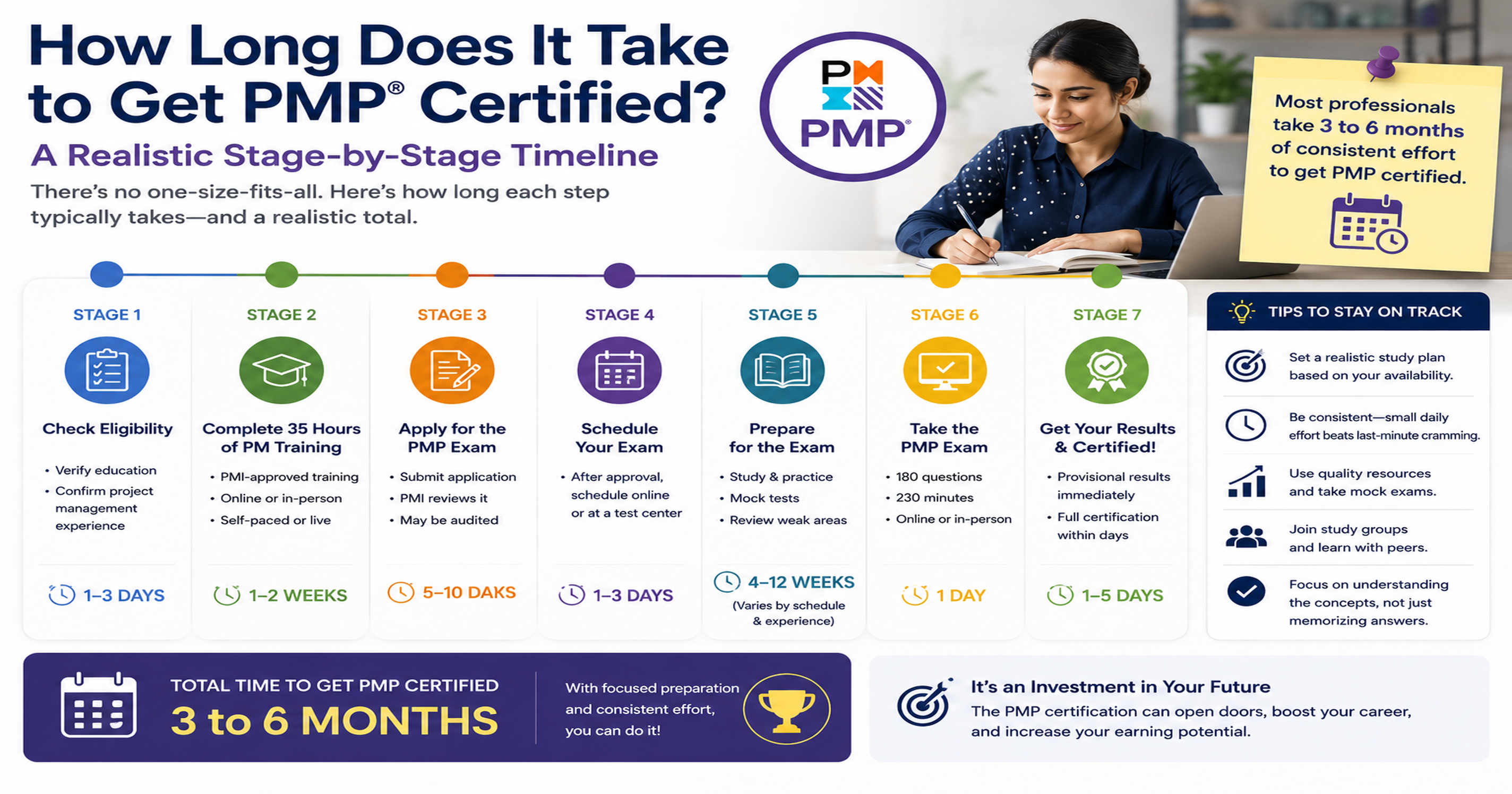
Most candidates move from checking their PMP eligibility to holding a passing exam result in two to six months, and the biggest swing factor is not the exam itself but how long it takes to document experience hours, clear PMI's application review (including a possible audit), and fit 35 to 150+ hours of study around a full-time job.
Candidates who complete a structured, employer-sponsored bootcamp with application help built in often finish in eight to ten weeks, while self-study candidates juggling a demanding job commonly take four to six months, and sometimes longer if they are audited or study inconsistently. The fastest realistic path, for someone who already meets the experience requirement and studies intensively, is roughly six to eight weeks; the slower, more common path for a working professional studying part-time is three to six months from first eligibility check to exam day.
Key Highlights: How Long Does It Take to Get PMP Certified
- A realistic end-to-end PMP timeline runs 2 to 6 months for most candidates, compressing to 6 to 8 weeks for intensive, well-prepared applicants and stretching to 9 to 12 months for slow, part-time self-study.
- PMI typically takes 5 to 7 business days to review a completed PMP application, but only after you have already spent weeks gathering and entering 36 to 60 months of non-overlapping project experience.
- PMI randomly audits an estimated 5 to 10 percent of PMP applications; an audit itself is usually resolved within 5 to 7 business days once documents are submitted, but candidates get up to 90 days to submit them.
- The 35-hour project management education requirement can be completed in as little as 4 to 5 days through an intensive bootcamp, or spread across 6 to 10 weeks through a self-paced course.
- Self-study candidates typically need 8 to 12 weeks at 10 to 15 study hours per week, while structured, instructor-led training can shorten active study time to 4 to 8 weeks because the 35-hour requirement and much of the content review happen in the same sessions.
- The PMP exam content outline updated on 9 July 2026 to align with the PMBOK Guide 8th edition, shifting significant weight onto the Business Environment domain, which means candidates studying under the new outline should budget extra time for strategy and value-delivery topics rather than pure process recall.
- Corporate-sponsored cohorts, where an employer funds group training for a team, typically finish faster than individual self-study candidates because the schedule, accountability, and application guidance are already built in.
The Full PMP Journey: Eight Stages From Eligibility to Certificate
The PMP timeline is not one continuous block of studying, it is eight distinct stages, each with its own realistic time range, and most existing guidance on this topic collapses them into a single vague number. Laying them out separately is the only way to see where your own timeline will actually stretch or compress.
Stage | What Happens | Realistic Time Range |
| 1. Eligibility check | Confirm degree and experience pathway against PMI's two eligibility routes | 1 to 3 days |
| 2. Experience documentation | Compile 36 to 60 non-overlapping months of project leadership experience into PMI's application format | 1 to 4 weeks |
| 3. 35-hour education requirement | Complete PMI-authorized training hours (waived if you hold an active CAPM) | 4 days to 10 weeks, depending on format |
| 4. Application submission | Submit the completed PMP application and pay the exam fee | Same day, once experience data is ready |
| 5. PMI review, including possible audit | PMI reviews the application; 5 to 10 percent of applicants are randomly selected for an audit | 5 to 7 business days (no audit); 2 to 6 weeks (audited) |
| 6. Study period | Active exam preparation beyond the 35-hour course, using practice questions and mock exams | 4 to 24 weeks, depending on pacing |
| 7. Exam scheduling | Book a Pearson VUE test centre or online-proctored slot using your one-year eligibility window | Can be same-day; 2 to 3 weeks ahead is recommended for preferred slots |
| 8. Exam day and result | Sit the 180-question, 230-minute computer-based exam | Under 4 hours |
Stage 1: Checking Your PMP Eligibility Takes Days, Not Weeks
Confirming eligibility itself rarely takes longer than a few days because it only involves matching your education and experience against PMI's two published pathways. A four-year degree pairs with 36 months of non-overlapping project leadership experience, while a high school diploma or associate degree pairs with 60 months, and in both cases the experience must sit within roughly the last eight to ten years and the applicant must also complete 35 contact hours of project management education, waived only for active CAPM holders, exactly as PMI itself sets out on its official PMP certification page. The real time cost is not the eligibility check, it is what comes next: proving that experience on paper. Simpliaxis's PMP eligibility requirements guide breaks down both pathways in detail if you are unsure which one applies to you.
Stage 2: Documenting Experience Hours Is the Most Underestimated Step
Gathering and writing up project experience is where most candidates lose the most calendar time, often one to four weeks, because it involves reconstructing project timelines, job titles, and role descriptions from memory or old records. PMI wants each project entry described in terms of leadership actions across its process groups, not just a job title, which means candidates who kept no notes during their actual project work end up reverse-engineering their history months or years later. This article deliberately does not walk through the mechanics of counting overlapping months and hours; that calculation is covered in detail in Simpliaxis's dedicated guide to the 36-month non-overlapping experience rule. What matters for your overall timeline is simply that this documentation step, not the eligibility check or the exam itself, is usually the first place a rushed schedule falls apart.
Stage 3: The 35-Hour Education Requirement Can Take Days or Weeks Depending on Format
How long the 35-hour requirement takes depends entirely on the training format you choose, ranging from a 4-day intensive bootcamp to a 10-week self-paced course. An instructor-led bootcamp compresses the entire requirement into three to five consecutive days of live sessions, which suits candidates trying to move quickly, while a self-paced online course spreads the same 35 hours across six to ten weeks of part-time study, which suits candidates who prefer to absorb material gradually alongside a full-time job. From late Q4 2026, PMI will only accept these 35 hours if they come from a PMI Authorized Training Partner, so confirming a provider's ATP status before enrolling protects your timeline from a late rejection. Simpliaxis's PMP certification training course is delivered as a PMI-authorized program that issues the full 35 contact hours on completion, and its self-paced PMP prep course is the slower-but-flexible alternative for candidates who cannot commit to consecutive bootcamp days.
Stage 4: Submitting the Application Itself Is Fast Once the Data Is Ready
Submitting the PMP application is the fastest stage in the entire process, typically same-day, because it is really just data entry once your experience documentation is already prepared. Candidates who try to fill in project entries as they submit, rather than compiling everything beforehand, are the ones who report the submission stage taking several extra days. The practical lesson is to treat documentation and submission as two separate stages on your own calendar rather than one, since conflating them is a common reason people underestimate how soon they can actually apply.
Stage 5: PMI's Review, and the Audit Contingency Most Timelines Ignore
PMI generally reviews a completed PMP application within 5 to 7 business days, but candidates selected for a random audit should budget an additional 2 to 6 weeks before their eligibility is confirmed. PMI audits an estimated 5 to 10 percent of PMP applications to verify that reported experience and education are accurate, and candidates who are audited are notified before paying the certification fee. Once selected, you have up to 90 days to submit supporting documentation such as signed manager verification letters and training certificates, though PMI's own review of a complete audit package is usually resolved within 5 to 7 business days after submission, as described in PMI's PMP certification handbook. Importantly, the one-year exam eligibility clock pauses while an audit is in progress, so an audit delays your start date rather than shrinking your available window. Because audit selection is random and cannot be predicted or avoided by a stronger application, the only real safeguard is keeping verifiable documentation (manager contacts, offer letters, project sign-offs) ready before you submit, so that a 2 to 6 week delay never balloons into a multi-month one caused by scrambling for evidence after the fact.
Stage 6: How Long the Study Period Actually Takes
The study period is the single largest variable in the entire PMP timeline, ranging from roughly 4 weeks for intensive, experienced candidates to 6 months or more for those studying a few hours a week. Estimates of total study time vary across training providers and candidate surveys, but a defensible range, once the 35 contact hours are complete, is another 40 to 150 hours of focused practice questions, mock exams, and content review, with many successful candidates landing between 70 and 125 hours. How those hours get spread across weeks depends almost entirely on pacing, which is why a single "study for X weeks" answer is misleading without knowing how many hours per week a candidate can realistically commit.
Self-Study vs Structured Training: A Realistic Pacing Comparison
A structured, instructor-led course generally reaches exam-ready status faster than self-study because the 35-hour requirement and a large share of content review happen in the same guided sessions, rather than being two separate efforts. The table below sets out realistic pacing for each approach, based on weekly time commitment, which is a more honest way to estimate your own timeline than a single blanket number.
Approach | Weekly Time Commitment | Typical Total Duration | Best Suited To |
| Intensive bootcamp | Full days for 3 to 5 consecutive days, then 2 to 4 weeks of independent practice exams | 4 to 8 weeks total | Candidates who can take time off work or study full-time briefly |
| Structured live-online course | 6 to 10 hours per week across live sessions and homework | 6 to 10 weeks | Working professionals who want pacing and accountability from an instructor |
| Self-paced course, disciplined | 10 to 15 hours per week | 8 to 12 weeks | Self-motivated candidates comfortable studying without live sessions |
| Self-paced course, part-time | 5 to 8 hours per week | 3 to 6 months | Candidates fitting study around unpredictable work schedules |
The consistent theme across candidate reports and training providers is that steady, shorter study sessions outperform occasional long ones, since a candidate studying 90 minutes five days a week for eight weeks generally retains more than one attempting the same total hours in a handful of weekend cram sessions. Simpliaxis's guide on how to prepare for the PMP exam covers pacing and practice-exam strategy in more depth if you want to build a week-by-week plan around one of the approaches above.
How the 2026 PMBOK 8th Edition Changes the Study-Time Math
The PMP exam updated on 9 July 2026 to align with the PMBOK Guide 8th edition, and this shift genuinely affects how long candidates should budget for study, which is a factor most existing timeline guides do not yet account for. The updated Examination Content Outline consolidated from 35 tasks down to 26, but rebalanced domain weighting so that Business Environment jumped from roughly 8 percent of the exam to 26 percent, while Process dropped from about 50 percent to 41 percent.
In practical terms, a domain that most 2021-outline candidates could skim in a weekend now carries more than a quarter of the exam's weight, and its questions lean toward scenario-based judgement on strategy, governance, and value realisation rather than straightforward recall of inputs, tools, and outputs, a shift that training providers tracking the 2026 PMBOK 8th edition update have flagged as the most consequential change to the exam in years.
Candidates studying under the updated outline should treat this as a reason to add study time rather than trim it, particularly if their real-world project experience is heavily technical or process-focused and comparatively light on organisational strategy and stakeholder governance. Eligibility requirements and the 35-hour training rule are unaffected by this change, only the exam content and its emphasis shifted, so the timeline impact sits entirely inside Stage 6, not the application stages before it.
Stage 7: Scheduling the Exam Rarely Adds Real Delay
Once PMI approves your application, you can schedule your Pearson VUE exam appointment immediately, and the only reason to wait is to line up your preferred date and location. Most candidates recommend booking two to three weeks ahead of your target date to secure a convenient test centre slot or online-proctored time, since availability is first-come, first-served and can tighten around popular dates. Your approved eligibility window lasts one full year and allows up to three exam attempts within that period, so scheduling itself is rarely the bottleneck in a PMP timeline, it is simply the last administrative step before study becomes exam performance. Simpliaxis's PMP exam schedule guide walks through the booking steps and rescheduling policy in more detail.
Stage 8: Exam Day Itself Is the Shortest Stage
The PMP exam takes 230 minutes, just under four hours, to answer 180 questions across two optional 10-minute breaks, making exam day itself the shortest stage in the entire journey by far. Most candidates receive a provisional pass or fail result on screen immediately after finishing, with the official digital certificate typically issued within four to five weeks afterward. Everything before this point, the experience documentation, the audit possibility, and months of study, exists to compress this single four-hour sitting into as few attempts as possible, which is really the entire point of treating the earlier stages seriously rather than rushing them.
Why Corporate-Sponsored Candidates Typically Finish Faster
Candidates whose employer sponsors a structured group cohort generally reach certification faster than individual self-study candidates, often in eight to ten weeks against a self-directed candidate's three to six months, because most of the friction described above is removed rather than left to the individual to manage alone.
A sponsored cohort typically arrives with the 35-hour training already scheduled on fixed dates, application guidance built into the program so experience documentation gets done correctly the first time, and a shared study calendar that creates peer accountability, all of which shrink Stages 2, 3, and 6 simultaneously rather than one at a time. Organisations with a team of PMP candidates rather than a single applicant can arrange this directly; Simpliaxis's corporate group training programme runs private PMP cohorts for teams, which is generally the fastest realistic path to certification for anyone whose employer is willing to fund and schedule training as a group rather than leaving each employee to self-study independently.
Conclusion
There is no single correct answer to how long PMP certification takes, but there is a defensible range once you separate the journey into its real stages rather than treating it as one undifferentiated block of "studying." Eligibility checks and application submission move quickly, in days rather than weeks; experience documentation and the audit contingency are the parts most candidates underestimate; and the study period is the stage where your own weekly time commitment, not some fixed industry number, ultimately decides whether you finish in six weeks or six months.
What has genuinely changed heading into the 2026 exam cycle is that the PMBOK 8th edition's rebalanced content outline rewards candidates who budget real study time for business environment and strategic judgement, not just process mechanics, so a study plan built for the old outline may now run short. The fastest, most predictable route through all eight stages remains a structured program, whether an individually booked bootcamp or an employer-sponsored corporate cohort, because both convert the vaguest and most delay-prone stages of the process into fixed, scheduled commitments rather than open-ended personal projects.







 Lowest-Price Challenge











 Personalized Path


.webp)


 USA
USA  Canada
 India
India UK
UK Australia
 Singapore


