


 Call Us



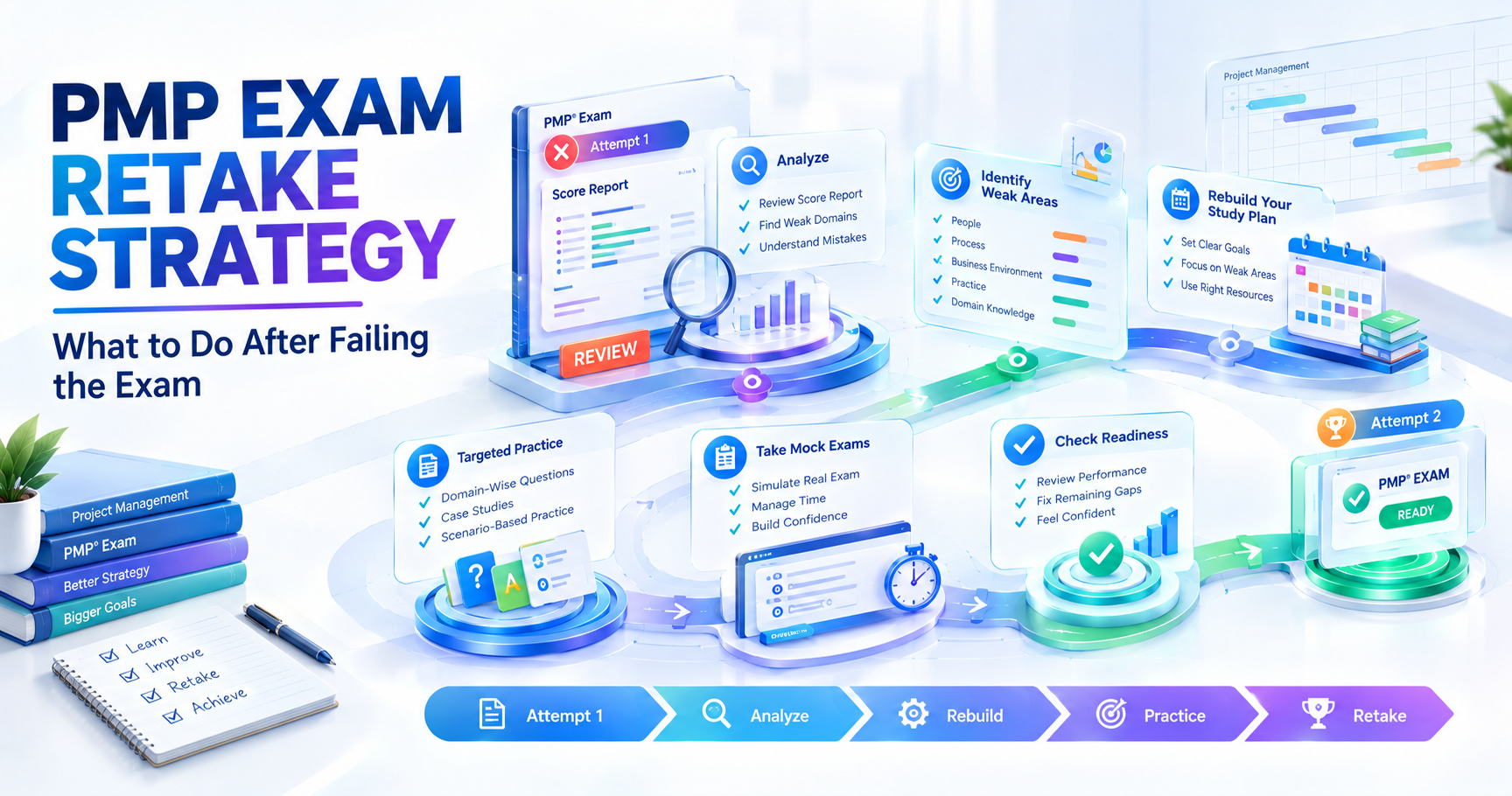
If you fail the PMP exam, you can retake it up to three times within your one-year eligibility period, for a reduced fee of $275 (PMI members) or $375 (non-members) per attempt. You don't need to redo your 35 hours of training. The most effective retake strategy starts with reading your score report's domain-level ratings, then building a focused 3-6 week study plan around the specific domains marked Below Target or Needs Improvement.
Key Highlights of PMP Exam Retake Strategy:
- Up to 3 attempts allowed within your 1-year eligibility period; a 1-year wait applies only after all 3 attempts are used
- Retake fee: $275 for PMI members, $375 for non-members, well below the original $425/$675 fee
- No need to redocument experience or redo the 35-hour training requirement for a retake within the same eligibility period
- Score reports use four bands per domain (Above Target, Target, Below Target, Needs Improvement); a single Below Target can sometimes be offset by strong performance elsewhere
- The July 2026 exam update raised Business Environment from 8% to 26% of total weight, a common blind spot for candidates who studied older materials
- Most successful retake candidates need 3-6 focused weeks, not a full repeat of their original 8-12 week study plan
Failing the PMP exam is not the same as failing at project management. It's a specific, diagnosable setback with a clear, well-documented path forward, and most candidates who fail once go on to pass. This article walks through exactly what to do in the days after a failed attempt: how to read your score report, what it actually costs to try again, and how to build a study plan that fixes the real problem instead of just repeating your original preparation.
If you're reading this within hours of an unexpected "Did Not Pass" result, it's worth pausing before you dive back into study materials. The instinct to immediately reopen your notes is understandable, but a few days of distance, combined with a genuinely honest read of your score report, will produce a far more effective retake plan than an emotional, same-day restart. The policy itself is more forgiving than most first-time candidates realize, and understanding exactly how forgiving it is tends to lower the anxiety enough to think clearly about what to do next.
You Failed the PMP Exam. Here's What Actually Happens Next
Here's the practical sequence. Your eligibility to sit the exam again doesn't disappear, PMI allows up to three attempts within your one-year eligibility period, and you don't need to resubmit your application, redocument your experience, or redo your 35 hours of training to try again within that window. What you do need is your official score report, which shows your performance across three domains, and a clear-eyed read of where things actually went wrong. The rest of this article is built around exactly that process.
The First 48 Hours: What to Do (and What Not to Do)
Before touching a study plan, there are a few practical steps worth taking immediately.
- Do request your official score report if you haven't already. For computer-based tests, you'll typically see a preliminary pass or fail result at the test center itself, but the detailed, domain-level score report arrives by email within a few business days. Don't build any retake strategy off memory of how the exam "felt"; wait for the actual report.
- Don't schedule your retake exam the same week. It's tempting to want to "get it over with," but scheduling before you've diagnosed what went wrong almost guarantees a similar result. Give yourself at least a few days of distance before committing to a new date.
- Do talk to your training provider or study group about your specific result, not just the fact that you failed. If you trained with a PMI Authorized Training Partner, many offer some form of post-exam guidance or gap-review support specifically for candidates preparing for a second attempt, which is a different service from a full retraining course.Simpliaxis's PMP Certification Training team, for instance, works with retake candidates on exactly this kind of targeted review.
- Don't assume you need to relearn everything. A failed attempt usually means a specific, identifiable gap, not a wholesale lack of knowledge. Treat the diagnosis step as seriously as the study step that follows it.
Understanding the PMP Retake Policy
How Many Times Can You Retake the PMP Exam?
According to PMI's current Examination Content Outline, you may take the exam up to three times within your one-year eligibility period. If you don't pass after three attempts, you must wait one year from the date of your last exam before reapplying for the certification. This policy exists to protect exam security and reduce overexposure of exam content to individual candidates, not to punish candidates who need more than one attempt.
During that one-year wait, you're free to apply for any other PMI certification, so the wait isn't necessarily dead time if you're building toward PMP alongside something like PMI-ACP or a Program Management credential.
What Happens If Your Eligibility Period Expires?
There's an important nuance most retake articles skip: if your one-year eligibility period simply expires without you having used all three attempts, you must reapply for the certification, but you are not subject to the one-year waiting period. That's meaningfully different from exhausting three failed attempts. If you're running close to your eligibility deadline with one attempt left and you're not ready, letting the eligibility lapse and reapplying fresh, with a brand-new one-year window and three fresh attempts, can sometimes be the smarter move than rushing an unprepared third attempt.FAQs on PMP Certification covers a few more of these procedural edge cases if you want the fuller picture.
PMP Exam Retake Cost: The Real Numbers
Retaking the exam costs less than your first attempt, but it's not free, and the math is worth doing honestly before you commit to a timeline.
Attempt | PMI Member Fee | Non-Member Fee |
| First attempt | $425 | $675 |
| Second attempt (retake) | $275 | $375 |
| Third attempt (retake) | $275 | $375 |
If you're not already a PMI member, it's worth running the math before your next attempt: membership costs roughly $159-169 per year and cuts the exam fee by $250, which frequently pays for itself on the discount alone, especially if you anticipate needing a second attempt. Beyond the exam fee itself, factor in a possible $70 reschedule fee if you need to move your date within 30 days of the exam, and remember that a no-show or a cancellation inside 48 hours risks forfeiting the entire fee.PMP Certification Cost breaks down the full first-attempt budget if you want to compare it against these retake numbers.
Two failed attempts followed by a pass on the third, as a PMI member, works out to roughly $425 plus $275 plus $275, just under $1,000 in exam fees alone, before any additional study materials. That's a real number, and it's exactly why getting your remediation plan right the first time matters more than rushing back into the testing center.
How to Read Your PMP Score Report Correctly
This is the step most candidates skip, and it's the single highest-leverage thing you can do before studying another hour.
PMI does not publish a numeric passing score. Instead, your score report rates your performance in each of the three domains, People, Process, and Business Environment, using four bands: Above Target, Target, Below Target, and Needs Improvement. Above Target means you performed clearly above the required standard. Target means you met it. Below Target means you fell short but were close. Needs Improvement means you fell well short.
Your overall pass or fail result is calculated from a psychometric model (based on Item Response Theory) applied across all three domains combined, not a simple average, and not an isolated pass/fail per domain. That means a single Below Target in one domain can sometimes be offset if your performance in the other two domains is strong enough. A Needs Improvement rating in any domain, though, is a much more serious signal and almost always needs direct attention before your next attempt.
The practical use of this report is diagnostic, not just informational. If your report shows Target or Above Target in People and Process but Below Target in Business Environment, your retake study plan should look completely different from someone who shows Needs Improvement in People specifically. Don't restudy everything evenly; restudy according to what your own report is actually telling you.
The 5 Most Common Reasons Candidates Fail (and How to Tell Which One Was Yours)
- Studying the wrong exam version. If you sat the exam on or after July 9, 2026, and prepared using older materials, you may have significantly underweighted Business Environment, which jumped from 8% to 26% of the exam. Check your score report: a Below Target or Needs Improvement specifically in Business Environment is a strong signal this was your issue.
- Memorizing instead of applying. The PMP exam tests scenario-based judgment, not recall of definitions or ITTOs. If you felt confident on straightforward recall questions but struggled whenever a question described a messy, multi-stakeholder situation, this is likely your gap, regardless of which domain shows the weaker rating.
- Weak time management under real exam pressure. If you rushed through the final section, guessed on questions you knew the content for, or ran out of time to review flagged items before a break locked you out of that section, the issue may not be knowledge at all. A consistent pattern of weaker performance in whichever domain appeared later in your exam session can point to this.
- Insufficient mock-exam volume before the real thing. Candidates who sit the real exam having completed fewer than two or three full-length, timed mock exams are more likely to be caught off guard by pacing, question style, or simple test-day stamina, independent of how well they know the material.
- Underestimating the agile and hybrid content. With roughly 60% of the current exam spanning adaptive, agile, and hybrid approaches, candidates from strictly predictive or Waterfall-heavy backgrounds sometimes underprepare here specifically. This tends to show up as inconsistent performance across all three domains rather than one clearly weak area, since agile and hybrid content is woven through every domain rather than isolated to one.
None of these 5 reasons are permanent limitations, and identifying which one (or which combination) applies to you is far more useful than a generic "study harder" resolution. If you're unsure which pattern matches your experience,15 Common PMP Exam Mistakes walks through a broader, more granular list of specific missteps that can help you pinpoint the exact behavior to correct, not just the general category.
Building Your PMP Exam Retake Study Plan
- Start with your score report, not your old notes. Identify every domain rated Below Target or Needs Improvement and treat those as your primary study targets, not an equal-weight review of everything.
- Set a realistic retake timeline of 3 to 6 weeks, not a full repeat of your original 8-to-12-week plan. You already know most of the material; this cycle is about closing specific, identified gaps.
- Rebuild an error log from your original practice exams, if you kept one, or start one now. Every practice question you get wrong should be logged with the reason: content gap, misread the scenario, or ran out of time. Patterns in that log tell you exactly where to focus.
- Take at least two new full-length, timed mock exams built around the current July 2026 domain weighting before you schedule your retake date.PMP Practice Exam Questions is a useful place to start if you need scenario-based questions aligned to the current exam.
- Practice under real time pressure specifically for your weak domain. If Business Environment was your gap, don't just re-read the material, drill scenario questions in that domain against a clock, since content knowledge alone rarely fixes a pacing-related weakness.
- Schedule your retake date only once your mock scores are consistently at or above Target across all three domains, not the moment you feel emotionally ready to get it over with.Nine Key Steps to Pass the PMP Certification Exam is a useful broader checklist to run through before you lock in a date, andSimpliaxis's PMP training schedules page shows current session dates if you decide a short refresher session fits your timeline.
Do You Need to Retrain Before a Retake?
Not for the formal eligibility requirements. If you're retaking within your existing one-year eligibility period, your original 35 hours of training and your documented experience remain valid; you don't need to submit a new application or new training certificate. What you likely do need is targeted content review and additional scenario practice in your identified weak domains, which is different from a full retraining course. Some candidates find a short, focused review session with a PMI Authorized Training Partner more useful at this stage than repeating an entire multi-day course, since the goal now is precision, not a second full pass through content you've already covered once.
That said, there's a meaningful difference between "I don't need to retrain" and "I don't need any additional structured support." If your original preparation was entirely self-directed, self-study books, free videos, scattered practice questions, and it didn't produce a pass, that's useful information in itself. A structured, domain-targeted review with an instructor who can answer specific questions about your weak areas often closes gaps faster than another few weeks of solo review, particularly for the Business Environment domain, where many older self-study resources are now noticeably out of date against the current 26% weighting.
What Changed in the July 2026 Exam That Might Have Caught You Off Guard
If your exam was on or after July 9, 2026, a few structural changes may explain a rougher-than-expected result even with solid preparation. The exam now runs 240 minutes instead of 230, with 170 scored questions and 10 unscored pretest items instead of the previous 175 and 5. The exam also opens with a dedicated case-study section, a new format where one detailed scenario feeds several linked questions, before moving into an independent-question portion, with breaks positioned after the case-study section and roughly midway through the independent questions. If you prepared using materials describing the older three-equal-sections format, the unfamiliar structure alone could have cost you time and composure on exam day, independent of your actual content knowledge.
How Long Should You Wait Before Retaking?
There's no PMI-mandated minimum wait between a first and second attempt within your eligibility period (some training providers cite a 30-day scheduling consideration, so confirm current scheduling availability directly through your Pearson VUE account), but rushing back in within days is rarely the right call unless your score report shows you were extremely close across all domains. For most candidates, 3 to 6 weeks of focused, score-report-driven study produces a meaningfully stronger second attempt than an immediate retest. The right wait time is the one it takes to move your practice-exam scores from inconsistent to consistently at or above Target, not a fixed calendar number.
Is a Second PMP Exam Attempt Common?
Yes, and it's worth saying plainly: needing a retake is a normal, well-anticipated part of the PMP process, which is exactly why PMI built a structured, affordable retake path into the certification rather than a one-shot, all-or-nothing exam. PMI doesn't publish first-attempt pass rates publicly, but the existence of a discounted retake fee, a full year of eligibility, and three total attempts all reflect an exam program designed with retakes as an expected outcome for a meaningful share of candidates, not an edge case.PMP Pass Rate has more context on how PMI's scoring approach evolved over the years if you want the fuller history.
That said, a second attempt without a genuinely different preparation approach tends to produce a similar result. The candidates who pass on their second try are almost never the ones who simply studied more of the same material; they're the ones who read their score report honestly, identified the real gap, whether content, application, or pacing, and built a shorter, sharper study cycle around that specific diagnosis.
Conclusion
A failed PMP attempt is a data point, not a verdict. The policy is built to accommodate it: three attempts in a year, a discounted retake fee, and no need to restart your training or eligibility from scratch. The candidates who turn a first failure into a second-attempt pass are the ones who treat their score report as a diagnostic tool, target their weakest domain specifically, and rebuild a tighter, more honest study plan rather than repeating what didn't work the first time.
If you're not sure whether your gap is content, application, or pure exam-day pacing, it's worth readingPMP Exam Time Management alongside this article, since pacing problems and knowledge gaps often look identical on a score report but need very different fixes. It's also worth checking15 Common PMP Exam Mistakes to see whether one of the well-documented, avoidable patterns there matches what happened on your attempt. And if you want a structured gap-review session rather than repeating a full course,Simpliaxis's PMP Certification Training team can help scope exactly that.






 Lowest-Price Challenge











 Personalized Path


.webp)


 USA
USA  Canada
 India
India UK
UK Australia
 Singapore


