


 Call Us



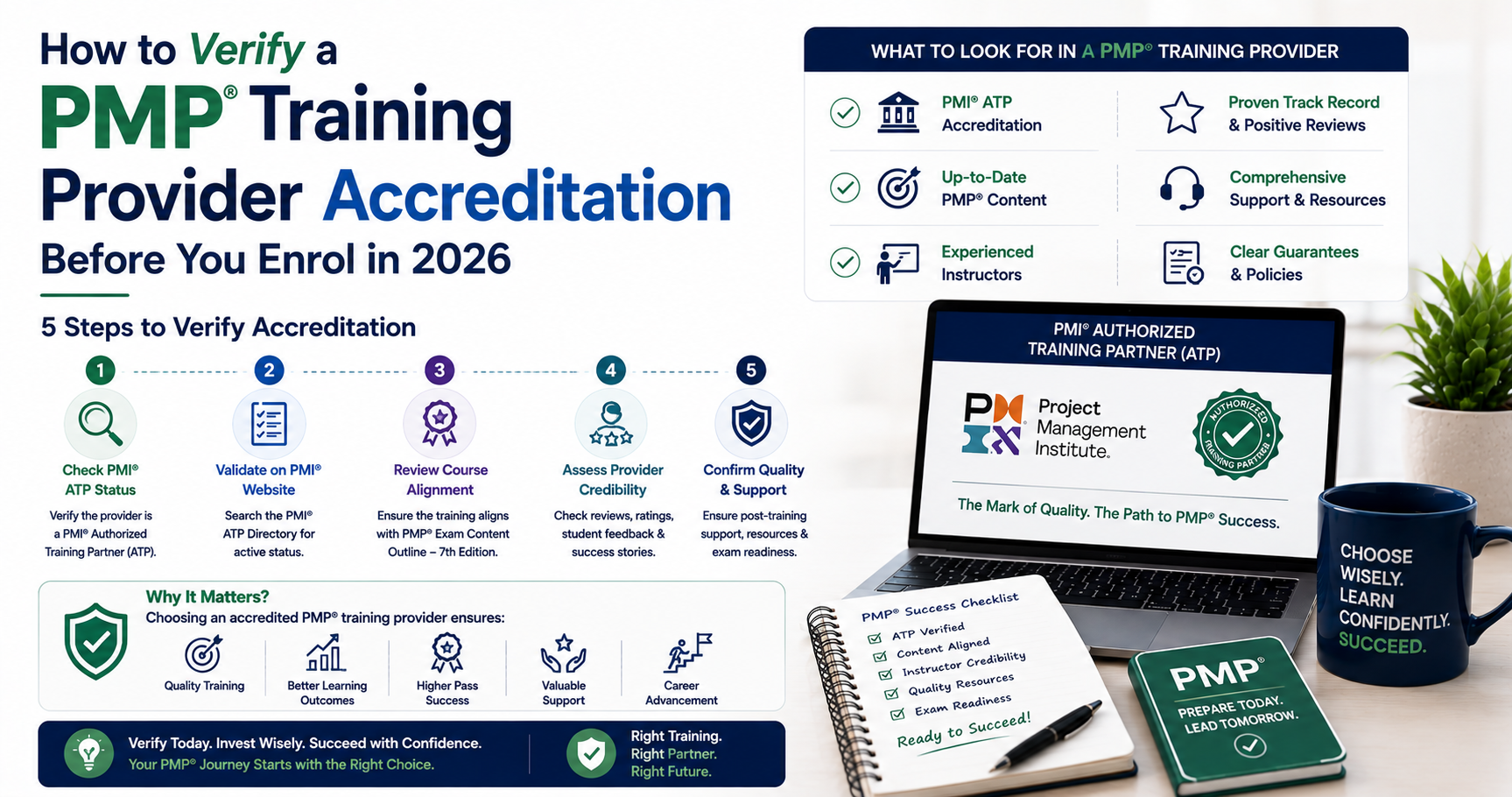
To verify a PMP training provider is genuinely accredited, search its name directly in PMI's own Authorized Training Partner directory rather than trusting a logo on its website, then confirm the digital access key code it issues matches PMI's records. If the provider is not listed, treat every "PMI-approved" or "PMI-accredited" claim on its marketing pages as unverified. Before paying, also read the exact wording of any money-back guarantee, since "100% money back" almost always carries attendance, timing, or attempt conditions that only appear in the fine print.
Key Highlights of How to Verify a PMP Training Provider Accreditation
- PMI retired its Registered Education Provider (R.E.P.) programme on 31 December 2020 and replaced it with the Authorized Training Partner (ATP) programme, effective 1 January 2021, so any provider still marketing "R.E.P." status is citing an outdated designation.
- PMI's own Training Partner Directory, searchable at pmi.org, is the only independent way to confirm current ATP status; a logo or badge on a provider's own website is not proof.
- PMI does not currently require your 35 contact hours to come from an ATP, but PMI has communicated to its ATP network that this will change from an announced effective date expected in late 2026, after which live, instructor-led hours must come from an ATP.
- A "100% money-back guarantee" is a marketing headline, not a single standard policy; every provider attaches its own conditions covering attendance, number of exam attempts, and the time window for a refund claim.
- Common red flags of non-accredited or low-quality providers include promises to add your name to the PMI registry without sitting the exam, prices far below the market range, and no verifiable company address.
- Instructors delivering PMI ATP-branded PMP courses must themselves hold an active PMP credential in good standing and complete PMI's ATP Train the Trainer programme, so an unverifiable instructor is itself a warning sign.
- A short, direct checklist, covering ATP verification, instructor credentials, guarantee terms in writing, and independent third-party reviews, is enough to separate a trustworthy provider from a risky one in a single sitting.
What Does "PMI Accredited" Actually Mean for a Training Provider?
There is no generic "PMI accreditation" badge that a training company can hold; the only formal designation PMI grants to training organisations is Authorized Training Partner, commonly shortened to ATP. When a provider's marketing says "PMI-accredited," "PMI-approved," or "PMI-certified training centre," the only claim worth anything is whether that organisation currently appears in PMI's own ATP directory. Everything else is language chosen to sound official without being independently checkable.
The PMI Authorized Training Partner Programme Explained
PMI states that ATP status is awarded only to established, financially sound project management education providers whose courses align with the PMI Talent Triangle and whose businesses pass PMI's own evaluation process before the designation is granted. According to PMI, ATP candidates must demonstrate a minimum of three years of project management training experience, and every instructor delivering an ATP-branded PMP course must complete PMI's Authorized Training Partner Train the Trainer programme before teaching it.
PMI also operates tiers within the programme, including a Premier level for the highest-volume, longest-standing partners, so two providers can both be genuine ATPs while sitting at different levels of the same programme. Simpliaxis publishes its own accreditation status, including its PMI ATP designation alongside its other authorisations, on a dedicated page rather than only as a footer logo, which is the kind of disclosure a buyer should expect from any provider making the claim.
Why the Old R.E.P. Programme No Longer Counts
PMI's Registered Education Provider programme, R.E.P. for short, was retired on 31 December 2020 and replaced by the Authorized Training Partner programme from 1 January 2021, a transition PMI announced in November 2019 and phased in over the following year. Any provider whose website, brochure, or sales script still references "PMI R.E.P." status is either using stale marketing copy or has not held current standing with PMI since that changeover, and either reading is a reason to verify directly before paying rather than take the claim at face value.
How Do You Check a Provider's ATP Status Yourself?
You confirm ATP status independently by searching PMI's own Training Partner Directory rather than relying on anything printed on the provider's own site, and the whole check takes a few minutes. PMI hosts this directory directly on pmi.org, and it is the single source that is not controlled by the training company you are evaluating.
- Search the provider by name in PMI's directory. Go to PMI's Authorized Training Partner search tool and type the exact legal or trading name the provider uses on its invoice, not just the brand name on its homepage, since some training companies operate several consumer-facing brands under one registered ATP entity. A provider confident in its status usually states its ATP designation on every course page, including city-specific pages such as Simpliaxis's PMP course for Dallas, not only on a single global homepage.
- Ask for the digital access key code. PMI-authorised course materials come with a unique digital access key code, an alphanumeric string such as the example format PMI publishes, and a genuine ATP will issue one to every enrolled learner; a provider that cannot produce one is not delivering PMI-licensed content.
- Check which ATP tier the listing shows. PMI's directory distinguishes standard Authorized Training Partners from Premier Authorized Training Partners, so compare the tier shown in the directory against any tier the provider claims for itself.
- Verify the instructor's own PMP credential. Ask for the instructor's PMP certification number and cross-check it is active, since PMI requires ATP instructors to hold their own PMP credential in good standing.
- Read PMI's own explanation of the programme. PMI's page on why to train with an Authorized Training Partner sets out what the designation is supposed to guarantee, so you can compare it against what the provider actually delivers.
Do You Actually Need an ATP Provider for Your 35 Contact Hours?
Right now, no: PMI's current PMP eligibility rules do not require your 35 contact hours of project management education to come specifically from an ATP, and hours from a non-ATP provider, a PMI chapter, or a university programme still count today.
That is changing. Training providers IMT-PM and Spoclearn, reporting on direct communication PMI has sent to its ATP network, state that PMI will begin accepting the 35 contact hours only from Authorized Training Partners for live, instructor-led training from an effective date PMI intends to announce in advance, with self-paced, on-demand training reportedly staying outside that restriction for now and training completed before the cutover remaining valid under the rules in force at the time.
Because the cutover date has been signalled but not yet fixed at the time of writing, the safest buying decision is the same either way: choose a current ATP now, since that protects your eligibility under both the existing rule and the announced future one. Simpliaxis positions its PMP certification training course around this exact point, delivering the full 35 contact hours as a PMI Authorized Training Partner so the hours remain valid regardless of which rule set applies on your application date.
What Are the Red Flags of a Non-Accredited or Low-Quality PMP Provider?
The clearest red flag is any provider that promises to get your name onto PMI's certification registry without you sitting and passing the PMP exam, since PMI has no mechanism that allows a credential to be granted that way and any such offer is not legitimate. Beyond that single disqualifying claim, several smaller signals tend to appear together on the sites of non-accredited or low-quality providers.
- Guaranteed registry placement without an exam. Treat any message, especially unsolicited outreach on LinkedIn or email, offering to place your name on the PMI credential registry without an exam as an outright scam.
- Pricing far below the visible market range. A course priced dramatically lower than comparable ATP offerings is a signal to check accreditation before you check anything else, since genuine ATP status carries real compliance and instructor costs a low-ball price usually cannot cover.
- No verifiable company details. A missing registered address, no named leadership, and no way to verify the business exists outside its own marketing pages are all signs to walk away.
- No independent reviews. A provider with no visible history on third-party review platforms, only testimonials hosted on its own domain, has given you no way to check its claims against outside evidence.
- Instructors without their own PMP credential. If a provider cannot name its trainers or confirm they hold active PMP certification, the course is not meeting the standard PMI sets for its own ATP instructors.
- Materials that ignore the current Examination Content Outline. PMI bases the PMP exam on its Examination Content Outline rather than the PMBOK Guide directly, and a provider whose materials have not been updated for the outline in force at the time of your exam, including the domain re-weighting PMI has built into the new PMP exam version PMI confirms will launch on 9 July 2026, is teaching to an outdated blueprint.
- Refusal to put the guarantee in writing. A sales conversation that talks up a "100% guarantee" verbally but will not send the written policy before you pay is a sign the actual conditions are less generous than the pitch.
What Does a "100% Money-Back Guarantee" Actually Cover?
A 100% money-back guarantee almost never means an unconditional refund; in practice, it is shorthand for a specific, provider-defined policy built around attendance, a fixed number of exam attempts, and a claim window, and those conditions vary widely between providers. Reading the actual policy, not the headline, is the only way to know what you would really be entitled to if the exam does not go your way.
Provider example | What the guarantee is tied to | Condition worth checking before you pay |
| PMTI | Refund if you do not pass within three exam attempts | Requires full, uninterrupted class attendance to remain eligible |
| Velociteach | Refund if you do not pass after three attempts within one year of the original class date | The one-year clock starts from your class date, not your exam date |
| Project Management Academy | Full tuition refund after three failed attempts within 120 days of completing the course | Requires completing a full mock exam and three full practice exams first |
| Simpliaxis | A satisfaction-based refund on the class itself within a defined short window after the session starts | Publicly states it "cannot guarantee you will pass the PMP exam," distinguishing a class-satisfaction guarantee from an exam-pass guarantee |
The practical lesson is to ask two separate questions rather than one: does the guarantee cover your satisfaction with the class itself, or does it cover the outcome of the exam, and if it is the latter, exactly how many attempts, within what time frame, and under what attendance conditions.
Providers that promote a "pass guarantee" almost always still require you to complete their own mock exams and practice tests as a condition of the refund, which is a reasonable requirement but one you should confirm before you rely on it. Before comparing guarantee wording across providers, it is worth reading how Simpliaxis structures its online PMP course against its live format, since the guarantee terms and support commitments can differ between the two delivery modes even from the same provider.
What Should Be on Your Buyer's Checklist Before You Pay?
Before you pay a deposit or the full course fee, work through a short, specific checklist rather than relying on impressions from the sales page, since every item below is independently verifiable in a few minutes.
- Confirm current ATP status directly in PMI's directory, using the provider's exact registered name, not just its consumer-facing brand.
- Ask for the digital access key code that PMI-licensed materials carry, and confirm it is issued at enrolment, not promised "later."
- Request the instructor's PMP certification number and check it independently rather than accepting a job title as proof.
- Get the money-back guarantee in writing before you pay, including the exact attempt count, time window, and attendance conditions.
- Read reviews on at least one platform the provider does not control, such as Trustpilot or Google, alongside anything the provider publishes itself; a provider willing to host its own reviews and feedback publicly at least gives you a second source to weigh against outside platforms.
- Check the materials are mapped to the current Examination Content Outline, not an older version, particularly with the domain re-weighting PMI has built into the exam version launching 9 July 2026.
- Confirm the 35 contact hours will be recorded and reportable in a form PMI will accept on your application, including how the provider issues your certificate of completion.
- Compare the price against the visible market range for ATP-delivered PMP courses, and treat a large gap either way as something to ask about directly.
- Ask what happens if you miss a live session, since rescheduling policies differ from refund policies and are frequently confused with each other.
- Confirm who provides PMP application support, since a provider that only sells the course but offers no help with PMI's application and audit process is leaving you to handle the most error-prone step alone.
Running through PMI's own Talent Triangle framework and comparing it against a shortlist of options is also useful groundwork before you commit; Simpliaxis's own comparison of leading project management certifications is a reasonable starting point for seeing how PMP sits alongside adjacent credentials before you narrow down to a single provider.
What Questions Should You Ask a Provider Before You Enrol?
A short, direct set of questions asked to a sales representative, before you pay, will surface most accreditation and guarantee problems faster than reading the website alone. Ask the provider to confirm its exact ATP status and tier, and to point you to where that status appears in PMI's own directory rather than only on its own page. Ask for the instructor's name and PMP credential number in advance of the course, not on the first day of class. Ask for the guarantee policy as a written document, and ask specifically what happens if you miss a session, fail to complete the required mock exams, or need to reschedule.
Ask how the 35 contact hours will be reported to PMI and what documentation you will receive to support your PMP application. A provider that answers all five clearly and quickly is behaving the way a genuine ATP should; hesitation, vague answers, or pressure to pay before you get answers are themselves signals worth weighing.
How Do Instructor Credentials Affect Training Quality?
Instructor quality is one of the few parts of PMP training accreditation you can verify against a hard PMI rule rather than a marketing claim, since PMI requires every instructor teaching an ATP-branded PMP course to hold an active PMP credential in good standing and to have completed PMI's ATP Train the Trainer programme. That programme, according to PMI-aligned training providers, includes a structured review of the current exam's technical content alongside facilitation training specific to teaching adult learners in live virtual formats.
Asking for an instructor's credential number and confirming it is active is a two-minute check that tells you whether the person teaching the course meets the bar PMI itself set for ATP instructors, which is a more reliable signal than years of experience quoted in a biography that cannot be independently checked.
Conclusion
Verifying a PMP training provider before you pay comes down to replacing marketing language with independent checks: confirm current ATP status in PMI's own directory rather than trusting a logo, get the instructor's credential number, and get the money-back guarantee in writing with its exact conditions rather than its headline.
The upcoming tightening of the 35 contact hours rule, moving live training toward ATP-only sources, makes this check more consequential in 2026 than it has been in previous years, since a course that satisfies today's rule may not satisfy the rule PMI has signalled is coming.
None of these checks require special access or paid tools; they take minutes against PMI's own public resources, and a provider confident in its own accreditation will make every one of them easy to complete before you commit your fee.








 Lowest-Price Challenge











 Personalized Path


.webp)


 USA
USA  Canada
 India
India UK
UK Australia
 Singapore


