


 Call Us



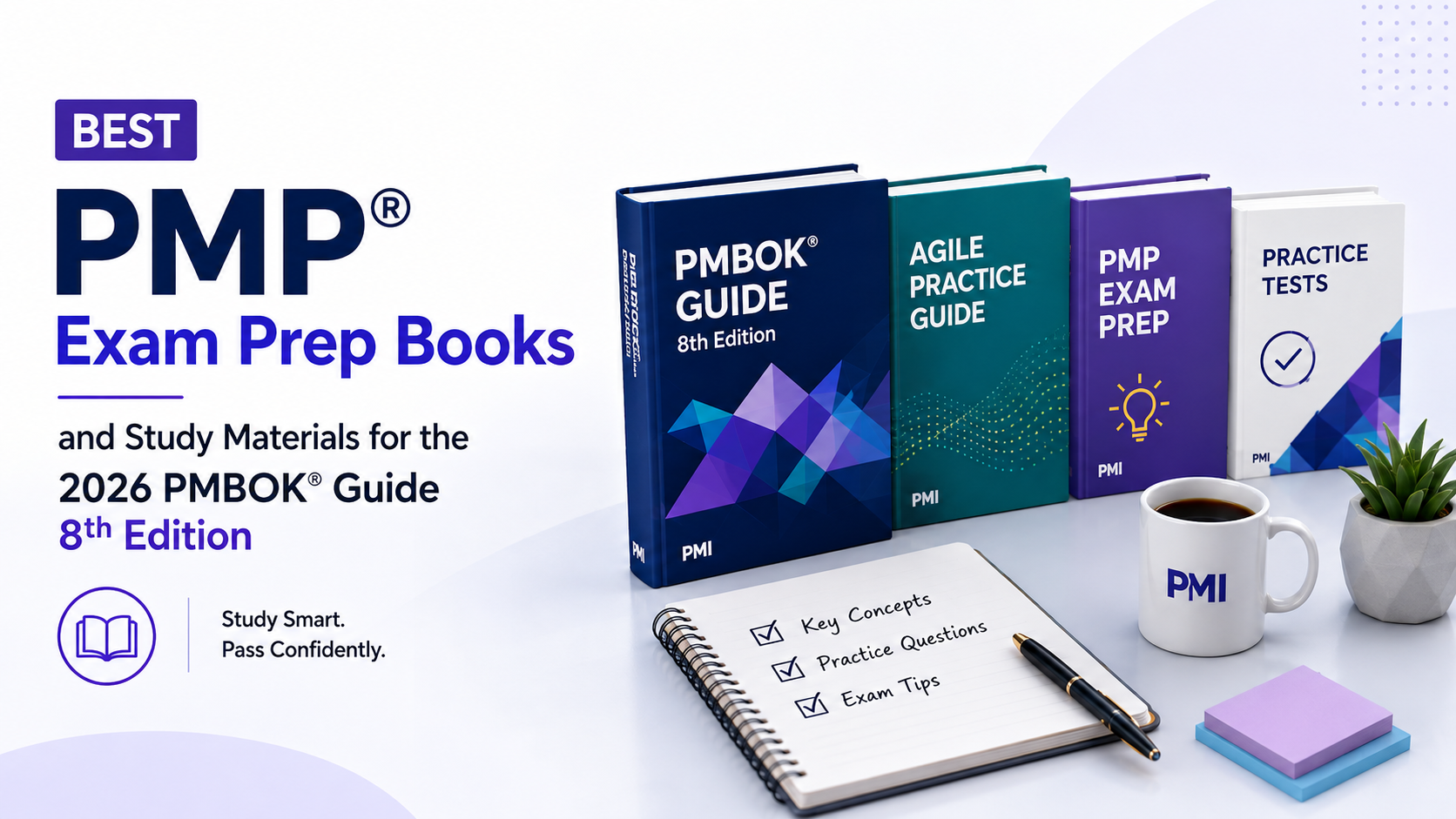
The best PMP exam prep books for 2026 are the ones explicitly aligned to the Exam Content Outline that took effect with the 9 July 2026 exam update, not simply the highest-rated title on a five-year-old bestseller list. Rita Mulcahy's PMP Exam Prep and Andrew Ramdayal's PMP Exam Prep Simplified remain the two most recommended commercial guides, but both need to be paired with the PMBOK Guide 8th Edition and supplementary material on the expanded Business Environment domain to reflect the new 33/41/26 domain weighting. Books alone rarely replace the 35 contact hours of formal education PMI requires, so most candidates use a book as their core study spine while a structured course or practice-test platform closes the remaining gaps.
Key Highlights of Best PMP Exam Prep Books
- PMI's updated exam, effective 9 July 2026, redistributes domain weighting to roughly People 33%, Process 41% and Business Environment 26%, up from 8% in the prior outline.
- Editions of popular study books printed before mid-2026 may not reflect the new weighting or the added emphasis on AI-enabled work environments and sustainability, so checking the copyright page before buying matters more than the author's name.
- Rita Mulcahy's PMP Exam Prep is still the most cited book for scenario-based practice questions that mirror the exam's situational judgement style.
- Andrew Ramdayal's PMP Exam Prep Simplified is frequently chosen by candidates who want a bundled 35-contact-hour course alongside the book itself.
- The PMBOK Guide 8th Edition and the Agile Practice Guide are the two PMI-published references most study plans build around, since both are free to download for PMI members.
- No single book meets PMI's 35 contact hours of project management education on its own, which is why a structured training course typically sits alongside a book-based study plan rather than replacing it.
- A realistic 2026 study stack combines one core prep book, the current PMBOK Guide, an agile/hybrid supplement, and a source of full-length mock exams.
Why Your Study Material Choice Matters More After the July 2026 Exam Update
Choosing outdated study material is now a bigger risk than it was two years ago. PMI's new PMP exam version, released on 9 July 2026 alongside the PMBOK Guide 8th Edition, shifted a meaningful share of scored questions toward the Business Environment domain and toward adaptive, agile and hybrid delivery scenarios rather than pure predictive process knowledge.
A book written for the 2021 Exam Content Outline will still teach sound project management fundamentals, but it will under-prepare a candidate for the newer questions on strategic alignment, governance, benefits realisation and AI-assisted project environments that now carry more weight. Before buying anything, check the edition date and the publisher's own note on which Exam Content Outline the material targets.
What Changed in the 2026 PMP Exam Content Outline
The table below compares the domain weighting candidates should study against, since this single change affects how much time a book needs to devote to each section to still be considered current.
Domain | 2021 ECO Weight | 2026 ECO Weight | What Shifted |
| People | 42% | 33% | Leadership and team topics remain core but now share more space with business-outcome questions |
| Process | 50% | 41% | Predictive process detail is still tested heavily but with more scenario framing |
| Business Environment | 8% | 26% | Largest change: governance, value realisation, compliance and external-factor questions expanded substantially |
PMI describes the new exam as placing more weight on real-world judgement, business value delivery and AI-enabled work environments rather than rote process memorisation. Candidates preparing primarily from a book edition written for the 2021 outline should treat the Business Environment domain as a self-study gap to close separately, using PMI's own exam update as the authoritative reference for what is now in scope.
The Core Study Stack Every 2026 Candidate Needs
Rather than buying every book on a "top ten" list, most successful candidates build a compact stack that covers reference material, exam-style practice and agile content without heavy duplication.
- A current PMBOK Guide edition. The 8th edition is the primary reference for terminology and principles PMI expects candidates to recognise, and it is available free to PMI members.
- One ECO-aligned prep guide. This is the book that turns PMBOK theory into exam-style situational questions, ideally an edition explicitly marketed against the 2026 outline.
- An agile and hybrid supplement. Because adaptive and hybrid scenarios now make up a larger share of scored questions, a dedicated agile reference such as the Agile Practice Guide closes a gap that predictive-only books leave open.
- A bank of full-length mock exams. Books provide end-of-chapter questions, but timed, 180-question simulations are what reveal whether a candidate can sustain focus and pacing across the full four-hour exam window.
Best PMP Exam Prep Books Compared
The comparison below focuses on what each title is genuinely best suited for rather than treating all five as interchangeable options.
Book | Best For | Format | Strength | Caution |
| Rita Mulcahy's PMP Exam Prep, 10th Edition | Scenario-based practice and exam strategy | Print, digital, bundled online simulator | Over 400 practice questions written in the exam's situational style, plus exercises and games that reinforce recall | Confirm the edition explicitly covers 2026 ECO weighting before relying on it as the sole reference |
| PMBOK Guide, 8th Edition | Authoritative terminology and principles | Digital (free for PMI members), print | The single source PMI itself draws exam terminology from | Reads as a reference standard rather than a study-friendly narrative; not designed to be read cover to cover as a first pass |
| Andrew Ramdayal's PMP Exam Prep Simplified | Time-constrained candidates who want plain-language explanations | Print, digital, often bundled with a 35-contact-hour course | Clear language, strong agile-focused examples, and the bundled course can satisfy the 35 contact hours requirement | Lighter on advanced scenario questions than Mulcahy's guide, so pair it with a separate question bank |
| Agile Practice Guide | Closing the adaptive and hybrid content gap | Digital (free for PMI members), print | Co-developed by PMI and the Agile Alliance specifically to cover agile and hybrid approaches now weighted more heavily on the exam | Not a full PMP study guide on its own; use alongside a predictive-focused book |
Signs Your Study Material Edition Is Already Outdated
A surprising number of candidates unknowingly study from an edition that predates the 2026 exam update, often because a well-reviewed older printing is still the top result on a bookstore search. Four checks catch most outdated copies before they waste weeks of study time.
First, check the copyright or preface page for an explicit reference to the 2026 Exam Content Outline or the PMBOK Guide 8th Edition, since a book that only references the 2021 outline will under-weight the Business Environment domain. Second, look for a dedicated chapter or section on AI-enabled project environments and sustainability considerations, both of which are new additions rather than reworded existing content.
Third, compare the book's stated domain weighting against the 33/41/26 split PMI now uses; if the percentages in the book's introduction still read 42/50/8, the material is built for the previous exam. Fourth, check whether the publisher has issued a free supplementary update or errata document, which several prep-book publishers released alongside the July 2026 exam change specifically to patch older printings rather than requiring a full repurchase.
How Much Do These Study Materials Actually Cost
Budgeting for study materials is a smaller decision than budgeting for the exam fee itself, but the two are related, since PMI membership unlocks free access to two of the resources on this list. The table below gives a realistic price band for each option, in addition to what a structured course typically adds on top.
Resource | Typical Price Band (USD) | Notes |
| Rita Mulcahy's PMP Exam Prep, 10th Edition | $70 to $110 | Often bundled with online simulator access at the higher end of this range |
| Andrew Ramdayal's PMP Exam Prep Simplified | $40 to $90 | Bundled course versions cost more but can satisfy the 35 contact hours requirement |
| PMBOK Guide, 8th Edition | Free for PMI members, roughly $50 to $70 for non-members | PMI membership itself costs around $129 to $139 annually, which the exam fee discount typically offsets |
| Agile Practice Guide | Free for PMI members, roughly $25 to $35 for non-members | Short enough to read in a weekend alongside other study material |
| Head First PMP | $40 to $60 | Priced similarly to other visual-format study guides |
A full breakdown of the exam fee, membership savings and typical training costs is available in Simpliaxis's PMP certification cost guide, which is a useful companion to this comparison when planning a total study budget rather than just the books themselves.
Books vs a Structured Training Course: What Books Cannot Give You
A book can teach concepts, but it cannot verify that a candidate has completed the 35 contact hours of project management education PMI requires unless it is explicitly bundled with an accredited course. It also cannot answer a candidate's specific question about how a formula applies to their own project scenario, and it cannot simulate the live, timed exam-day pressure the way an instructor-led mock exam session can.
This is one reason many candidates who start with self-study eventually add a course such as Simpliaxis's PMP certification training, which layers structured lessons, coach access and full-length simulations on top of whatever books they already own, rather than replacing the reading they have done.
The same logic applies at scale. When an L&D manager or PMO lead is preparing several team members for the PMP exam at once, individually purchased books create inconsistent coverage across the team because each person studies different editions on their own schedule. A shared, structured course booked through Simpliaxis's corporate and group training programme keeps an entire cohort aligned to the same 2026 ECO-current curriculum, with one coach tracking everyone's readiness rather than each employee independently guessing which book edition is current.
How to Use These Books Alongside Practice Exams and Mock Tests
Reading a book once is rarely enough to pass; PMI's exam rewards applied judgement over recall, which only practice questions can train. A workable rhythm is to read one knowledge area, immediately answer that chapter's practice questions, and revisit any topic scoring below roughly 70 to 75% before moving on. Once the full syllabus has been read once, candidates typically shift to full-length, timed simulations such as the ones available through Simpliaxis's PMP practice test platform, which mirrors the real 180-question, four-hour format including the two optional ten-minute breaks. Consistently scoring in the mid-70s or above on full mocks, rather than isolated chapter quizzes, is the more reliable signal that a candidate is ready to book the actual exam.
Free and Low-Cost Study Resources Worth Adding
Not every useful resource requires a separate purchase. PMI members already receive free digital access to both the PMBOK Guide and the Agile Practice Guide, which alone can offset a large share of the one-time PMI membership fee before accounting for the discounted member exam rate. Beyond PMI's own library, many candidates supplement their core book with the PMI-published Exam Content Outline document itself, which is free and lists every task and enabler PMI expects candidates to recognise, making it a useful checklist against whichever book edition a candidate already owns.
Matching a Book to Your Learning Style
The books compared above are not interchangeable even when they cover the same content, because candidates absorb material differently depending on whether they prefer dense text, visual diagrams, or question-first practice. A candidate who already manages projects day to day and wants efficient, situational reinforcement tends to get the most out of Rita Mulcahy's question-heavy format, since it mirrors how the actual exam frames decisions rather than testing recall of definitions.
A candidate newer to formal project management terminology, or one who finds the PMBOK Guide's reference style dense, often does better starting with Andrew Ramdayal's plainer explanations or Head First PMP's visual approach before returning to the PMBOK Guide as a lookup reference rather than a first read.
Candidates who struggle to stay motivated with independent reading, regardless of which book they choose, are usually better served by adding structured, scheduled sessions such as those in a live instructor-led course, where a fixed timetable and a coach create accountability that a book by itself cannot.
It is also worth deciding early whether print or digital format suits your study habits, since this affects how practically you can annotate, search and carry the material. Digital editions make keyword searching and cross-referencing between the PMBOK Guide and a prep book considerably faster, which matters when checking a specific process's inputs and outputs during timed practice.
Print editions remain popular for readers who retain information better when annotating physical pages, and several publishers now bundle both formats with a single purchase, which removes the need to choose one exclusively.
A Realistic 2026 Study Plan Using These Books
The exact pace depends on a candidate's starting familiarity with project management, but the sequence below reflects how most successful 2026 candidates structure an eight to twelve week plan around the books above.
- Weeks 1 to 2: Read the PMBOK Guide 8th Edition sections on foundational principles and the People domain, and begin the equivalent chapters in an ECO-aligned prep book.
- Weeks 3 to 6: Work through the Process domain, which still carries the largest single share of scored questions, answering chapter-end questions after each topic.
- Weeks 6 to 8: Study the expanded Business Environment domain and the Agile Practice Guide's core agile and hybrid concepts, since these are the areas most likely to be under-covered in an older book edition.
- Weeks 8 to 10: Sit two to three full-length, timed mock exams, reviewing every wrong answer against the book chapter it relates to.
- Final week: Light review of formulas, process inputs and outputs, and any domain still scoring below target on mock exams.
Conclusion
The right PMP study book in 2026 is defined less by brand reputation and more by whether its content still matches the domain weighting PMI introduced with the July 2026 exam update. Rita Mulcahy's guide and Andrew Ramdayal's Exam Prep Simplified remain the two most commonly recommended commercial titles, but neither replaces the PMBOK Guide 8th Edition as PMI's own reference or the Agile Practice Guide's coverage of adaptive delivery, both of which are free for PMI members.
Because no book alone satisfies the 35 contact hours of formal education PMI requires, most candidates treat their chosen book as the backbone of a study plan that also includes a current Exam Content Outline, full-length mock exams, and, for many, a structured course that verifies the education requirement and adds coached practice on top of independent reading.







 Lowest-Price Challenge











 Personalized Path


.webp)


 USA
USA  Canada
 India
India UK
UK Australia
 Singapore


