


 Call Us


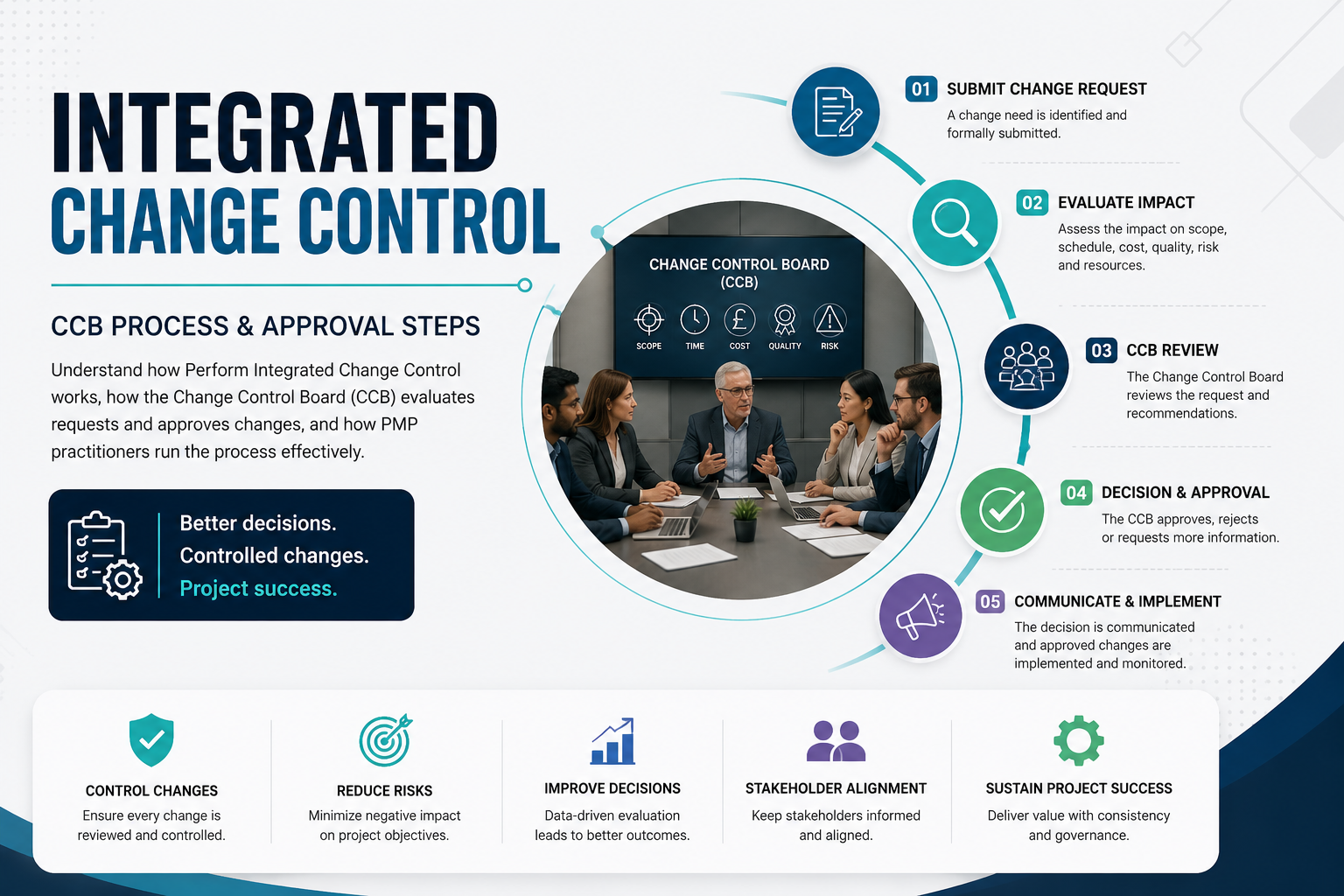
Perform Integrated Change Control is the PMBOK process of reviewing every change request against a project's approved baselines, deciding through a formally chartered Change Control Board whether to approve, reject or defer it, and then updating the project management plan and documents to reflect that decision. It exists to stop uncontrolled scope, schedule or cost changes, known as scope creep, from being made informally without anyone assessing their downstream impact first. For a broader look at building the change management plan this process runs against, Simpliaxis's guide to change control management and its steps covers the surrounding plan-level detail this article does not repeat.
Key Highlights: What Is Integrated Change Control?
- Perform Integrated Change Control sits inside the Project Integration Management knowledge area and the Monitoring and Controlling process group of the PMBOK Guide.
- A Change Control Board, or CCB, is a formally chartered group with defined authority to approve, reject or defer change requests based on documented impact analysis.
- Every change, no matter how small, should go through the documented change control process at the appropriate approval level; skipping the process for "minor" changes is one of the most common causes of scope creep.
- Contingency reserve funds changes tied to identified risks; management reserve funds genuinely unforeseen changes outside the risk register, and mixing the two up is a frequent, avoidable mistake.
- Integrated change control is distinct from configuration management: configuration management controls the product's technical baseline, while change control governs how project management plan changes are approved.
- AI-assisted tools can now draft an initial impact analysis for a change request in minutes rather than days, but the approve, reject or defer decision itself still requires a human CCB.
What Actually Happens During Perform Integrated Change Control?
Perform Integrated Change Control takes every submitted change request through four consistent stages: the request is logged, its impact is analysed against the current baselines, a decision-making authority approves, rejects or defers it, and the decision is documented and communicated back to every affected stakeholder. The process applies to change requests arising from anywhere in the project, whether a stakeholder asks for a new feature, a risk materialises and forces a schedule adjustment, or a defect requires a corrective action.
| Input | What it provides |
|---|---|
| Project management plan | The current approved scope, schedule and cost baselines the change is measured against |
| Project documents | Requirements traceability matrix and risk register, used to trace what the change actually affects |
| Work performance reports | Current status data that shows whether the project can realistically absorb the proposed change |
| Change requests | The specific requested modification, whether a corrective action, preventive action, defect repair or an update |
The output of the process is a change request marked approved, rejected or deferred, along with updates to the project management plan, the relevant project documents, and the approved change log, which becomes part of the project's permanent record for anyone auditing what changed and why. This consistency matters most on longer programmes: a project that is eighteen months in and has processed sixty change requests needs that log to be a reliable single source of truth, since reconstructing what changed and why from memory or scattered email threads becomes effectively impossible once a project reaches that scale.
How the Change Control Board Approval Process Actually Works
A Change Control Board reviews a change request in a fixed sequence: intake and logging, impact analysis across scope, schedule, cost, quality and risk, a formal decision, and then implementation and verification once approved. The specific composition of the CCB varies by organisation, but it is always formally chartered with documented authority, rather than an informal group that happens to weigh in on changes.
- Submit and log the request. The requester documents what is being asked for, why, and what happens if it is not approved. It receives a unique identifier in the change log the moment it is logged, regardless of what the board eventually decides.
- Analyse the impact. A designated analyst, often the project manager or a technical lead, assesses the effect on scope, schedule, cost, quality, resources and risk, and checks whether the cost impact fits inside the approved contingency reserve or would require drawing on management reserve instead.
- Present to the CCB. The analysis is presented with a clear recommendation, not just raw data, since a CCB meeting that receives unprocessed numbers without a recommendation tends to stall on inconclusive discussion. A well-prepared presentation states the requested change, its total cost and schedule impact, which reserve would fund it, and a specific recommendation to approve, reject or defer, leaving the board to interrogate the recommendation rather than build one from scratch in the meeting.
- Decide: approve, reject or defer. The board weighs necessity, benefit against cost, risk introduced, and organisational readiness to implement, then records the decision and its rationale.
- Update baselines and documents. An approved change triggers updates to every affected baseline and every project document that depended on the old baseline, including the schedule, cost baseline, requirements documentation and risk register.
- Communicate and implement. Every stakeholder affected by the change is notified of the decision, and the approved work is scheduled and executed like any other planned project work.
What Approval Thresholds Should a Change Control Plan Define?
A change control plan that never writes down clear approval thresholds tends to fail in one of two predictable ways: either every change, regardless of size, gets escalated to the full CCB, which turns the board into a bottleneck that teams quietly learn to route around, or nothing gets escalated and changes get absorbed informally, which is exactly the scope creep the process exists to prevent. A workable threshold table assigns approval authority by the size of the change's impact, so that only genuinely significant changes consume the full board's time.
| Change impact level | Typical approval authority | Example |
|---|---|---|
| Minor (no baseline impact) | Project manager, logged for visibility | Reordering two non-dependent tasks within the same sprint |
| Moderate (within contingency reserve) | Project manager with sponsor notification | A $15,000 cost increase covered entirely by contingency reserve already allocated to that risk |
| Major (exceeds contingency, needs management reserve) | Full Change Control Board | A vendor failure requiring an unbudgeted $80,000 and a two-week schedule extension |
| Strategic (changes project charter or scope baseline materially) | CCB plus sponsor or steering committee | Adding an entirely new deliverable not in the original charter |
Even changes that fall below the CCB threshold should still go through the documented change control process at the appropriate lower approval level, rather than being handled informally just because they are small; the point of the threshold table is to route decisions to the right authority, not to exempt small changes from the process entirely.
Integrated Change Control vs Configuration Management: What Is the Difference?
Integrated change control governs how changes to the project management plan and its baselines are approved; configuration management governs how the technical specifications and versions of the product itself are tracked and controlled. The two are closely related and often run through the same CCB, but they answer different questions: change control asks whether a proposed change should be approved at all, while configuration management asks which exact version of a specification, drawing or deliverable is the current, approved one once a change has already been accepted.
| Aspect | Integrated Change Control | Configuration Management |
|---|---|---|
| What it governs | Approval of changes to scope, schedule, cost and other plan baselines | Identification, versioning and control of the product's technical specifications |
| Core question | Should this change be approved? | Which version of this deliverable or specification is currently correct? |
| Typical output | An approved, rejected or deferred change request | An updated configuration baseline and version history |
How AI-Assisted Tools Are Changing Change Control
Current-generation project platforms can classify an incoming change request by likely severity and risk within seconds of submission, and can model the schedule and cost impact of a proposed change against the live project plan far faster than a manual analysis, in minutes rather than the days a manual cross-check against every dependent task used to take. This genuinely speeds up the analysis stage that used to be the slowest part of the process. What it does not do is make the approve, reject or defer decision itself: that call still requires weighing organisational priorities, stakeholder relationships and risk appetite that a model trained on historical change data cannot fully see. Trusting an AI-generated impact analysis without verifying its underlying data connections are current is a fast way to bring a confidently wrong number into a CCB meeting, since a stale schedule or cost feed produces plausible-looking output that is simply incorrect.
Common Mistakes in Integrated Change Control
- Allowing informal approval of "small" changes outside the documented process, which is the single most common cause of scope creep on real projects.
- Confusing contingency reserve with management reserve when funding an approved change, leading to reserve figures that do not reconcile at project close.
- Updating the schedule or cost baseline without updating every dependent document, such as the risk register or requirements traceability matrix, leaving the project's documentation internally inconsistent.
- Presenting a CCB with raw data and no recommendation, which slows decisions and pushes changes into an informal backlog while the board waits for someone to actually analyse the numbers.
- Treating configuration management and change control as the same process, which causes technical version-control questions to be routed to the wrong authority.
- Skipping communication of a rejected or deferred decision back to the original requester, which erodes trust in the process and quietly encourages people to route future requests informally instead.
- Trusting an AI-generated impact analysis without verifying the underlying schedule and cost data feeding it are current, producing a confidently wrong recommendation presented to the board.
Where This Shows Up on Real Programmes
The mechanics of change control are easy to describe; the judgement calls only become clear once real money and real schedules are on the line.
Illustrative scenario one: a stakeholder bypasses the process. A senior sponsor emails a project manager directly, asking for an additional integration to be added before the next release, framing it as urgent and non-negotiable. The correct response is not to quietly slot the work in, however senior the requester, but to log it as a formal change request and route it through the documented impact analysis, even if that means a short delay while the analysis is completed. When the analysis shows the integration would push the release date by three weeks and consume the entire remaining contingency reserve, the CCB has the data it needs to have an informed conversation with the sponsor about trade-offs, rather than discovering the impact only after the work has already started.
Illustrative scenario two: threshold table prevents a bottleneck. A construction programme with a well-defined approval threshold table lets its site supervisors approve minor sequencing changes on the spot, as long as they stay within an already-allocated contingency line and do not touch the critical path. Only changes exceeding that threshold, such as a design change from the client, are escalated to the full board. Over a twelve-month programme this keeps the CCB's meeting agenda focused on genuinely significant decisions instead of drowning in low-impact requests, while every change, large or small, still lands in the same documented change log for audit purposes.
Integrated Change Control on the PMP Exam
PMP scenario questions on this topic typically describe a change request arriving through an unusual channel, such as a stakeholder emailing the project manager directly, and ask what the project manager should do next; the correct answer is almost always to route it through the documented change control process rather than act on it unilaterally, even when the requester is senior or the change seems obviously beneficial. Integration Management, including this process, is one of the ten knowledge areas covered in PMI's current PMP Examination Content Outline, and candidates preparing through Simpliaxis's PMP certification training typically practise these process-flow questions alongside the exam's other integration-management processes.
Conclusion
Integrated change control exists because uncontrolled changes, made informally and without a documented impact analysis, are one of the most reliable ways a project drifts off its baseline without anyone noticing until it is too late. The mechanics are not complicated: log the request, analyse the impact against the current baselines, route it to the right approval authority based on its actual size, and update every document the decision touches. What separates a change control process that works from one that becomes a bottleneck or gets quietly bypassed is whether the approval thresholds are actually written down and whether every change, including the small ones, genuinely goes through them. For readers building this into a broader PMP exam preparation plan, reviewing the current PMP certification syllabus shows exactly where integration management processes like this one sit relative to the rest of the exam content, and a dedicated organisational change management course is worth pairing with this if your role also involves leading people through the change once it has been approved, not just approving it.






 Lowest-Price Challenge











 Personalized Path


.webp)


 USA
USA  Canada
 India
India UK
UK Australia
 Singapore


