


 Call Us



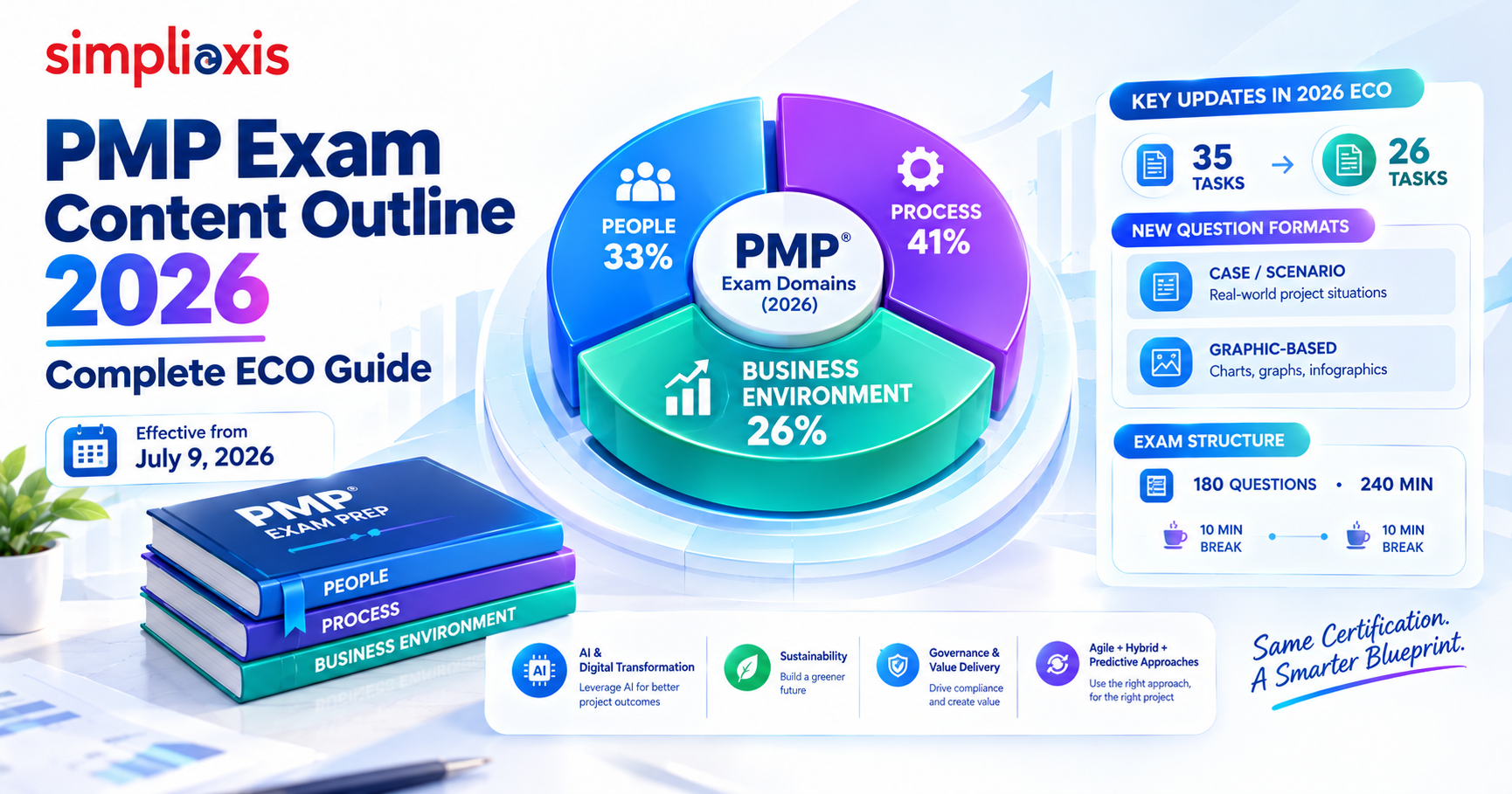
The PMP Exam Content Outline (ECO) is PMI's official blueprint for the PMP exam, and the version that took effect on 9 July 2026 rebalances the three domains so that People counts for 33%, Process for 41%, and Business Environment for 26%, up from just 8% previously. It also consolidates the task list from 35 to 26 tasks and introduces case study and graphic based questions alongside the existing formats. Candidates who started preparing before July 2026 need to check which outline their study material is built on, because the two versions test noticeably different things. Existing PMP holders are not affected and do not need to retake anything.
Key Highlights
- The 2026 PMP Exam Content Outline shifts domain weightings to People 33%, Process 41%, and Business Environment 26%, a near fourfold rise for Business Environment.
- The task list has been consolidated from 35 tasks to 26 tasks, with Tasks and Enablers redefined under each domain.
- Two new question formats, case or scenario sets and graphic based items, join the existing matching, drag and drop, and multiple response formats.
- The exam remains 180 questions across 240 minutes, but pretest items have doubled from 5 to 10, and two 10 minute breaks are built in.
- Roughly 40% of items reflect predictive approaches, with the remaining 60% split between agile and hybrid approaches.
- AI in project management, sustainability, and value delivery are now explicit, testable content areas within Business Environment.
- Current PMP certification holders are unaffected; the credential does not indicate which ECO version a candidate sat, and renewal continues through PMI's standard Continuing Certification Requirements programme.
What Is the PMP Exam Content Outline
The PMP Exam Content Outline is the document PMI publishes to define exactly what the PMP certification exam tests, how many questions come from each domain, and what a passing candidate is expected to be able to do on the job, not just recall from a textbook. PMI, the Project Management Institute, governs the ECO and updates it periodically through a Role Delineation Study, a research exercise in which PMI surveys thousands of practising project professionals about which tasks, knowledge areas, and behaviours are actually being used in current project environments. The resulting outline becomes the sole basis for exam questions; PMI is explicit that the exam assesses a candidate's ability to think critically and apply practices based on experience, rather than recite definitions from the PMBOK Guide.
The version effective from 9 July 2026 replaces the outline that had been in place since January 2021 and is published alongside the PMBOK Guide 8th edition. The official document, the 2026 PMP Examination Content Outline, is the primary source every training provider and candidate should be studying from once they start preparing for an exam date after that launch. If you booked your exam before July 2026 but sit it afterwards, you are tested against the new outline regardless of when you began studying, so checking your exam date against the launch date matters more than checking when you enrolled in a course.
The Role Delineation Study behind the 2026 revision is a formal, multi-stage research process. PMI convenes practitioner panels drawn from different industries and regions, surveys thousands of currently working project professionals about the tasks and knowledge they actually use, and then statistically validates the resulting task list before it is approved for exam use. This is different from how a university updates a syllabus; it is closer to a labour-market audit of what the job of "project professional" now requires, which is why the ECO carries weight with employers and not just with candidates. It also explains the timing: PMI does not revise the ECO on a fixed annual schedule but whenever the Role Delineation Study indicates the gap between the exam and current practice has grown wide enough to justify a rewrite, which is what happened as agile and hybrid delivery, AI-assisted work, and heightened governance expectations became mainstream between 2021 and 2026.
Domain Weightings: Before and After
The single biggest change is the redistribution of marks across the three domains that have anchored the PMP exam since 2021. Business Environment, previously a minor domain worth only 8% of the exam, or roughly 14 of the 180 questions, now accounts for 26%, or approximately 47 questions. People drops from 42% to 33%, and Process drops from 50% to 41%. Both People and Process remain the two largest domains, but Business Environment is no longer a domain candidates can treat as an afterthought.
| Domain | 2021 ECO Weight | 2026 ECO Weight | Approx. Questions (of 180) |
| People | 42% | 33% | ~59 |
| Process | 50% | 41% | ~74 |
| Business Environment | 8% | 26% | ~47 |
The practical effect is that questions on governance, compliance, regulatory factors, organisational strategy alignment, benefits realisation, and external market forces now appear far more often, and candidates who studied from pre-2026 materials will find this domain under-covered in older question banks.
Task and Enabler Restructuring
Underneath each domain, the ECO breaks work into Tasks, the responsibilities a project professional is expected to carry out, and Enablers, the concrete actions that demonstrate each task in practice. The 2026 outline consolidates the previous 35 tasks into 26, folding several overlapping People and Process tasks together and adding new tasks and enablers inside Business Environment that explicitly reference artificial intelligence in project delivery, sustainability considerations, and value delivery across the project life cycle. This is a structural simplification as much as a content expansion: fewer, broader tasks with enablers that map more directly to how predictive, agile, and hybrid approaches are actually blended on real projects.
Exam Format and Question Types
The overall exam length is unchanged at 180 questions in 240 minutes with two optional 10 minute breaks, but two things inside that structure have changed. First, pretest (unscored) items have doubled from 5 to 10, which PMI uses to trial future questions on live candidates without it affecting their score. Second, two new question formats have been added:
- Case or scenario sets: a multi-paragraph project scenario followed by three to five linked questions that test whether a candidate can follow the consequences of a decision across a connected situation, not just answer isolated recall items.
- Graphic based questions: a chart, network diagram, burndown chart, or stakeholder matrix is presented, and the candidate must interpret or act on it directly.
These join the existing formats already used since 2021, including multiple choice, multiple response, matching, drag and drop, and pull down list completion. The approach split has also been reaffirmed: roughly 40% of items assume a predictive delivery approach and the remaining 60% are split between agile and hybrid approaches, which lines up with how the core PMP certification requirements have consistently emphasised approach-agnostic project delivery rather than a single methodology.
What Has Not Changed
Eligibility requirements, the four year degree plus 36 months of project leadership experience (or high school diploma/associate degree plus 60 months), and the CAPM substitution options remain the same. The exam fee structure, the three attempt limit within the eligibility window, and the requirement to submit and, if audited, document your application through PMI's system are also unchanged. Candidates already holding a PMP certification retain it unaffected and continue renewal through the standard 60 PDU, three year Continuing Certification Requirements cycle.
Transition Guidance for Candidates Mid-Preparation
Candidates who were already partway through a study plan when the July 2026 cut over happened are not starting from zero. The underlying project management knowledge, stakeholder engagement, team leadership, scheduling, cost control, risk management, and quality practices, has not been rewritten; what has changed is the emphasis and the framing of certain topics, plus the addition of Business Environment content that many older courses covered only briefly. The most efficient path is a gap analysis rather than a restart: compare your existing course syllabus or book's table of contents against the current task list, mark which enablers are missing or thin, and focus new study time there. For most candidates this concentrates additional effort on governance, compliance, benefits realisation, and AI-related enablers within Business Environment, while People and Process study largely continues as planned.
2021 ECO vs 2026 ECO Comparison
| Feature | 2021 Exam Content Outline | 2026 Exam Content Outline |
| Domain weights | People 42%, Process 50%, Business Environment 8% | People 33%, Process 41%, Business Environment 26% |
| Total tasks | 35 tasks | 26 consolidated tasks |
| Question formats | Multiple choice, multiple response, matching, drag and drop, pull down list | All prior formats plus case/scenario sets and graphic based items |
| Pretest items | 5 of 180 | 10 of 180 |
| AI and sustainability coverage | Referenced only indirectly | Explicit, testable enablers within Business Environment |
| Predictive vs agile/hybrid split | Approximately 50/50 | Approximately 40% predictive, 60% agile/hybrid |
The comparison shows the shift is not cosmetic. A candidate who only reviews an older PMP practice exam question bank built for the 2021 outline is, in effect, studying a different exam in the Business Environment domain, even though the People and Process material overlaps far more closely between the two versions.
Why This Matters for Your PMP Career
For working project professionals, the practical value of understanding the ECO update goes beyond passing an exam. Employers increasingly expect certified project managers to speak credibly about governance, regulatory exposure, benefits realisation, and how AI tools are changing delivery work, all areas the 2026 Business Environment domain now tests directly. A candidate who prepares against the current outline is, by definition, being assessed on the same organisational and strategic competencies that hiring managers are already asking about in interviews. This also strengthens the long-term value of the credential itself: because PMI periodically re-anchors the ECO to a fresh Role Delineation Study of practising professionals, the PMP stays aligned to what organisations currently need from a project leader rather than to a fixed syllabus from years earlier. For professionals weighing the certification investment, this recurring realignment is part of why the PMP has retained its standing relative to newer, narrower credentials, and it is a point worth understanding fully via a broader PMP exam preparation strategy rather than a single-pass memorisation effort.
Where Candidates Get Caught Off Guard
- Studying from a pre-2026 question bank or an older edition of prep material without checking which ECO version it is built on.
- Assuming Business Environment is a minor domain because it was worth only 8% under the old outline; at 26% it can now decide a marginal pass or fail.
- Ignoring the new case/scenario and graphic based question formats during practice, then encountering them unprepared on exam day.
- Confusing "PMBOK Guide 8th edition" content with "exam content outline" content; the ECO, not the PMBOK Guide narrative, is what the exam is built from.
- Booking an exam date without confirming which outline version applies, particularly for candidates who started preparing before the July 2026 cut over.
- Overlooking that eligibility requirements and PDU renewal rules did not change, and wrongly assuming the whole certification pathway needs to be restarted.
- Treating the increased pretest item count as a sign the exam has become longer or harder overall, when in fact total scored questions and total time are unchanged.
- Relying solely on flashcard style recall drills, which suit the older, more definition-heavy question style less well than the case/scenario format now weighted more heavily in the outline.
Why PMOs Are Already Auditing Their Training Vendors
PMI's periodic ECO updates are themselves a product of employer and industry input, since the Role Delineation Study behind each revision surveys practising project professionals and their organisations directly. That gives the 2026 outline a level of employer buy-in that a purely academic syllabus update would not have. Large enterprises running PMO functions typically track ECO changes closely because they influence internal competency frameworks, internal certification sponsorship policies, and how project management career ladders are defined. Training providers that hold PMI Authorized Training Partner status, such as Simpliaxis, are required to update their curricula to the current ECO promptly. Simpliaxis's own PMP Certification Training is refreshed to match each new outline as soon as PMI publishes it, which is one practical way enterprise learning and development teams verify that a vendor's PMP offering is current before sponsoring staff through it.
Building a Study Plan Around the New Weightings
In practice, candidates are handling the transition in a few consistent ways. Someone midway through a study plan built around older material typically does a gap analysis rather than a restart, cross-checking their existing course or book against the current task list and adding targeted study specifically where Business Environment coverage is thin. PMO directors evaluating training vendors for a cohort of candidates increasingly use the published 2026 task list as a screening checklist, ruling out providers still teaching to the 2021 outline before sponsoring anyone through their programme. And candidates whose employer-run internal training predates the update are finding that material now leaves a meaningful share of the exam under-covered, which is prompting many to supplement specifically on governance, compliance, and AI-related enablers before booking an exam date.
- Confirm your intended exam date and check whether it falls before or after 9 July 2026, since that determines which ECO version applies to you.
- Download and read the official PMI PMP certification page and the current ECO document to see the domain weights and task list firsthand.
- Audit your existing study materials, including books, video courses, and practice question banks, against the 2026 task list, paying particular attention to Business Environment coverage.
- Enrol in a training programme built for the current outline, such as Simpliaxis's PMP Prep Online Course, rather than assuming any current-year label on a course means it is actually compliant.
- Build a study plan that reflects the new weightings proportionally, allocating meaningfully more time to Business Environment than a 2021-era plan would have.
- Practise with case/scenario sets and graphic based questions specifically, since these formats reward familiarity with the question style as much as subject knowledge.
- Submit your PMI application, gather your project experience documentation in case of audit, and schedule your exam once your practice scores are consistently at or above the passing threshold across all three domains.
Conclusion
The 2026 PMP Exam Content Outline is the most significant rebalancing of the exam since the 2021 shift to a three-domain structure, and the headline change, Business Environment moving from 8% to 26%, has knock-on effects for task structure, question formats, and study planning. None of this affects professionals who already hold the PMP, and the eligibility and renewal rules underneath the exam remain the same. For anyone preparing now, the practical priority is straightforward: confirm which outline applies to your exam date, and make sure your study plan, practice questions, and training provider are all aligned to the current 2026 version rather than material built for the outline it replaced.
Key Takeaways
- Business Environment jumps from 8% to 26% of the exam, the single largest structural change in the 2026 ECO.
- The task list is consolidated from 35 to 26 tasks, with new AI, sustainability, and value delivery enablers added under Business Environment.
- Case/scenario sets and graphic based questions are new formats; total questions, time, and break structure are otherwise unchanged.
- Existing PMP holders are unaffected and do not need to retake anything; eligibility and PDU renewal rules are unchanged.
- Candidates mid-preparation should run a gap analysis against the current task list rather than restarting from scratch.
- Training providers and PMOs are already screening for ECO-aligned material, since a 2021-era course now under-covers roughly a quarter of the exam.





 Lowest-Price Challenge











 Personalized Path


.webp)


 USA
USA  Canada
 India
India UK
UK Australia
 Singapore


