


 Call Us



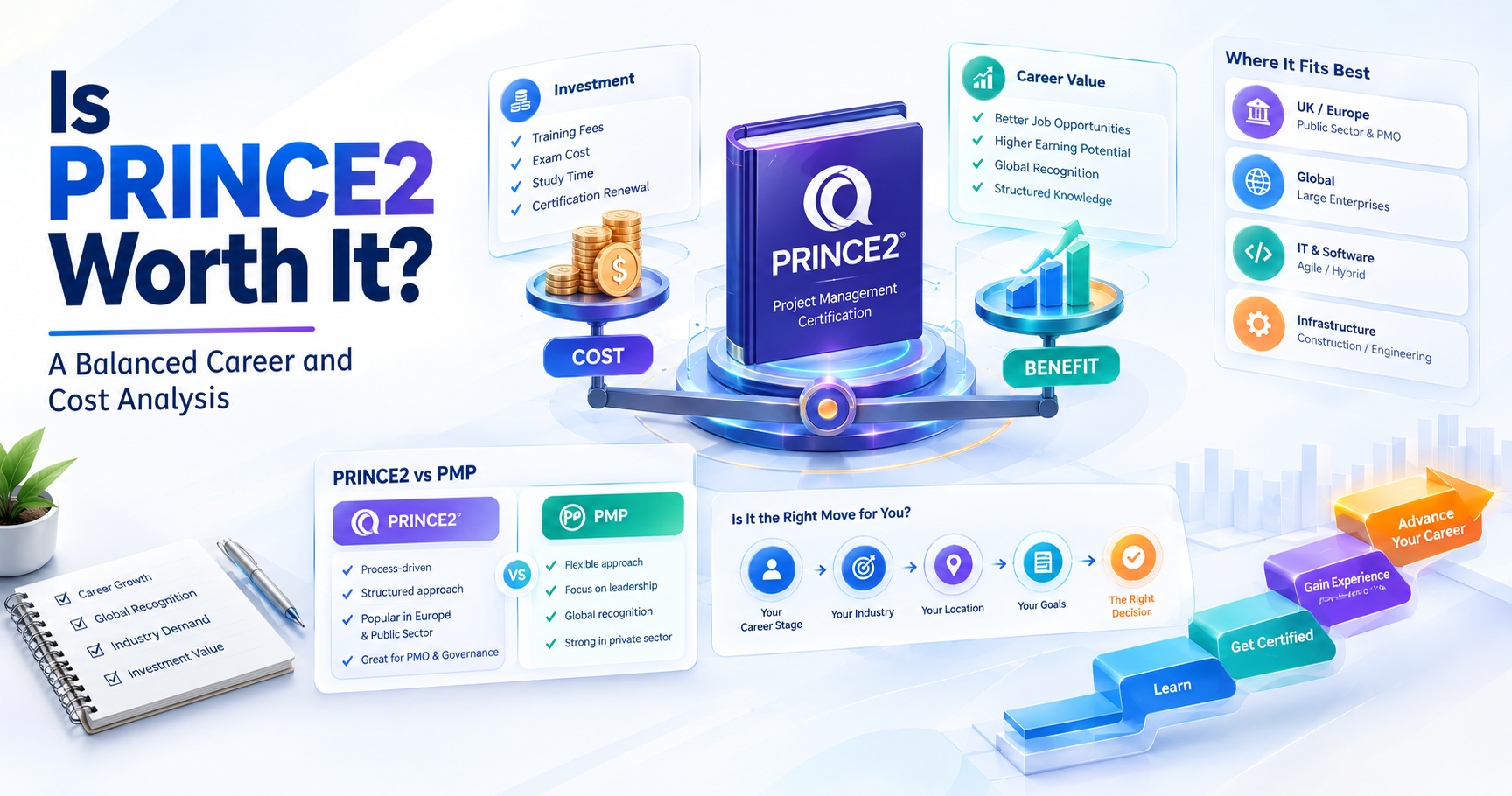
PRINCE2 is worth it if you work in or want to work in UK, European, or public-sector project environments, PMO roles, or government-adjacent delivery, where it is often a stated or preferred requirement. It is less valuable on its own for agile-native software teams or US private-sector roles, where PMP or a Scrum credential often carries more weight. For most mid-career project professionals outside those niches, the honest answer is "it depends on where you work and what you already know," not a flat yes or no.
Key Highlights: Is PRINCE2 Worth It?
- PRINCE2 carries the most practical weight in UK and European project environments, especially government, public sector, NHS, defence, and large PMO settings where governance frameworks are often built around it.
- Advertised salaries for PRINCE2 Practitioner-related UK roles have grown faster than the general project management market in the past year, according to IT Jobs Watch data, though PRINCE2 accounts for a modest and declining share of total UK IT job postings.
- PMP remains the stronger default in North America, the Middle East, and multinational private-sector roles, so the "worth it" calculation depends heavily on your target geography and industry.
- Pure software or agile-only shops that never touch formal stage-gate governance get limited direct return from PRINCE2 alone, though PRINCE2 Agile can bridge that gap for hybrid teams.
- The certification's real payoff usually shows up as eligibility (being shortlisted for PMO, gov-framework, or PRINCE2-mandated roles) rather than a guaranteed raise or promotion.
- Choosing the right level (Foundation, Practitioner, or an Agile variant) matters more than simply "getting PRINCE2" for maximizing return on the time and cost invested.
"Is PRINCE2 worth it?" is one of those questions that gets a different honest answer depending on who is asking. A project coordinator in a UK local authority, a delivery lead bidding on central government contracts, and a product manager at a US software startup are effectively asking three different questions, even though they are typing the same search term.
This article tries to answer all three, without pretending PRINCE2 is either a magic career unlock or a waste of time. PRINCE2 (PRojects IN Controlled Environments) is a structured, process-based project management method owned by AXELOS and examined globally through PeopleCert. It has genuine, well-documented traction in specific markets and sectors, and comparatively little traction in others. The goal here is to help you work out which side of that line you sit on, using real market data rather than marketing claims, before you commit time and money to a course. If you want the fundamentals first, Simpliaxis's overview of what PRINCE2 certification is and how it's beneficial is a useful companion read.
We will look at who PRINCE2 is worth it for by industry, region, and role, where it falls short, how the cost stacks up against the realistic benefit, how it compares to PMP for career purposes, and what a sensible decision process looks like if you are still on the fence.
Who PRINCE2 Is Genuinely Worth It For
By Industry and Sector
PRINCE2's clearest, most consistently reported value sits in a specific cluster of sectors:
UK central and local government. Many public-sector portfolio and programme offices built their governance structures, stage-gate reviews, and reporting templates directly around PRINCE2 terminology (Project Board, Highlight Reports, Exception Reports, and so on). Job postings for Project Manager, Programme Manager, Project Support Officer, and PMO Analyst roles in this space frequently list PRINCE2 Foundation or Practitioner as a minimum or strongly preferred qualification.
NHS and public health bodies. NHS trusts and commissioning groups commonly run capital and digital transformation projects under PRINCE2-aligned governance, particularly for larger, multi-stakeholder initiatives that need formal board-level sign-off at defined stages.
Defence and large infrastructure contractors. Defence procurement and major infrastructure programmes in the UK often specify PRINCE2 (sometimes alongside APM qualifications) because of the audit trail and formal control points it provides for large, publicly funded spend.
Large PMOs and consultancies with UK/European client bases. Consulting and outsourcing firms that deliver into the above sectors need a bench of PRINCE2-qualified staff simply to be eligible to bid on certain frameworks and tenders, regardless of whether every individual project manager personally prefers the methodology.
Construction, engineering, and utilities. These industries favour PRINCE2's stage-gate discipline because projects are capital-intensive, have long lead times, and need clear, auditable decision points before funding is released for the next phase.
By Region
Geography matters more for PRINCE2 than most certifications. It is most recognised and most frequently requested in the United Kingdom, Ireland, and much of Europe, and it has meaningful (if smaller) recognition in Australia, New Zealand, and parts of Asia where UK-influenced public-sector practice has spread. In North America, the Middle East, and most US-headquartered multinationals, PMP is the default reference point, and PRINCE2 is comparatively rare outside a handful of UK-linked subsidiaries or government-adjacent contracts.
If your career is anchored in the UK or Europe, or you are actively targeting government, NHS, or public-sector-adjacent work, this alone is a strong argument in PRINCE2's favour. If your career is anchored in the US, Canada, or the Gulf, the calculation tilts the other way (more on this in the PRINCE2 vs PMP section below).
By Role and Career Stage
PRINCE2 is not a single credential; it is a tiered qualification, and "worth it" depends on which tier matches your role.
Team members, coordinators, and business analysts who need to understand how a PRINCE2 project is structured, without personally running one, generally get sufficient value from the PRINCE2 Foundation Certification Training. It gives you the shared vocabulary and process awareness to work effectively inside a PRINCE2-governed project without the deeper practitioner-level assessment workload.
Project managers, senior project managers, and PMO leads who will actually run or govern PRINCE2 projects, tailor the method to a specific project, and make stage-boundary decisions typically need the deeper, scenario-based PRINCE2 Practitioner Certification Training. This is the level employers usually mean when a job advert says "PRINCE2 qualified" for a PM role, and it is the level most closely tied to the stronger salary data discussed later in this article.
Professionals who want to move straight to full competency without two separate enrollment cycles often choose the combined PRINCE2 Foundation & Practitioner Certification Training, which is worth considering if you already know you need Practitioner-level capability and want to avoid a gap between the two exams.
When PRINCE2 Is Less Useful
It is just as important to be honest about where PRINCE2 adds little direct value.
Pure software or agile-native organisations. If your organisation runs entirely on Scrum, Kanban, or a similar lightweight framework, with no stage-gate governance, no formal business case reviews, and no PRINCE2-influenced client or funder, a standalone PRINCE2 certificate will not map cleanly onto your daily work. The vocabulary (Project Board, Exception Plan, Product Description) simply will not come up.
Early-career roles in US private-sector tech. If you are building a career purely in US-based product or software delivery, PMP (or a Scrum-focused credential like CSM or PSM) is far more likely to be recognised by hiring managers than PRINCE2, because PRINCE2 has limited market penetration in that specific segment.
Startups and small, informal teams. Very small organisations rarely have the governance overhead, multiple stakeholder layers, or funding-gate structure that PRINCE2 is designed to control. In that context, the certification is more of a personal credibility signal than an operational fit.
If you sit in one of these categories but still want the credibility of a recognised, structured method while keeping agile ways of working, look at PRINCE2 Agile rather than classic PRINCE2. It was built specifically to bridge PRINCE2 governance with agile delivery, through the PRINCE2 Agile Foundation Certification Training and PRINCE2 Agile Practitioner Certification Training, or the combined PRINCE2 Agile Foundation & Practitioner Certification Training if you want both levels in one structured path. This is often the more honest "worth it" answer for hybrid teams that need governance credibility without abandoning agile practice.
Cost vs Benefit: What You Are Actually Weighing
The realistic cost of PRINCE2 certification is not just the exam fee. It includes course fees (which vary by provider, format, and level, and change over time, so check current pricing directly on the relevant Simpliaxis programme page rather than relying on a fixed figure here), study time, time away from billable or project work if you attend during working hours, and, for Practitioner, a more demanding scenario-based exam that requires real preparation rather than memorisation.
The realistic benefit is not a guaranteed raise. It is better understood as a set of probabilities:
- Increased eligibility. You become shortlist-eligible for roles, tenders, and frameworks that explicitly require PRINCE2, which you were not eligible for before.
- Faster onboarding into PRINCE2-governed environments. You spend less time confused by unfamiliar terminology and more time contributing, which matters if you are moving into a public-sector or PMO role from a different background.
- A credible, portable data point on your CV, particularly in UK/European hiring, where recruiters and applicant tracking systems commonly filter on named certifications.
- A structured foundation you can build on, especially if paired with practical delivery experience rather than treated as a substitute for it.
What it will not reliably do is guarantee employment, a specific salary increase, or an automatic promotion. Certifications open doors; they do not walk you through them. Treat any provider claim promising a guaranteed outcome with scepticism, including, honestly, some of the more optimistic marketing copy you will find across the training industry.
On the salary question specifically, the most useful available data comes from UK job-market tracking rather than certification-body marketing. According to the Association for Project Management's Salary and Market Trends Survey 2025 (published 19 May 2025, based on a YouGov survey of more than 3,800 UK project professionals), the average UK project manager salary rose to £52,500 in 2025, up around 10% from £47,500 in 2023. That figure covers the profession broadly and is not broken out by certification, so it should be read as market context rather than a PRINCE2-specific number.
For a more certification-specific signal, IT Jobs Watch (UK job-advert data, six months to 7 September 2026) showed a median advertised salary of £70,000 for roles mentioning "PRINCE2 Practitioner," up 13.82% year on year from £61,500 the previous year. Roles mentioning "PRINCE2" more broadly (not specifically Practitioner) showed a median of £60,000 across 877 permanent vacancies, down 4% year on year, and representing roughly 0.78% of all UK permanent IT vacancies tracked by the site. That second figure is a useful reality check: PRINCE2 mentions are a real but modest slice of the overall UK IT job market, concentrated in the sectors described above rather than spread evenly across every project role.
These are advertised job-posting figures, not a promise of individual earnings, and they will move over time. Treat them as directional evidence that PRINCE2 Practitioner specifically carries real market weight in the UK, rather than as a number you should quote back in a salary negotiation.
PRINCE2 vs PMP for Career Purposes
This is not a "PRINCE2 is better" or "PMP is better" argument. Both are well-established, and the honest answer is that they suit different markets and different working styles.
PMP, administered by the Project Management Institute, is a knowledge-based, methodology-agnostic credential that tests your ability to apply project management principles across predictive, agile, and hybrid approaches. It has strong global recognition, particularly in North America, the Middle East, and multinational private-sector organisations, and requires ongoing professional development units (PDUs) to maintain.
PRINCE2, examined via PeopleCert on behalf of AXELOS, is a prescriptive, process-based method with defined roles, themes, and stages. It has strong recognition in the UK, Ireland, and much of Europe, particularly in government, public sector, and large-PMO contexts, and (unlike PMP) does not require ongoing PDUs to keep the qualification technically valid, though the Practitioner-level certificate itself has a validity period before re-registration or re-certification is needed.
| Criterion | PRINCE2 | PMP |
| Strongest regional recognition | UK, Ireland, Europe, parts of Australia/Asia | North America, Middle East, global multinationals |
| Governing body | AXELOS (owner), examined via PeopleCert | Project Management Institute (PMI) |
| Framework style | Prescriptive, process-based (defined stages, roles, themes) | Descriptive, principles-based, methodology-agnostic |
| Typical prerequisites | Foundation: none required. Practitioner: Foundation or equivalent | Degree plus verified project-management experience hours, or high-school diploma plus more experience hours |
| Recertification /upkeep | No PDUs required; Practitioner has a validity period | Requires 60 PDUs every 3 years |
| Best-fit environment | Government, PMO, regulated, stage-gate-governed projects | Broad range including private sector, agile-hybrid, and international programmes |
| UK advertised salary signal (2026, IT Jobs Watch) | ~£70,000 median for "PRINCE2 Practitioner" postings | ~£67,500 median for "PMP" postings |
Neither certification "beats" the other in absolute terms. If your target employer, sector, or country is one where PRINCE2 is the named standard, holding PMP instead does not help you the way you would hope, and vice versa. Some experienced project professionals in the UK end up holding both, precisely because it lets them bid on both PRINCE2-mandated and PMP-mandated work without being excluded by an ATS keyword filter. For a deeper side-by-side on requirements, exam structure, and prerequisites, see Simpliaxis's dedicated comparison, Decoding PRINCE2 vs PMP: Choosing the Right Project Management Certification.
What "Worth It" Looks Like in Practice
Stripped of marketing language, PRINCE2 tends to pay off in a few concrete, observable ways rather than as a vague career boost:
Bid and tender eligibility. Consultancies and delivery partners bidding on UK government or NHS frameworks often need a minimum bench of PRINCE2-qualified staff to even qualify to bid. If you hold the certification, you become part of that eligible bench; if you do not, you may be excluded from those opportunities entirely, regardless of your actual delivery skill.
Passing the initial CV/ATS filter. Many UK and European recruiters and applicant tracking systems filter specifically on "PRINCE2 Foundation" or "PRINCE2 Practitioner" as a keyword for PM and PMO roles. Not holding it can mean your application never reaches a human reviewer for those specific roles, even if your experience is strong.
Internal move into governance or PMO-adjacent roles. Team members who complete Foundation often find it easier to move into project support, PMO analyst, or junior PM roles inside PRINCE2-governed organisations, because they can already speak the process language the organisation runs on.
Formal eligibility for Practitioner-level PM roles. Practitioner is frequently the named minimum for "Project Manager" postings inside PRINCE2-shops, so completing it can move you from "supporting" project work to formally leading it, subject to your employer's own promotion process and business need.
None of this is a guarantee. A certification changes what you are eligible for; it does not override a hiring manager's judgement about your experience, your interview performance, or your organisation's specific promotion criteria. Anyone promising a guaranteed pay rise or job offer in exchange for a certificate is overselling it.
Practical Guidance: A Simple Decision Framework
Use this checklist to decide whether PRINCE2 is worth pursuing for your specific situation, rather than relying on a generic yes or no.
| Question | If yes | If no |
| Do you work in, or want to work in, UK/European government, NHS, defence, or large PMO environments? | PRINCE2 is likely worth it; start with the level matching your role | Weigh PMP or a hybrid approach more heavily |
| Does your target employer's job postings name PRINCE2 Foundation or Practitioner as a requirement? | Strong signal to pursue the named level directly | Check whether PMP or an agile credential is named instead |
| Is your organisation's delivery model mostly agile/Scrum with no stage-gate governance? | Consider PRINCE2 Agile instead of classic PRINCE2 | Classic PRINCE2 is a more natural fit |
| Are you a team member/coordinator rather than someone who will run project stage boundaries? | Foundation is likely sufficient for now | Practitioner is the more relevant target |
| Will you personally lead or govern PRINCE2 projects, tailor the method, or sit on a Project Board? | Practitioner is the appropriate target level | Foundation may be enough until your role changes |
| Does your organisation fund or reimburse the training, or can you access team/corporate training rates? | Cost-benefit improves significantly; check corporate training options | Weigh the personal cost against realistic near-term eligibility gains |
| Are you also targeting non-UK/European, non-government roles where PMP dominates? | Consider holding both certifications over time | PRINCE2 alone may be sufficient |
If most of your answers point toward government, PMO, UK/European, or stage-gate-governed work, PRINCE2 is very likely worth it, and the remaining question is simply which level to start with. If most answers point toward agile-native, US-centric, or small-team environments, the certification is not without value, but it is not the highest-leverage option available to you, and PMP or PRINCE2 Agile deserve equal consideration.
Simpliaxis Training Relevance
Which PRINCE2 path makes sense depends on where you are in your career, not just whether PRINCE2 "is worth it" in the abstract.
If you are a team member, business analyst, or project coordinator who needs to understand PRINCE2-governed projects without running them yourself, the PRINCE2 Foundation Certification Training gives you the process vocabulary and structural understanding to contribute effectively from day one, at a lower time and cost commitment than Practitioner.
If you are already managing projects, or are being considered for a PM role inside a PRINCE2-governed organisation, the PRINCE2 Practitioner Certification Training is the level most job postings actually mean when they say "PRINCE2 qualified," and it is the level most closely associated with the stronger salary data discussed above. If you already know you will need both levels, the combined PRINCE2 Foundation & Practitioner Certification Training can be a more time-efficient route than two separate enrollments.
If your organisation runs agile or hybrid delivery and you need governance credibility without giving up iterative ways of working, look at the PRINCE2 Agile Foundation Certification Training and PRINCE2 Agile Practitioner Certification Training, or the combined PRINCE2 Agile Foundation & Practitioner Certification Training if you want to cover both levels in one structured plan. This path tends to be the more honest fit for teams that sit between classic PRINCE2 environments and pure agile shops.
If you are responsible for upskilling a whole project or PMO team rather than a single individual, it is worth comparing cohort options through Simpliaxis's corporate and group training programmes, which can also make the cost-benefit calculation in the checklist above considerably more favourable, since shared training costs and consistent internal terminology tend to compound in value across a team rather than a single learner.
Conclusion
"Is PRINCE2 worth it?" does not have one universal answer, and anyone telling you it does is simplifying past the point of usefulness. The honest, evidence-based version is this: PRINCE2 is worth it if you work in or are targeting UK or European government, public sector, NHS, defence, or large PMO environments, where it is frequently a named requirement and where advertised salaries for Practitioner-level roles have shown real growth. It is a weaker standalone choice for agile-native software teams, US-centric private-sector careers, or very small, informal organisations, where PMP or a PRINCE2 Agile variant is often the better-fitting option.
Rather than asking "is PRINCE2 worth it" in the abstract, it is more useful to ask "is PRINCE2 worth it for my sector, my region, and my current role." Use the decision checklist above to work through that question for your own situation, and choose the certification level, Foundation, Practitioner, or an Agile variant, that actually matches what you do day to day, rather than defaulting to the most commonly advertised option. Simpliaxis's guide to understanding PRINCE2 certification levels and its piece on the importance of PRINCE2 Foundation certification are both useful next reads if you are still narrowing down which level fits you.
Ready to Compare Your Options?
If you are still weighing Foundation against Practitioner, or wondering whether an Agile variant fits your team better than classic PRINCE2, compare the PRINCE2 certification levels side by side before enrolling, starting with the PRINCE2 Foundation Certification Training or PRINCE2 Practitioner Certification Training pages for full syllabus and eligibility details, or the corporate and group training page if you are planning this for a whole team rather than a single learner.





 Lowest-Price Challenge











 Personalized Path


.webp)


 USA
USA  Canada
 India
India UK
UK Australia
 Singapore


