


 Call Us



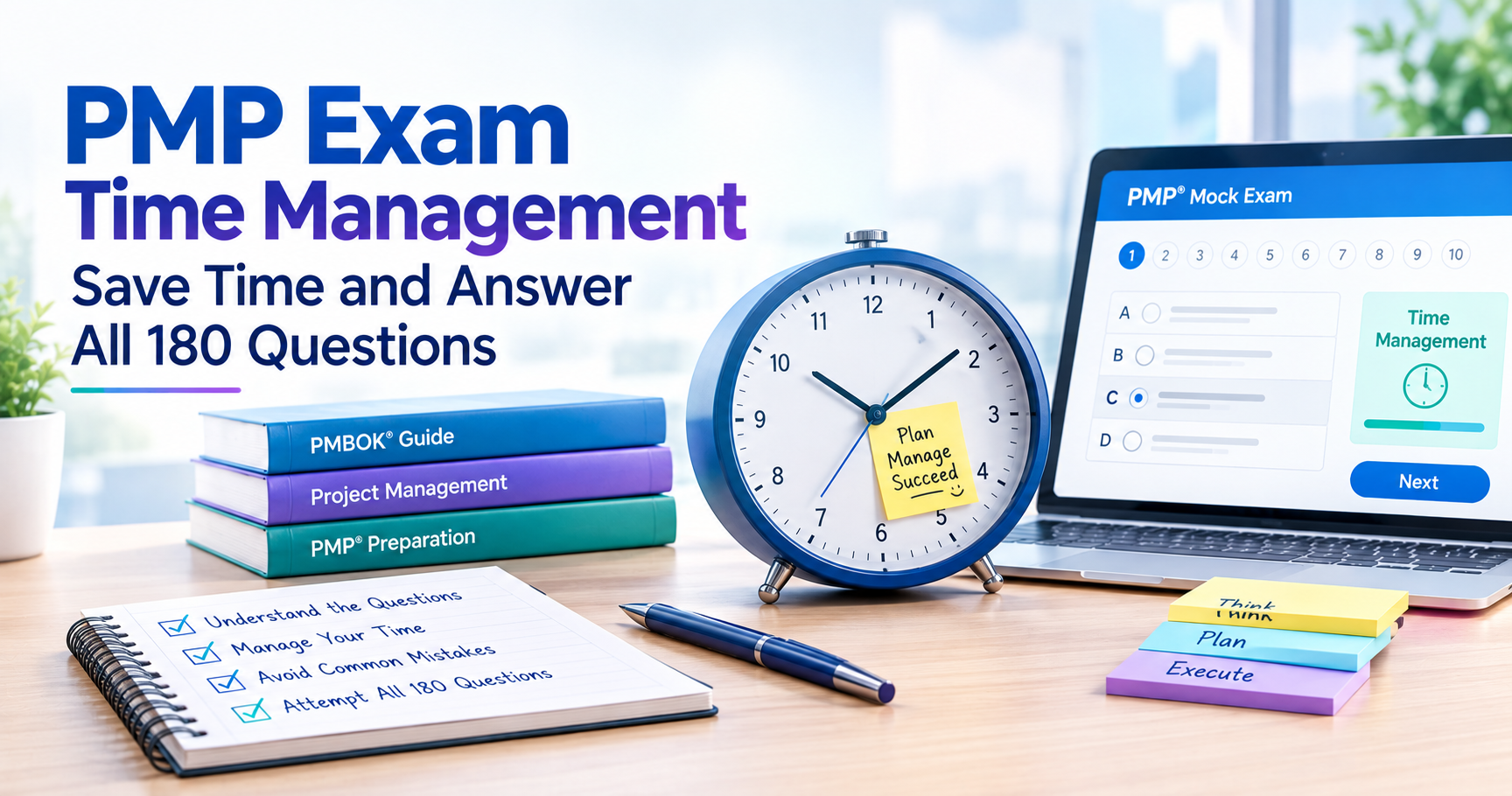
You have 240 minutes to answer 180 questions (170 scored and 10 unscored or pretest questions). This means you have about 80 seconds per question. PMP exam is divided into a case-study section and an independent question section, and you get two 10-minute breaks.
To help you with time management during the PMP exam, you should use checkpoints instead of checking the clock after each question. You should check your performance at natural intervals, and if you are not sure of any question, mark it instead of worrying about it. Be careful about how you plan each break because you cannot go back to a section once you have moved on.
Key Highlights of PMP Exam Time Management:
- 240 minutes for 180 questions (170 scored and 10 unscored pretest). Average of about 80 seconds per question.
- Two mandatory 10-minute breaks: after the case-study section, and roughly midway through the independent-question portion.
- Once you start a break, you cannot return to the previous section's questions, making pre-break review critical.
- The exam's new case-study format (one detailed scenario feeding several linked questions) changes pacing math compared to the older, uniform question-by-question structure.
- Checkpoint-based pacing, checking progress at set intervals rather than per question, is more reliable than moment-to-moment clock-watching.
- Flagging and moving on, rather than stalling on a difficult question, is the single most effective real-time pacing tool available during the exam.
Running out of time on the PMP exam is one of the most common, and most preventable, reasons candidates underperform relative to their actual knowledge. It's also one of the few failure causes that has nothing to do with how well you know project management and everything to do with how well you manage a specific, mechanical constraint: four hours, 180 questions, and a structure that's genuinely different from most other certification exams you may have taken.
This article breaks down exactly how much time you have, how the exam's structure affects your pacing, and a concrete, checkpoint-based method for managing that time in real time on exam day, not just generic advice to "budget your time wisely." If you've already sat the exam once and suspect pacing, rather than content, was your real problem, the sections below are written specifically to help you confirm or rule that out before your next attempt.
How Long Is the PMP Exam, Exactly?
As of the July 2026 update, the PMP exam gives you 240 minutes (four hours) to answer 180 total questions, 170 of which are scored and 10 of which are unscored pretest items used to validate future exam content. Since you cannot identify which questions are unscored, the practical approach is to treat every single question with equal seriousness. On average, that works out to roughly 80 seconds per question, though your actual pacing needs to vary by question type and complexity rather than aiming for a rigid 80-second cutoff on every item.
Why Time Management Matters More on the PMP Exam Than Most Certifications?
Part of what makes PMP pacing genuinely tricky, compared to shorter or more straightforward certification exams, is the combination of exam length and question complexity. A four-hour exam already tests sustained focus in a way a one-hour exam doesn't. Layer on top of that the fact that PMP questions are scenario-based rather than simple recall, meaning even a question you fundamentally know the answer to can take real time to read and interpret correctly, and pacing becomes a skill in its own right, not just a side effect of knowing the material well.
PMP Pass Rate notes that poor time management is frequently cited as a leading cause of underperformance on this exam specifically, distinct from a knowledge gap. That distinction matters for how you prepare: if pacing is genuinely your weak point, more content review won't fix it; only deliberate, timed practice will.
PMP Exam Time Management Starts With Understanding the Exam's Structure
The Two-Section Format
The current exam opens with a dedicated case-study section, a new format introduced in the July 2026 update, where you're presented with a detailed scenario, sometimes including charts, graphs, or other visual data, and then answer a series of linked questions based on that single scenario. After completing the case-study section, the exam moves into an independent-question portion covering the remaining content.
This structural change matters for pacing specifically because a case-study cluster front-loads your reading time into one detailed scenario, then lets you move relatively quickly through the several questions tied to it. If you pace yourself as though every question requires the same fresh-scenario reading time as an independent question, you'll likely misjudge your available time in the case-study section.
A practical way to think about this: your first read of a case-study scenario is the expensive part, since you need to absorb the business context, the stakeholders involved, and any accompanying data before you can answer confidently. Each subsequent question tied to that same scenario should take noticeably less time than a fresh independent question, since you're applying context you've already built rather than starting from zero. If a case-study question is taking as long as your first read of the scenario itself, that's usually a sign you're re-reading the whole scenario instead of referring back to the specific detail the question is asking about.
The Two Mandatory Breaks
There are two 10-minute breaks built into the exam. The first occurs after you complete the case-study section, and the second occurs approximately midway through the independent-question portion. Both breaks are optional in the sense that you don't have to use the full 10 minutes, but the section boundary itself is not optional: once you review your responses and begin a break, you cannot return to the questions from the section you just completed.
This is the single most important mechanical fact for pacing purposes. It means your review process for a section needs to be complete before you start that section's break, not something you plan to circle back to "after a quick breather."
What PMI Has (and Hasn't) Published About Section-Level Timing?
It's worth being precise here, since several competing articles present invented specifics as fact. PMI's official July 2026 Examination Content Outline confirms the total exam time (240 minutes), the total question count (180, with 170 scored and 10 pretest), and the two break points (after the case-study section, and roughly midway through the independent questions). What PMI has not published is an exact question count or time allocation for the case-study section specifically versus the independent-question portion.
That means any article citing a precise number of case-study questions or an exact minute count for that section specifically is going beyond what PMI has confirmed. This article's pacing guidance, below, is built entirely around the numbers PMI has actually published, plus the two confirmed break points, rather than an invented section-by-section breakdown.
The Checkpoint Pacing Method
Rather than watching the clock after every single question, which tends to increase anxiety without improving decisions, a checkpoint-based approach works more reliably in practice.
- Set three or four checkpoints across the exam, roughly evenly spaced by question number rather than by section, since section lengths aren't precisely published. For example, checking your progress after questions 45, 90, and 135 gives you three evenly spaced readings across the 180-question exam.
- At each checkpoint, compare your question number to your elapsed time. If you're at question 90 and roughly half your time has elapsed, you're on pace. If significantly more than half your time is gone, you're behind and need to adjust immediately, not at the next checkpoint.
- When you're behind pace, speed up on remaining straightforward questions rather than trying to claw back time on one difficult question. A single hard question is rarely worth sacrificing your pace on five easier ones later in the exam.
- Reserve the final stretch of each section specifically for reviewing flagged questions, not for starting new, unfamiliar content. If you consistently run out of review time, that's a signal to speed up your first-pass answering, not just your review process.
- Use your breaks as a genuine pacing checkpoint, not just a physical rest. Before starting a break, do a final, deliberate check that you've resolved every flagged question in the section you're about to leave, since you cannot return to it afterwards.
Here's what this looks like in practice. Say you reach your second checkpoint at question 90 and discover you've used 140 of your 240 minutes, well ahead of the halfway point you'd expect at question 90. That's a clear signal to slow down slightly and read more carefully, since you have a comfortable time buffer.
Conversely, if you reach question 90 having already used 160 minutes, you're meaningfully behind, and the correct response is to consciously tighten your pace immediately: flag anything genuinely uncertain rather than deliberating, and move faster through questions you're confident about.
The checkpoint system's value isn't the specific numbers; it's that it forces a concrete pace-correction decision at fixed points, rather than a vague, ongoing sense of "I should probably hurry" that often doesn't translate into an actual behavior change until it's too late.
How to Handle a Difficult Question Without Losing Your Pace?
The exam allows you to flag a question and move on, then return to it later within the same section, before you start that section's break. This single feature is the most effective real-time pacing tool available to you.
If you've spent more than roughly 90 seconds to two minutes on a question without clear progress toward an answer, flag it, make your best current guess so you're not leaving it blank, and move forward. Returning to flagged questions with fresh eyes, and with the pressure of "I have to answer this right now" removed, frequently produces better decisions than grinding through it the first time.
This matters even more in the exam's new case-study sections, where a genuinely confusing scenario can eat disproportionate time if you let it. Flag the specific linked question you're stuck on rather than re-reading the entire scenario repeatedly; the scenario itself rarely changes on a second read, so the confusion is usually in how a specific question is asking you to apply it.
A related technique worth building into your practice: process of elimination. Even when you're not fully confident in the correct answer, actively ruling out one or two clearly wrong options before choosing between the remainder improves your odds meaningfully and often takes less time than trying to reason your way to certainty from scratch. Combined with flagging, this keeps you moving without sacrificing accuracy on questions you're genuinely unsure about.
Should You Take Both Breaks?
Generally, yes, unless you're meaningfully ahead of pace and feel genuinely fine skipping one. A four-hour exam is a real mental and physical endurance test, and the fatigue that sets in during the final section is a well-documented factor in late-exam mistakes, independent of content knowledge.
The breaks exist outside your 240 minutes of answering time, so taking them doesn't cost you exam time; skipping a break to "save time" is based on a misunderstanding of how the clock works. The only reasonable case for skipping a break is if you're in a strong rhythm and genuinely concerned that stopping will break your focus, which is a real but relatively rare situation.
Practicing Time Management Before Exam Day
Reading about pacing strategy is necessary but not sufficient; the skill itself is built through repetition under realistic conditions.
Take at least two or three full-length, properly timed mock exams before your actual exam date, ideally structured to mirror the real exam's two-section, two-break format as closely as your practice tool allows.PMP Practice Exam Questions with Explanations is a useful place to start building this practice habit with scenario-based questions aligned to the current exam. During these mock exams, actually practice your checkpoint system; don't just answer questions passively, stop at your planned checkpoints and make the same pace-adjustment decisions you'll need to make on the real exam day.
If you consistently run out of time on mock exams despite knowing the content well, that's a distinct problem from a knowledge gap, and it needs pacing-specific practice, not more content review.PMP Exam Mistakes covers this exact pattern: poor time management as a standalone failure cause separate from content knowledge- in more depth, if you want to see how it fits alongside other common pitfalls.
It's also worth simulating the logistics, not just the content. If you plan to take an online proctored exam, run at least one mock session at the same time of day, in the same room, with the same setup you'll use for the real exam. Unfamiliar surroundings, background noise, or an unfamiliar chair can quietly cost you focus in ways that show up as pacing problems even though the root cause is environmental.9 Key Steps to Pass the PMP Certification Exam covers additional preparation habits worth building alongside your timed practice, including how to structure mock-exam review sessions for maximum benefit. If you're still deciding on a training approach that includes this kind of structured mock-exam practice,Simpliaxis's PMP Certification Training bundles timed practice exams with the core course content rather than treating pacing practice as a separate add-on.
Common Time Management Mistakes
A handful of pacing mistakes show up repeatedly across candidates who otherwise know the material well. Recognizing your own pattern in this table is often more useful than a generic reminder to "manage your time better."PMP Certification Course Requirements touches on a few of these same test-taking strategies within its broader enrollment overview, if you want additional context.
Mistake | Better Approach |
Watching the clock after every question | Use three to four fixed checkpoints instead of continuous monitoring |
Spending 5+ minutes on one difficult question | Flag it after 90 seconds to two minutes, guess, and move on |
Rushing through review to "save time" before a break | Complete review fully before the break; you can't return to the section afterwards |
Skipping both breaks to finish faster | Take both breaks; they don't count against your 240 minutes |
Treating pretest (unscored) questions carelessly | Give every question equal focus, since you can't identify the 10 unscored items |
Practicing only in short, low-pressure sessions | Simulate full 240-minute conditions at least twice before exam day |
What Changed From the Pre-July-2026 Format?
If you're comparing notes with someone who took the exam before July 9, 2026, or reading older study materials, a few timing-specific details changed. The exam grew from 230 minutes to 240 minutes. The scored-to-pretest question split changed from 175 scored/5 pretest to 170 scored/10 pretest. And the exam's internal structure moved from three roughly equal 60-question sections to a dedicated case-study section followed by an independent-question portion, changing where the two mandatory breaks fall. If your preparation materials still describe "three 60-question sections," they're describing the previous format, and your actual pacing plan should be built around the current structure covered in this article instead.
If you're not sure whether your current study materials reflect this update, a quick way to check is to look for any mention of the case-study section specifically; older materials, published before July 2026, won't reference it at all, since the format didn't exist yet.Simpliaxis's PMP Orientationsession is built around the current exam structure if you want a quick, low-commitment way to confirm your understanding of the format before committing to a full study plan.
Conclusion
Time management on the PMP exam isn't about memorizing a perfect seconds-per-question number and sticking to it rigidly. It's about knowing the exam's actual structure, the case-study section, the independent-question portion, and the two break points, and using a checkpoint system that lets you adjust in real time rather than discovering you're behind schedule only in the final ten minutes. Practised under realistic mock-exam conditions a few times before your actual exam date, this approach turns a genuinely stressful four-hour constraint into something you've already rehearsed.
If pacing was the specific issue behind a previous attempt,PMP Exam Retake walks through how to read your score report for signs that timing, rather than content knowledge, was the real problem. AndPMP Exam Mistakes covers the 15 most common pitfalls candidates run into during both preparation and the exam itself, several of which compound directly with poor pacing.







 Lowest-Price Challenge











 Personalized Path


.webp)


 USA
USA  Canada
 India
India UK
UK Australia
 Singapore


