


 Call Us



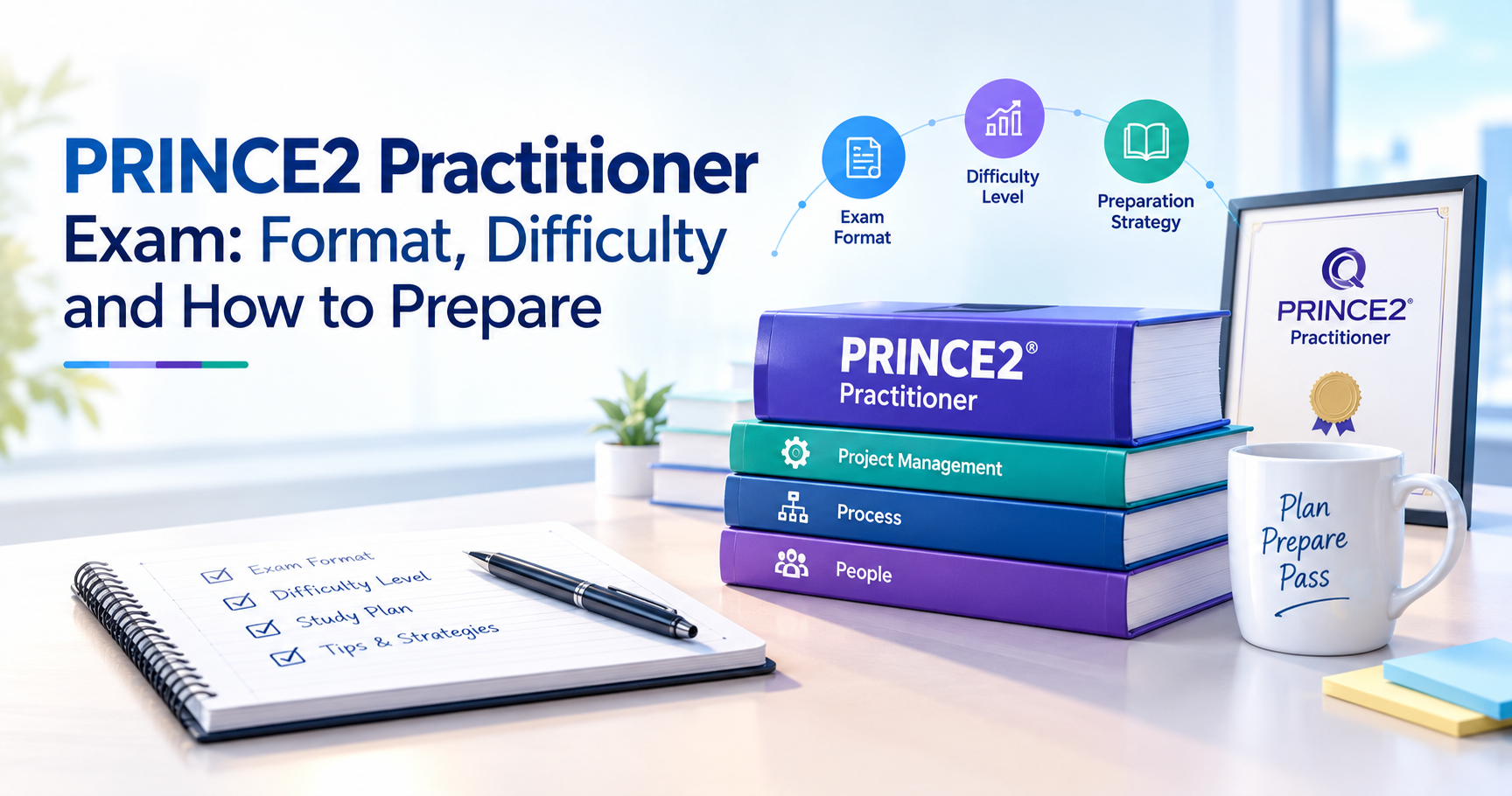
The PRINCE2 Practitioner exam (7th edition) has 56 questions and sub-questions worth 70 marks, runs for 150 minutes, and requires a 60% pass mark (42/70). It is open book, using only the official PRINCE2 7 manual, and tests application and judgement rather than recall. PRINCE2 Foundation (or an accepted equivalent such as PMP or CAPM) is a prerequisite before you can book it.
Key Highlights of PRINCE2 Practitioner Exam
- 56 questions and sub-questions worth 70 marks, completed in 150 minutes, with a 60% pass mark.
- Open book format, but only the official PRINCE2 7th edition manual is permitted, no personal notes.
- Practitioner questions are scenario-based and test application and analysis (Bloom's levels 3-4), unlike Foundation's recall-based multiple choice.
- PRINCE2 Foundation (7th edition) or a recognized equivalent certification is required before booking.
- Candidates can sit the exam online via remote proctoring or at an approved test center.
- Non-native English speakers can request 25% additional time.
If you have already passed PRINCE2 Foundation, or you are researching what comes after it, the Practitioner exam is the next real hurdle. It is a different kind of test from Foundation. Instead of recalling definitions and process names, you are given a project scenario and asked to apply PRINCE2 principles, themes and processes to it, often deciding which management product, role, or action is most appropriate given the specific circumstances described.
Many candidates who breeze through Foundation are caught off guard by Practitioner, not because the content is unfamiliar, but because the exam asks you to reason with the material rather than repeat it. This guide walks through the exact exam format for the 7th edition, how Practitioner questions differ from Foundation, what the exam day process actually looks like, where candidates typically lose marks, and a realistic study plan built specifically around the judgement-based question style. If you are deciding whether you are ready to book the exam, or comparing self-study against structured training, this should give you a clear, accurate picture before you commit.
What Is the PRINCE2 Practitioner Exam?
The PRINCE2 Practitioner exam is the second of the two standard certifications in the PRINCE2 project management scheme, sitting above Foundation. Where Foundation confirms that you understand the PRINCE2 method (its principles, themes, processes and roles), Practitioner confirms that you can apply that method to a real project scenario and make sound decisions in context. It is administered by PeopleCert, the official examination body for AXELOS's PRINCE2 qualifications.
Passing Practitioner signals to employers that you are not just aware of PRINCE2 terminology but capable of tailoring the method to a project's actual scale, complexity, risk profile and environment, which is precisely why the certification carries more weight in project management and delivery roles than Foundation alone.
PRINCE2 Practitioner Exam Format (7th Edition)
The current PRINCE2 Practitioner exam is based on the 7th edition of the PRINCE2 manual. Here is the format, confirmed against the official PeopleCert certification page:
- Questions: 56 questions and sub-questions, worth 70 marks in total. Some questions are split into linked sub-parts that each carry marks, which is why the mark total (70) is higher than the raw question count (56).
- Duration: 150 minutes (2 hours 30 minutes). Candidates who are not sitting the exam in their native language can request 25% extra time.
- Pass mark: 60%, equivalent to 42 out of 70 marks.
- Question format: Objective testing, delivered as scenario-based multiple choice. Each question is built around a project scenario document that stays constant for a block of questions.
- Book status: Open book, but restricted to the official printed or approved digital PRINCE2 7 manual only. Personal notes, printed study guides, and annotated copies with your own commentary are not permitted.
- Delivery method: Online via PeopleCert's remote proctoring service, or in person at an approved test center.
This is meaningfully different from how the exam is sometimes described online as "70 questions." The 70 figure refers to the total marks available, not a flat count of separate questions, and understanding that distinction matters when you are pacing yourself through scenario blocks that contain several sub-questions.
For the official, up to date specification, see the PeopleCert PRINCE2 7 Practitioner certification page.
How Practitioner Questions Differ From Foundation
This is the part candidates most often underestimate. Foundation and Practitioner test the same body of knowledge (the same principles, themes, processes and practices) but at completely different cognitive levels.
Foundation questions are recall-based. They typically ask you to identify a definition, match a term to its description, or recognize which theme, process or role a statement belongs to. If you have memorized the manual's structure, you can usually answer directly without needing much context.
Practitioner questions are application and judgement-based. You are given an extended project scenario, usually several paragraphs describing an organization, a project's objectives, its risk appetite, its stage boundaries and sometimes extracts from its management products. From there, questions ask things like: which action should the Project Manager take next given this specific risk; which management product should be updated to reflect this change; or which of several plausible-sounding options is the most appropriate response given the scenario's stated constraints. Bloom's taxonomy places Foundation at levels 1-2 (remember and understand) and Practitioner at levels 3-4 (apply and analyze).
In practice, this means Practitioner questions often have more than one "technically correct" answer, and your job is to pick the most appropriate one for that scenario, not just a valid one in the abstract. This is why open-book access does not make the exam easy. You cannot look up the answer directly. You look up the relevant section of the manual to confirm your reasoning, then apply it to the specifics you were given.
Foundation vs Practitioner Exam Comparison Table
| Aspect | PRINCE2 Foundation (7th Edition) | PRINCE2 Practitioner (7th Edition) |
|---|---|---|
| Number of questions | 60 questions | 56 questions and sub-questions, worth 70 marks |
| Duration | 60 minutes | 150 minutes |
| Pass mark | 60% | 60% (42/70) |
| Question format | Multiple choice, direct recall | Scenario-based objective testing |
| Book status | Closed book | Open book (official PRINCE2 7 manual only) |
| Cognitive level | Remember and understand (Bloom's 1-2) | Apply and analyze (Bloom's 3-4) |
| Prerequisite | None | PRINCE2 Foundation (7th edition) or accepted equivalent |
| Typical focus | Terminology, structure, definitions | Judgement, tailoring, cross-referencing management products |
Prerequisites for Sitting the Practitioner Exam
You cannot book the Practitioner exam cold. PeopleCert requires one of the following before you are eligible:
- PRINCE2 Foundation (7th edition), or
- PRINCE2 Foundation or Practitioner from the 5th or 6th edition, or
- Project Management Professional (PMP), or
- Certified Associate in Project Management (CAPM), or
- IPMA Level A, B, C or D, or
- Other approved project management qualifications recognized by PeopleCert (such as PMQ or PPQ)
For most candidates coming through a structured pathway, this means completing Foundation first. If you have not yet passed Foundation, the PRINCE2 Foundation Certification Training program is the logical starting point, and reading how to pass the PRINCE2 Foundation exam first will help you gauge your own readiness before moving on to Practitioner-level material.
If you are unsure whether your existing project management background qualifies as an accepted equivalent, it is worth checking the current PRINCE2 certification eligibility requirements before booking, since PeopleCert periodically updates which qualifications it accepts.
Many candidates choose to sit Foundation and Practitioner back to back as a single structured program rather than as two separate bookings months apart, which is where the combined PRINCE2 Foundation & Practitioner Certification Training path tends to fit, since it keeps the Foundation material fresh going into Practitioner-level application questions.
What to Expect on Exam Day
- Whether you sit the exam online or at a test center, the mechanics are broadly the same, but a few details catch first-time candidates out.
- Booking and identity checks. You book through PeopleCert directly or through your training provider, and you will need to verify your identity with a government-issued photo ID before the exam starts. For online proctored exams, this usually involves showing your ID to the webcam and completing a scan of the room you are sitting in.
- Environment rules for online exams. You need a clear desk, a stable internet connection, and a private room with no other people entering during the session. Only the permitted PRINCE2 7 manual can be on your desk. No phones, no second monitors, no scrap paper beyond what the proctoring software provides digitally.
- Manual navigation matters more than people expect. Because the exam is open book, many candidates assume they can look everything up as they go. In practice, the 150-minute window does not leave much slack for searching an unfamiliar manual page by page. Candidates who know the manual's structure well (which theme covers which management product, where the process descriptions sit relative to the principles) move faster and have more time left for the genuinely difficult judgement calls.
- Pacing. With 150 minutes for questions worth 70 marks, you have roughly two minutes per mark on average, but scenario blocks are not evenly weighted. Some sub-questions are quick to resolve once you understand the scenario; others require you to cross-reference two or three sections of the manual. It helps to read the full scenario once before answering any questions tied to it, rather than jumping straight to question one.
Results. For online proctored exams, provisional results are typically available immediately after submission, with an official certificate following once PeopleCert completes its review.
Common Areas Where Candidates Struggle
Based on how the Practitioner exam is structured, a few recurring problem areas show up consistently:
Cross-referencing management products. Questions often ask which document should be updated or consulted given an event in the scenario (for example, distinguishing when the Issue Register, the Risk Register, or the Lessons Log is the correct answer). Candidates who studied themes and processes in isolation, rather than understanding how the management products connect across them, lose marks here.
Applying the tailoring principle. PRINCE2 explicitly requires tailoring the method to the project's context, and Practitioner scenarios test this directly. Candidates who answer with the "textbook" process step, ignoring what the scenario says about the project's size, risk tolerance or organizational structure, often pick the wrong option.
Role and responsibility confusion. Distinguishing what the Project Board, Project Manager, Team Manager, Project Assurance and Project Support are each responsible for, especially where a scenario describes an unusual reporting structure, is a frequent weak spot.
Overthinking "most appropriate" questions. When several answer options are all technically defensible, candidates sometimes select the first plausible option rather than working through which one best fits the specific scenario detail given. Practitioner questions reward disciplined comparison of all options against the scenario, not pattern-matching to a memorized rule.
Time pressure on later scenario blocks. Candidates who spend too long searching the manual on early questions run short of time on the final blocks, which are often no less demanding. Practicing with a timer against full-length mock scenarios is the most reliable way to catch this before exam day.
Sustainability and the People theme. The 7th edition manual expanded coverage of sustainability considerations and the People theme compared with earlier editions. Candidates who studied primarily from older 6th edition materials or third-party summaries sometimes find these areas underprepared relative to how they are tested.
A Realistic Study Plan for the PRINCE2 Practitioner Exam
There is no single study plan that fits everyone. Someone who passed Foundation last month and is moving straight into Practitioner needs a different pace than someone returning to PRINCE2 after a year away. The plan below assumes roughly 5-6 weeks of part-time study alongside work, which is a realistic window for most candidates studying outside a fully immersive course.
- Week 1: Refresh Foundation knowledge. Re-read the principles, themes and processes at a structural level. Do not just re-read; rebuild the mental map of how themes, processes and management products connect.
- Week 2: Deep dive on management products. Study every management product (its purpose, who creates it, who approves it, when it is updated) since Practitioner questions rely heavily on this. Build your own one-page reference summarizing each.
- Week 3: Practice with short scenarios. Work through shorter scenario-based practice questions, focusing on identifying which theme or process area each question is really testing, not just picking an answer.
- Week 4: Full-length scenario practice. Attempt full scenario blocks under timed conditions, using only the manual. Review every wrong answer by tracing exactly which manual section supports the correct one.
- Week 5: Manual navigation drills. Practice finding specific content in the manual quickly. Tab or index the sections you find yourself returning to most (management products table, roles and responsibilities, tailoring guidance).
- Week 6: Full mock exam and review. Sit at least one complete 150-minute mock exam in exam-like conditions. Review not just wrong answers but near-misses, questions you got right for the wrong reason. Rest the day before the real exam rather than cramming.
If you are working from a structured course rather than pure self-study, this timeline compresses considerably, since a trainer-led program front-loads the management product and tailoring content in the first week or two, leaving more of the remaining weeks for scenario practice rather than first-pass learning.
Practice Question Strategy for Judgement-Based Questions
- Because Practitioner questions are built around scenarios rather than isolated facts, an effective practice strategy looks different from Foundation prep.
- Read the whole scenario before answering. Scenario documents often contain details relevant to more than one question in the block. Skimming and jumping straight to the first question means missing a constraint mentioned two paragraphs later that changes the correct answer.
- Identify what the scenario is testing before you look at the options. Ask yourself which theme, process or principle the question is really probing. This narrows down which section of the manual is relevant before you start reading four or five answer options.
- Eliminate options that ignore the scenario's stated constraints. A common wrong-answer pattern is an option that is correct in general PRINCE2 terms but wrong for this specific scenario, for example recommending an action that ignores a stated risk tolerance or a specific stage boundary already mentioned.
- Use the manual to confirm, not to discover. If you find yourself reading an entire manual section from scratch during the exam because you have no idea what it says, that is a sign the topic needs more study time beforehand. The manual should confirm what you already believe is correct, not teach you the concept for the first time under exam pressure.
Review wrong answers by cause, not just outcome. When practicing, categorize your mistakes: did you misread the scenario, misunderstand which management product applies, or run out of time? Different causes need different fixes, and lumping them together as "I got it wrong" wastes the diagnostic value of practice questions.
For a broader set of tactical exam-day tips, see 21 tips and tricks for acing your PRINCE2 Practitioner exam, which covers additional pacing and manual-navigation techniques worth combining with the study plan above.
Simpliaxis Training Relevance
Self-study can work for the Practitioner exam, but the jump from Foundation-level recall to Practitioner-level judgement is exactly where structured training tends to pay off, because it is hard to know which of your own answers reflect solid reasoning and which reflect guessing until someone experienced reviews them with you.
The PRINCE2 Practitioner Certification Training program is built around this gap specifically. Rather than re-teaching Foundation-level definitions, it works through scenario-based exercises modeled on the real exam format, gives you structured practice with management product cross-referencing, and includes mock exam sessions under timed conditions so you are not sitting the real 150-minute exam for the first time on exam day. Trainers walk through why one answer option is more appropriate than another for a given scenario, which is the exact skill Practitioner tests and the hardest one to build from reading the manual alone.
If you have not yet completed Foundation, the PRINCE2 Foundation & Practitioner Certification Training combines both levels into a single program, which keeps the foundational material fresh going into the application-based Practitioner content rather than leaving a gap between the two exams.
For teams working in agile or hybrid delivery environments, it is also worth knowing that PRINCE2 Agile follows the same two-tier exam structure. The PRINCE2 Agile Foundation Certification Training and PRINCE2 Agile Practitioner Certification Training extend the same principles into an agile context, and the combined PRINCE2 Agile Foundation & Practitioner Certification Training is a common path for project managers whose organizations blend PRINCE2 governance with agile delivery methods like Scrum.
Organizations certifying multiple project managers or delivery leads at once, rather than a single individual, typically find it more efficient to run this through corporate and group training, which allows exam preparation, scenario practice and scheduling to be coordinated across a whole team rather than booked separately person by person.
Conclusion
The PRINCE2 Practitioner exam is not harder than Foundation because it covers more content. It is harder because it asks you to do something different with the same content: apply it to a scenario, weigh several plausible options, and choose the one that fits the specific situation described rather than the one that sounds most correct in the abstract.
Knowing the exact format (56 questions and sub-questions worth 70 marks, 150 minutes, 60% pass mark, open book with the official manual only) removes some of the uncertainty. What actually determines whether you pass is how deliberately you practice the judgement side of the exam, not just how many times you re-read the manual. A realistic study plan, honest mock exam practice under timed conditions, and structured feedback on your reasoning (whether from a trainer or from careful self-review) are what close the gap between knowing PRINCE2 and being able to apply it under exam conditions.
Ready to Prepare for the PRINCE2 Practitioner Exam?
If you have already passed Foundation and want structured, scenario-based exam preparation, view PRINCE2 Practitioner certification training options to see program dates, format and included mock exam practice. If you have not yet completed Foundation, compare it against the combined PRINCE2 Foundation & Practitioner Certification Training path to decide which sequence fits your timeline. [VERIFY current pricing] before booking, since program fees and exam voucher inclusions are updated periodically.







 Lowest-Price Challenge











 Personalized Path


.webp)


 USA
USA  Canada
 India
India UK
UK Australia
 Singapore


