


 Call Us



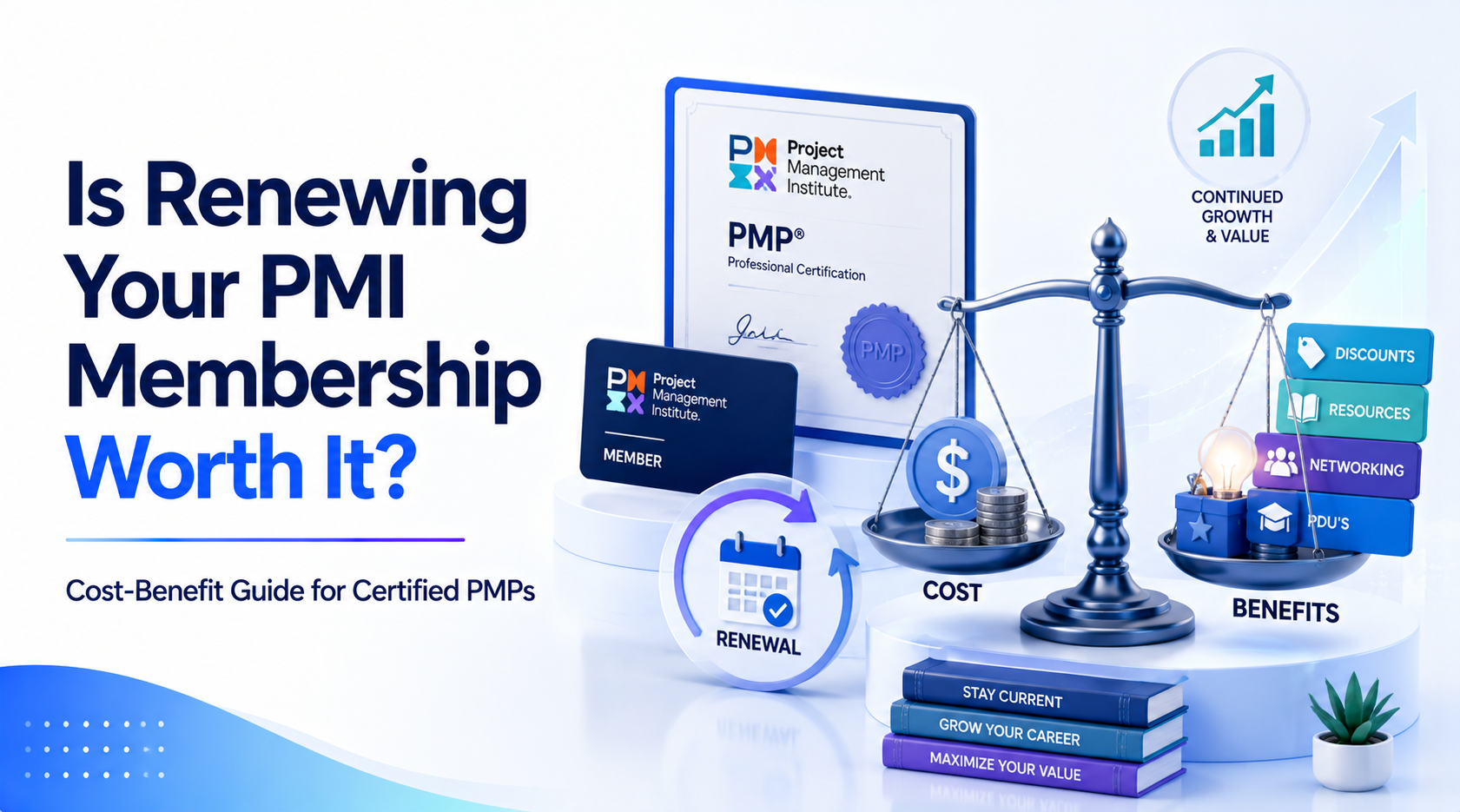
For most certified project managers, renewing PMI membership purely to keep the certification renewal discount does not pay for itself financially, since that discount is worth roughly $90 every three years against an annual fee that adds up to several hundred dollars over the same period. It becomes worth it only when you actually use the PDU-eligible webinars, the on-demand learning library, a local chapter, or member pricing on a second PMI credential. Professionals who let their PMP lapse into inactive study habits, never attend chapter events, and source PDUs elsewhere for free generally save money by not renewing. The right answer depends entirely on whether you will use what the membership includes, not on the certification alone.
Key Highlights: Is Renewing PMI Membership Worth It in 2026?
- The Project Management Institute's individual membership renewal now runs at roughly $159 a year including local chapter access, according to PMI's updated membership model rolled out from 2025, up from the older $129-$139 range that charged chapter fees separately.
- The PMP certification renewal fee is $60 for PMI members versus $150 for non-members every three years, according to PMI's own certification maintenance page, a saving of about $90 per cycle, or roughly $30 a year.
- Paying membership fees for three straight years costs around $477, against a $90 recertification saving, leaving a shortfall of roughly $387 that only non-financial benefits (PDUs, library access, chapter events, resource discounts) can close.
- The one-time exam-fee discount that makes joining PMI worthwhile before sitting the PMP is a separate calculation from this ongoing renewal decision, and the two should not be confused.
- Members who actively use PMI's PDU-eligible webinar library, attend a local chapter, or plan to pursue a second PMI credential such as the PMI-ACP typically get enough value to justify renewal.
- Members who source free PDUs elsewhere, never attend chapter events, and do not plan another PMI credential usually come out ahead by letting membership lapse and rejoining only when needed.
- A short annual checklist, reviewed shortly before each renewal notice, is a more reliable way to decide than relying on habit or on the sunk cost of previous years' payments.
What Are You Actually Paying For When You Renew PMI Membership?
If you recently qualified through a structured programme such as Simpliaxis's PMP certification training course, the excitement of passing the exam usually overshadows a much quieter, recurring decision: whether to keep paying PMI membership dues every single year afterwards. Renewing PMI membership buys access to a bundle of specific services, not a single benefit, and the value of that bundle depends entirely on which pieces you use. According to the Project Management Institute's own membership pages, a renewing individual member gets a home chapter allocation, discounted or free access to PDU-eligible content, member pricing on PMI standards and a second credential, and a scaled-down job of engagement with PMI's professional community. The table below breaks down what a typical renewal year includes and roughly what each element is worth if you tried to buy it separately.
| Benefit included in renewal | Approximate standalone value | Who actually uses it |
| PDU-eligible webinars and on-demand course library counted toward the Talent Triangle | $150 to $400 a year if bought as standalone continuing-education content | PMPs actively working through their 60-PDU, three-year requirement rather than leaving it to the last few months |
| Digital access to the PMBOK Guide and other PMI standards (Agile Practice Guide, PMIstandards+) | $50 to $150 if purchased individually as print or digital standards | Practitioners who reference multiple PMI standards for client work, audits, or internal methodology documents |
| PMP recertification fee discount ($60 member vs $150 non-member) | $90 every three years, roughly $30 a year | Every renewing PMP, though the value is modest on its own |
| Local chapter meetings, mentoring circles, and volunteer roles | Varies by chapter; often free or heavily discounted versus $20 to $60 non-member event tickets | Members who are genuinely active in their home chapter's community, not those who joined once and never attended |
| Member pricing on a second PMI credential exam (PMI-ACP, PMI-RMP, PgMP) | $100 to $170 saved per additional exam | Professionals planning to stack another PMI credential onto their PMP |
| Career Central job board, resume tools, and templates library | Comparable to niche job-board subscriptions, typically $10 to $20 a month elsewhere | Members actively job-hunting or building out project templates from scratch |
Notice how differently these line items behave. The recertification discount is small but guaranteed for anyone who stays certified. Everything else is conditional: it is only worth its listed value to someone who actually opens the webinar library, walks into a chapter meeting, or downloads a standard. If your renewal fee is buying you six benefits and you only use one, you are not getting six benefits' worth of value, you are getting one, plus a small guaranteed discount.
Does the PMP Renewal Fee Discount Alone Justify the Annual Fee?
No, on its own the PMP recertification discount does not come close to covering the cost of ongoing PMI membership. This is the calculation that trips people up, because it feels similar to the join-before-the-exam decision, but the numbers behave very differently once the one-time exam discount is off the table.
Before sitting the PMP exam, joining PMI is close to a formality: PMI's exam-fee structure applies a lower member rate against a higher non-member rate, and the difference between the two easily exceeds the cost of joining, which is why Simpliaxis's guide to PMI membership benefits recommends joining before you register for the exam. That is a one-time, one-sided trade: pay the membership fee once, save considerably more once on the exam fee itself.
The renewal decision is a completely different shape of maths, because you are now paying every single year for a discount that only becomes usable once every three years. Here is the calculation set out plainly, using PMI's published certification maintenance figures and a current published individual renewal fee.
| Line item | Non-member cost | Member cost |
| PMP recertification fee (once per 3-year cycle) | $150 | $60 |
| PMI individual membership (paid annually, 3 years) | $0 | approximately $477 (3 x approximately $159) |
| Net 3-year cost attributable to certification renewal alone | $150 | approximately $537 |
Run purely on the recertification discount, staying a member costs you roughly $387 more over three years than simply paying the non-member recertification fee when it comes due. That is the core reason CertNorth's "actual maths" breakdown of PMI membership concludes that the ongoing renewal discount, taken by itself, does not pay for itself the way the join-time exam discount does. For the full published fee schedule, Simpliaxis's own breakdown of PMP certification renewal fees is worth checking alongside PMI's figures. The fee figures above are current published snapshots (PMI's individual membership pricing reflects its updated membership model rolled out from early 2025, and its certification renewal fees are published on PMI's own certification maintenance page), and PMI does revise both periodically, so it is worth checking pmi.org's membership page and PMI's certification maintenance page for the exact current figures before you decide.
None of this means renewal is a bad deal across the board. It means the recertification discount specifically is not the reason to renew. If you are going to renew, it needs to be because you will use the other five items in the benefit table above, not because of the $30-a-year equivalent saving on your PMP renewal.
Who Gets Real Ongoing Value From Renewing PMI Membership?
Renewing tends to pay off for certified project managers who are structurally likely to use PMI's non-financial benefits, not just those who feel loyal to the credential. Four groups consistently come out ahead.
Professionals actively earning PDUs through PMI's own content
PMP holders must earn 60 PDUs every three years, split across PMI's Talent Triangle categories of Ways of Working, Power Skills, and Business Acumen (formerly Strategic and Business Management). Members who use PMI's own PDU-eligible webinars and on-demand library to hit that requirement are converting their membership fee directly into continuing-education content they would otherwise have to buy from a third-party provider or piece together for free. If you are the kind of PMP who logs PDUs steadily throughout the three-year cycle rather than scrambling in the final quarter, PMI's own library is usually the most convenient single source, and that convenience has real value.
Members who are actually active in a local chapter
PMI's chapter network exists specifically for members who show up: mentoring circles, study groups, guest-speaker events, and volunteer leadership roles that build a genuine professional network. If you attend chapter events, know people in your local chapter, or use chapter mentoring to prepare junior colleagues for their own PMP, the membership is buying you something a non-member genuinely cannot access at the same price or convenience.
Professionals planning a second PMI credential
Anyone planning to add the PMI-ACP, PMI-RMP, PgMP, or another PMI credential on top of their PMP benefits from member pricing on that second exam, which is often a saving of $100 or more on its own. Layered on top of the recertification discount and any webinar use, this tips the maths back in favour of staying a member.
Employer-funded members
When an employer, PMO, or learning and development budget covers the membership fee rather than the individual, the personal cost-benefit calculation above becomes largely irrelevant. The decision shifts to the organisation, which is often assessing a different question: whether funding memberships and PDU access across a whole certified team is a good use of a broader training budget.
Who Should Probably Let Their PMI Membership Lapse?
Letting membership lapse tends to be the financially sound choice for PMPs who do not touch most of what they are paying for. If you source your PDUs for free through employer-provided training, open-source webinars, or other low-cost continuing-education providers, if you have never attended a chapter event and do not plan to, and if you have no intention of pursuing a second PMI credential, then you are effectively paying roughly $159 a year for a $90-per-three-years discount and a set of resources you never open. In forum and community discussions, this is exactly the pattern that recurs: professionals who stay certified but explicitly stop renewing membership tend to describe missing very little beyond the modest recertification saving, which they simply absorb as a one-time cost every three years instead.
It is also reasonable to lapse temporarily. PMI membership is not a prerequisite for keeping your PMP active; the certification and the membership are billed and renewed separately, so you can let membership lapse for a cycle, pay the higher non-member recertification fee when it is due, and rejoin later if your circumstances change, for example if you start pursuing a second credential or move into a role where a local chapter's network becomes genuinely useful.
Does PMI's New Membership Model Change This Calculation?
Yes, to a degree, because PMI's restructured membership model folds local chapter access directly into the single annual fee rather than billing it separately. Under PMI's older structure, a member typically paid a global membership fee and then a further, separate fee to join a specific local chapter, meaning many members who wanted PDUs and standards access but skipped the chapter add-on paid less overall. Since PMI rolled out its updated membership model in phases from early 2025, new and renewing members instead pay one bundled fee that already includes a home chapter allocation and access to chapter services more broadly, according to PMI's own leadership communications and multiple chapter websites covering the change.
For the renewal decision specifically, this bundling cuts both ways.
If you were previously paying for global membership only and skipping the chapter fee, your effective renewal cost has gone up, but you have also gained chapter access you were not paying for before, which is worth checking out at least once before writing it off as a benefit you will not use. If you were already paying for both global and chapter membership separately, the bundled fee may work out roughly similar or slightly cheaper than the two combined. Either way, it is worth treating this as a prompt to re-run your own usage checklist rather than assuming your renewal maths from a few years ago still holds, since PMI has stated the rollout continues in phases by country through 2026.
How Do You Decide? A Renewal Decision Checklist
A short annual review, done shortly before your renewal notice arrives rather than on autopilot, answers this question more reliably than habit. Work through the following before you pay.
- Check your PDU log. If you are behind on PDUs and PMI's on-demand library is the fastest way to catch up, that alone can justify renewal.
- Check your chapter activity. Look back honestly at the last twelve months. If you did not attend a single chapter meeting or event, this benefit is not paying off for you.
- Check your credential roadmap. If you are planning a second PMI credential within the next renewal cycle, member pricing on that exam changes the maths in favour of staying.
- Check who is paying. If your employer or PMO covers the fee, the personal cost-benefit question is largely moot; confirm the reimbursement process instead.
- Add up your actual usage in dollars. Total what you genuinely used (webinars attended, standards downloaded, events joined, the $90 recertification saving amortised) and compare it honestly against the fee.
- Decide, don't default. If the total from step five falls short of the fee, let it lapse for this cycle rather than renewing out of habit; you can always rejoin later.
Where Employer-Funded Training Changes the Calculation
The individual cost-benefit maths above assumes a single project manager paying out of pocket, but the picture looks different once an organisation is funding certification and membership across a whole team. A PMO or L&D manager comparing the cost of PMI membership renewals for, say, fifteen certified staff against the value of keeping that entire group current on PDUs, engaged with a local chapter, and eligible for member pricing on future credentials is not running the same one-person calculation.
At that scale, membership renewal often becomes one line item inside a broader, structured training investment rather than a standalone decision, particularly when it is bundled with formal exam preparation, PDU-aligned coursework, and recertification support for the group. Organisations weighing that kind of team-wide investment, alongside structured PMP training and recertification support for their certified staff, can look at Simpliaxis's corporate and group training programmes as one way to bundle exam preparation, PDU-aligned learning, and renewal support across a team rather than leaving each employee to make the membership call alone.
What Happens If You Let Your Membership Lapse and Then Want to Rejoin?
Rejoining PMI after a lapse is straightforward: you pay the current new-member fee (which typically includes a small one-time application charge alongside the annual dues) and your membership resumes, giving you back access to member pricing, the webinar library, and your home chapter allocation.
Your PMP certification itself is unaffected by a membership lapse, since the two are administered and billed separately; the only certification-side consequence is that you would pay the higher non-member recertification fee for any renewal cycle that falls while you are not a member. If you know you will want a second credential, more PDU content, or renewed chapter access within the next year or two, it is worth comparing the cost of rejoining against simply staying enrolled continuously, since a lapse-and-rejoin cycle carries the one-time application charge each time you come back.
Conclusion
The renewal decision is genuinely different from the decision to join PMI before your PMP exam, and treating them the same way is what leads people to either over-pay for years out of habit or drop membership and quietly lose access to resources they were actually using. Run on the recertification discount alone, continuous PMI membership costs more than it saves, by roughly $387 over a typical three-year cycle based on current published fees. It only becomes worth it when you can point to specific, recurring use: PDU webinars you actually watch, a chapter you actually attend, or a second credential you are actually pursuing. For individuals, that means reviewing usage honestly each year rather than renewing by default. For organisations funding certification across a team, it means treating membership as one component of a broader training relationship rather than an automatic annual line item. Either way, the right call comes from checking your own usage against the fee, not from the certification badge itself.







 Lowest-Price Challenge











 Personalized Path


.webp)


 USA
USA  Canada
  India
India  UK
UK  Australia
  Singapore


