


 Call Us



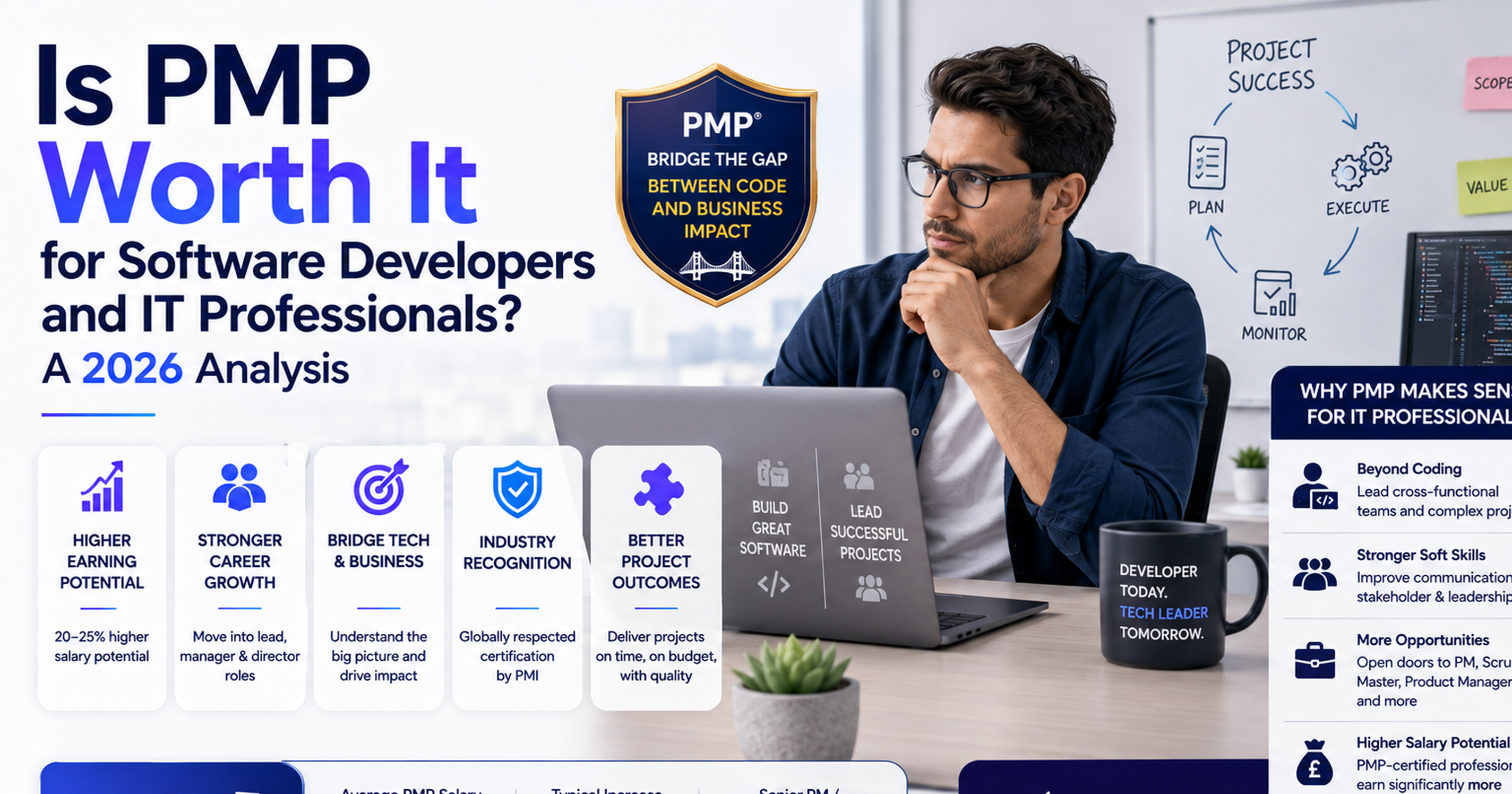
The honest answer is that it depends heavily on which corner of the IT world you sit in and where you want to go next. A software engineer who wants to stay hands on code, or move into product management, will get little practical mileage from a PMP, and community sentiment on forums such as Blind and Quora backs that up bluntly. A developer or team lead who wants to move into technical programme management, delivery leadership, or an IT PMO role, especially inside a regulated, contract-heavy, or large-enterprise environment, is looking at a genuinely different calculation, where PMP is often preferred and sometimes explicitly required. This article works through both cases with real evidence rather than a blanket verdict.
Key Highlights: Is PMP Worth It for Software Developers?
- On Blind and Quora, many senior engineers and product-side hiring voices say PMP carries little to no weight for individual-contributor engineering or product management roles, and can even read as a mismatch if used on a product manager application.
- PMP experience hours are calculated from project leadership responsibility, not job title. PMI's own guidance treats developers who write code, run tests, or execute assigned tasks as contributors whose time typically does not count, unless they also held real authority over scope, backlog, or team direction, for example as a Scrum Master, delivery lead, or de facto project owner.
- Government IT contracting and defense-adjacent ERP work is one of the clearest cases where PMP has explicit pull, because Earned Value Management reporting under DFARS and "key personnel" clauses in RFPs frequently name PMP as a requirement for the project manager role.
- PMI's 14th edition salary survey reports PMP holders earning a median salary around 17% higher globally and close to 24% higher in the United States than non-certified peers, but this is an all-industry average across every sector PMI surveys, not an IT-specific or developer-specific figure, and should be quoted with that caveat.
- The PMP exam changed on 9 July 2026: the Business Environment domain jumped from 8% to 26% of the exam, and AI and sustainability became formally testable content areas, a shift that pulls the credential closer to the kind of business-context, technology-adjacent thinking a technical programme manager is expected to demonstrate.
- For a developer whose goal is to stay technical and agile-native, PMI-ACP or a Scrum-family certification is very often the better-fitting credential, since it validates iterative delivery skills that are directly relevant to how most modern software teams actually work.
- Sector matters more than job title. The same "software engineer wants to move into management" profile gets a very different answer depending on whether the employer is a product-led startup or a bank, an SAP-heavy enterprise, or a public-sector IT contractor.
Where the PMP Debate Actually Comes From
Search "is PMP worth it" on Reddit, Blind, or Quora and you will find genuinely split opinion, not manufactured controversy. On teamblind.com, threads about PMP consistently attract comments arguing that the certification is mainly valued by older project or programme managers, that it will not move the needle on a software engineer's salary, and that it functions at best as a harmless checklist item rather than a differentiator. Other Blind commenters are more neutral, noting that while employed it makes little difference, but during a job search into a project or programme management role it can still come up as a discussion point in interviews.
Quora threads on whether PMP helps a software engineer move into product management are more pointed still.
Several answers state plainly that PMP is not valued by software companies hiring for product management, and that listing it on a product manager application can read as a signal the candidate has not registered that product management and project management are different disciplines with different skill sets.
That distinction matters a great deal for this article's audience, because "I want to move into management" covers at least three very different destinations: product management, engineering management, and technical programme or delivery management, and PMP is really only aimed at the third.
None of this means the credential is worthless in IT. It means the value is conditional, and the condition is largely about sector and role rather than about "tech" as a monolith.
Where PMP Genuinely Helps in a Technology Career
Regulated and Contract-Heavy IT Environments
The clearest evidence of demand sits in government IT contracting and large enterprise systems work. Reporting on federal and defense contracting shows that agencies frequently mandate that the project manager on a contract hold a PMP certification, partly because it signals familiarity with the disciplined documentation and Earned Value Management reporting that DFARS-governed programmes require. Request for Proposal documents for large IT or infrastructure contracts often include a "key personnel" clause naming PMP as a named requirement for the project manager role, not a nice-to-have.
The same logic extends into large ERP and SAP implementation work, especially in aerospace, defense, banking, and healthcare IT, where a single failed cutover can carry regulatory or financial consequences that make predictive, phase-gated planning genuinely useful alongside agile delivery within workstreams. Industry commentary from vendors such as Scand.com frames this as PMP suiting situations where "everything must work from the first try," citing large corporate implementations, external client contracts, and high-regulation sectors like fintech, healthcare, and the public sector as the natural home for the credential.
Moving From Individual Contributor Into Delivery Leadership
The most realistic path from a pure engineering background into a PMP-relevant role is not "developer becomes product manager." It is "developer or tech lead becomes technical programme manager, delivery lead, solutions delivery manager, or IT PMO lead." Career-path research on technical programme management describes this as an evolution, not a leap: engineers typically spend two to four years in foundational technical roles before the transition, and TPMs are still expected to understand system architecture and discuss trade-offs credibly with engineering teams, even though they are no longer writing production code day to day.
Multiple sources aimed at this exact transition, including guidance from PMTI and itcareerfinder.com, position PMP as the credential that formalises the shift, precisely because it teaches the governance, stakeholder, budget, and risk vocabulary that a delivery lead or TPM is expected to use with executives, even when the day-to-day team runs on Scrum or Kanban underneath. Anyone weighing this move should check the exact eligibility path before committing time to the application, since PMI's rules on what counts as leadership experience are stricter than most candidates expect.
The Business Environment Shift Is Relevant to This Audience Specifically
The PMP exam changed on 9 July 2026, and the change is unusually relevant to a technical audience. The Business Environment domain went from 8% to 26% of the exam, and PMI formally added AI and sustainability as testable content areas, meaning candidates can now be examined on how AI intersects with planning, risk, governance, and stakeholder expectations, alongside sustainability and ESG considerations in project decisions.
For a software professional evaluating whether the credential still reflects how technology organisations actually operate, this update is worth noting on its own merits: PMI is visibly pulling the exam toward the kind of business-context, technology-and-value reasoning that a TPM or delivery lead is expected to bring to an executive conversation, rather than pure Gantt-chart mechanics.
Where PMP Does Not Help, and Community Sentiment Is Right to Push Back
Pure Individual-Contributor Engineering Roles
If the goal is to stay an engineer, or to be promoted into a staff or principal engineering track, PMP is close to irrelevant, and the "nobody cares about certs in tech" sentiment on forums reflects real hiring behaviour. Senior engineers evaluating candidates for IC roles are looking at system design ability, code quality, and shipped impact, not project management credentials, and a PMP on an engineering resume does nothing to answer those questions.
Agile-Native Product Companies and Startups
In product-led software companies, particularly startups and scale-ups that run almost entirely on Scrum or Kanban, PMP's predictive-planning, phase-gate framing is a poor cultural fit. These organisations are far more likely to recognise a Certified ScrumMaster, PMI-ACP, or SAFe credential, because it signals fluency in the actual operating model of the team the candidate would join. Comparative guides consistently note that PMI-ACP carries stronger recognition specifically within software development, digital transformation, and enterprise agile environments, while PMP's recognition is broader but less specifically tuned to that world.
Product Management as a Destination
This is worth repeating because it is such a common mistake: PMP is a project management credential, not a product management one. Multiple Quora answers addressing engineers who want to move into product management state directly that PMP is not what hiring teams are looking for in that transition, and can even undercut a candidate's credibility if it appears to conflate the two disciplines. A developer with that specific goal is better served by product-focused training, portfolio work, and stakeholder experience than by PMP.
How PMP Experience Hours Actually Work for Developers
This is the part of the debate that gets misunderstood most often, and it deserves a plain explanation rather than marketing language. PMI's eligibility rules require project leadership experience, measured in months rather than raw hours, alongside 35 hours of formal project management education. The requirement is 36 months of project leadership experience with a bachelor's degree, or 60 months without one.
The critical word is leadership. Guidance aggregated from PMTI and similar sources is consistent on this point: agile and Scrum experience counts toward PMP eligibility when the applicant held a role with real authority, such as Scrum Master, Product Owner, or Agile Delivery Lead, with decision-making power over sprint scope, backlog prioritisation, or resolving impediments. Pure developer work, meaning writing code, running tests, or executing assigned tasks under someone else's direction, generally does not count, even on large or high-visibility projects, because PMI explicitly distinguishes contributor-only experience from leadership experience.
In practice, this means:
- A backend developer who simply completes sprint tickets is unlikely to be able to claim that time toward PMP eligibility, regardless of how senior or technically demanding the work was.
- A developer who also ran sprint planning, owned the backlog, made prioritisation calls, or coordinated cross-team dependencies as an informal or formal Scrum Master has a real claim to that time as leadership experience.
- Anyone unsure where their own experience falls should read PMI's eligibility criteria carefully and, where useful, check Simpliaxis's detailed breakdown on the PMP certification prerequisites page, which lays out what qualifies as project-leading experience before applying.
PMP vs Agile-Family Certifications: A Scenario-by-Scenario Comparison
Because this is inherently comparative content, the table below matches common IT career scenarios to the certification path that tends to fit best, based on the evidence gathered above rather than a generic "it depends."
| IT Career Scenario | Better-Fitting Path | Why |
| Staying an individual-contributor software engineer | Neither; invest in technical depth instead | Hiring for IC roles weighs system design and shipped work, not PM credentials, per Blind and Quora sentiment. |
| Moving from developer into Scrum Master or agile coach | PMI-ACP or CSM | Validates iterative delivery skills directly relevant to sprint-based teams; stronger recognition in agile-native software shops. |
| Moving from tech lead into Technical Programme Manager or delivery lead | PMP | Formalises governance, stakeholder, budget, and risk vocabulary expected at that level, especially where the org still runs some predictive planning. |
| IT project manager at a bank, insurer, or government IT contractor | PMP, often explicitly required | RFP "key personnel" clauses and EVM reporting under frameworks like DFARS frequently name PMP directly. |
| Delivery role on a large SAP or ERP implementation | PMP | Phase-gated, high-stakes cutover work rewards predictive planning discipline alongside agile workstream execution. |
| Product manager role inside a software company | Neither PMP nor PMI-ACP | Product management is a distinct discipline; PMP can even read as a mismatch on a PM application. |
| Startup or scale-up engineering team lead moving into delivery | PMI-ACP or Scrum-family certification first | Culturally and practically closer to how these organisations actually operate day to day. |
For readers who want to see the full agile alternative rather than take this comparison on faith, Simpliaxis's PMI-ACP certification training page covers the agile-specific path side by side with the PMP option, without this article turning into an agile promotion piece; the point is simply that the right answer depends on the destination role, not on which certification is more talked about online.
What a Hiring Manager Actually Looks At
Resume guidance aimed specifically at Technical Programme Manager hiring is useful here because it cuts through certification-versus-experience arguments with a clearer picture. Hiring managers for TPM roles want a strong technical foundation demonstrated through specific technologies and delivered outcomes, evidence of having run a project end to end including objectives, timelines, and resource allocation, and a clear answer to why the programme mattered to the business. Certifications including PMP, CSM, and SAFe Agilist are listed as relevant signals, but the same guidance is explicit that hiring managers weight the last two to five years of demonstrated delivery work more heavily than certifications or older job history.
The practical implication is that PMP functions best as a credential that organises and validates experience a candidate already has, or is actively building, rather than as a substitute for that experience. This is consistent with why PMI requires verified project-leadership months before certification rather than issuing the credential on exam performance alone.
The Salary Premium Claim, and Why It Needs a Caveat
PMI's 14th edition Earning Power salary survey reports that PMP-certified respondents earned a median salary roughly 17% higher globally than non-certified peers, and in the United States the gap was closer to 24%, with PMP holders reporting a median of around 135,000 US dollars against 109,157 US dollars for non-certified respondents. Tenure compounds the effect: respondents certified for more than ten years reported a median of 173,000 US dollars, against 123,000 US dollars for those certified less than five years.
These figures are drawn from PMI's own survey population across all industries the survey covers, not from an IT-only or developer-only sample, so they should not be read as "a software developer who gets PMP will earn 17-24% more." The honest framing is that the premium exists at an aggregate level across the project management profession, and it is reasonable to expect it to hold most strongly in the sectors where PMP is already valued, such as regulated industries and large enterprise programmes, and least strongly in agile-native software companies where the certification carries little signalling weight in the first place. Readers who want current, India-and-global salary benchmarks specifically can review Simpliaxis's PMP certified salary page for a fuller regional breakdown.
A Practical Route If You Decide PMP Fits Your Goal
- Confirm eligibility first. Map your actual project-leadership months, not just years in a developer role, against PMI's requirements before committing to exam prep.
- Choose training that reflects the 2026 exam. Given the Business Environment domain now carries 26% of the exam and AI and sustainability are testable, make sure any course you take has been updated to the July 2026 outline rather than an older syllabus. Simpliaxis's PMP certification training course is built around the current exam content outline.
- Budget realistically. Exam fees, training, and renewal costs add up, and the full breakdown is worth checking on Simpliaxis's PMP certification cost page before enrolling.
This same route scales at organisation level. An IT department or engineering organisation that wants to build an internal pipeline of delivery leads and technical programme managers, rather than relying on external hires who already carry the credential, can look at Simpliaxis's corporate and group training programme, which is a common way regulated or enterprise-heavy employers fund PMP training across a cohort of senior engineers and tech leads moving into delivery-facing roles at the same time.
Conclusion
For a software developer who intends to stay a developer, or who is aiming specifically at product management, PMP is not the right investment, and the sceptical Blind and Quora sentiment on this point is well founded rather than outdated snark. For a developer, tech lead, or engineer who wants to move into technical programme management, delivery leadership, or an IT PMO role, especially inside banking, insurance, government IT contracting, aerospace and defense, healthcare IT, or large SAP and ERP programmes, PMP is a credible and often explicitly preferred credential, not a legacy artefact of waterfall thinking.
The determining factor is not whether you work in "tech" broadly, but which specific role and which specific sector you are aiming at next, and whether your actual day-to-day experience includes real project-leadership authority rather than pure execution work.
The July 2026 exam changes, with Business Environment now worth 26% of the exam and AI and sustainability formally testable, make the credential a somewhat better fit for a technology-adjacent audience than the version of PMP that earned its "waterfall relic" reputation in the first place, though that reputation has not fully caught up with the update yet.





 Lowest-Price Challenge











 Personalized Path


.webp)


 USA
USA  Canada
  India
India  UK
UK  Australia
  Singapore


