


 Call Us



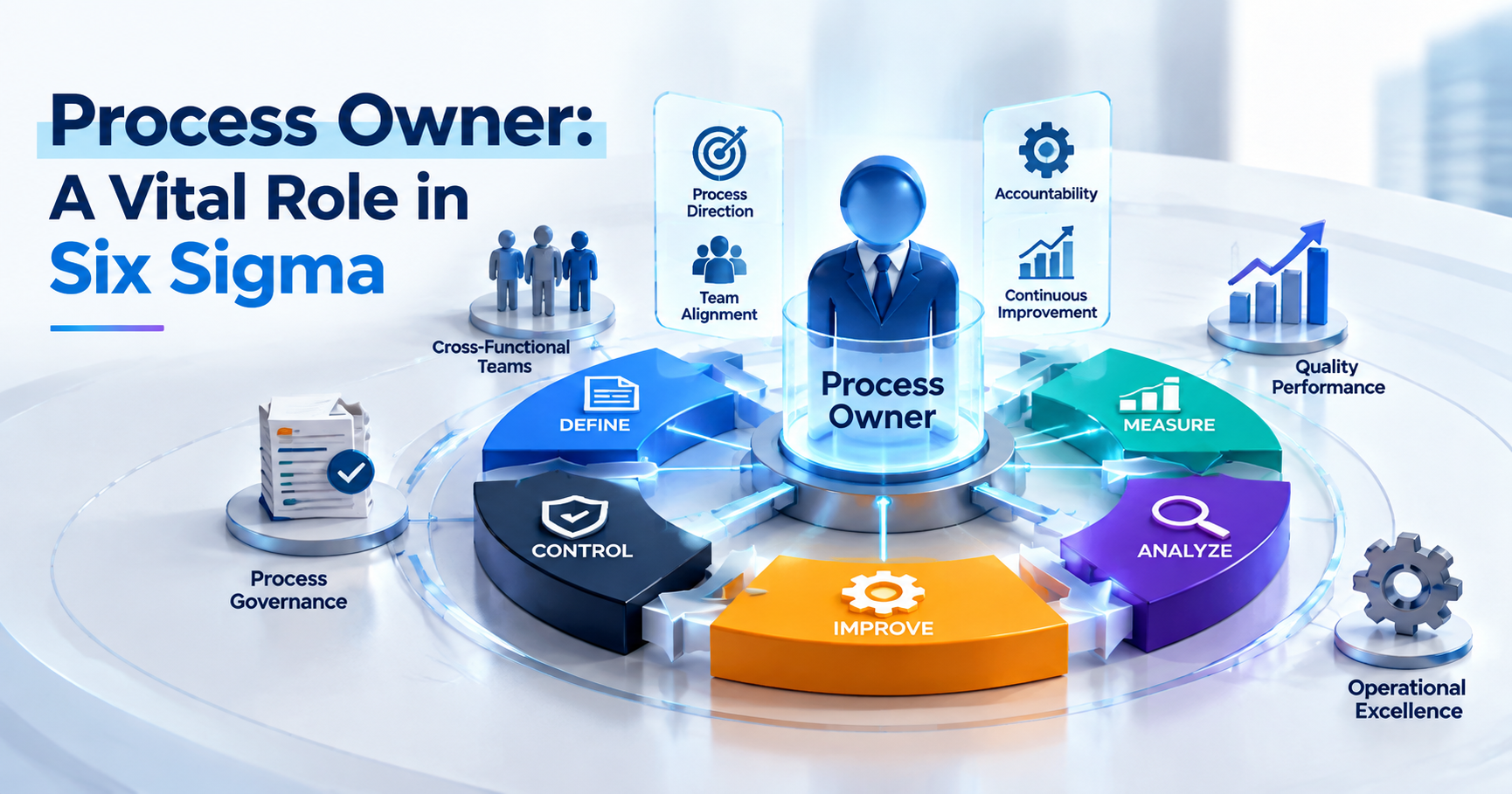
It is now clear how crucial the process owner's role is once the project team has determined the root cause or implemented a solution, since Six Sigma improvement doesn't stop there; the follow-up assessment begins. It is necessary to discover whether the improved process will still produce the expected results when the project team subsequently moves on.
The person responsible for a particular business process has to ensure that the process continues to perform well, is properly governed, and is improved. As part of Six Sigma, process owners work closely with Green Belts, Black Belts, process teams, managers, and other stakeholders in order to understand the process's performance, support the various improvement projects, implement the necessary changes, and prevent the processes from going back to their previous states.
The article talks about the duties of a Six Sigma Process Owner, the importance of the role, the skills and responsibilities associated with it, the way in which Process Owners take part in the DMAIC (Define, Measure, Analyze, Improve, Control) cycle, and the practices that help to make process ownership effective.
What is a process owner in Six Sigma?
The individual appointed as process owner in Six Sigma is the one to whom responsibility and the authority for the continued performance of a business process are assigned. This process owner makes certain that the process is clearly defined, that it is measured accurately, that it is carried out in a consistent way, and that it is constantly improved in order to meet both organizational and customer requirements.
Let us look at the order-to-delivery process. This could include the sales department, finance, warehousing, logistics, and customer service. Even if each department is responsible for its own activities, there still has to be someone who keeps an end-to-end view of how the process is performing.
It might be the process owner's responsibility. In different organizations the process owner could have the following duties:
Establishing or maintaining process standards and documentation
Defining or agreeing on process performance measures
Monitoring KPIs and process results
Identifying performance gaps
Supporting improvement initiatives
Coordinating stakeholders across functional boundaries
Reviewing proposed process changes
Ensuring approved improvements are implemented
Maintaining controls after an improvement project
Encouraging continuous improvement
The process owner does not simply consist of the individual who puts workflows in writing; the role also involves taking responsibility for how well the process functions and performs over time. For example, where a customer support process is facing longer resolution times, the process owner helps to investigate the issue, examines the performance data, consults with the appropriate stakeholders, supports the various initiatives intended to improve the process, and ensures that any successful changes are adopted by normal operations.
The degree of authority held by a process owner differs from one organization to another. In certain companies the owner has considerable authority when it comes to making decisions, while in others they have to depend on the functional managers and top-level leadership if they are to implement changes. The basic principle is unchanged in all cases: there must be one person clearly responsible for the process's health and performance.
Why Is the Process Owner Important in Six Sigma?
Six Sigma seeks to enhance processes by reducing variation, by eliminating defects and the causes of poor performance, and by making better decisions on the basis of data; however, the improvement projects are usually temporary while business processes go on for a length of time. This leads to a significant question:
Who takes responsibility after the improvement project ends?
It is the process owner's responsibility to ensure continuity. Even if a Black Belt or a Green Belt leads the project or offers support, responsibility for the process usually returns to the operational owners when the improvements have been verified and transferred to normal operations.
There are a number of reasons why the person responsible for the process is important.
Maintaining process accountability
Process problems can remain unresolved if the responsibilities are not clear because the different teams have a tendency to believe that somebody else is to blame. Designating a clearly defined process owner creates a feeling of accountability.
Connecting improvement with operations
A technically sound Six Sigma solution has to be suitable for use in the actual operating environment because the people in charge of the process know about the operational constraints, dependencies, customer requirements, resources, and stakeholder expectations.
Supporting data-driven management
Process owners can monitor such measures as defects, cycle time, cost, throughput, customer complaints, service levels, or other relevant KPIs. On this basis, they are able to detect any deterioration before it develops into a more serious problem.
If continuous monitoring and ownership are not carried out, the teams will slowly return to the ways they had previously. The people responsible for the process keep records of the standard work, the controls, the documentation, the responsibilities, and the performance reviews.
Encouraging continuous improvement
The notion that process ownership involves leaving things as they are must not be accepted. Experienced process owners always seek out methods to improve efficiency, quality, customer value, and process reliability. Six Sigma projects and process ownership have complementary functions; although Six Sigma projects are concerned with improving processes, it is the responsibility of effective process ownership to maintain and continue that improvement.
What Are the Key Responsibilities of a Six Sigma Process Owner?
The exact responsibilities of a process owner will depend on the organization, the particular process involved, and the degree of authority held. That said, there are certain responsibilities that are common in Six Sigma environments.
Defining and Documenting the Process
In order for a process to be properly managed, it is necessary for people to clearly understand how it is intended to work. A fundamental obligation of the process owner is to assist in defining and keeping a clear definition of the process. This may involve:
Purpose
Scope
Starting and ending points
Inputs and outputs
Customers
Suppliers
Activities and decision points
Roles and responsibilities
Business rules
Performance requirements
Process owners have the chance to use or assist with a wide range of tools, including SIPOC diagrams, process maps, flowcharts, value stream maps, standard operating procedures (SOPs), and RACI matrices. For example, a SIPOC diagram provides a high-level summary of the suppliers, inputs, process, outputs, and customers of a specific process.
It is not enough to carry out documentation just once; when a process changes, the associated procedures, workflows, responsibilities, systems, and controls must also be updated. The process owner helps to make sure that the documentation stays in line with the approved way of working.
Monitoring Process Performance and KPIs
For process ownership to be effective, it is necessary to have visibility concerning performance. The person who is in charge of a process should know what success means and how to measure it. In different cases, the appropriate measures might be:
Defect rate
Error rate
Cycle time
Lead time
First-pass yield
Rework
Cost per transaction
Throughput
Customer complaints
On-time delivery
Service-level performance
Collecting data alone is not enough; the individual in charge of the process must understand what the data tells them about the process. For instance, an order-fulfilment process might be meeting its average delivery-time target but could still have a lot of variation, with some customers experiencing serious delays.
Focusing solely on the averages might fail to highlight that problem. In order to establish important measures, appropriate targets, procedures for review, and criteria for escalation, the process owners work with the relevant teams. Statistical Process Control (SPC) and control charts can also be used to distinguish between normal variations in a process and those that require investigation.
Identifying Process Problems and Improvement Opportunities
A process owner should be able to identify the situations where the process is not meeting expectations, since problems can stem from a range of sources, including customer complaints, trends in the KPIs, defects, audit findings, employee feedback, delays, the need for rework, bottlenecks, concerns regarding compliance, increasing costs, or changes in customer requirements.
To recognize a symptom does not mean that one has identified its cause. For instance, if there is an increase in customer complaints because deliveries are late, it would be wrong to immediately place the blame on the logistics provider.
The actual cause might involve:
Delayed order approvals
Incorrect inventory records
Warehouse capacity constraints
Poor handoffs
Incorrect customer information
System integration failures
Six Sigma encourages teams to examine the situation before introducing any solutions, and the process owners support this method by combining their knowledge of the processes with evidence of performance in order to determine which problems require immediate operational action and which should be the focus of structured improvement projects.
Supporting Six Sigma Improvement Projects
Process owners usually work with Green Belts, Black Belts, Champions, subject-matter experts, and operational teams when they are carrying out Six Sigma projects, and they can help the project by:
Clarifying the business problem
Providing process knowledge
Helping establish project scope
Identifying stakeholders
Facilitating access to process data
Explaining operational constraints
Reviewing proposed solutions
Supporting pilots
Helping remove implementation barriers
Approving or facilitating process changes within their authority
Accepting ownership of controls after project completion
The relationship is important since people who specialize in improvement and those who are responsible for the process have different viewpoints. The Black Belt has advanced skills in analysis and in carrying out improvement, whereas the Process Owner has a thorough understanding of the process, the stakeholders, the operational facts, and the long-term needs. When these two kinds of capabilities are combined, it becomes more likely that an improvement will be both analytically justified and operationally sustainable.
Implementing and Sustaining Process Improvements
The implementation stage is not the last step in the process of improvement; it is the responsibility of the person in charge to make sure that the approved solutions are incorporated into the normal course of operations. This may involve:
The procedures should be updated, information about the changes should be communicated, employees should be trained, the systems should be changed, responsibilities should be assigned, controls should be established, and the results should be monitored.
For instance, consider a Six Sigma project that reduces invoice errors by means of introducing automated validation rules. The project team might design and test the solution, but long-term success depends on someone who ensures:
Validation rules remain active
Employees follow the revised process
Exception procedures are clear
Error rates continue to be monitored
System changes do not break the control
Corrective action occurs if performance deteriorates
It is at this point that ownership becomes important; before responsibility is passed back to the normal operations, the Control phase of DMAIC establishes many of these requirements via a control plan.
Managing Stakeholders and Communicating Changes
A great many processes span functional boundaries. For instance, an order-to-cash process could involve:

Altering one element of that process can have an effect on a number of departments, which is why the process owner must possess strong stakeholder-management skills. This involves communicating:
Why a change is needed
What is changing
Who will be affected
When implementation will occur
What employees need to do differently
How performance will be measured
Where issues should be escalated
Good communication serves to lessen resistance; employees will resist a new process if they do not understand its purpose, think that it will involve extra work, or have not taken part in the change. In order to be effective, process owners should involve the relevant stakeholders at an early stage and set up opportunities for feedback both during and after the implementation.
What Skills and Qualities Should a Process Owner Have?
To be a process owner, one must have a combination of business knowledge, leadership skills, the ability to communicate, and analytical thinking.
Process and Domain Expertise
A process owner must understand the process thoroughly in order to be able to see how its various components interact.
This includes knowledge of:
Process inputs and outputs
Customer requirements
Operational workflows
Roles and responsibilities
Systems and technologies
Regulatory or compliance requirements
Process dependencies
Common failure points
Process expertise should not result in resistance to change. Good process owners mix experience with a spirit of curiosity since they know how the process functions and are still willing to question whether it could be improved.
Leadership and Decision-Making
Since people who do not report directly to them often have to be coordinated, it is essential that leadership be in place. The leaders should be capable of:
Setting clear expectations
Establishing accountability
Facilitating decisions
Resolving disagreements
Prioritizing improvements
Escalating issues appropriately
Balancing competing stakeholder needs
Good decision-making means knowing when not to act immediately. Six Sigma emphasizes evidence-based decisions. A process owner should avoid making assumptions about processes when data can be collected and analyzed.
Communication and Change Management
Process improvementsoften require people to change how they work. A process owner needs to explain not only what is changing but also why the change matters. Strong communication helps connect improvement of customer outcomes, the responsibilities of employees, the objectives of the organization, and the measurable performance of the processes.
Listening is also important. Frontline employees frequently have useful insights into bottlenecks, workarounds, customer problems, and weaknesses in the processes that are not apparent in the reports. An owner of a process who collects this feedback can make better decisions.
Problem-Solving Skills
Process owners do not necessarily need the statistical depth expected from an experienced Six Sigma Black Belt, but they should be comfortable interpreting process data. Useful capabilities include:
Understanding KPIs
Interpreting trends
Recognizing unusual variation
Reading process maps
Understanding basic statistical concepts
Asking appropriate analytical questions
Using root-cause thinking
Evaluating improvement results
It is useful to be familiar with tools such as Pareto charts, cause-and-effect diagrams, 5 Whys, control charts, process maps, and basic descriptive statistics; most important of all, process owners must be able to tell the difference between symptoms and root causes.
What Is the Role of a Process Owner in the DMAIC Process?
DMAIC—which consists of the steps Define, Measure, Analyze, Improve, and Control—is a structured method used in Six Sigma for improving existing processes, and the person in charge of the process can take part in all stages of the DMAIC cycle.
Define
In the Define phase, the problem, the scope, the objectives, the customers, and the business case are established. The process owner can assist the project team:
Explain the existing process
Clarify business requirements
Identify customers and stakeholders
Define process boundaries
Explain known pain points
Validate the project scope
Connect the project with operational objectives
Tools such as the project charter, SIPOC, the Voice of the Customer (VOC), and high-level process maps can be used, and the involvement of the process owner helps to avoid solving the wrong problem or expanding beyond a manageable scope.
Measure
The Measure phase shows how well the process is currently performing, and the process owner could assist in identifying:
Existing data sources
Relevant KPIs
Process outputs
Customer requirements
Operational definitions
Data-collection challenges
Existing performance baselines
For instance, all members of the team had to agree on the meaning of 'response time' if they wanted to reduce it.
Does measurement begin when an email arrives?
When is a ticket created?
When does an agent open it?
When does the customer receive a response?
Without an operational definition, measurements become inconsistent.
The person responsible for the process makes sure that the measures are appropriate within the context of the process itself.
Analyze
In the analyze phase, the aim is to identify and verify the reasons for poor performance, and the process owner provides their knowledge of the process to help the team understand the data and formulate reasonable hypotheses.
Common analytical approaches may include:
Root cause analysis
Cause-and-effect diagrams
5 Whys
Process analysis
Statistical analysis where appropriate
An important principle here is
While experience may point to possible causes, it is necessary for data to test key assumptions. The person responsible for the process should offer their expertise without allowing the statement 'we have always known the problem' to take the place of proper analysis.
Improve
While in the Improve phase the team designs, tests, and puts into action solutions that deal with proven causes, the process owner assists in deciding if the suggested solutions are feasible within the operating environment. Possible questions might be:
Is it realistic for employees to adhere to the new workflow?
Does the solution bring in new risks?
Will any other department suffer?
What training is required?
Does technology have to change?
Can the solution be kept on a large scale?
Pilots can be carried out before the full implementation has taken place. The person responsible for the process can assist with coordinating the pilots, gathering feedback from the stakeholders, and getting the operations in place for a successful adoption.
Control
Control is especially important to the process owner since it involves keeping the benefits gained as a result of the project. The project team might draw up a control plan that sets out:
What will be measured
How it will be measured
Who is responsible
How frequently performance will be reviewed
Acceptable limits or triggers
Actions required when performance deteriorates
Other controls can include:
SOPs, dashboards, visual management, training, mistake-proofing, audits, checklists, and control charts; at the time the improvement project comes to an end, responsibility for continuous monitoring generally passes over to operational ownership. That is the reason why the process owner should get involved well in advance of the Control phase; they should understand and support the improvements rather than be given a process that is unfamiliar at the conclusion of the project.
Who Can Become a Six Sigma Process Owner?
A process owner is a person who has knowledge of the process, is accountable for it, exerts influence over it, and also possesses the necessary authority with regard to the process. In different organizations, this role may be carried out by:
Operations managers
Department managers
Functional leaders
Business process managers
Quality managers
Service-delivery managers
Supply chain leaders
Finance managers
HR leaders
IT service managers
Product or operational leaders
Who the appropriate process owner is will vary according to the process in question. For instance, an HR manager might be in charge of recruitment, while an operations or supply chain manager might be in charge of order fulfillment.
Since it has the advantage of helping a process owner to understand structured problem-solving and methods for improvement, a Six Sigma certification can be useful. Nevertheless, process owner is a role within an organization and not a standard Six Sigma certification level. One does not automatically become a process owner just by obtaining a Green Belt or Black Belt qualification. It is possible for someone to be the owner of a process without taking charge of every Six Sigma project connected with it.
What Is the Difference Between a Process Owner and a Six Sigma Project Manager?
Even though the roles can work closely together, their duties are different.
Area | Process Owner | Six Sigma Project Manager/Improvement Lead |
Primary focus | Ongoing process performance | Defined improvement project |
Time horizon | Continuous | Project lifecycle |
Main responsibility | Health and performance of the process | Delivering project objectives |
Process knowledge | Usually deep operational knowledge | May vary by project |
Project methodology | Supports improvement activity | Leads/manages structured project work |
DMAIC | Participates across phases | Coordinates or leads DMAIC activities |
Improvement implementation | Helps operationalize changes | Helps design/test/implement solution |
After project completion | Continues owning the process | Project roles usually close. |
Control | Maintains agreed controls | Helps establish a control plan |
Stakeholders | Ongoing relationships | Project-specific stakeholder management |
What Are the Best Practices for Effective Process Ownership?
Just naming a process is not enough if effective process ownership is to be achieved; organisations have to assign definite responsibilities, provide the necessary information, and grant the required authority to their process owners.
Process Roles and Responsibilities
Establish who owns the process and clarify the responsibilities of everyone involved. Clear roles reduce confusion, prevent duplicated efforts, and improve accountability across teams.
Set Clear Process Goals and KPIs
Define measurable objectives and relevant Key Performance Indicators (KPIs). These metrics help process owners evaluate performance, identify gaps, and determine whether the process is meeting business expectations.
Document and Standardize the Process
Maintain accurate process maps, procedures, guidelines, and workflows. Standardization helps teams follow a consistent approach and makes it easier to identify deviations or improvement opportunities.
Monitor Process Performance Regularly
Review process data and KPIs regularly instead of waiting for problems. Continuous monitoring helps process owners identify bottlenecks, delays, defects, and other issues early.
Collaborate With Cross-Functional Teams
Maintain regular communication with employees, managers, customers, and other stakeholders. Their feedback provides valuable insights into operational problems and potential improvements.
Focus on Continuous Improvement
Treat process improvement as an ongoing responsibility. Process owners can use Lean Six Sigma, root cause analysis, and performance data to identify and eliminate inefficiencies.
Manage Changes Effectively
Communicate process changes clearly and explain their impact on employees and business outcomes. Provide guidance or training to help teams adopt new procedures.
Review and Sustain Improvements
Continue tracking performance after changes. Regular reviews confirm whether improvements deliver intended results and prevent the process from reverting to old practices.
What Are the Common Challenges Faced by Process Owners?
Process ownership can be challenging, especially when processes cross multiple teams and systems. Here are some key challenges they face:
Lack of Clear Roles and Responsibilities
When process responsibilities are unclear, teams may be unsure who owns specific activities or decisions. This creates accountability gaps, delays, and duplicated work.
Cross-Functional Coordination
Many business processes involve multiple departments. Process owners may struggle to align teams, priorities, and methods while keeping the process consistent.
Resistance to Change
Employees may hesitate to adopt new procedures, technologies, or improvements. Process owners must communicate the purpose of changes and encourage teams to follow updated practices.
Limited Authority
A process owner may be responsible for performance without direct authority over every team. This makes implementing improvements and resolving issues harder.
Inaccurate or Insufficient Data
Poor or incomplete data makes it difficult to identify problems, measure KPIs, find root causes, and evaluate if improvements deliver expected results.
Balancing Daily Operations and Improvement
Process owners must keep operations running while identifying opportunities for improvement. Managing both can be challenging when resources and time are limited.
Maintaining Process Standardization
Different teams or locations may perform the same process differently. Process owners must establish consistent standards while allowing flexibility for specific business needs.
Sustaining Process Improvements
Implementing an improvement is only part of the job. Process owners must continuously monitor performance to ensure teams follow the new process and improvements stay effective.






 Lowest-Price Challenge











 Personalized Path


.webp)


 USA
USA  Canada
 India
India UK
UK Australia
 Singapore


