


 Call Us




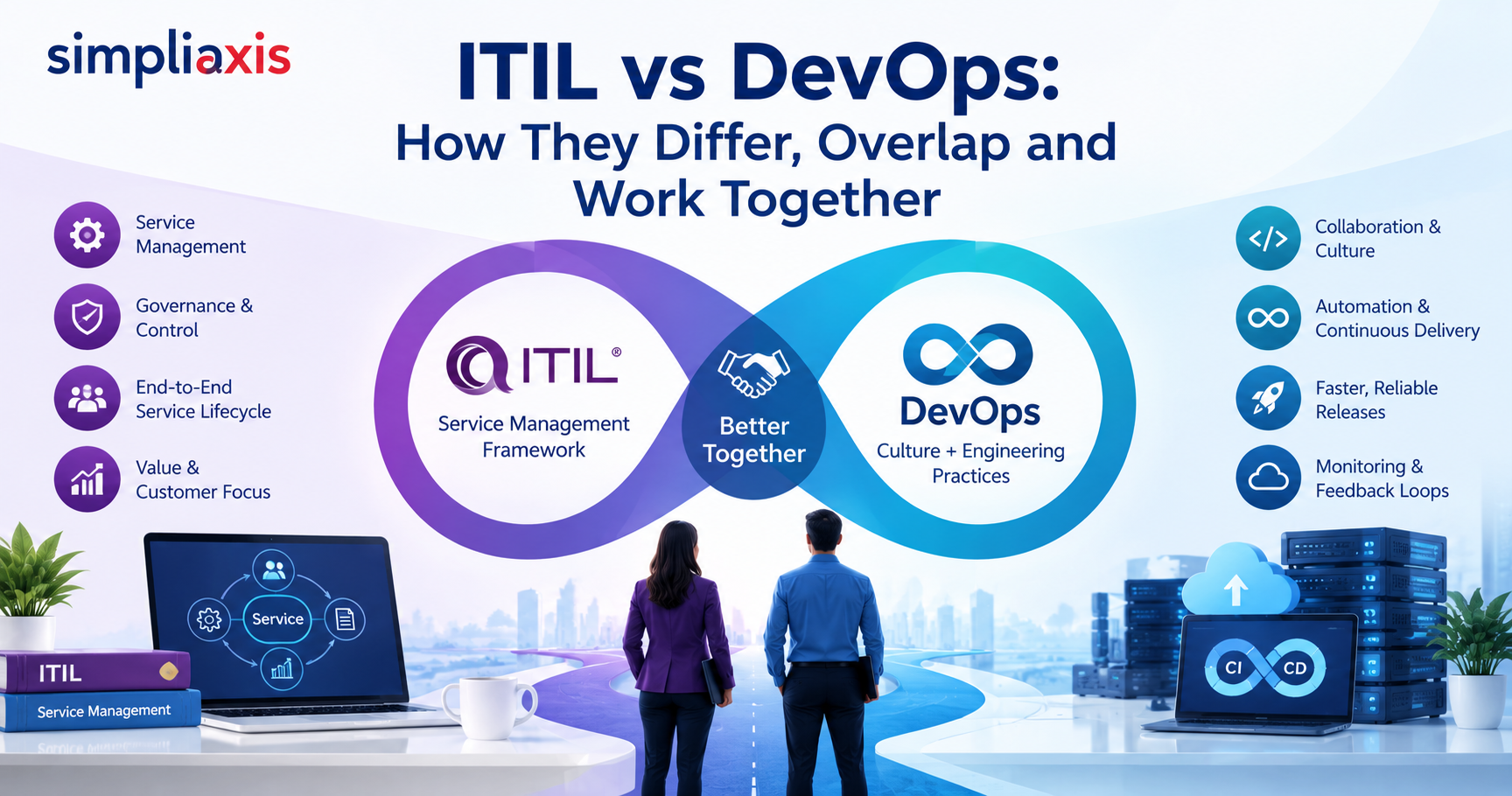
ITIL and DevOps are often presented as rivals, as though an organisation must choose between governed service management and fast, automated delivery. In practice they answer different questions. ITIL asks how an organisation designs, delivers and improves services that create value. DevOps asks how development and operations teams can ship changes quickly and reliably through collaboration and automation.
This guide explains the difference between ITIL and DevOps in plain terms, compares their goals, practices, roles and measures, shows where they overlap and where they clash, describes how teams combine them and helps you decide which to learn first. It stays at the level of what the frameworks say and avoids unsourced statistics.
Key Highlights of ITIL vs DevOps
- ITIL is a service management framework with practices for the whole service lifecycle. DevOps is a culture and set of engineering practices focused on fast, reliable software delivery.
- They are not mutually exclusive. ITIL 4 explicitly connects to DevOps, Lean and Agile ideas, and many organisations run both.
- The most visible tension is change control: traditional approval boards versus automated pipelines with small, frequent changes.
- ITIL suits service desk, operations, governance and service management careers. DevOps suits engineers who build, automate and run software.
- Many professionals benefit from both, and the sensible order depends on your current role.
What Is the Difference Between ITIL and DevOps? The Short Answer
ITIL is a framework of IT service management practices that guides how services are planned, delivered and improved, while DevOps is a culture and engineering approach that unites development and operations to deliver software faster and more reliably. One governs the service as a whole; the other speeds and stabilises the delivery of change.
ITIL is published today by PeopleCert, whose site at peoplecert.org lists the current ITIL certifications. DevOps has no single owner. Its research reference point is the DORA programme at dora.dev, which studies the practices and capabilities linked to software delivery and operational performance. That difference in origin matters: ITIL is a published framework with formal certifications, while DevOps is a movement with many tools, training providers and interpretations.
If you need a refresher on either side first, read our guides to the ITIL framework and DevOps principles.
ITIL vs DevOps at a Glance
| Dimension | ITIL | DevOps |
| Nature | Service management framework | Culture plus engineering practices |
| Primary focus | Value from services across the lifecycle | Speed and reliability of software change |
| Typical scope | Whole IT organisation and its services | Product and platform engineering teams |
| Origin | Published guidance, now maintained by PeopleCert | Community movement with research from DORA and others |
| Core mechanism | Practices, governance, continual improvement | Collaboration, automation, feedback loops |
| Change approach | Controlled, risk-based change enablement | Small, frequent, automated changes |
| Certification | Formal ITIL certifications | Many vendor and training-body options |
| Typical roles | Service desk, service owner, change and problem managers | DevOps engineer, SRE, platform engineer |
| Measures | Service quality, incident and request performance, customer outcomes | Delivery speed and stability measures, such as those researched by DORA |
The table shows complementary scopes. ITIL tells you what good service management looks like. DevOps tells you how to build and run software so that frequent change is safe.
What ITIL Provides
ITIL 4 organises its guidance around the service value system and the four dimensions of service management, and it names a set of management practices covering general management, service management and technical areas. Examples include incident management, problem management, change enablement, service request management, service level management, release management and continual improvement.
Its strengths are structure and shared vocabulary. A service desk, a security team and a vendor manager can talk about incidents, requests and changes in the same terms. It is also well suited to governance, auditing and customer-facing service commitments. For a breakdown of the guiding ideas, see our overview of ITIL principles, and for how work flows, see the ITIL process guide.
ITIL 4 describes seven guiding principles, including focus on value, start where you are, progress iteratively with feedback, collaborate and promote visibility, think and work holistically, keep it simple and practical, and optimise and automate. Several of these resemble DevOps and Agile thinking, which is why practitioners say the frameworks are closer in ITIL 4 than in earlier versions.
What DevOps Provides
DevOps is about removing the wall between the people who build software and the people who run it. It encourages shared ownership of outcomes, automation of repetitive work, continuous integration and delivery, infrastructure managed as code, and monitoring that feeds back into development.
Typical DevOps practices include:
- Version control for application and infrastructure code
- Automated build, test and deployment pipelines
- Small, frequent releases with fast rollback
- Monitoring, logging and observability tied to user impact
- Blameless reviews of failures
Our guide to CI/CD and how it works shows the pipeline side in more detail, and the article on the three ways of DevOps explains the flow, feedback and learning ideas behind the culture.
Key Differences Between ITIL and DevOps
Scope and Purpose
ITIL covers the full set of services an IT organisation offers, including support, vendor management and continual improvement. DevOps concentrates on delivering and operating software. A company can practise strong DevOps in its engineering group while still needing ITIL-style practices for its service desk and enterprise-wide services.
Approach to Change
Traditional ITSM change control relied on review boards and scheduled windows, which suits high-risk, infrequent changes. DevOps favours many small changes protected by automated tests, since a small change is easier to understand and reverse. ITIL 4 reframed this as change enablement, which differentiates change types and encourages lower-risk changes to be pre-approved or automated. That evolution narrows the gap, but cultures still differ in how readily they trust automation.
Culture and Ownership
DevOps stresses that teams own what they build, including running it. ITIL organisations often separate build and run, with handoffs between teams. Neither is automatically right, yet handoffs slow feedback, and many organisations adopting DevOps move toward shared ownership.
Documentation and Governance
ITIL values documented processes, policies and records, which supports audit and consistency. DevOps prefers working automation and code as documentation, with lightweight records. Regulated organisations often need both, using the pipeline itself as evidence of control.
Measures of Success
ITIL measures service quality: how fast incidents are resolved, whether service levels are met and whether customers get value. DevOps research highlights delivery performance, covering how quickly changes reach users and how stable they are. Used together, they give both a customer view and an engineering view.
Where ITIL and DevOps Overlap
The overlap is larger than the marketing suggests.
| Theme | In ITIL 4 | In DevOps |
| Continual improvement | A named practice and a guiding principle | Feedback loops and blameless learning |
| Collaboration | Collaborate and promote visibility | Shared ownership across teams |
| Automation | Optimise and automate | Automated pipelines and infrastructure as code |
| Incremental delivery | Progress iteratively with feedback | Small, frequent releases |
| Customer value | Focus on value | Delivering value quickly to users |
| Incident learning | Incident and problem management | Post-incident reviews |
Because of this alignment, ITIL practices like incident, problem and release management can be implemented through DevOps tooling. A deployment pipeline can raise change records automatically, and monitoring can open incidents without human intervention. Our comparison of ITIL vs Agile and the article on Agile vs DevOps show how the same questions apply to the other pairings.
Where ITIL and DevOps Clash, and How Teams Resolve It
Friction is real, particularly during adoption. These are the usual flashpoints and the sensible resolutions.
| Friction point | Why it happens | Practical resolution |
| Change approval boards slow releases | Review designed for large, rare changes | Classify changes by risk and automate approval for low-risk, well-tested changes |
| Separate build and run teams | Org charts mirror old ITIL structures | Create shared responsibility for production health |
| Heavy documentation | Process-first mindset | Generate records from the pipeline and keep manual forms for high-risk work |
| Tool silos | Service desk and engineering use different tools | Integrate the ticketing system with the delivery toolchain |
| Different vocabularies | Each community uses its own terms | Agree a shared glossary and map terms |
| Fear of loss of control | Speed seems to increase risk | Use tests, monitoring and rollback as evidence of control |
The common thread is to keep the intent of ITIL controls, such as managing risk and protecting customers, while changing the mechanism so it fits fast delivery.
How Organisations Combine ITIL and DevOps
Practitioners usually combine the two in one of three ways.
1. ITIL for the service layer, DevOps for the engineering layer. The service desk, vendor management and service levels follow ITIL, and product teams build and run software with DevOps practices.
2. DevOps pipelines embedded in ITIL practices. Incident, change and release practices stay recognisable, but are automated and integrated with delivery tools.
3. A lightweight blended model. The organisation selects a handful of ITIL practices, such as incident management, problem management and change enablement, and adapts them to product teams.
For large scaled environments, our guide to why DevOps matters in SAFe shows another route, in which delivery pipeline thinking sits inside a scaling framework. If you work in this space, the article on DevOps challenges lists the obstacles to expect.
A Worked Example: One Change Through Both Lenses
Consider a team that needs to release a small update to a customer-facing application. Looking at the same change through each lens shows how the approaches fit together rather than compete.
| Step | Traditional ITSM view | DevOps view | Blended approach |
| Request | Change request raised and categorised | Work item enters the backlog | Backlog item links to a change record automatically |
| Assessment | Risk assessed by a review board | Automated tests and checks assess risk | Low-risk changes pre-approved by policy, high-risk ones reviewed |
| Build and test | Handed to a separate team | Pipeline builds and tests on every commit | Pipeline results attached as evidence |
| Release | Scheduled deployment window | Deployed when checks pass | Deployed on pass, with a rollback plan |
| Operate | Operations team monitors | Team that built it watches production | Shared monitoring and a clear on-call route |
| Learn | Problem record if something fails | Blameless review of the incident | Review feeds the improvement register |
The blended column keeps what ITIL protects, namely a record, a risk decision and a path to learn from failure, while using DevOps mechanisms to make each step quick. Teams that adopt this pattern usually start with a single product team and a narrow class of low-risk changes, then widen the policy as confidence grows. The aim is not to remove control but to move it earlier and make it repeatable.
Tips for Teams Introducing DevOps Into an ITIL Organisation
- Start with a pilot. Choose one product team with a motivated owner and measurable pain, such as slow releases.
- Involve service management early. Invite the change and incident managers to design the new flow, so they shape the controls instead of resisting them.
- Define change categories. Agree which changes are standard, normal and emergency, and what evidence each needs.
- Integrate the tools. Connect the service desk, source control and deployment tools so records are created without manual re-entry.
- Share the measures. Report both service quality and delivery performance in the same review.
- Teach both vocabularies. Short workshops on ITIL terms for engineers, and on pipelines for service managers, reduce misunderstandings.
ITIL vs DevOps Careers and Skills
| Factor | ITIL-oriented path | DevOps-oriented path |
| Typical roles | Service desk analyst, service manager, change manager, problem manager, service owner | DevOps engineer, site reliability engineer, platform engineer, release engineer |
| Core skills | Process design, service levels, governance, stakeholder communication | Scripting, CI/CD, cloud, containers, monitoring |
| Entry point | Foundation-level service management knowledge | Programming and systems basics plus tooling |
| Best fit for | People who enjoy structure, customers and coordination | People who enjoy building, automating and troubleshooting |
| Growth | Service management leadership, IT governance | Engineering leadership, reliability, platform work |
Neither path is a safer bet in every market, and salary and demand vary by country and employer, so check current job postings in your region instead of relying on generic averages. Our guides to the ITIL certification career path and how to become a DevOps engineer describe each journey.
Which Should You Learn First?
Use your current role as the guide.
- You work in a service desk, operations or IT management role: start with ITIL, then add DevOps concepts to understand how modern delivery changes your processes.
- You are a developer, tester or cloud engineer: start with DevOps practices, then learn enough ITIL to talk to service management and governance teams.
- You are a project or programme manager moving into technology delivery: learn both at a foundation level, since you will sit between engineering and operations.
- You work in a regulated or enterprise environment: ITIL vocabulary is likely to be expected, so combine it with DevOps skills.
If you are weighing certification, ITIL certification levels explains the ladder, and is DevOps certification worth it gives a balanced view of the DevOps side. Foundation courses are the usual starting point in both frameworks.
Common Misconceptions About ITIL and DevOps
- "ITIL is outdated and DevOps replaced it." ITIL 4 was redesigned to align with modern ways of working, and many organisations still need service management.
- "DevOps means no process." Effective DevOps relies on disciplined practices, including testing, monitoring and incident learning.
- "You must choose one." The frameworks address different layers and are commonly combined.
- "DevOps is just tools." Tools help, but the core is shared ownership and feedback.
- "ITIL requires heavy bureaucracy." ITIL 4 advises keeping things simple and practical and adapting to context.
Conclusion
ITIL and DevOps are complementary. ITIL gives organisations a shared way to manage services for customers, and DevOps gives teams a way to deliver and run software quickly and safely. The clash appears mostly in change control, ownership and documentation, and it eases when teams keep the purpose of ITIL controls while automating how they work. Choose which to learn first based on your role, and expect to learn the other later.
Build service management skills: Explore the ITIL Foundation certification course.
Build delivery and automation skills: Explore the DevOps Foundation certification course.






 Lowest-Price Challenge












 Personalized Path



.webp)


 USA
 Canada
 India
 UK
 Australia
 Singapore


