


 Call Us




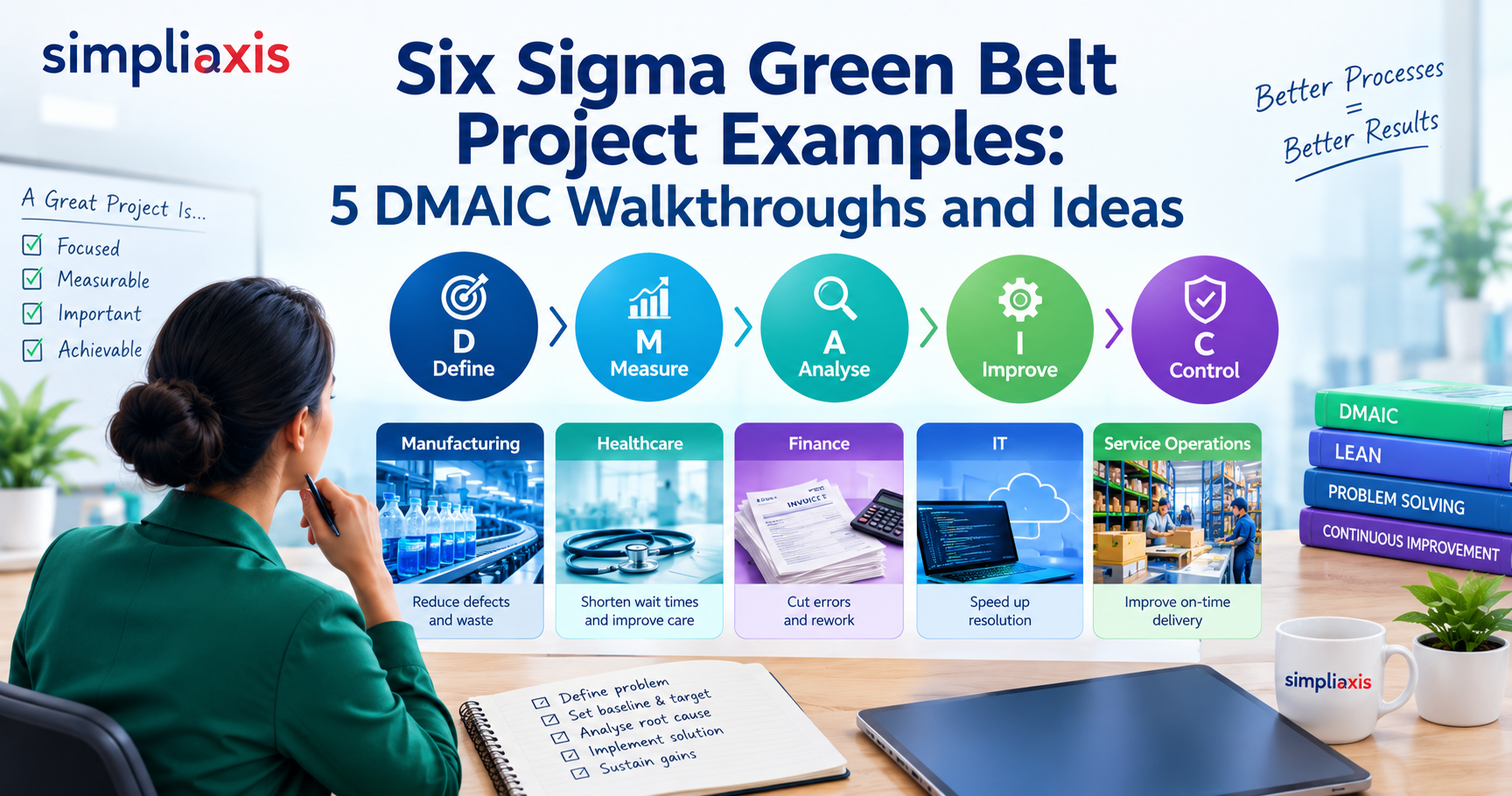
Most Green Belt candidates understand the DMAIC phases in theory and then stall on a practical question: what should my project actually be? A good project is narrow enough to finish in a few months, important enough that someone cares, and measurable enough to prove an improvement. A poor one is a vague wish to "improve quality" that never leaves the Define phase.
This guide gives realistic Six Sigma Green Belt project examples across manufacturing, healthcare, IT, finance and service operations, and walks through each with its DMAIC steps. The examples are illustrative scenarios built to teach the method. They are not case studies of real organisations, and any numbers shown are placeholders for the kind of measurement you would collect yourself. You will also find criteria for choosing a project, a charter template and the mistakes that sink first projects.
Key Highlights of Six Sigma Green Belt Projects
- A Green Belt project applies DMAIC (Define, Measure, Analyse, Improve, Control) to one specific, measurable process problem.
- Good projects have a clear problem statement, a baseline measure, a target, a defined scope and a sponsor.
- Examples range from reducing defects on a production line to shortening patient wait times, cutting invoice errors and speeding up IT ticket resolution.
- Scoping matters most. Projects that aim too wide rarely finish, and projects with no baseline cannot prove results.
- Every DMAIC phase produces a deliverable, so the project doubles as a portfolio piece for interviews.
What Counts as a Six Sigma Green Belt Project?
A Six Sigma Green Belt project is a focused improvement effort that uses the DMAIC method to reduce variation, defects or waste in one defined process, backed by data and a measurable target. Green Belts typically lead such projects part time alongside their regular job, often supported by a Black Belt or quality lead.
If DMAIC is new to you, our overview of the Six Sigma DMAIC process and methodology explains each phase. The American Society for Quality also publishes a plain description of the DMAIC method, which is useful as a neutral reference.
A project differs from a general improvement idea in four ways: it has a measurable problem, it has a defined boundary, it follows evidence from data collection through analysis, and it ends with a control plan so gains last. You can read how the Green Belt role fits in our guide to Six Sigma Green Belt roles and responsibilities.
How to Choose a Good Green Belt Project
Before looking at examples, use these tests. A candidate project should pass most of them.
| Test | Good sign | Warning sign |
| Measurable | You can count defects, time, cost or errors today | "Better customer experience" with no measure |
| Scoped | One process, one location, one product or one team | A department-wide or company-wide goal |
| Data available | You can collect or already have baseline data | No data and no way to collect it in weeks |
| Controllable | The team can change the process | Root cause sits outside your authority |
| Valuable | A sponsor cares about the outcome | No one will act on the result |
| Achievable | Finishable in about three to six months | Needs a major system replacement |
| Cause unknown | The root cause needs investigation | The solution is already decided |
The last test is often missed. If management has already chosen the solution, you have a project execution task, not a DMAIC improvement. DMAIC is for problems where the cause is not yet known.
The Project Charter: Your Starting Document
Every example below begins with a charter. A short charter keeps the team aligned and gives the sponsor something to approve. It usually contains the problem statement, business case, goal statement, scope, team and timeline. Our guide to the elements of a project charter in Six Sigma goes through each field.
| Charter field | What to write | Example wording |
| Problem statement | Observable gap with a baseline and period | "Between January and March, 8 percent of invoices contained errors" (placeholder figure) |
| Business case | Why it matters | "Errors delay payment and consume rework hours" |
| Goal | Measurable target and date | "Reduce invoice errors to 3 percent by September" |
| Scope | What is in and out | "Accounts payable invoices under a set value, one region" |
| Team and sponsor | Names and roles | Sponsor, Green Belt lead, process owner, analyst |
| Timeline | Phases and milestones | One to two months per phase |
Write the problem statement without including a cause or a solution. "Invoices have errors because staff are untrained" already assumes the answer.
Example 1: Reducing Defects on a Manufacturing Line
Scenario. A packaging line produces labelled bottles, and a share of units are rejected at final inspection because labels are misaligned.
| Phase | What the team does | Typical deliverable |
| Define | Write the charter, map the process at a high level using a SIPOC diagram, identify the customer requirement for label placement | Charter, SIPOC |
| Measure | Check the measurement system for inspectors, collect defect counts by shift, machine and label batch | Baseline defect rate, measurement system results |
| Analyse | Compare defect rates across machines, shifts and suppliers, use a cause and effect diagram and a Pareto chart | Verified root causes |
| Improve | Test fixes such as a standard machine setup and a label supplier specification, pilot on one line | Pilot results |
| Control | Add a setup checklist, a control chart on rejection rate and a response plan | Control plan |
Supporting tools include the SIPOC diagram, measurement system analysis and Pareto analysis. A frequent finding in projects like this is that inspectors disagree on what counts as a defect, so fixing the measurement comes before fixing the machine.
Example 2: Reducing Patient Wait Time in an Outpatient Clinic
Scenario. Patients at an outpatient clinic often wait longer than the clinic's own target between check-in and seeing a clinician.
| Phase | What the team does | Typical deliverable |
| Define | Define "wait time" precisely, for example check-in to consultation start, and set scope to one clinic and weekday appointments | Charter with operational definition |
| Measure | Record timestamps for each step over several weeks, capture variation by hour and by clinician | Baseline average and spread |
| Analyse | Map the process, find where queues build, test whether arrival pattern, room availability or paperwork explains delays | Value stream map, verified causes |
| Improve | Trial staggered appointment slots, pre-visit form completion and room turnaround standards | Pilot results |
| Control | Track weekly wait time on a run chart and assign an owner for the schedule rules | Control plan and dashboard |
Value stream thinking is helpful here, and our guide to value stream mapping shows the technique. Always involve clinical staff early, because they know the constraints, and respect patient privacy by using aggregated or anonymised data.
Example 3: Cutting Invoice Errors in Accounts Payable
Scenario. An accounts payable team spends time correcting invoices that were entered with wrong amounts, wrong vendors or missing purchase order numbers.
| Phase | What the team does | Typical deliverable |
| Define | Define "error" as any invoice needing correction after entry, and set scope to one invoice type | Charter, defect definition |
| Measure | Sample invoices over a period, count error types and the rework time per error | Baseline error rate and cost of rework |
| Analyse | Pareto the error types, use five whys on the largest category and compare errors by entry method | Root causes confirmed with data |
| Improve | Add mandatory fields, a purchase order check at entry and a vendor template | Pilot results |
| Control | Monitor weekly error rate, document the revised procedure and train new staff | Control plan |
A useful metric set is described in commonly used Six Sigma metrics, including defects per unit and defects per million opportunities. Choose the metric your sponsor understands, because a clear measure is easier to defend than a sophisticated one.
Example 4: Speeding Up IT Service Ticket Resolution
Scenario. An IT support team wants to cut the time it takes to resolve routine tickets, which drifts well beyond its service target for certain categories.
| Phase | What the team does | Typical deliverable |
| Define | Choose one ticket category, define resolution time from creation to closure and agree exclusions | Charter |
| Measure | Extract ticket timestamps, check data quality and compute baseline median and spread | Baseline and data quality notes |
| Analyse | Segment by category, priority and assignment path, find where tickets wait in queue or bounce between teams | Cause analysis |
| Improve | Test improved routing rules, a knowledge base article for the top issue and a first-contact checklist | Pilot results |
| Control | Track resolution time on a control chart and set an escalation trigger | Control plan |
Because ticket data usually exists already, IT projects are a convenient first project, though data quality needs checking before you trust it. Related service management ideas appear in our comparison of ITIL and agile.
Example 5: Reducing Order Fulfilment Delays in a Warehouse
Scenario. A warehouse often ships orders later than promised, and customers complain about missed delivery dates.
| Phase | What the team does | Typical deliverable |
| Define | Define "late" against the promised ship date and limit scope to one product family | Charter |
| Measure | Record timestamps for picking, packing and dispatch and measure the share shipped late | Baseline late rate |
| Analyse | Look for waiting, motion and rework using the seven wastes, and test whether stock location, batch size or staffing drives delays | Verified causes |
| Improve | Test location slotting, batch release rules and a packing station layout | Pilot results |
| Control | Visual management board, daily late-order review and standard work | Control plan |
The lean lens fits well. Our guide to the seven wastes of Lean lists the types of waste to look for, and the Lean Six Sigma tools article shows which methods apply at each stage.
More Green Belt Project Ideas by Function
Here are shorter ideas that can be shaped into full projects once you add a baseline and target.
| Function | Project idea | Possible measure |
| Customer support | Reduce repeat contacts for the same issue | Repeat contact rate |
| Human resources | Shorten time to fill a common role | Days from request to offer |
| Procurement | Reduce purchase orders issued with missing details | Percentage needing rework |
| Software testing | Reduce defects that escape to production | Escaped defects per release |
| Retail | Reduce stockouts in a product category | Stockout rate |
| Hospital pharmacy | Reduce medication order turnaround | Minutes from order to delivery |
| Logistics | Reduce damaged goods in transit | Damage rate per shipment |
| Banking operations | Reduce account opening rework | Share of applications returned |
Treat each as a starting prompt. Before choosing one, confirm data access and sponsor interest.
How to Run Your Project Week by Week
Teams that finish projects usually plan the rhythm up front. The outline below suits a part-time Green Belt working across roughly four months. Adjust it to your data and sponsor availability.
| Weeks | Phase | Milestone to aim for |
| 1 to 2 | Define | Signed charter, SIPOC and a clear defect definition |
| 3 to 6 | Measure | Verified measurement system and a baseline that the sponsor accepts |
| 7 to 9 | Analyse | Root causes confirmed with data, not opinion |
| 10 to 13 | Improve | Pilot run with before and after comparison |
| 14 to 16 | Control | Control plan, owner named and handover completed |
Hold a short review with the sponsor at the end of each phase. These gates catch scope drift early and give the sponsor a chance to remove obstacles. Practitioner communities such as iSixSigma publish articles and templates that can supplement your own tools, though you should check any template against your certifying body's expectations.
Questions to Ask Before You Close a Project
- Did the measure move against the baseline, and is the change larger than normal variation?
- Does the control plan name an owner and a review frequency?
- Would someone new to the process follow the revised procedure correctly?
- Which of the root causes did we confirm, and which remain untested?
- What did we learn that another team could reuse?
Answering these keeps the final report honest and gives future projects a better starting point.
Common Mistakes in Green Belt Projects
- Starting with the solution. If the answer is already decided, DMAIC becomes a justification exercise.
- Skipping the baseline. Without a starting measure you cannot prove improvement.
- Boiling the ocean. Wide scope stretches the timeline and hides root causes.
- Trusting the data blindly. Check the measurement system before analysing.
- Ignoring the people. Front-line staff know where the process breaks, and ignoring them causes resistance.
- Forgetting the control phase. Gains fade without monitoring and an owner.
- Counting activities as results. Training sessions delivered are not defect reductions.
Our article on Six Sigma implementation challenges covers organisational obstacles in more detail.
Using Your Project for Green Belt Certification and Your Career
Many certification routes expect or encourage a real project, and a completed project gives you concrete evidence for interviews. Requirements differ between certifying bodies, so check the rules of the one you choose before you start. If you are still comparing options, read about the benefits of Six Sigma Green Belt certification and whether Six Sigma Green Belt is worth it, and review the Six Sigma Green Belt tools you will need.
When presenting the project, tell it as a story: the problem and baseline, what the data showed, what you changed, the result and how you protected it. Report results honestly, including partial results. A modest, well-evidenced improvement is more credible than an impressive number with no method behind it.
Conclusion
The best Six Sigma Green Belt project is a small one with a measurable baseline, a defined scope and a cause you do not yet know. The five examples above, covering manufacturing, healthcare, accounts payable, IT support and warehousing, show the same discipline in different settings: define precisely, measure honestly, analyse before acting, test the fix and lock in the gain. Choose a problem that matters to a sponsor, write a clear charter and let the data lead.
Prepare for the credential: See the Lean Six Sigma Green Belt certification training.
Test your knowledge: Try the Lean Six Sigma Green Belt practice tests.








 Lowest-Price Challenge












 Personalized Path



.webp)


 USA
 Canada
 India
 UK
 Australia
 Singapore


