


 Call Us



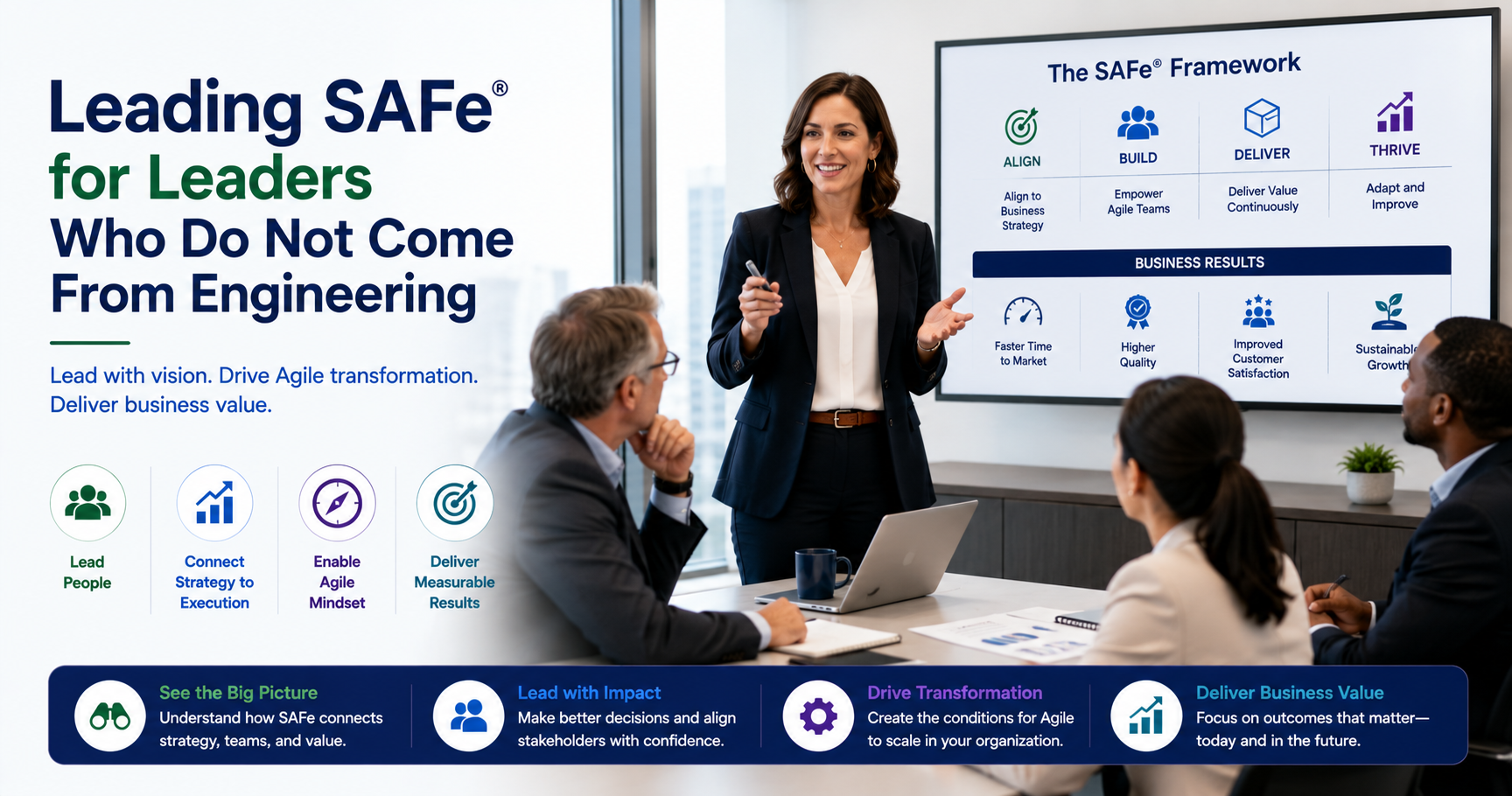
Leading SAFe assumes no technical background and a large share of every cohort comes from finance, operations, HR, marketing and general management. The class does not require you to read code or understand architecture. What it does assume is that you have watched delivery at scale go badly, which is a far more common qualification than engineering experience and a considerably more useful one.
Key Highlights
- Scaled Agile lists no prerequisites for SAFe Agilist certification, and the training course is not required in order to sit the exam.
- The syllabus weights portfolio funding and organisational change heavily, which are business subjects rather than technical ones.
- Two of the six exam domains, covering product development flow and Lean Portfolio Management, carry 25 to 28 percent each and neither requires engineering knowledge.
- The genuine barrier for non-technical leaders is vocabulary rather than concepts, and it is a fortnight's problem rather than a permanent one.
- Finance and operations leaders frequently find the portfolio material more intuitive than delivery-side attendees do, because funding models are already their subject.
- The framework's hardest requirements are behavioural and structural, which is why business leaders are often better placed to act on them than engineering ones.
What the class actually assumes
Worth separating what is assumed from what people fear is assumed.
Assumed: that you have seen work move slowly through an organisation and want to know why. That you understand budgets and approval processes. That you have some sense of how decisions get made where you work.
Not assumed: any programming knowledge. Any architecture knowledge. Any experience of Agile at team level. Any familiarity with the tooling.
The class does use vocabulary that will be unfamiliar, and that is the real obstacle rather than the concepts. Terms like Feature, Capability and Enabler carry precise meanings that differ from ordinary usage, and a leader who does not pin them down early spends day two decoding rather than thinking. Our SAFe glossary covers the terms worth learning before you arrive.
Why business leaders are often better placed than engineers
Counterintuitive and worth stating, because non-technical attendees frequently arrive assuming they are at a disadvantage.
The framework's genuinely difficult requirements are not technical. They are that money moves to value streams rather than projects, that approval authority is delegated, that reporting stops asking for percentage complete against fixed scope, and that early bad news is met with help rather than scrutiny.
Every one of those is a business decision. An engineering leader can advocate for them and generally cannot make them. A finance director, a chief operating officer or a business unit head frequently can.
That is why the SAFe implementation roadmap sequences leadership before teams, and why adoptions sponsored only from within technology tend to stall at the funding conversation. The people who can resolve that conversation were never in the room.
The parts you will find easy
Portfolio funding. Lean Portfolio Management covers funding value streams rather than projects, lean budgets and guardrails, and how governance changes when money stops moving through annual approval. Finance and operations leaders often find this the most intuitive part of the class while delivery-side attendees struggle with it, which reverses the usual pattern. It is also 25 to 28 percent of the exam.
Business agility. The framing that opens the class is about organisational responsiveness to market change. This is business strategy expressed in Agile vocabulary, and general managers usually recognise the problem immediately.
Leading the change. The closing module covers what leaders do to move an organisation. Anyone who has run a change programme will find the substance familiar even where the terminology is new.
Business Owner accountability. Assigning business value to objectives during planning is a business judgement about relative worth. Our piece on what Business Owners do in PI Planning covers the accountability, and it requires no technical knowledge at all.
The parts that take more work
Honest about where the effort goes.
The sizing hierarchy. Epic, Capability, Feature, Story, with Enabler as a type rather than a level. Pure vocabulary, no technical content, and the single most examined area on the paper. Budget an hour and treat it as memorisation.
Team and technical agility. The domain covering how teams operate and the technical practices the model assumes. This is the least intuitive section for non-technical attendees and it is worth 7 to 9 percent of the exam, so the effort should be proportionate.
The events and their outputs. Five recurring events, each producing something specific. Learnable in an evening and frequently under-revised because it looks trivial. Our guide to every SAFe event covers what each one produces.
The cadence logic. Why the framework insists on fixed-length increments and synchronised planning. Once it clicks it is obvious; before it does, it reads as arbitrary bureaucracy. The shortest route to it is an analogy from your own function: a monthly close, a quarterly board cycle, a weekly trading meeting. All of them impose a rhythm that individually feels inconvenient and collectively makes coordination possible, which is exactly the argument the framework is making about delivery.
None of these requires engineering knowledge. They require accepting a period of unfamiliar vocabulary, which is uncomfortable for senior people used to being the most informed person in a room.
Preparing if you are coming from outside technology
Four things, worth about three hours in total.
Learn eight terms before you arrive. Agile Release Train, Program Increment, PI Planning, value stream, Feature, Epic, Capability, Enabler. Arriving with these already meaning something changes the entire experience of day one.
Read the Agile Manifesto once. The class assumes it rather than teaching it, and the principles section builds directly on top.
Find out how your organisation currently funds change. Annual budgets, project approvals, who signs off at what threshold. This is the material the portfolio section will connect to, and having it in mind makes that section land rather than float.
Write down one delivery problem you have watched. Something taking longer than it should for reasons nobody can quite name. Every module becomes more useful when tested against something concrete.
Sitting the free Leading SAFe practice test beforehand is also worth ten minutes, because it tells you whether the vocabulary gap is small or large before you are in the room.
What to do about the confidence problem
The real obstacle for senior non-technical attendees is rarely capability. It is discomfort at being a beginner in front of people who are not.
Three things help.
Ask the basic question early. Someone else in the room has it and is not asking. In a mixed cohort the person who asks what an Enabler actually is will usually be thanked, and asking on day one is far cheaper than working it out on day two.
Contribute what you know. When the class reaches portfolio funding or organisational change, you will frequently know more than the delivery-side attendees. Cohorts benefit from that and it resets how the room reads you.
Separate vocabulary from concept. Most of the initial disorientation is terminology rather than difficulty. Once the eight terms above are solid, the conceptual content is not hard for anyone who has run a function.
What business leaders bring that the room needs
Worth saying explicitly, because non-technical attendees consistently underestimate their contribution.
You know how decisions actually get made. Engineering leaders frequently describe the approval process as a black box. A finance or operations leader can explain why it exists, who owns it, and what would have to change. That is the single most valuable piece of knowledge in any adoption conversation.
You can price things. When the class covers the cost of planning cadence or the Innovation and Planning Iteration, someone who thinks in capacity and budget can make the tradeoff concrete rather than theoretical.
You have watched change programmes fail. Most business leaders of any seniority have. That scepticism is not an obstacle, it is calibration, and it produces better questions than enthusiasm does.
You are not attached to the current delivery model. Engineering leaders sometimes defend existing practice because they built it. A business leader is usually more willing to ask why it works the way it does.
In mixed cohorts these contributions consistently improve the room, which is worth knowing if you are worried about being the least technical person present. Our breakdown of the Leading SAFe class covers how the cohort dynamic actually works.
The specific decisions you will be asked to make
If your organisation adopts SAFe, a business leader ends up owning several decisions the framework depends on. Knowing which ones in advance is useful.
Whether funding moves to value streams. The most consequential decision in any adoption, and it belongs to finance rather than delivery. Our piece on the SAFe implementation roadmap covers why the sequence puts this early.
What the approval thresholds become. Lean budgets come with guardrails, which are spending policies rather than approval gates. Setting them is a business judgement about acceptable risk.
Who the Business Owners are. Naming the people accountable for the value a train delivers, and ensuring they have the authority and the diary space to do it.
What reporting changes to. If leadership continues asking for percentage complete against fixed scope, teams will produce it, and producing it requires maintaining the plans the framework replaced.
Every one of those sits with business leadership rather than engineering. Attending the class without understanding the model means taking them blind, which is the strongest practical argument for going.
Whether the credential is worth it for a business leader
Depends on one thing: whether your organisation runs SAFe or is adopting it.
If it is, the credential is close to a working requirement. Not for the certificate, but because the next twelve months of conversations will run on this vocabulary and you will be making funding and governance decisions inside it. Attending without understanding the model means deciding blind.
If it is not, the value is much lower. The framework's concepts are transferable in a general sense and the specifics are not, and there are better uses of two days for a leader in a non-SAFe organisation.
If a decision is pending, this is the strongest case of all. A leader deciding whether to adopt SAFe should understand what it will actually require of them, and the class is the cheapest way to find that out before committing an organisation to it.
The Leading SAFe course target audience breakdown covers whether your role is in scope, and Leading SAFe certification training runs two days with the exam attempt included.
Translating the framework back to your own function
The most useful thing a non-technical leader can do after the class is translate the model into the language of their own function, since that is where they will have to defend it.
For finance. The framework's core financial argument is that funding fixed-scope projects annually forces decisions to be made when least is known. Funding value streams instead moves the decision closer to the information. That is a recognisable argument about option value rather than an Agile one, and it lands with finance audiences far better than any framework diagram.
For operations. The argument is about queues and flow. Work in progress lengthens lead times, handoffs create waiting, and local efficiency targets produce global slowdown. Operations leaders usually know this from other contexts and recognise it immediately when it is not dressed in Agile vocabulary.
For HR and people functions. The framework assumes stable long-lived teams and treats people as the source of value rather than as allocatable capacity. That has direct implications for how roles, reporting lines and performance conversations are structured, and it is a conversation HR usually is not invited into early enough.
For marketing and commercial. The argument is about responding to market change faster than the planning cycle allows. Anyone who has watched a campaign approved in October become irrelevant by March will recognise the problem the framework claims to solve.
Doing this translation once, for your own function, is worth more than a second read of the course materials. It also prepares you for the conversation where a peer asks what this actually means for them, which is where adoptions are quietly won or lost. Our piece on business agility covers the framing that underpins all four of these translations, and Leading SAFe certification training works through them across the two days.
What the class will not tell you
Three things worth knowing that the syllabus does not cover, and which matter more to a business leader than to a delivery one.
The framework cannot fix a strategy problem. If the organisation is building the wrong things, SAFe will help it build them faster and more predictably. Business leaders are usually better placed than engineering leaders to notice when this is the actual issue, and adopting a delivery framework to address a strategy failure is a common and expensive misdiagnosis.
Adoption cost is front-loaded and benefit is back-loaded. The training, the planning time and the transition disruption all arrive early. The predictability and flow improvements arrive later. Anyone approving budget should understand that shape before committing, because the trough is where sponsors lose their nerve.
Partial adoption is legitimate and usually sensible. The framework is presented in configurations, and starting small is supported rather than a compromise. Business leaders under pressure to demonstrate scale sometimes push for organisation-wide rollout, which removes the learning the sequence was designed to produce.
None of these is hidden. They are simply not what a two-day class organised around a framework has time to emphasise, and they are exactly the considerations a business leader is being asked to weigh. The free Leading SAFe practice test is worth ten minutes before booking to see how much of the underlying model you already hold.
The first meeting after the class
A practical note, because the return to work is where the two days either convert or evaporate.
Business leaders come back to a diary full of the things that were waiting, and the framework knowledge sits unused until something forces it out. The way to prevent that is to book one conversation before you attend.
Pick the person who owns the constraint you expect to find. Usually that is finance, occasionally it is whoever owns the approval process. Book thirty minutes for the week after the class, without an agenda beyond wanting to talk through something you have been looking at.
That single booking does two things. It creates a deadline for turning the material into something specific, which is the work that actually matters. And it puts the conversation in front of the person who can act, rather than in a summary email that gets skimmed.
The alternative, which is what usually happens, is that the certificate is added to a profile and the material is never applied to anything. Our breakdown of the Leading SAFe course curriculum is worth reviewing beforehand so you know which module will produce the material for that conversation.
The short version
The barrier for non-technical leaders is real and it is temporary. It is vocabulary, it lasts about a fortnight, and it is the price of participating properly in decisions you are already responsible for.
What is not a barrier is the substance. The framework's hardest requirements are about money, authority and behaviour, which are business subjects. A leader who can change how a value stream is funded is more useful to an adoption than one who can explain the architecture, and the class is built on that premise rather than in spite of it.
Leading SAFe certification training covers the full syllabus across two days including the exam attempt, current certification costs are listed separately, and the free Leading SAFe practice test is a quick way to size the vocabulary gap before booking.


Exam-01_1724672816.jpg)
_1738228799.jpg)




 Lowest-Price Challenge











 Personalized Path


.webp)


 USA
USA  Canada
  India
India  UK
UK  Australia
  Singapore


