


 Call Us




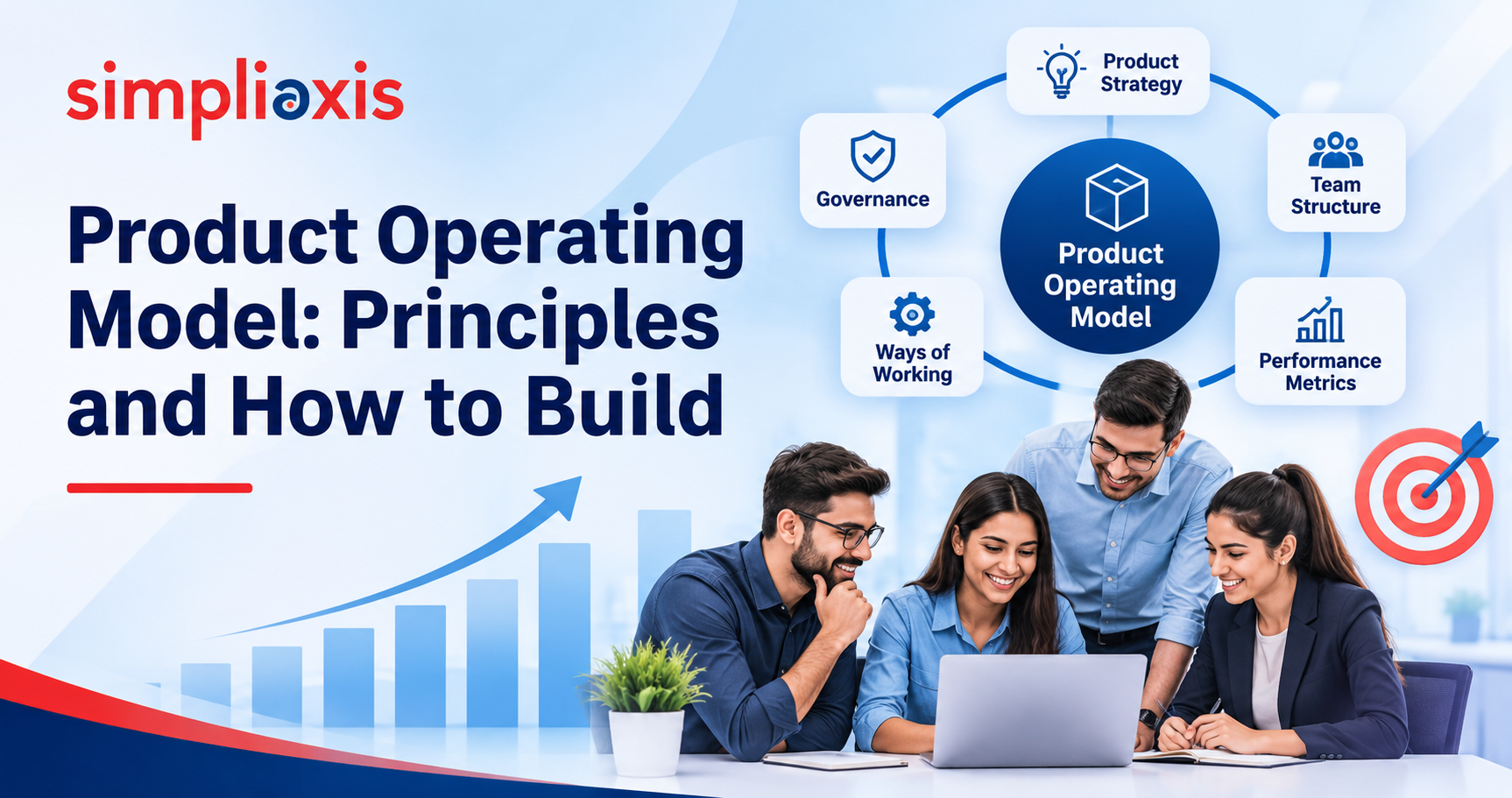
A product operating model defines how an organization structures teams, makes product decisions, and delivers value to customers. Instead of assigning teams a fixed list of features, it gives them responsibility for solving customer problems and achieving measurable business outcomes. The model connects product strategy, cross-functional collaboration, continuous discovery, delivery, and performance measurement. Its purpose is to help organizations build products that meet customer needs while supporting long-term business goals.
Key Highlights of Product Operating Model
A product operating model connects business strategy, product development, team ownership, and customer outcomes.
Its core principles include empowered teams, continuous product discovery, outcome-based decisions, and shared accountability.
McKinsey's study of more than 400 publicly traded companies found that businesses with higher product operating model maturity had 60% greater total shareholder returns (McKinsey, The bottom-line benefit of the product operating model). than lower-maturity companies. This is an association, not proof of causation.
The main product operating model components include product strategy, team structure, ways of working, performance metrics, and governance.
A successful transition requires more than adopting Agile practices. Organizations must also reconsider decision-making authority, leadership responsibilities, and how they measure success.
Introduction
A company can release features every month, meet its sprint commitments, and still struggle to improve customer retention. The delivery process may be working, but the product itself might not be solving the right problems.
This disconnect is one reason organizations are reconsidering how they manage products.
In December 2023, McKinsey published research covering more than 400 publicly traded companies. Its analysis found that organizations with mature product and platform operating models had 16% higher operating margins than companies in the bottom half of its maturity assessment. The study also reported stronger customer engagement and brand awareness among high-maturity organizations.
These findings do not mean that changing an operating model automatically improves profitability. They do, however, show why the relationship between organizational practices and business performance deserves attention.
A product operating model addresses how teams identify customer needs, decide what to build, test possible solutions, and measure the results.
This guide examines its principles, components, practical examples, and the steps organizations can take to move from project-based delivery towards a product-focused approach.
What Is a Product Operating Model?
A product operating model is the organizational approach used to develop, manage, and continuously improve products. It establishes how product teams operate, who makes decisions, and how their work contributes to customer and business outcomes.
Rather than treating product development as a series of assignments with fixed completion dates, the model encourages teams to take ongoing responsibility for a product or customer problem.
For example, a digital banking team might be responsible for improving the account-opening experience. Its work would not necessarily end after launching a redesigned registration form. The team would continue examining completion rates, customer feedback, verification failures, and opportunities for improvement.
The emphasis shifts from completing predefined tasks to improving measurable results.
Product Operating Model Definition
The product operating model framework brings together the people, processes, capabilities, and decision-making practices required to deliver product value.
Marty Cagan of Silicon Valley Product Group (SVPG) describes the product model through principles, practices, and competencies associated with successful technology-powered companies. His work emphasizes giving skilled product teams responsibility for solving problems rather than simply implementing requested features.
In practical terms, the model answers four questions:
- Which customer or business problems should the organization prioritize?
- Who is responsible for discovering and delivering solutions?
- How much decision-making authority do product teams have?
- How will the organization know whether its products are successful?
These questions also influence product strategy, which connects long-term business objectives with the product decisions teams make.
Why Companies Move to a Product Operating Model
Organizations often adopt a product model when traditional delivery structures begin creating delays, excessive handoffs, or weak connections between technology investments and customer needs.
A product-focused approach can help teams respond to changing requirements without waiting for an entirely new project to be approved.
McKinsey's 2024 analysis of industrial-sector technology found that 44% of top-performing companies across industries had adopted product- or platform-centric operating models. Adoption among industrial companies was 15%, compared with 26% among nonindustrial companies in the study.
The figures illustrate how adoption differs across sectors. They should not be interpreted as evidence that every organization needs the same operating structure.
Common reasons for making the transition include reducing dependencies between departments, improving customer experiences, accelerating learning, and giving teams clearer responsibility for results.
However, changing job titles or reorganizing reporting lines is rarely sufficient.
A meaningful product operating model transformation, like anyAgile transformation, also requires changes to leadership behaviour, funding decisions, team capabilities, and performance measurement.
The Core Principles of the Product Operating Model
The product operating model principles influence how teams select problems, develop solutions, and evaluate success. They are not limited to software development practices. They also affect leadership decisions, budgeting, collaboration, and how organizations respond when a product fails to meet expectations.
Solving Problems, Not Just Shipping Features
Shipping a feature does not necessarily mean a customer problem has been solved.
Consider a SaaS company experiencing low trial-to-paid conversion. A stakeholder might suggest adding more onboarding tutorials. But before building anything, the team needs to understand why users are not converting.
Are customers struggling with setup? Do they understand the product's value? Are important capabilities missing?
Answering these questions may reveal that users need a simpler onboarding process rather than additional tutorials.
This principle also changes how teams approach a minimum viable product (MVP). Instead of building a smaller version of every requested feature, they can useproduct discovery techniquesto test the most important assumptions with limited effort.
The goal is to learn whether a proposed solution creates value before committing substantial development resources.
Empowered, Cross-Functional Teams
A product team needs more than a product manager assigning tasks to developers.
Effectivecross-functional teams bring together complementary expertise, often including product management, design, engineering, and other specialists as needed. They are given a clear problem, strategic context, and authority to make appropriate solution decisions.
Marty Cagan's SVPG framework identifies product management, product design, and engineering as essential competencies for empowered product teams. Leadership is responsible for providing direction, staffing, and coaching rather than prescribing every solution.
Research also supports the importance of team effectiveness. In December 2024,McKinsey reported findings froman analysis of more than 1,700 teams across 75 organizations. The research examined how strategy, structure, people, processes, and technology relate to effectiveness, speed, productivity, and quality.
For organizations adopting a product model, this highlights the importance of looking beyond team structure alone. A team may have the right specialists but still struggle if decisions require several layers of approval or if responsibilities remain unclear.
Continuous Discovery and Delivery
Product development involves two closely connected activities: understanding what should be built and delivering working solutions. Product discovery focuses on identifying customer problems, testing assumptions, and evaluating possible solutions. Product delivery involves building, testing, releasing, and maintaining those solutions.
These activities should inform one another. For example, a subscription platform might discover through customer interviews that users struggle to compare pricing plans. The team could test revised plan descriptions with a prototype before changing the live website.
After release, it could measure plan-selection rates, conversion, and customer support inquiries. The findings would inform the next improvement. Continuous discovery does not require interviewing customers every day. It requires a regular learning process appropriate to the product, its users, and the decisions being made.
Common activities include customer interviews, product reviews,backlog refinement, experimentation, release planning, and performance analysis.
Outcomes Over Output
Output describes what a team produces. Outcomes describe the changes that result from that work. A team may release five features, resolve 40 defects, and complete every planned user story. Those activities demonstrate delivery, but they do not establish whether customer experience improved. Outcome measures provide a different perspective.
For a mobile banking application, relevant outcomes might include a higher percentage of successful transactions, fewer failed account registrations, or reduced customer support requests. These measures should be defined before major development begins.
For example:
- Output: Launch a redesigned account-opening journey.
- Outcome: Increase successful account-opening completion from 60% to 75%.
- Guardrail: Ensure fraud-related losses do not increase beyond an agreed threshold.
The percentages above are illustrative targets, not industry benchmarks. An outcome-focused approach also allows teams to reconsider solutions that are not producing the expected results.
The Building Blocks of a Product Operating Model
There is no single organizational template that works for every company. A startup with two product teams will have different requirements from a financial institution managing dozens of digital products. Nevertheless, several product operating model components are consistently important.
Product Strategy and Vision
Product vision describes the long-term direction of a product. Strategy identifies the customer problems, market opportunities, and competitive choices that will help achieve that vision. Without a clear strategy, teams can become busy delivering requests that have little connection to organizational priorities.
For example, a learning platform might establish a strategic goal of improving course completion among working professionals. Its teams could then investigate scheduling difficulties, learning-content relevance, mobile accessibility, and learner engagement.
A product roadmap would communicate the problems and opportunities being prioritized, along with planned initiatives and dependencies. The product operating model strategy should also clarify what the organization will not pursue. Without these boundaries, teams may struggle to make consistent prioritization decisions.
Team Topology and Ownership
Team topology describes how product teams are organized around products, capabilities, customer journeys, or business problems. An e-commerce business might have teams responsible for product discovery and search, checkout, payments, and post-purchase experiences.
Each team needs a defined area of ownership. However, teams must also coordinate when a customer journey crosses several product boundaries. Ownership should include more than feature development. Teams need visibility into product quality, customer feedback, technical health, and relevant performance measures.
Marty Cagan has also emphasized that team topology and organizational reporting structure are not the same thing. A company can change how teams collaborate without necessarily changing every employee's reporting relationship. This distinction matters during product operating model design because unnecessary restructuring can create disruption without resolving the underlying problems.
Ways of Working and Cadences
Ways of working define how teams conduct discovery, prioritize opportunities, coordinate delivery, and review results. Common activities include customer interviews, product reviews, backlog refinement, experimentation, release planning, and performance analysis. The frequency of these activities depends on the product and its operating environment.
A consumer mobile application might release improvements several times a week. A regulated financial product may require additional security, risk, and compliance checks before deployment. Both can operate with a product-focused approach.
McKinsey's research into product and platform operating model maturity identified ways of working as the area most strongly associated with overall business performance among the five dimensions it examined. Organizations should therefore evaluate how decisions and collaboration actually happen, rather than measuring maturity only by the number of Agile ceremonies conducted.
Metrics and Governance
Metrics help teams understand whether their decisions are improving customer and business outcomes. The appropriate measures depend on the product. A SaaS platform might track activation, customer retention, expansion revenue, and feature adoption. An internal employee platform might focus on task completion, processing time, satisfaction, and operational reliability.
Governance establishes how decisions are made, reviewed, and escalated. A practical product operating model framework may include:
- Outcome-based product goals and supporting KPIs (seeOKR vs KPI).
- Clear decision rights for product teams and leadership.
- Regular reviews of customer feedback and product performance.
- Defined financial, security, legal, and compliance requirements.
- Processes for managing dependencies across products and platforms.
Governance should provide accountability without requiring senior management to approve every routine product decision. The challenge is finding an appropriate balance between team autonomy and organizational oversight.
How to Transition to a Product Operating Model
Moving from project-based delivery to a product model requires changes in how teams work, how leaders make decisions, and how success is measured. The transition should begin with an assessment of existing practices rather than an immediate organization-wide restructuring.
The following steps explain how to build a product operating model that fits an organization's needs.
Step 1: Assess the Current State
Begin by examining how products are currently planned, funded, developed, and managed.
Identify where teams experience delays, unclear ownership, excessive approvals, or frequent changes in priorities.
Review the existing product operating model framework against areas such as strategy, organizational structure, ways of working, team capabilities, and tooling.
These categories are also reflected in McKinsey's Operating Model Index, which assesses maturity across five core areas and 17 dimensions. The assessment should produce a clear picture of what needs improvement.
For instance, an organization might discover that development teams deliver features consistently but rarely receive customer feedback after release. That finding would suggest improving discovery and measurement practices before making major structural changes.
Step 2: Redefine Roles and Team Ownership
Once the main gaps are identified, clarify which teams are responsible for particular products, customer journeys, or business capabilities.
Define the responsibilities of product managers, product owners, designers, engineers, and relevant business stakeholders.
Teams also need clarity about which decisions they can make independently and which require leadership involvement.
During product operating model implementation, organizations should avoid changing job titles without changing actual responsibilities.
Start with a small number of teams, evaluate the results, and use the lessons to inform wider adoption.
A product manager who is expected to deliver a fixed feature list but has no authority to investigate alternatives is still working largely within a feature-delivery model.
Step 3: Shift From Output to Outcome Metrics
Traditional project reporting often emphasizes milestones, budgets, completed tasks, and delivery dates. These measures remain useful, but they do not fully explain product performance.
Organizations should introduce outcome measures that reflect the customer or business problems teams are expected to solve.
For example, a team responsible for improving an online application process might track completion rates, time to complete, abandonment, and support requests. Its product roadmap could then prioritize initiatives based on their expected contribution to these outcomes. Teams should also establish baseline measurements before making changes. Without a baseline, it becomes difficult to evaluate whether an improvement actually occurred.
Step 4: Coach Leaders and Empower Teams
Leadership behaviour is one of the most important aspects of product operating model transformation.
Managers accustomed to assigning features and approving detailed requirements may need to adopt a different approach.
- Instead of specifying every solution, leaders can applyAgile leadership principles: communicate strategic priorities, explain business constraints, and help teams develop the skills needed to make sound decisions.
Coaching should cover product discovery, experimentation, stakeholder collaboration, outcome measurement, and decision-making.
Empowerment does not mean removing accountability. Teams remain responsible for delivering solutions that satisfy customer needs while meeting technical, financial, security, and regulatory requirements.
The transition becomes more sustainable when leadership expectations, funding practices, and performance reviews reinforce the same product-focused behaviours. Consider the SaaS example. A company might initially assign separate projects for onboarding tutorials, email reminders, and dashboard improvements.
The Product Operating Model and SAFe
The Scaled Agile Framework (SAFe) provides structures and practices for coordinating Agile development across larger organizations. Although SAFe and the product operating model are not identical frameworks, they share an emphasis on customer value, collaboration, feedback, and alignment between strategy and execution.
How SAFe Roles and ARTs Support a Product Model
SAFe organizes groups of Agile teams intoAgile Release Trains (ARTs)to coordinate delivery around shared value streams. ARTs bring together the people and capabilities required to develop and deliver solutions.
Within a product-focused organization, these structures can support collaboration across teams working towards common objectives. However, adopting SAFe ceremonies or creating ARTs does not automatically establish empowered product teams. Organizations still need to ensure that teams understand customer problems, participate in discovery, and evaluate the outcomes of their work.
The Product Owner and Product Manager in the Model
Product managers and product owners play related but distinct roles within SAFe. Product management focuses on customer needs, product direction, features, and ART-level priorities. Product Owners work more closely with Agile teams, helping manage team backlogs, clarify stories, and support delivery aligned with product objectives.
Understanding theSAFe POPM roles and responsibilitieshelps explain how these roles connect strategic priorities with team-level execution.Professionals can exploreSAFe POPM certification trainingfrom Simpliaxis For readers new to the certification, the guide onwhat the SAFe POPM certification isprovides additional context.
Common Pitfalls When Adopting a Product Model
Organizations can adopt product terminology without changing how work is actually performed.
Some common mistakes include:
1. Renaming teams without changing responsibilities
Calling a delivery group a product team does not make it empowered. Teams still need ownership, strategic context, and the ability to evaluate possible solutions.
2. Continuing to measure only delivery output
Story points, completed features, and release dates are useful operational measures. However, they cannot replace indicators of customer and business value.
3. Treating product discovery as a one-time activity
Customer needs and market conditions are always changing, and if a team ceases to learn after the first research phase has been finished, it will end up with solutions that are based on outdated assumptions.
4. Creating unclear decision-making boundaries
It is difficult to achieve empowerment when team members do not know which decisions are theirs since they need to understand their responsibilities, the escalation procedures, and the organizational constraints.
5. Ignoring leadership development
New processes will not succeed if managers take charge of every solution and evaluate the teams solely on the volume of delivery.
6. Attempting an organization-wide transition too quickly
Attempting to introduce new team structures, funding arrangements, governance systems, and performance criteria all at the same time can lead to confusion, whereas a step-by-step approach allows organizations to try out improvements before widening their implementation.
Conclusion
A product operating model is one that alters the way organizations manage product development, decision-making, and long-term ownership; rather than assessing progress solely in terms of feature completion and delivery milestones, it prompts teams to concentrate on customer problems and measurable business outcomes.
The model features product strategy, self-organizing cross-functional teams, continuous discovery, delivery practices, and governance. All of these elements enable organisations to decide which products to develop, to understand why they are important, and to assess whether they deliver the expected value.
When introducing Agile methods or reorganizing the departments, teams need to have clearly defined responsibilities, the necessary decision-making authority, access to customer insights, and meaningful performance measures. Likewise, leaders should give direction without trying to control every solution.
An organization that is planning a transition should first evaluate the way it currently operates, spot any gaps in responsibility, and set definite objectives within a small number of teams.
The experience gained from these initial changes can then be used to guide a wider implementation.
The true value of a product operating model is the extent to which it links everyday product decisions with customer needs and the organization's objectives. A successful model enables teams not only to deliver products but also to learn from their performance and improve them over time.








 Lowest-Price Challenge












 Personalized Path



.webp)


 USA
 Canada
 India
 UK
 Australia
 Singapore


