


 Call Us




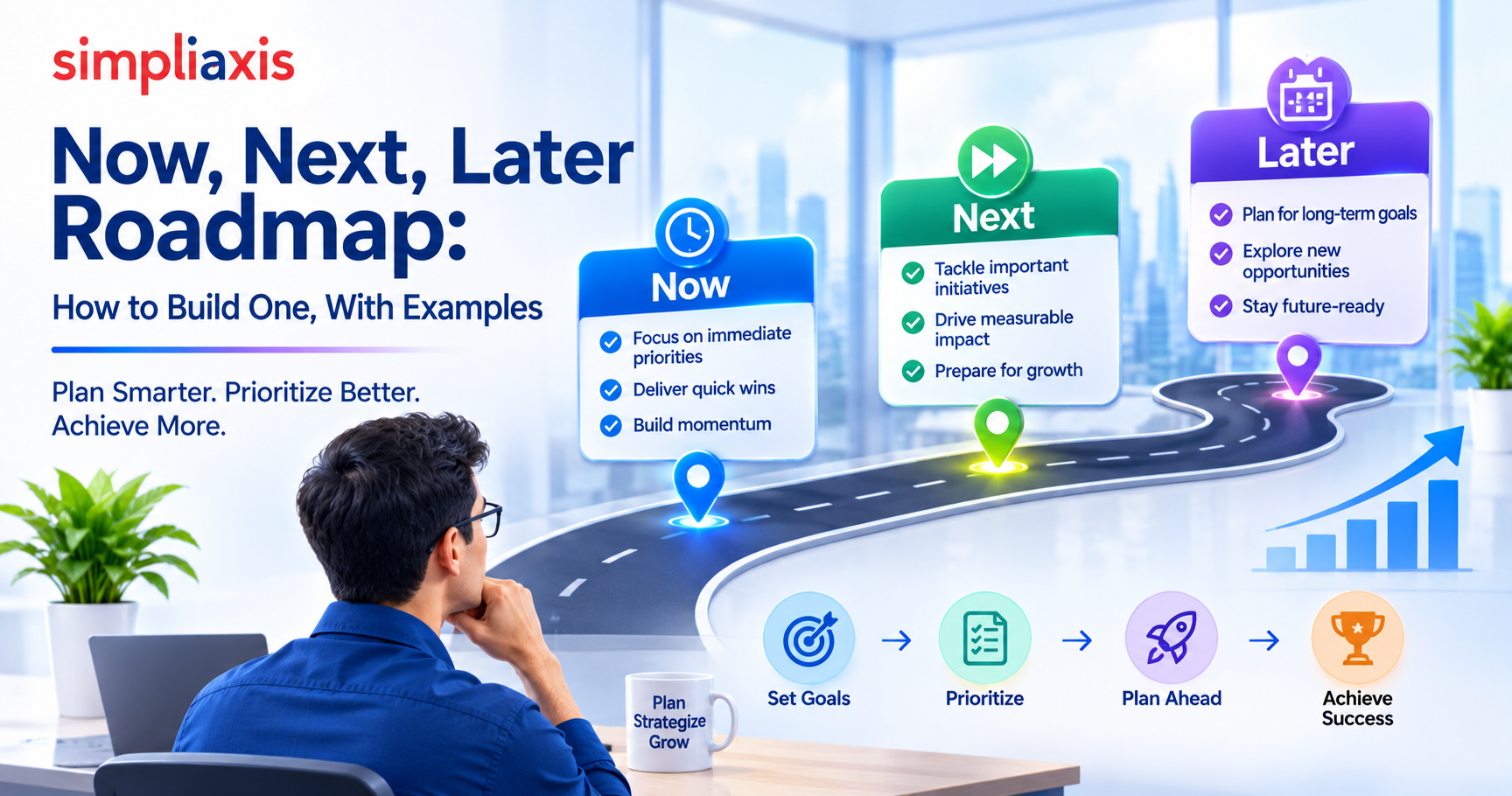
A now-next-later roadmap is a product planning framework that organizes initiatives into three time horizons: now, next, and later. Instead of assigning fixed dates to every feature, it shows what the team is actively working on, what it expects to tackle next, and what it may explore in the future.
This format helps product managers communicate priorities, connect product work to business goals, and adapt plans as customer needs and market conditions change. To create one, start with measurable objectives, identify the customer problems that matter most, prioritize initiatives by impact and confidence, and review the roadmap regularly.
Unlike a traditional timeline roadmap, a Now-Next-Later roadmap emphasizes direction and sequencing rather than exact delivery dates.
Key Highlights: Now, Next, Later Roadmap
Three planning horizons: Now covers active commitments, Next includes upcoming priorities, and Later captures future opportunities.
Outcome over output: The roadmap focuses on the customer or business problems the team wants to solve, not simply a list of features to release.
Flexible planning: Teams can adjust priorities as new evidence, customer feedback, and technical constraints emerge.
Clearer communication: Stakeholders can understand the product direction without mistaking tentative ideas for confirmed delivery commitments.
Backlog alignment: Roadmap initiatives connect strategic objectives with the detailed tasks managed in the product backlog.
Practical application: The framework works for startups, established product teams, SaaS businesses, and agile organizations that need a clear view of priorities.
Introduction
Imagine a product team preparing its roadmap for the next six months. The sales department wants a new reporting dashboard, customers are requesting a simpler onboarding experience, and the engineering team has identified performance problems that need attention. Leadership also expects the team to explore AI-powered recommendations.
Every request sounds reasonable, but the team cannot deliver everything simultaneously. When each idea is assigned a delivery date too early, the roadmap can quickly become a collection of promises that are difficult to keep.
This is where a Now-Next-Later roadmap can help.
Rather than predicting exactly when every feature will ship, the team groups initiatives according to their current priority and level of certainty. Work that is actively underway sits in Now. The most likely upcoming initiatives belong in Next. Longer-term opportunities remain in Later until the team has enough evidence to make a more informed decision.
The approach is particularly useful in product environments where priorities evolve as teams learn from customers, test assumptions, and discover technical dependencies.
According toAtlassian's product roadmap guide, a product roadmap communicates a product's vision, direction, priorities, and progress over time. A Now-Next-Later format provides a straightforward way to communicate that direction without requiring every initiative to have a fixed delivery date.
It is important to understand that flexibility does not mean a lack of planning. Teams still need clear objectives, prioritization criteria, ownership, and measurable outcomes. The difference is that they make commitments at the level supported by the available evidence.
In this guide, we will explain how the framework works, what belongs in each column, how to create a practical roadmap, and how to connect it with your product backlog. You will also find a reusable template, examples from different product scenarios, and guidance for handling stakeholder expectations.
What Is a Now Next Later Roadmap?
A Now-Next-Later roadmap is a visual roadmap that organizes product initiatives into three broad planning horizons instead of arranging every task against a calendar.
It answers three questions:
Now: What are we working on to achieve our immediate objectives?
Next: What are we most likely to work on once the current priorities progress or finish?
Later: Which opportunities are worth keeping in view for the future?
Each column represents a different level of certainty and readiness. Current work should be well understood, upcoming initiatives should have a reasonable evidence base, and future ideas can remain exploratory.
For example, a subscription software company might place a payment failure fix in Now, a self-service subscription management feature in Next, and international payment support in Later.
These initiatives all contribute to improving the customer experience, but they do not necessarily have equal urgency or readiness.
A well-designed Now-Next-Later roadmap connects these priorities to the product vision and business objectives. It also makes clear that an initiative's position can change when new information becomes available.
If you are new to roadmapping, it helps to first understand how roadmaps fit into the wider agile planning process.
Origin of the Format
The modern Now-Next-Later roadmap is closely associated with Janna Bastow and her co-founder Simon Cast, who developed an early version while building ProdPad in 2012.
In her article,ProdPad: The Now Next Later Roadmap, Bastow explains how traditional timeline-based roadmaps often created unrealistic expectations. Teams spent considerable time estimating delivery dates for initiatives that were still uncertain, and conversations frequently focused on missed deadlines instead of product priorities.
The early format used three flexible time horizons to communicate what was happening, what was likely to follow, and what remained under consideration.
The underlying idea was simple: confidence generally decreases as teams look further into the future. Current work can be planned in greater detail because the problem, scope, and dependencies are better understood. Future work requires more discovery and is more likely to change.
There is an important historical nuance. Bastow's account describes the development of the modern format used by ProdPad, rather than establishing that nobody had used similar three-horizon terminology before. A related Thoughtworks article on Now, Next, and Later appeared in 2012 as well.
Today, the framework is widely discussed in product management because it offers a simple way to explain priorities without suggesting that every future idea is already a commitment.
Outcome-Based vs Date-Based Roadmaps
The main difference between an outcome-based roadmap and a date-based roadmap is what each one emphasizes.
A date-based roadmap organizes work around calendar milestones, such as monthly releases or quarterly delivery targets. An outcome-based roadmap focuses on the results the team wants to achieve and the initiatives most likely to produce those results.
Consider a product team trying to improve customer retention.
A date-based roadmap might say:
January: Introduce personalized onboarding.
February: Release usage reminders.
March: Launch a loyalty dashboard.
An outcome-based Now-Next-Later roadmap might say:
Now: Identify and address the onboarding steps where new users abandon setup.
Next: Test personalized guidance for users who struggle to complete setup.
Later: Explore engagement features that encourage customers to return regularly.
The second approach gives the team room to change the solution when research or experiments reveal something unexpected.
For instance, the team might discover that users are not abandoning onboarding because it is too complicated. Instead, they may be unable to import existing data. That insight could change the next initiative entirely.
This is the advantage of an outcome-based roadmap: it preserves the intended business result while allowing the team to reconsider the best way to achieve it.
However, date-based planning is still useful when deadlines are genuine constraints. Regulatory requirements, contractual obligations, coordinated marketing campaigns, and external launch events may require specific dates. A flexible roadmap should acknowledge these commitments rather than ignore them.
Who Should Use It
A Now-Next-Later roadmap is useful for teams that need to communicate strategic priorities while accepting that future work may change.
Product managers can use it to connect customer problems, product discovery, and delivery priorities. Anyone learningwho is a product manager will find that roadmap management is an important part of coordinating product decisions and stakeholder expectations.
Product owners can use the framework to explain why certain initiatives deserve attention before others and how those initiatives relate to the product backlog.
Startup founders can use it to communicate direction when the product is still evolving and the team has limited resources.
Engineering and design teams can use it to understand the problems they are expected to solve without prematurely locking every solution into a delivery schedule.
Business leaders and sales teams can use a simplified version to understand what is being prioritized, what may come next, and which requests remain under consideration.
The approach is especially helpful in agile environments where learning, iteration, and reprioritization are part of the development process.
It may be less suitable as the only planning document when an organization needs detailed delivery dependencies, fixed contractual milestones, or a coordinated implementation schedule. In those cases, the Now-Next-Later roadmap can sit alongside a separate delivery plan.
What Goes in Each Column
The three columns should reflect more than the order in which ideas were submitted. Each item needs a clear reason for its placement, an appropriate level of detail, and a connection to the product's objectives.
The columns do not need to contain the same number of initiatives. If the team has two well-validated priorities and several uncertain opportunities, a roadmap with two items in Now, three in Next, and six in Later may be perfectly reasonable.
Now
The Now column contains the initiatives the team is actively pursuing or has committed to addressing in the immediate planning horizon.
These items should have a reasonably clear problem statement, a strong connection to business or customer outcomes, and enough information for the team to begin execution.
Typical items include:
Fixing a critical usability problem.
Improving a slow or unreliable customer workflow.
Testing a solution to a validated customer problem.
Building a feature that has passed discovery and prioritization.
Addressing a security, compliance, or operational requirement.
For example, an online learning platform might place the following initiative in Now:
Initiative: Simplify course enrollment.
Problem: New learners abandon the enrollment process before completing payment.
Desired outcome: Increase the proportion of learners who successfully enroll.
Success measure: Improve enrollment completion from an illustrative baseline of 62% to 72%, subject to validation through product analytics.
The numbers above are hypothetical and serve as an example of how a measurable objective can guide the work.
Notice that the initiative does not begin with a list of interface changes. The team first identifies the problem and the result it wants to achieve. Design and engineering can then investigate which changes are most likely to improve enrollment.
Because Now contains active work, it generally deserves the most detail. The team should understand the scope, dependencies, responsible owners, and immediate next steps.
Still, being in Now does not guarantee that every item will be delivered exactly as initially imagined. If new evidence changes the problem definition, the team should reassess the initiative rather than continue with an ineffective solution.
Next
The Next column contains initiatives that are likely to follow the current priorities but are not yet ready for the same level of commitment.
These items should be supported by a reasonable understanding of customer needs and strategic value. However, the team may still need additional research, technical investigation, dependency resolution, or prioritization before beginning implementation.
Examples include:
Testing a new pricing page after validating the underlying conversion problem.
Improving reporting capabilities once the team understands which customer segments need them most.
Developing a self-service cancellation flow after resolving higher-priority billing defects.
Exploring an integration that several target customers have requested.
For example, a project management platform may place Improve team workload visibility in Next.
Customer interviews suggest that managers struggle to identify overloaded team members. The product team has enough evidence to investigate the problem, but it has not yet decided whether the best solution is a workload dashboard, automated alerts, or improved reporting.
The initiative belongs in Next because the problem is understood, but the solution and implementation details still need refinement.
A common mistake is to treat Next as a guaranteed delivery queue. It is better understood as a set of likely upcoming priorities that can change when current work produces new insights or when business conditions shift.
Keep Next more detailed than Later, but avoid spending excessive time estimating every implementation task before the team is ready to act.
Later
The Later column contains longer-term opportunities, emerging customer needs, and strategic possibilities that are worth monitoring but are not yet ready for commitment.
These initiatives may have significant potential, but the team lacks sufficient evidence to justify immediate discovery or delivery.
Typical examples include:
Exploring an AI assistant for a customer support platform.
Expanding a product into a new geographic market.
Developing advanced analytics for enterprise customers.
Investigating a new business model or pricing structure.
Exploring integrations that may become important as the customer base grows.
Suppose a digital banking product is considering personalized financial coaching.
The idea aligns with the company's product vision, but the team has not yet validated whether customers want automated recommendations, human guidance, or a combination of both. The company may also need to evaluate data privacy requirements and the operational cost of providing the service.
The initiative can remain in Later while the team gathers relevant customer feedback and market evidence.
Later is not a parking lot for every suggestion the company has ever received. Items should still connect to strategic objectives or represent credible opportunities worth revisiting.
As priorities change, some items may be removed, combined, or reconsidered. Others may move into Next when evidence and readiness improve.
How to Build a Now, Next, Later Roadmap?
Creating a useful roadmap does not require sophisticated software or a large planning workshop. A shared document or spreadsheet is enough to get started.
What matters is the quality of the decisions behind the roadmap.
The following process provides a practical foundation for developing a roadmap that supports product strategy, prioritization, and execution.
Start From Objectives
Begin by identifying the business and customer outcomes the product needs to achieve.
Without clear objectives, the roadmap can become a collection of unrelated feature requests. Each department may push its own priorities, leaving the product team without a consistent way to decide what matters most.
Start with questions such as:
What is the product trying to achieve over the next planning cycle?
Which customer problems are preventing that progress?
What evidence suggests those problems are important?
Which business metrics should improve if the team succeeds?
What technical, financial, or regulatory constraints must be considered?
Suppose a subscription software company wants to reduce customer churn. Its objectives might include improving first-month activation, helping users discover important features, and resolving recurring reliability issues.
The team can then assess potential initiatives against those objectives instead of prioritizing requests simply because they come from influential stakeholders.
A clear product strategy, built into your product management workflow, helps connect the product vision, target customers and roadmap choices that appear on the roadmap.
For each initiative, document the intended outcome and, where possible, a baseline and target measure.
For example:
Objective: Improve new-customer activation.
Baseline: 45% of new accounts complete the setup process within seven days.
Target: Increase seven-day setup completion to 55%.
Potential initiative: Investigate setup abandonment and test a simpler onboarding experience.
The figures are illustrative rather than industry benchmarks. A real team should calculate its baseline using reliable product data and set a target that reflects its own context.
This step ensures that the roadmap communicates why work matters, not merely what the team plans to build.
Frame Items as Problems to Solve
Once the objectives are clear, identify the customer problems, business opportunities, and operational constraints that may prevent the team from achieving them.
Avoid translating every request directly into a feature.
A stakeholder might ask for an export button, but the underlying problem could be that customers cannot share reports with colleagues. Depending on the need, a scheduled email, shared dashboard, or downloadable report might solve the problem more effectively.
Problem framing also makes it easier to compare initiatives that require different solutions but contribute to the same objective.
A practical initiative description can include four elements:
Problem: What difficulty are customers or the business experiencing?
Evidence: What research, analytics, feedback, or operational data supports the problem?
Outcome: What should improve if the team solves it?
Approach: What solutions or experiments might help achieve the outcome?
For instance, instead of writing "Build an AI chatbot" on the roadmap, a team could write "Help customers resolve common account questions without contacting support."
The team might eventually build a chatbot, improve help content, simplify account settings, or introduce a guided troubleshooting flow. The roadmap preserves the objective while leaving room for evidence-based decisions.
This process should be supported by product discovery, which helps teams investigate customer needs, test assumptions, and reduce uncertainty before committing significant development resources.
For prioritization, teams can consider customer impact, strategic alignment, urgency, confidence, effort, risk and dependencies. The RICE prioritization framework turns several of these factors into a simple score. Frameworks such as MoSCoW and otheragile prioritization techniques can help separate essential needs from nice-to-haves.
The purpose is not to find a mathematically perfect ranking. It is to make the reasoning behind roadmap decisions transparent and consistent.
Review and Move Items Regularly
A roadmap should evolve as the team learns. An initiative that looked promising last month may become less important after a competitor changes direction, customer feedback reveals a different need, or an experiment fails.
Establish a review cadence that matches the pace of your product and business. A weekly or fortnightly review may suit a rapidly changing team, while a monthly review may be sufficient for a more stable product. Major strategic reviews can take place quarterly.
During each review, ask:
Is the current work still the highest priority?
Have we achieved the intended outcome, or only completed the planned activity?
Has new evidence changed our understanding of a customer problem?
Are upcoming initiatives still strategically relevant?
Are dependencies or risks preventing progress?
Should an initiative move, change, or be removed?
For example, a team may begin work on improving search functionality because customers report difficulty finding content. During discovery, it discovers that most failed searches are caused by outdated content labels rather than the search algorithm.
The team may adjust its current initiative to address metadata quality first and move a more advanced search upgrade into Next or Later.
This is not a failure of planning. It is a sign that the roadmap is responding to evidence.
At the same time, avoid moving initiatives between columns simply to make the roadmap appear active. Every meaningful change should have a reason, such as new customer evidence, a changed objective, a dependency, or a shift in business priorities.
A short decision log can record what changed, why it changed, and which stakeholders need to know.
Now Next Later Roadmap Example
Consider a fictional SaaS company that provides project management software to small and midsize businesses.
Customer feedback highlights three recurring problems: new users struggle to set up their first project, managers cannot easily understand team capacity, and enterprise customers want integrations with other business systems.
The product team has limited engineering capacity and cannot tackle all three problems simultaneously.
It creates a Now-Next-Later roadmap to connect the most important customer needs with its current business objectives.
Sample Roadmap Table
The following Now-Next-Later roadmap template illustrates how a team can organize initiatives, outcomes, evidence, and readiness.
Planning Horizon | Initiative | Problem to solve | Desired outcome | Readiness |
Now | Simplify project setup | New users abandon setup before creating their first project | Improve first-project activation | Validated problem; solution in progress |
Now | Fix slow dashboard loading | Managers experience delays when reviewing team activity | Improve dashboard response time and reliability | Performance issue reproduced and measured |
Next | Improve workload visibility | Managers struggle to identify overloaded team members | Help managers distribute work more effectively | Customer need validated; solution under discovery |
Next | Add reusable project templates | Teams repeat the same setup tasks across projects | Reduce time required to start a new project | Opportunity supported by customer feedback |
Later | Explore advanced analytics | Enterprise customers need deeper operational insights | Support more informed planning decisions | Needs further research |
Later | Investigate additional integrations | Customers want project data connected to other systems | Reduce manual data transfer between tools | Demand and technical feasibility need validation |
The initiatives and outcomes in this table are hypothetical examples. A real roadmap should include the team's own evidence, owners, constraints, and measures of success.
Notice that the roadmap does not require an exact delivery date for every initiative. It gives stakeholders a clear view of current commitments, likely upcoming work, and opportunities that remain under consideration.
For teams that prefer a more visual roadmap, each initiative can be represented as a card in one of three columns. Add labels for the relevant objective, an owner, a confidence level, and a link to supporting research where useful.
The same structure can work as a lightweight roadmap template in a spreadsheet, a whiteboard, a presentation, or dedicated roadmap tools.
How Items Move Between Columns
Initiatives should move between columns when their priority, readiness, or strategic relevance changes.
A common progression is:
Later → Next → Now → Completed or Measuring Success
However, this is not a mandatory sequence. An initiative can move directly from Later to Now when a critical problem emerges. It can also be removed entirely if the evidence no longer supports it.
Consider the workload visibility initiative from the sample table.
Initially, it sits in Next because customer interviews have established that managers struggle with workload planning, but the team has not yet validated the best solution.
During discovery, the team tests a low-fidelity dashboard prototype with a small group of users. Feedback indicates that a simple capacity indicator and warning for overloaded team members may solve the problem without requiring a complex analytics system.
The team now has stronger evidence about the problem, a clearer solution direction, and a better understanding of the technical work involved.
If workload visibility remains a high priority, the initiative can move into Now when the team has capacity to begin implementation.
The advanced analytics initiative may remain in Later because its value is less certain and the team has not yet established which metrics enterprise customers actually need.
Use explicit criteria for moving initiatives forward:
The problem has credible evidence behind it.
The initiative supports a current product or business objective.
The team has enough information to define the next steps.
Major dependencies and risks are understood.
Capacity is available, and the initiative is more important than competing work.
Moving an item into Now should mean the team is prepared to act, not simply that someone has asked for an update.
Likewise, moving an initiative backwards is acceptable when assumptions prove incorrect or a more important problem emerges. The roadmap is a decision-making tool, not a promise that every idea will eventually be delivered.
Now Next Later vs Timeline Roadmaps: Comparison Table
A Now-Next-Later roadmap and a timeline roadmap both communicate product direction, but they serve different planning needs.
A timeline roadmap places initiatives against calendar periods, milestones, or delivery dates. A Now-Next-Later roadmap groups work according to priority, readiness, and planning horizon.
Neither format is universally better. The right choice depends on the level of uncertainty, the audience, and the commitments the organization must manage.
Comparison Factor | Now-Next-Later Roadmap | Timeline Roadmap |
Primary focus | Priorities and planning horizons | Calendar periods and milestones |
Dates | Optional; used when justified | Usually central to the presentation |
Flexibility | High when priorities or evidence change | Changes may require timeline revisions |
Level of detail | More detail for current work; less for future ideas | Often includes milestones across multiple periods |
Uncertainty | Explicitly accommodates uncertainty | Can imply greater certainty than the team has |
Stakeholder communication | Explains what matters now and what may follow | Shows expected timing and sequencing |
Best suited for | Discovery-driven product work and evolving priorities | Fixed milestones, coordinated launches, and delivery planning |
Common risk | Horizons become vague without clear prioritization | Tentative dates become perceived commitments |
A timeline roadmap is useful when stakeholders genuinely need to understand delivery windows or dependencies. For example, a product launch involving regulatory approval, hardware procurement, and a marketing campaign may require a detailed timeline.
A Now-Next-Later roadmap is often more appropriate when the team is still discovering the right solution or when the exact scope of future work depends on current results.
Some organizations combine the two formats. They use Now, Next, and Later to communicate strategic priorities while maintaining a separate timeline roadmap or release planfor delivery coordination.
This hybrid approach can work well as long as the documents have distinct purposes and the team explains which dates are firm commitments and which are estimates.
For more detail on delivery planning, consult theAtlassian guide to agile roadmaps.
Communicating the Roadmap to Stakeholders
Even a well-prioritized roadmap can cause confusion if stakeholders interpret it differently.
Executives may want to understand business outcomes. Sales teams may need to answer customer questions. Engineering teams need sufficient context to plan technical work. Customers may want to know whether a requested capability is being considered.
The same roadmap may serve several audiences, but the explanation should be tailored to their needs.
For executives, highlight strategic objectives, major investments, risks, and expected business impact.
For engineering and design teams, explain the customer problem, relevant research, dependencies, and what needs to be learned or delivered next.
For sales and customer success, provide a clear summary of current priorities and the status of relevant requests. Avoid implying that an item in Next or Later has a guaranteed release date.
A visual roadmap works particularly well when every initiative has a concise title and a clear explanation of its intended outcome. Use color coding sparingly, maintain consistent labels, and link to supporting documents when more detail is needed.
Most importantly, establish a single source of truth. If teams rely on separate spreadsheets and presentation decks, updates can quickly become inconsistent.
TheAtlassian product roadmaps guide recommends keeping roadmaps accessible, aligned with strategy, and updated as priorities change.
Handling Requests for Dates
Stakeholders often ask questions such as, "When will this feature be ready?" or "Can we promise this to the customer by the end of the quarter?"
These are reasonable questions, especially when sales commitments, customer expectations, or business events depend on the answer. The challenge is to respond honestly without presenting uncertain estimates as guarantees.
Start by distinguishing between a delivery commitment and a planning forecast.
A delivery commitment is a date the organization has explicitly agreed to meet, often because of a contractual, regulatory, or operational requirement. A planning forecast is the team's best current estimate, based on what it knows today.
If the initiative is in Now and its scope is well understood, the team may be able to provide a meaningful estimate or target window.
If the initiative is in Next, the estimate may depend on the outcome of current work or unresolved technical questions. If it is in Later, providing an exact date may be misleading.
For example, instead of saying, "The reporting dashboard will launch on March 15," a product manager might say:
"We have prioritized reporting improvements for the next planning horizon. We still need to validate the scope and confirm the engineering dependencies before providing a reliable delivery window."
When a genuine deadline exists, work backward from the required date, identify dependencies, assess delivery risks, and make the necessary trade-offs explicit.
If the team cannot meet the deadline with the available capacity, stakeholders should know early enough to adjust scope, resources, or expectations.
The objective is not to avoid dates altogether. It is to make date commitments only when the evidence and constraints justify them.
Using Confidence Levels Instead of Dates
Confidence levels help teams communicate how much they know about an initiative without creating unnecessary precision.
For example, a roadmap might use three simple labels:
High confidence: The problem is validated, the scope is understood, and the team has a credible plan.
Medium confidence: The problem is supported by evidence, but important questions about scope, feasibility, or dependencies remain.
Low confidence: The opportunity is promising but requires additional discovery or validation.
These labels are illustrative. Teams should define their own criteria so that everyone interprets them consistently.
Confidence should not be confused with business priority. An initiative can be strategically important but have low confidence because the team has not yet validated the solution.
Similarly, a high-confidence initiative may not deserve immediate attention if its expected impact is small.
For a more useful assessment, consider documenting three separate factors:
Priority: How important is the initiative relative to competing work?
Confidence: How strong is the evidence supporting the problem, approach, and expected outcome?
Readiness: Is the team prepared to begin the next stage of work?
For example, an AI-powered recommendation feature may have high strategic potential but low confidence and low readiness. A payment reliability improvement may have high priority, high confidence, and high readiness.
This distinction makes roadmap prioritization more transparent and helps stakeholders understand why the team is addressing one problem before another.
Confidence labels should also be reviewed as evidence changes. Avoid assigning numerical percentages unless the team has a meaningful, consistent method for estimating them.
Connecting the Roadmap to the Product Backlog
A roadmap and a product backlog are related, but they are not interchangeable.
The roadmap communicates the product's direction, the problems it intends to address, and the initiatives that deserve attention. The product backlog contains the detailed, ordered work that may be needed to develop, improve, or maintain the product.
Understanding the distinction prevents the roadmap from becoming an oversized task list.
For a detailed explanation, read product roadmap vs product backlog.
A simple example illustrates the relationship.
The roadmap initiative might be "Improve customer onboarding."
The product backlog could contain user research tasks, design experiments, technical investigations, user stories, acceptance criteria, and implementation tasks related to that initiative.
Not every backlog item needs to appear on the roadmap. The roadmap should preserve the strategic view, while the backlog provides the detail needed to manage and deliver the work.
From Now Column to Sprint Backlog
The Now column should provide enough clarity for the team to decide which work is ready to enter its delivery process.
However, an initiative should not automatically move into a sprint just because it appears in Now. The team must still evaluate its scope, dependencies, acceptance criteria, and alignment with the current sprint goal.
A practical workflow looks like this:
Select a roadmap initiative: Choose a high-priority problem aligned with the product objectives.
Refine the initiative: Gather the research, constraints, and solution details needed to make informed decisions.
Create backlog items: Break the work into manageable product backlog items, user stories, experiments, or technical tasks.
Refine and order the backlog: Clarify requirements, identify dependencies, and assess the relative importance of each item.
Plan the sprint: Select work that supports the sprint goal. Theproduct owner’s role in sprint planningis to make sure that work reflects current roadmap priorities.
Measure the outcome: Review whether the work improved the intended customer or business metric, rather than treating task completion as proof of success.
For teams using Scrum, the distinction is important. The Scrum Guide describes the Product Backlog as an emergent, ordered list of what is needed to improve the product. Sprint planning determines the work the team intends to undertake during a specific sprint.
The Now-Next-Later roadmap complements this process by providing strategic context. It does not replace backlog refinement, sprint planning, or the team's delivery responsibilities.
For example, an onboarding initiative may enter Now because reducing setup abandonment is a priority. During refinement, the team may discover that a small usability experiment should happen before implementation. The experiment can help determine which backlog items are worth pursuing.
If the experiment shows that the proposed solution will not improve onboarding, the team can reconsider the implementation plan without losing sight of the original objective.
This connection between strategy and execution is one of the most valuable aspects of a well-maintained roadmap.
Tools for Building the Roadmap
You do not need specialized software to create a Now-Next-Later roadmap. The best tool is one that makes priorities visible, supports collaboration, and is easy to update.
Common options include:
Spreadsheets: Google Sheets and Microsoft Excel are useful for small teams that want a simple roadmap template with columns for initiative, outcome, priority, confidence, and owner.
Whiteboards: Tools such as Miro and similar collaborative whiteboards work well for workshops, brainstorming, and early-stage roadmap planning. Teams can move initiative cards between columns during discussions.
Project management platforms: Jira and related tools can connect roadmap initiatives with epics, issues, and delivery work. This can be useful when engineering teams need visibility into how strategic priorities relate to execution.
Dedicated product management tools: ProdPad is particularly associated with the Now-Next-Later approach. Its product management workflows support idea management, prioritization, customer feedback, and roadmapping.
For additional context, seeProdPad's explanation of the Now-Next-Later roadmap.
When comparing roadmap tools, consider the following questions:
Can the tool connect initiatives to business objectives?
Can users distinguish current commitments from future possibilities?
Is it easy to update priorities and explain why they changed?
Can stakeholders access the roadmap without maintaining multiple copies?
Does it link strategic initiatives to the product backlog or delivery workflow?
Can the team track outcomes and learn from completed initiatives?
Avoid choosing a tool simply because it produces attractive visuals. A sophisticated timeline roadmap is not necessarily more useful than a clear spreadsheet if the team lacks a consistent prioritization process.
Start with the simplest format that meets your needs, then introduce more advanced roadmap tools when collaboration, reporting, or portfolio complexity justifies the investment.
Teams looking to strengthen these practices can also explore CSPO certification training or A-CSPO certification training to build their understanding of product ownership, backlog management, and stakeholder collaboration.
Conclusion
A Now-Next-Later roadmap offers a practical way to communicate product priorities without pretending that every future initiative has a predictable delivery date.
By separating current commitments from upcoming priorities and longer-term opportunities, teams can make better decisions, communicate uncertainty honestly, and adapt their plans as they learn.
The framework works best when every initiative connects to a clear product objective, is supported by credible evidence, and has an appropriate level of detail for its planning horizon.
To put the approach into practice, start with a simple roadmap template. Identify your most important outcomes, frame initiatives around customer problems, prioritize the work that matters most, and review the roadmap regularly. Connect current initiatives to the product backlog so that strategic priorities translate into actionable work.
Remember that a roadmap is not a guarantee that every idea will be delivered. It is a shared explanation of where the product is heading, why that direction matters, and what the team currently believes it should do next.
When used consistently, a Now-Next-Later roadmap can help product managers, product owners, engineering teams, and business stakeholders spend less time debating speculative dates and more time discussing customer value, priorities, and meaningful results.










 Lowest-Price Challenge












 Personalized Path



.webp)


 USA
 Canada
 India
 UK
 Australia
 Singapore


