


 Call Us




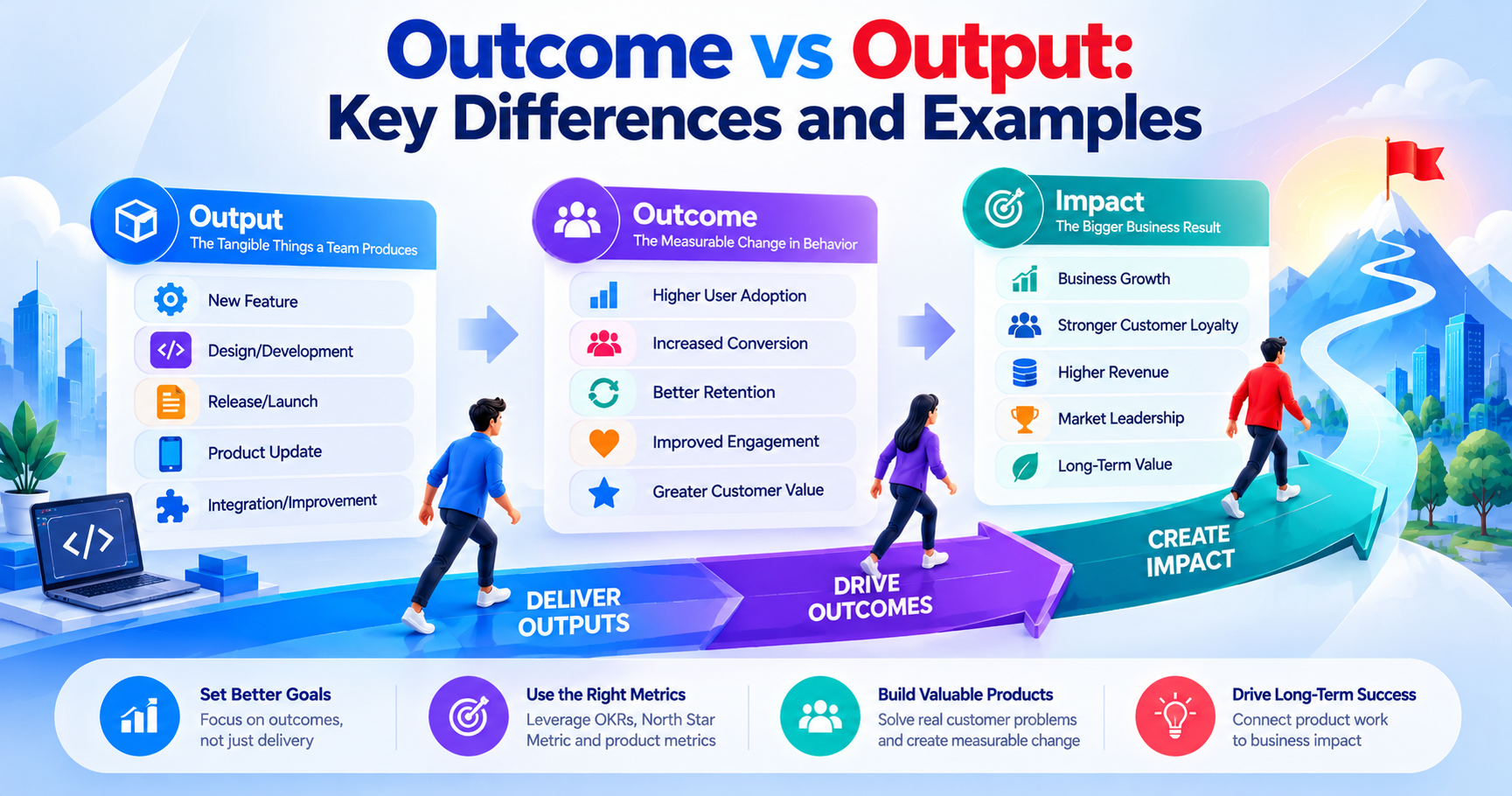
In the field of product management, having more shipments does not mean that more value has been created. An enterprise team can launch a new onboarding flow, dashboard, or payment feature on time, but the real question to ask is: what changes occurred after the release?
It is helpful to distinguish between outcome and output because outputs tell us what the team delivered, while outcomes indicate whether that work resulted in a change in customer behaviour or caused an important product metric to shift.
For instance, the introduction of a redesigned checkout page is an output while an increase in the number of customers who complete the checkout process is an outcome. The difference between these two affects the way teams define their goals, prioritize their roadmaps, setAgile OKRs, and evaluate product success.
A product management approach that is outcome-oriented does not mean ignoring delivery; rather, it involves linking the things that teams develop with real customer and business value.
Key Highlights of Outcome vs Output
According to Product Talk’sCDH Benchmark Survey, around 20% of product teams consider themselves outcome-focused, whereas nearly half describe themselves as working in a mixture of outcomes and outputs, and about 30% are still output-focused.
Nearly half (48.3%) of the teams surveyed are working toward outcomes while also delivering outputs. This indicates it is necessary to move important metrics in the right direction while also building predetermined features.
McKinsey’s research onwhat makes product teams effective analyzed over 1,700 teams. The study measured actual business value delivered as one of three factors of team effectiveness.
A North Star Metric demonstrates whether product work is creating value for customers or not. According to Amplitude, it should show customer value, be influenced by product and marketing activities, and offer an early sign of revenue.
Outcomes help teams in evaluating the features that happen once a product or feature is delivered. Therefore, instead of considering delivery as the final measure of success, teams should assess what happened afterwards.
Introduction
Product teams are constantly under pressure to deliver. Roadmaps contain features, sprint boards contain stories, and release calendars are filled with deadlines. When those items move to “done,” it is tempting to consider the work successful.
But customers rarely care about how many features were shipped in a quarter. They care whether a product makes something easier, faster, safer, cheaper, or more useful. Likewise, a business ultimately needs more than a growing list of releases—it needs evidence that its product strategy is influencing customer behavior and contributing to broader goals.
This creates an important question for product managers: Should success be measured by what the team completes or by what changes because of that work?
Understanding outcome vs. output, therefore, gives teams a clearer way to connect everyday product decisions with the value they ultimately intend to create.
What Is an Output?
Definition: The Tangible Things a Team Produces
An output is actually a tangible result obtained from a team’s collective work. It usually includes product features, applications, integrations, prototypes, reports, or other completed deliverables. For example, consider a product team building a new one-click checkout feature for an e-commerce app. Once the feature has been designed, developed, tested, and released, the team has produced an output.
The important point is that completing the feature tells the organization what was delivered, but it does not yet establish whether customers found it useful or whether it improved product performance.
This is why outputs remain important. Teams need to create and deliver things to solve problems. The limitation arises when delivery itself becomes the final measure of success.
Why Outputs Are Easy to Plan and Count
Outputs fit naturally into traditional planning because they are concrete and visible. A roadmap may state “launch mobile app,” asprint planmay include “build search filters,” and a project plan may assign a deadline for “release payment integration.
With the completion of the above tasks, generating reports of this progress becomes straightforward. For instance, you can report like this:
There were 10 features planned; 9 were delivered, which equals a 90 per cent completion rate for the delivery.
This makes output metrics useful for monitoring execution, workload, and delivery predictability. The problem occurs when teams assume that completing more items automatically creates more customer value. A team could deliver every feature on its roadmap and still see little improvement in adoption, conversion, engagement, or retention.
Output measurement can therefore answer “Did we deliver what we planned?” It cannot, by itself, answer the more important product question: “Did what we delivered make the intended difference?”
Examples of Common Product Outputs
Common output and outcome examples become easier to understand when viewed through everyday product work. Typical outputs include:
Product situation | Output |
E-commerce | New one-click checkout feature |
SaaS platform | Redesigned onboarding flow |
Banking app | Biometric login feature |
Streaming platform | Personalized recommendation feature |
Learning platform | New progress dashboard |
Mobile application | Push-notification functionality |
Collaboration software | Third-party integration |
Product team | New analytics dashboard |
What Is an Outcome?
Definition: The Measurable Change in Behavior
An outcome describes the change or impact that occurs as a result of product work. In product management, useful product outcomes frequently focus on observable changes in customer behavior that the team can influence. For a better understanding:
Consider the earlier checkout example.
Output: Launch a one-click checkout feature.
Outcome: Increase the percentage of customers who successfully complete checkout.
The first one shows that a thing had been constructed, while the second looks at the actual changes in customer behaviour following their interaction with it. The changes in user behaviour could include them going through the onboarding process, visiting more often, taking up a key feature, completing transactions, working with other users, or reaching a significant activation point.
Outcome metrics are therefore especially useful since they enable product teams to assess whether their efforts are causing customer behaviour to change in the direction that was intended.
Why Outcomes Capture the Value Outputs Create?
A team's solution is what an output shows, but an outcome gives evidence of whether that solution worked.
Suppose a SaaS team launches a redesigned onboarding process. Simply measuring the release shows that the project has been carried out. However, by looking at activation rates, onboarding completion, or the number of customers who successfully carry out their first action, one can find out if the redesign has actually helped customers to reach value more quickly.
The fact that there is a difference affects the way in which teams reach decisions. Instead of sticking to a predetermined list of features, outcome-based product management sets teams a measurable objective and allows them to consider different methods to achieve it.
describes this shift as starting with the desired outcome and then considering which solution or whether a new build at all is most appropriate. It also explains why measures such as an appropriate North Star Metric can be useful. A well-chosen North Star focuses attention on the customer value a product creates rather than simply the volume of work completed. Amplitude
Examples of Product Outcomes
The following outcome vs output examples show how a deliverable can be connected to a measurable change:
Output | Possible Outcome |
Redesigned onboarding flow | Increase onboarding completion |
One-click checkout | Increase successful checkout completion |
Personalized recommendations | Increase engagement with recommended content |
New search filters | Increase successful product discovery |
Collaboration feature | Increase active collaboration between team members |
Push notifications | Increase the percentage of users returning to complete important actions |
Learning progress dashboard | Increase course completion |
Self-service support feature | Increase successful self-service issue resolution |
Outcome vs Output: Side-by-Side Comparison
The difference between outcome vs. output becomes clearer when both are viewed as connected parts of product work rather than competing ideas. Teams need outputs because something usually has to be created, changed, or delivered to solve a customer problem. However, delivery alone does not prove that the problem was solved.
An output records the work completed by the team. An outcome looks beyond completion and examines the change that followed. For product managers, connecting these two perspectives helps prevent roadmaps from becoming lists of features with no clear measure of whether those features created value.
The What vs. the Why and So What
A simple way to distinguish outputs from outcomes is to ask three questions: What did we deliver? Why did we deliver it? What happened because of it?
The “what” usually points toward the output. It could be a redesigned checkout page, a recommendation engine, a new dashboard, or an automated support feature. These are concrete things a team can plan, build, test, and release.
The “why” and “so what” take the conversation further. Why was the checkout redesigned? Perhaps too many customers were abandoning purchases. So what should change after the redesign? More customers should successfully complete checkout.
For example:
What we built? → A simplified checkout flow.
Why we built it? → Customers were leaving before completing the checkout process.
What should change? → More customers should complete the checkout process successfully.
The last question shifts attention from completing work to creating value.
This does not make outputs less important. Without an output, there may be nothing new for customers to interact with. But in outcome-driven product management, teams avoid treating “shipped” as the end of the story. They continue measuring what happens after the release.
How Each Is Measured and Owned
Outputs and outcomes require different types of measurement.
Outputs are generally measured using completion and delivery metrics, with a team possibly keeping record of the number of features released, stories completed, integrations launched, experiments run, or milestones achieved. Such measures are helpful in determining whether the planned work is progressing.
Outcomes require teams to observe changes after that work reaches customers. Depending on the product and objective, outcome metrics might include activation rate, checkout completion, feature adoption, repeat usage, task completion, or another measurable customer behavior. Ownership can also look different.
Delivery of an output may include key responsibilities across domains like engineering, product, design, QA, etc., and specific responsibilities across product, engineering, design, QA, and other functions. Outcomes are generally more cross-functional because achieving a customer or business result rarely depends on one role alone.
For example, releasing an onboarding flow may involve designers, developers, and a product manager. Increasing successful customer activation afterward could depend on the combined quality of the experience, product positioning, user education, messaging, and continued experimentation.
That is why outcome-based product management encourages teams to share responsibility for the result rather than simply handing work from one function to another.
A Comparison Table of Outputs and Their Outcomes
The following output and outcome examples illustrate how common product deliverables can be connected with measurable changes:
Product Goal/Problem | Output | Possible Outcome | Possible Outcome Metric |
Customers struggle during signup | Simplified signup flow | More visitors successfully create accounts | Signup completion rate |
New users fail to reach value quickly | Redesigned onboarding | More new users complete key activation actions | Activation rate |
Customers abandon purchases | One-click checkout | More customers complete transactions | Checkout completion rate |
Users struggle to find relevant products | Improved search and filters | More users successfully find and view relevant products | Search-to-product-view rate |
Users overlook relevant content | Recommendation feature | More users engage with recommended content | Recommendation engagement rate |
Customers depend heavily on support agents | Self-service help center | More customers resolve common problems independently | Self-service resolution rate |
Users rarely return after initial use | Personalized notifications | More users return to perform meaningful actions | Returning-user rate |
Learners leave courses unfinished | Learning progress dashboard | More learners complete their courses | Course completion rate |
Output, Outcome, and Impact
The discussion does not necessarily end with outcomes. A product team may successfully change customer behavior, but organizations also need to understand whether those changes contribute to broader business or societal results.
This creates another useful distinction: output vs. outcome vs. impact.
Think of them as connected levels of evidence:
Output → Outcome → Impact
A team delivers something. Customers respond to it. Over time, that change can contribute to a larger result. The farther along this chain you move, however, the more external factors can influence what happens. This makes it important to understand what a product team can directly deliver, what it can meaningfully influence, and what broader impact it ultimately hopes to support.
Where Impact Fits Above Outcomes
Impact represents the broader or longer-term result that an organization wants its work to contribute to. Suppose an online learning platform introduces a personalized learning path feature.
The broader or more long-term outcome that an organization would like its activities to produce is known as impact. For example, if an online learning platform introduces a feature that provides personalized learning paths.
The learning paths that have been customized are started.
Result: More learners carry out the recommended lessons and courses.
The outcome might be greater success for learners, with this resulting in better retention, increased customer value, and sustainable business growth.
The difference is highly crucial, as the final impact is hardly caused by one single feature. Revenue, retention, market share, profitability, customer lifetime value, or other high-level results can be affected by pricing, marketing, competition, economic conditions, customer segments, and many other variables. Product teams therefore need metrics that are close enough to their work to guide everyday decisions while still connecting to the broader product strategy.
This is where carefully chosen product metrics and a North Star Metric can help. A North Star Metric is intended to capture the value customers receive from a product while providing a shared direction for product work. Amplitude emphasizes that a useful North Star should represent customer value and act as a leading indicator of future business results.
The relationship can be summarized as:
Outputs tell you what was delivered.
Outcomes show what changed.
Impact indicates why that change ultimately matters.
The Chain From Feature to Behavior to Business Result
One practical way to apply outcome vs. output vs. impact thinking is to trace a line from a feature to customer behavior and then to the broader result the organization wants. Let us consider a fitness app on a subscription basis that is seeing low levels of engagement from new users. The team could start with the business problem rather than immediately deciding to build another feature:
Problem: A large number of new subscribers cease to use the app within the first few weeks.
They investigate the problem and choose to carry out some experiments with personalized workout recommendations. Delivery is confirmed whenever the feature is released. The next thing the team has to do is check whether there is a change in customer behaviour. The result is that more new users finish the recommended workouts during their first month.
That kind of behaviour can then help achieve a broader business objective. The impact is that greater sustained engagement could lead to better subscriber retention and higher recurring revenue. So, the complete chain becomes:
Personalized recommendations → More completed workouts → Higher sustained engagement → Improved retention
The chain is useful since it brings to light certain assumptions. It would be wrong for the team to assume that personalized recommendations will lead to an improvement in retention.
First, customers must use the recommendations. Then that usage needs to influence meaningful engagement. Finally, stronger engagement needs to contribute to retention. If customers ignore the recommendations, the team has learned something important, even though the feature was delivered perfectly.
That is one of the biggest advantages of outcome-based goals. They encourage teams to test whether the connection between what they build and what they hope to achieve actually exists. In practice, strong product management therefore does not choose between outputs, outcomes, and impact. It connects all three:
Build intentionally → Measure behavioral change → Evaluate the broader result.
This gives teams a much clearer picture of whether they are merely completing roadmap items or making measurable progress toward the customer and business results their product strategy is designed to achieve.
Why Outcomes Matter More Than Outputs
Outputs are still necessary since teams eventually have to design, build, test, and release solutions, but the number of completed features only tells half the story. A product team may be able to deliver all that has been promised on the roadmap and yet still fail to improve either the customer experience or business performance.
When the focus is on outcomes, the meaning of progress changes; rather than simply asking whether the work has been completed, teams look into whether that work led to the desired change in customer behaviour. As a result, product managers are able to prioritize problems, assess solutions, and link the day-to-day decisions they make as product managers with the wider business objectives.
Avoiding the Feature Factory Trap
A feature factory describes an environment where teams are primarily judged by how many features they ship rather than the value those features create. Roadmaps become long lists of requests, and success can gradually become synonymous with keeping the delivery pipeline moving. The problem is not that features are bad. The problem is shipping without learning what happened afterward.
Imagine a team that releases 15 features in a quarter. From an output perspective, this may look productive. But what if customers barely use five of those features and the remaining ten make no noticeable difference to activation, engagement, retention, or another important behaviour?
An outcome-oriented team would look beyond the release count. It would ask:
Are customers using the solution?
Has the targeted behavior changed?
Did the change solve the original customer problem?
Is the improvement large enough to matter?
What should we learn before investing further?
This approach helps teams avoid equating more features with more value. Instead,product discovery, experimentation, delivery, and measurement become part of the same learning cycle.
Giving Teams Autonomy Over the How
Output-based planning often defines the solution before the team has fully explored the problem.
For example:
Output-based direction: Build a new onboarding tutorial.
The team already knows what it must build. Its main responsibility becomes delivering the tutorial.
An outcome-based goal could instead be:
Outcome-based direction: Increase the percentage of new users who successfully complete activation during their first week.
Now the desired result is clear, but the solution remains open. The team might discover that users do not need another tutorial at all. The signing up process may be confusing, the setup may involve too many steps, or users may not quickly grasp the product's core value.
A key element of outcome-driven product management is for leaders to set the strategic direction and constraints while enabling product teams to explore problems and decide the best way to achieve the desired result.
Autonomy does not mean teams can do whatever they like; it means they can use research, product data, experiments, and customer feedback to arrive at an effective solution.
Connecting Daily Work to Strategy
A typical challenge facing product management is the gap between high-level strategy and actual development work. The leadership team could have a strategic goal, for example, focusing on improved customer retention, while the engineering team is carrying out work on search improvements, onboarding changes, notifications, and account-management features. If there is no outcome that links these different levels together, then employees may find it difficult to see how the various items on the roadmap contribute to the overall objective. Outcomes can establish that missing link. For example:
Business objective: Improve customer retention
↓
Product outcome: Increase the percentage of new customers reaching the activation milestone.
↓
Product initiatives: Improve onboarding, remove setup friction, provide contextual guidance
↓
Outputs: New onboarding flow, setup checklist, in-product prompts
This hierarchy gives teams a reason behind the work. Outputs are no longer isolated deliverables; they become hypotheses about how to achieve an outcome that supports the wider product strategy.
Real Examples of Outputs vs Outcomes
The difference between outputs and outcomes is easiest to understand through realistic product situations. In each of the following outcome vs output examples, the output represents something a team can deliver, while the outcome describes the customer behavior the team hopes to influence.
Importantly, the relationship is not guaranteed. Shipping the output creates an opportunity to achieve the outcome; measurement tells the team whether that assumption was correct.
Onboarding Tutorial vs Reduced First-Week Churn
Imagine a SaaS company notices that many new customers sign up but stop using the product within their first week. The team thinks the user may not understand the ways to start; it builds an interactive onboarding tutorial.
Output: Launch an interactive onboarding tutorial.
If success is measured only by whether the tutorial launches on schedule, the team learns little about whether it solved the original problem.
The intended result might instead be:
Outcome: More new users reach important activation behaviors during their first week.
The team could monitor tutorial completion alongside activation, first-week engagement, and early retention indicators. There is also an important distinction here: reduced first-week churn is closer to a business/customer result rather than the tutorial itself, and the team should identify the behavioral changes expected to lead to it.
For example:
Tutorial → More users complete setup → More users reach first value → Lower first-week churn
This gives the team several points at which it can test whether its assumptions are working.
Redesigned Sign-up Flow vs. Higher Completion Rate
Suppose analytics reveal that many potential customers begin creating an account but abandon the process before completing registration. The team decides to redesign the sign-up experience by removing unnecessary fields, simplifying instructions, and reducing the number of steps.
Output: Redesigned sign-up flow.
The new interface may look cleaner and require less effort, but completing the redesign does not prove success.
A corresponding outcome could be:
Outcome: Increase the percentage of users who successfully complete sign-up.
Assume 60 out of every 100 users who start registration currently finish it. Rather than setting a goal to simply “redesign the signup page,” the team could establish an outcome-based goal such as:
Increase sign-up completion from 60% to 70% during the next quarter.
The team now has a baseline, target, metric, and timeframe. More importantly, it can experiment with multiple solutions and measure whether each one improves the desired behavior.
New API vs Faster Partner Integration
Consider a B2B platform that wants more external partners to integrate with its product. The team might initially plan:
Output: Develop and release a new partner API.
That API could be technically excellent, yet partners might still take weeks to integrate because the documentation is unclear, authentication is difficult, or testing requires extensive support. A more useful outcome could therefore be:
Outcome: Reduce the time required for a qualified partner to complete a successful integration. This shifts attention from simply making the API available to improving the partner's actual experience. The team might discover that reaching the outcome requires several outputs:
New API + clearer documentation + sandbox environment + sample code → Faster successful integrations
This example demonstrates why starting with outcomes can broaden solution thinking. Had the team focused exclusively on “build the API,” it might have overlooked other barriers preventing partners from integrating successfully.
How to Write Outcome-Based Goals
Moving from output thinking to outcome-based goals requires changing the language teams use to define success. Statements such as “launch the dashboard,” “redesign onboarding,” or “build a recommendation engine” describe solutions.
A strong outcome-based goal describes the change the team wants to create while leaving room to investigate how best to create it. This makes the goal measurable without unnecessarily locking the team into one solution.
Framing Goals as Behavior Change
A useful starting point is to identify whose behavior needs to change, what behavior matters, and how the change will be measured. Instead of launching a new onboarding experience.
Consider:
Increase the percentage of new users who complete the core activation action from 55% to 70% by the end of Q3.
The second statement provides considerably more direction. It establishes:
Audience: New users
Behaviour: Completing the activation action
Baseline: 55%
Target: 70%
Timeframe: End of Q3
The solution has deliberately been left out. The team can now research why users fail to activate and explore different possibilities. A redesigned onboarding flow may be one option, but contextual guidance, simpler setup, better defaults, or another intervention might work better.
Not every outcome needs to fit exactly the same template, but good outcome metrics should be specific enough to tell the team whether meaningful change is occurring.
Using OKRs to Express Outcomes and Key Results
Objectives and Key Results (OKRs) can provide a useful structure for expressing outcome-oriented goals when they are written around desired results rather than task completion. The objective communicates the direction or meaningful change the team wants to pursue. Key Results provide measurable evidence that progress is being made toward that objective.
For example:
Objective: Help new customers reach value faster.
Possible Key Results:
Increase new-user activation from 58% to 70%.
Increase successful first-week completion of the core workflow from 45% to 60%.
Reduce median time to first value from 2 days to 1 day.
Notice what is missing: “Launch onboarding checklist” or “build tutorial.”
Those could become initiatives the team experiments with, but they are not the result itself. This distinction is central to outcome-based OKRs. Key results should ideally measure changes that demonstrate progress rather than becoming a checklist of features to ship.
It also points to an important difference when you’re consideringOKR vs KPI. KPIs, meanwhile, are for keeping a constant eye on the health of the product or business in key areas. OKRs are usually for getting people focused on achieving a certain goal and measurable change.
Choosing a North Star Metric and Product Metrics
Outcome-based goals also require teams to choose metrics carefully. Measuring everything can create almost as much confusion as measuring nothing.
A North Star Metric is a holistic metric associated with the core value that customers get from the product. Amplitude’sNorth Star Playbooksays a good North Star should express customer value, reflect product strategy, and be a leading indicator of revenue.
Depending on the product model, a team might care about meaningful actions such as successful transactions, successful learning activities, or collaborative work rather than simply counting logins or downloads.
But one North Star Metric doesn’t tell the whole story about how your product is performing. Teams still need supporting product metrics that diagnose what is happening at various stages of the customer journey.
A simplified measurement structure could look like this:
North Star Metric: Captures the core value customers repeatedly receive
↓
Outcome metrics: Measure behaviors the team wants to influence.
↓
Diagnostic metrics: Help explain why those behaviors are changing.
↓
Guardrail metrics: Check that improving one area is not harming another.
For example, an e-commerce team trying to improve purchasing behavior might track checkout completion as an outcome metric while also monitoring page performance, payment failures, refunds, and customer complaints.
The goal is not to find the largest possible collection of metrics. It is to select a small set that helps teams answer three practical questions:
Are customers receiving value? Are the behaviors we care about changing? And is that change supporting the direction of our product strategy?
When outcome-based product management connects goals, OKRs, a North Star Metric, and supporting product metrics in this way, teams gain a clearer line of sight from everyday product decisions to measurable customer and business value.
How to Shift Your Team From Outputs to Outcomes?
Moving from output-focused delivery to outcome-driven product management rarely happens by replacing a few metrics or rewriting the roadmap. It requires teams to change how they plan work, discuss progress, evaluate success, and respond when an idea does not produce the expected result.
The goal is not to stop shipping. It is to make delivery part of a larger learning cycle: identify a meaningful problem, define the desired outcome, explore possible solutions, deliver the most promising ones, and measure what changes.
Turning Roadmaps From Feature Lists Into Outcome Bets
Traditional roadmaps often describe what will be built and when:
Q1: New dashboard
Q2: Advanced search
Q3: Recommendation engine
Q4: Mobile redesign
The difficulty with this structure is that features can start looking like commitments before teams have established whether they are the best solutions. An outcome-based roadmap starts from the change the organization wants to create. Instead of “build advanced search,” for example, a team might focus on “increase the percentage of customers who successfully find a relevant product.”
Potential solutions can then be treated as bets or hypotheses:
Desired outcome: Increase successful product discovery
Possible bets: Better search, improved filters, recommendations, category redesign
This gives teams room to test assumptions and change direction when evidence suggests a different solution would work better. The roadmap still provides direction, but it shifts the commitment from a predetermined feature toward a meaningful customer or business result.
Reframing Standups and Reviews Around Outcomes
Changing the roadmap will have limited effect if everyday conversations, including thedaily scrum, remain entirely focused on tasks. A typical status discussion might sound like:
“The design is finished. Development is 80% complete. Testing starts Thursday.”
Those details are useful for managing delivery, but they do not tell the team whether it is getting closer to the desired outcome. Outcome-oriented discussions add another layer of questions:
What are we trying to change? What have we learned? What does the latest product data show? Has our assumption been supported? What should we try next?
Sprint reviews can also go beyond demonstrating the features that are complete.. In addition to the functionality they shipped, teams can also look at early adoption, feedback from consumers, experiments, behavioural data, and relevant product metrics. Over time, this will help make outcomes part of normal team conversations and not something reviewed only during quarterly planning.
Rewarding Learning and Impact, Not Just Shipping
Teams will optimize for what the organization measures and rewards. When success is always measured on the number of features shipped, story points completed, or deadlines met, employees have few reasons to ask whether those outputs actually delivered meaningful value. Outcome-oriented organisations also appreciate learning.
Suppose you’re on a team that launches a new recommendation feature and finds it doesn’t move the needle on client engagement. From a pure output perspective, the project may appear unsuccessful. From a learning perspective, the team has prevented further investment in an assumption that evidence does not support.
This does not mean deadlines or delivery quality become irrelevant. Instead, performance conversations balance execution with customer value, evidence, experimentation, and learning.
Teams should feel comfortable saying, “The solution did not produce the outcome we expected, so here is what we learned and what we will test next.”
Outcome vs Output in Agile and SAFe
The output vs. outcome in Agile discussion is particularly relevant because Agile delivery can increase the speed at which teams produce working solutions. However, faster delivery is most valuable when those solutions contribute to meaningful customer and business results.
SAFe also links execution to value through mechanisms like PI Objectives, Business Value, Product Management, Product Ownership, customer centricity, and continuous exploration. The main difference is that Agile practices can help with outcome thinking, but teams still have to intentionally tie delivered work with measurable results.
Connecting Program Increment Objectives to Outcomes
In SAFe,PI Objectives capture the business and technical goals that teams or Agile Release Trains want to achieve in a Planning Interval. They help communicate intent and provide a basis for aligning work to business priorities.
In planning for outcomes, teams shouldn't just reword feature names as objectives. E.g.:
Feature-oriented: Enhancement of account setup workflow.
That might be because of the work that's gone into a more results-oriented goal:
Outcome-focused: Get more new customers to successfully set up their accounts and start using the core product features.
The supporting features and stories then describe possible means of accomplishing that objective.
SAFe’s use ofBusiness Value(BV) for PI Objectives can also support conversations about priorities and results. But BV is not to be confused with a real product outcome metric. Teams still need customer proof and product performance data to understand whether what was delivered created the intended effect.
The SAFe Product Owner and Product Manager Role
Product management and product ownership are two essential roles in SAFe that bridge strategy, customer needs, and delivery. Product management is all about understanding customer needs, defining and supporting product direction, managing the ART backlog, and working to ensure solutions deliver value. Product owners work more closely with Agile teams to help link stories and team backlogs to features, goals, and customer needs.
In an outcome-oriented environment, these roles should enable teams to understand not only what needs to be built but also why the work matters and what change is expected. For example, instead of “launching a customer analytics dashboard,” product management and product ownership can help you understand the problem and the behaviour you want.
That might lead the conversation to:
Problem → Customers don’t understand how the account is doing.
Expected result → More customers using performance information to make regular decisions.
Potential output – Analytics Dashboard
This mapping of customer problems, measurable outcomes, and possible solutions facilitates the alignment of Agile delivery with broader product strategy.
Professionals who want to build these capabilities can look intoSAFe POPM certification training and get to know theSAFe POPM roles and responsibilities better.
Common Mistakes to Avoid
Adopting outcome-based product management does not automatically improve decision-making. Poorly selected metrics, unrealistic goals, or an excessive swing away from delivery can create new problems. The following mistakes are particularly important to watch for.
Vanity Metrics That Look Like Outcomes
Not every number is a meaningful outcome. Metrics such as total downloads, registered users, page views, impressions, or total feature usage can look impressive because they are easy to report and often increase over time. But without context, they may reveal little about whether customers are receiving meaningful value.
Suppose an app receives 100,000 downloads after a campaign. That number sounds positive. But if most people never complete signup or return after their first session, downloads alone provide an incomplete picture of product success.
Teams should therefore ask:
What customer behavior does this metric represent? Why does that behavior matter? How does it connect with customer value or our product strategy?
A smaller, behaviour-focused metric can sometimes provide more useful information than a large headline number.
Ignoring Outputs Entirely
Moving toward outcomes does not mean outputs stop mattering. A team cannot improve checkout behavior without eventually making changes to the experience. It cannot improve partner integration without documentation, APIs, tooling, or other solutions. Outputs are how ideas become things customers can actually use.
Delivery performance also matters. Poor-quality releases, excessive delays, technical problems, and unreliable execution can prevent teams from achieving outcomes regardless of how well their goals are written.
The better approach is therefore not outputs versus outcomes as an either/or decision. It is:
Deliver useful outputs → Measure the resulting outcomes → Learn → Adjust the next output.
Outputs provide the intervention. Outcomes tell the team whether that intervention worked.
Setting Outcomes Teams Cannot Influence
Another common mistake is choosing a high-level business result and calling it a product outcome even when the team has limited ability to influence it.
For example:
“Increase company revenue by 30%.”
Revenue matters, but an individual product team may not control pricing, sales performance, marketing spend, market conditions, customer acquisition, or numerous other factors affecting it.
A more actionable outcome might focus on behavior closer to the team's work:
Increase the percentage of trial customers who successfully activate and convert to paid accounts.
This does not mean teams should ignore revenue. Instead, their outcome metrics should create a credible connection between controllable customer behavior and broader business impact. Good outcomes sit in a useful middle ground: meaningful enough to matter, but close enough to the team's work to influence.
Best Practices for Outcome-Driven Product Management
Building an outcome-oriented product culture takes consistency. The following practices will enable teams to keep customer value and measurable results at the heart of their product decisions.
Start With the Problem, Not the Feature
Before looking at possible solutions, it is necessary to clearly define the customer's problem or opportunity. By understanding the problem, teams can avoid rushing into committing to a feature that does not deal with the root cause.
Define a Measurable Behavioral Outcome
Rephrase the problem as a change that can be observed and measured. Wherever possible, determine the existing baseline, the desired target, the relevant group of customers, and the time frame.
For example:
Raise new-user activation from 55 per cent to 68 per cent during the third quarter.
It is more useful than just saying "improve onboarding."
Keep Outputs as Hypotheses
View features, designs, workflows, and all other outputs as possible means of achieving an outcome rather than as certain solutions.
The underlying logic becomes:
We think that [output] will have an effect on [customer behavior] and this will in turn lead to [desired result].
Check whether that belief is correct by using evidence.
Combine Quantitative and Qualitative Evidence
Product analytics can tell us what customers are doing, while interviews, usability research, conversations with support staff, surveys, and other qualitative methods can explain the reasons behind it. When both approaches are combined, teams are given a more solid basis for deciding what to build or what to change next.
Choose Metrics Teams Can Influence
Choose product metrics that are important to customers and have a sufficient link to the team's activities. Do not base your efforts solely on distant business measures that can be affected by factors beyond the team's control.
Connect Outcomes With Product Strategy
Each individual outcome should contribute to the overall strategic objectives. Teams need to understand how improving activation, adoption, engagement, conversion, or another behavior supports the direction of the product.
A clear hierarchy might look like:
Product strategy → Strategic objective → Product outcome → Initiatives/experiments → Outputs
Use OKRs Carefully
When using OKRs, avoid turning key results into task lists. Statements such as “launch three new features” measure activity. Key results are more useful when they describe measurable progress toward the desired change. You can explore OKR Vs KPI to understand an in-depth comparison of measurement approaches.
Use a North Star Without Relying on One Metric Alone
A well-chosen North Star Metric can provide a shared measure of the value customers receive, but it should be supported by other product, outcome, diagnostic, and guardrail metrics. Teams can explore the concept further in this guide to the North Star Metric and learn how different Product Metrics support product decisions.
Review Outcomes After Release
Do not close the conversation when a feature ships. Define when the team will review adoption, customer behavior, feedback, and relevant metrics. A release should often mark the beginning of measurement rather than the end of responsibility.
Make Learning Part of Success
Not every experiment will produce the desired outcome. Document what worked, what did not, and how the evidence changes the team's understanding of the problem. An unsuccessful hypothesis that prevents months of unnecessary development can still create significant value.
Conclusion
The outcome vs output distinction changes a deceptively simple question in product management. Instead of asking only, “What did we deliver?" teams begin asking, “What changed because we delivered it?”
Outputs remain essential. Features, APIs, workflows, prototypes, and other deliverables turn ideas into usable solutions. But completing them does not automatically prove that customers got the value. Outcomes provide that next layer of evidence by measuring changes in customer behavior, while broader impact connects those changes with strategic business results.
Adopting outcome-driven product management therefore does not require teams to abandon roadmaps, delivery targets, Agile practices, or outputs. It requires connecting them more deliberately. Start with a meaningful customer issue, define the behavior you want to impact, select appropriate outcome metrics, experiment with potential outcomes, and evaluate the results that happen after release.
Approaches such as outcome-based goals, outcome-based OKRs, outcome-based roadmaps, product metrics, and North Star metrics can make that connection clearer. Ultimately, a productive team can ship a lot. An effective product team knows why it is building, what it expects to change, and whether that change actually happened.








 Lowest-Price Challenge












 Personalized Path



.webp)


 USA
 Canada
 India
 UK
 Australia
 Singapore


