


 Call Us



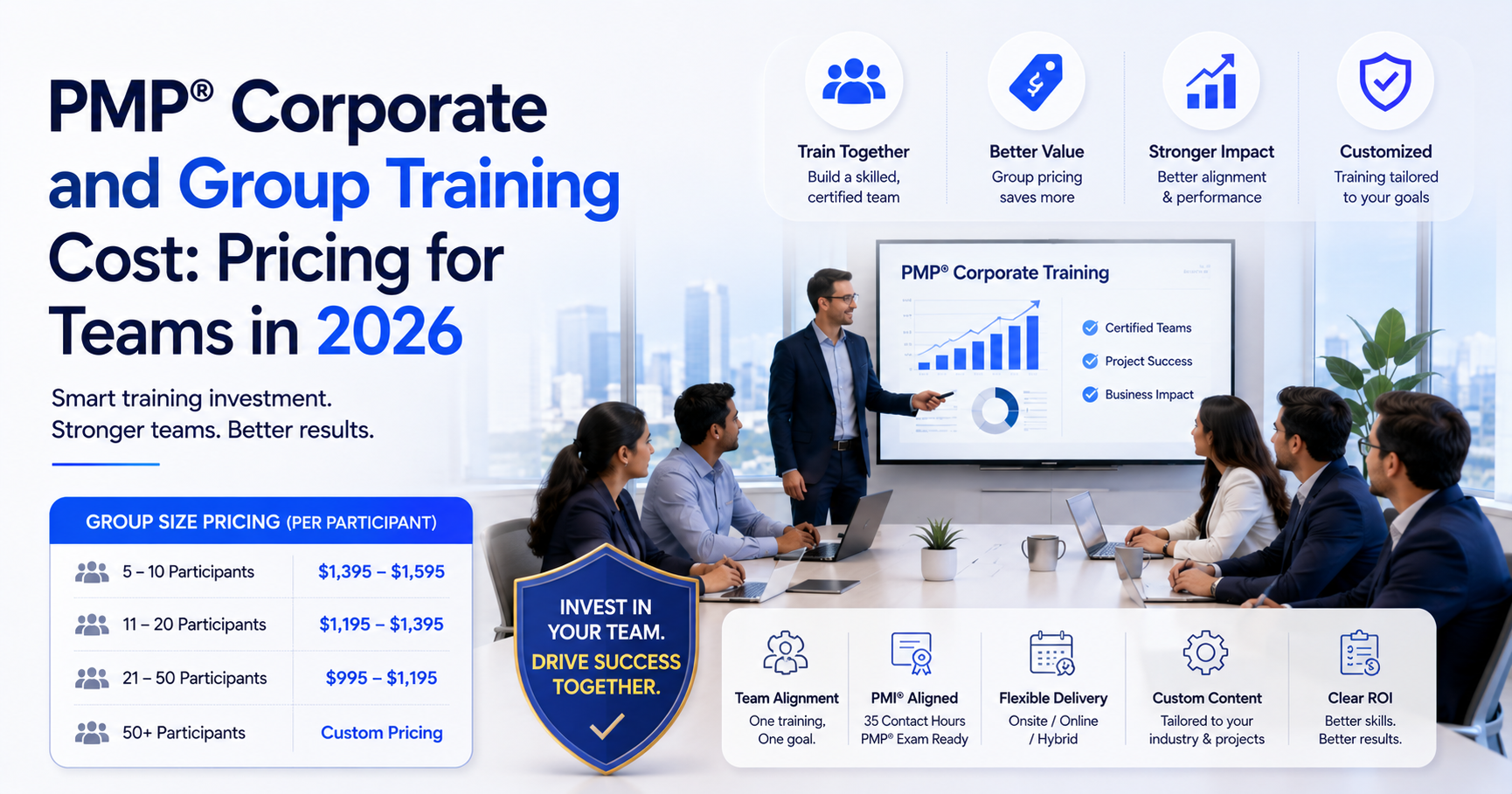
Corporate and group PMP training pricing is almost never a fixed number on a website. It is built from a base per-participant rate that shifts with group size, how much the curriculum is customised, whether delivery is on-site or virtual, and how many seats a provider can bill under one contract. Most training companies, including Simpliaxis's corporate and group training programmes, quote group pricing only after they know headcount, delivery format and timeline, which is why a genuine like-for-like number rarely appears in public rate cards. Understanding the variables behind that quote lets an L&D or PMO buyer negotiate from a position of knowledge rather than guesswork.
Key Highlights of PMP Corporate Training Cost
- Corporate PMP training is priced per seat, and that per-seat rate typically falls as group size rises, with meaningful discount tiers commonly starting around 5 to 10 participants.
- Individual instructor-led PMP training generally runs from roughly $800 to $3,500 depending on provider, country and format, while negotiated group rates can bring the effective per-person cost down by 20 to 40 percent at higher volumes.
- Delivery mode changes the cost structure: on-site training adds trainer travel, venue and logistics costs, while virtual instructor-led training (VILT) removes most of those and is usually the cheaper route for distributed teams.
- Every participant in a group cohort must still individually complete the full 35 contact hours PMI requires for PMP eligibility; a shorter or shared-hours format for the group is not compliant.
- PMI is moving toward accepting the 35 contact hours only from PMI Authorized Training Partners (ATPs) for PMP applications, which makes ATP status a non-negotiable line item in any corporate training RFP.
- Curriculum customisation, industry-specific case studies, and reporting or completion tracking for a PMO all add cost on top of the base per-seat rate.
- The strongest internal business case for group PMP training pairs the total programme cost against measurable outcomes: fewer schedule and budget overruns, more predictable delivery, and a shared project vocabulary across the team.
How Does Corporate and Group PMP Training Pricing Actually Work?
Corporate PMP training pricing works on a base per-seat rate that is discounted as group size increases, then adjusted for delivery mode and the amount of customisation requested. There is no single published corporate price because the final number depends on how many people are being trained, where they are located, whether the course runs on-site or virtually, and whether the organisation wants a standard PMP exam-prep curriculum or one adapted to its own project types. This is why most training providers, Simpliaxis included, describe corporate and group PMP training as quote-based rather than listing a flat team price online.
The core pricing variables
Four variables do most of the work in determining what a corporate PMP programme costs per participant.
| Variable | What it affects | Typical direction of impact |
| Group size | Per-seat rate, minimum batch thresholds | Larger cohorts lower the per-person price; many providers set real volume pricing at 8 to 10+ participants |
| Delivery mode | Trainer travel, venue hire, materials logistics | Virtual/VILT delivery is usually cheaper per seat than on-site; on-site adds logistics cost but suits teams that want in-person facilitation |
| Customisation depth | Curriculum design time, industry case studies, internal terminology | Off-the-shelf cohort pricing is lowest; tailored curricula add a design fee on top of the per-seat rate |
| Contract scope | Number of cohorts, reporting, post-training support | Multi-batch or annual training agreements typically unlock better per-seat economics than a single one-off session |
What Does PMP Training Cost Per Person Compared With Group Rates?
Individually booked PMP training tends to cost more per person than the same training bought as a group, because a large share of the delivery cost, the instructor's time, curriculum access, and administrative overhead, is fixed regardless of class size and gets divided across more participants in a group booking. Public benchmarking on instructor-led PMP training generally places individual pricing between $800 and $3,500 depending on provider, region and course length, while negotiated group rates can bring the effective per-seat cost down meaningfully once an organisation is booking a defined cohort rather than individual seats. Providers and buyers exploring options can review a standard course structure on Simpliaxis's PMP certification training before comparing it against a group quote.
| Aspect | Individual booking | Group / corporate booking |
| Typical per-person price movement | Fixed list price per seat | Per-seat price typically falls as headcount rises, often most noticeably once 8 to 10 or more seats are booked together |
| Curriculum | Standard, publicly available syllabus | Can be customised to the organisation's project types, tools and terminology |
| Scheduling | Fixed public batch dates | Dates set around the team's own calendar and project cycles |
| Administration | Each learner registers and is invoiced separately | A single contract, invoice and, often, a consolidated completion report for the PMO |
| Contact-hours compliance | Tracked individually by the learner | Still tracked individually per learner, but the provider can supply a group-level completion report for HR or PMO records |
| Best fit | One or two employees, ad hoc timing | Five or more employees, especially where an organisation wants a consistent project-management language across a team |
The gap between individual and group pricing is real, but it is not automatic. A provider needs enough seats in one cohort, or across a defined contract period, to justify a lower rate, which is why most quotes reference a minimum group size before any discount tier applies.
Does Group Training Actually Cost Less Per Person?
Yes, group training generally costs less per person than the same training bought individually, once a cohort reaches a provider's minimum group threshold. The instructor's preparation and delivery time, platform or venue costs, and course materials are largely fixed costs that get spread across more learners as the group grows, so the fixed-cost share of each seat shrinks. This is a standard pattern across corporate learning and development purchasing generally, not just PMP training, and published corporate training rate benchmarking shows volume-based per-seat pricing is the dominant model for team training across the wider L&D market.
The relationship is not perfectly linear, though. A group of five may see a smaller discount than a group of twenty five, and very small cohorts (two or three people) may see little to no reduction at all, since the provider still needs to run a dedicated live session regardless of headcount below the minimum threshold.
How Many Employees Do You Need for a Dedicated Corporate PMP Batch?
Most training providers set a minimum of around 8 to 10 participants before they will run a dedicated, privately scheduled PMP cohort with meaningful group pricing, though this varies by provider and delivery mode. Smaller teams of five to seven employees can sometimes still access a reduced group rate, but the discount is usually smaller than what is available once headcount clears the 8 to 10 mark. Organisations with fewer than five employees needing certification are typically better served by booking individual seats in a public scheduled batch, since a dedicated private cohort for two or three people rarely reaches a price point below what those same people would pay joining an open class.
For teams above 25 to 30 participants, providers frequently split the cohort into multiple parallel batches rather than one very large session, both to preserve interaction quality and to keep contact-hour delivery manageable. Organisations training more than 50 employees, whether a full PMO or a project delivery function, should expect the conversation to shift from "per-seat pricing" to a structured, multi-batch rollout plan with its own timeline and reporting cadence.
On-Site or Virtual: Which Delivery Mode Costs Less for a Team?
Virtual instructor-led training (VILT) is usually the lower-cost delivery mode for a corporate PMP cohort because it removes trainer travel, venue hire and on-site logistics, while on-site delivery adds those costs but can be worth it for teams that specifically want in-person facilitation. The learning content, official PMI-aligned curriculum, and contact-hour outcome are the same either way; the cost difference comes almost entirely from logistics rather than instruction quality.
| Factor | On-site delivery | Virtual (VILT) delivery |
| Trainer travel and accommodation | Included in cost, rises with distance and trainer seniority | Not applicable |
| Venue and equipment | Room hire, AV, printed materials | Not applicable; delivered via platforms such as Zoom or Teams |
| Best suited to | Single-location teams, leadership cohorts, cultures that favour in-person facilitation | Distributed or multi-location teams, larger headcounts, tighter budgets |
| Typical relative cost | Higher per seat once logistics are included | Lower per seat; often the default recommendation for cost-conscious corporate buyers |
| Scheduling flexibility | Lower, tied to trainer and venue availability | Higher, easier to run across time zones and in evening or weekend blocks |
Organisations that want the cost advantage of virtual delivery without losing structure can review how a self-paced or live-online PMP format is typically delivered on Simpliaxis's online PMP training and compare it against an on-site quote for the same headcount.
How Does the PMI 35 Contact-Hour Rule Apply to a Corporate Cohort?
The 35 contact-hour requirement applies individually to every employee in a corporate cohort, not to the group as a whole, so a company cannot reduce the compliance burden simply by training people together. PMI requires PMP applicants to complete at least 35 contact hours of project management education covering the process groups the exam is built around, and PMI has been moving toward requiring that those hours come specifically from a PMI Authorized Training Partner (ATP) for the hours to count toward exam eligibility. For a corporate buyer, this has a direct practical consequence: every seat in a group cohort needs its own verifiable 35-hour completion record, and the vendor delivering that cohort needs to hold current ATP status for those hours to be accepted when each employee applies for the exam.
This is one of the most commonly overlooked details in corporate training RFPs. A provider can be cheaper per seat and still be the wrong choice if its contact hours will not be accepted by PMI at the point an employee submits their exam application. Confirming ATP status, and getting it in writing as part of the contract, is a due-diligence step, not a formality.
What Should an L&D or PMO Manager Ask a Provider Before Signing?
Before signing a corporate PMP training contract, an L&D or PMO manager should confirm ATP status, per-seat contact-hour compliance, customisation scope, and what reporting the provider will supply once the cohort finishes. The questions below cover the areas where corporate buyers most often discover a gap only after the contract is signed.
- ATP status: Is the provider a current PMI Authorized Training Partner, and will that status remain valid for the duration of the contract and every employee's exam application window?
- Contact-hour records: Will each employee receive an individual, PMI-acceptable completion certificate showing all 35 contact hours, not just a single group attendance record?
- Customisation scope: What exactly is customised for the fee quoted, industry case studies, internal terminology, specific project types, and is that customisation a one-time design cost or repeated per cohort?
- Delivery flexibility: Can the same contract cover a mix of on-site and virtual sessions if the team is partly distributed, and does the per-seat rate change between the two?
- Minimum and maximum batch size: What is the minimum headcount to unlock group pricing, and at what point does the provider split the cohort into multiple batches?
- Reporting for the PMO: Will the provider supply a consolidated view of attendance, contact hours completed, and (where offered) practice exam readiness across the whole team, not just individual certificates?
- Rescheduling and no-shows: What happens, cost-wise, if a portion of the cohort cannot attend a scheduled session and needs to join a later batch?
- Post-training support: Is exam-application guidance, mentoring, or access to updated materials included, or billed separately after the initial contact hours are delivered?
A provider that answers all eight clearly, in writing, is generally a safer commercial choice than one offering the lowest headline per-seat number. Teams comparing options can check how these details are addressed on a standard programme page, such as Simpliaxis's PMP certification training programme for US-based teams, before requesting a tailored group quote.
How Should You Structure an RFP for Corporate PMP Training?
A corporate PMP training RFP should state headcount, delivery preference, timeline and required outcomes up front, then ask each vendor to respond against the same fixed set of evaluation criteria so quotes can be compared fairly. Because group PMP pricing is negotiated rather than published, an RFP that lacks these specifics will generate quotes that are impossible to compare side by side.
| RFP section | What to specify |
| Programme scope | Total headcount, whether it is a single cohort or multiple batches, and target certification timeline |
| Delivery requirements | On-site, virtual, or blended; time zones and locations involved |
| Compliance requirements | Confirmation of current PMI ATP status and individual 35 contact-hour records per learner |
| Customisation requirements | Any industry-specific content, internal case studies, or tool references needed |
| Reporting requirements | Format and frequency of completion and progress reporting to the PMO or L&D function |
| Commercial terms | Per-seat pricing at stated headcount tiers, payment schedule, and rescheduling or cancellation terms |
Weighting these criteria before quotes arrive, rather than after, keeps the final decision anchored to what the organisation actually needs rather than whichever proposal reads best on the day.
How Do You Build the ROI Case for Training an Entire Team?
The ROI case for group PMP training is built by comparing the total programme cost against measurable improvements in project delivery, then presenting that comparison in terms leadership already tracks, such as schedule variance, budget variance and resourcing costs. A training spend that looks large as a single line item becomes easier to justify once it is expressed against the cost of the problems it is meant to reduce: missed deadlines, budget overruns, and inconsistent project practices across a growing team.
What to include in the business case
- Total programme cost: the negotiated per-seat rate multiplied by headcount, plus any customisation or on-site logistics fees, set against the exam fee and any provider-side prep resources.
- Current baseline: existing project performance metrics, such as how often projects finish on time and on budget, before the training programme runs.
- Expected shift: realistic, sourced improvement ranges rather than invented figures, for example that certified project managers are commonly associated with lower budget variance and more consistent delivery outcomes in published training case studies.
- Time to payback: how many project cycles it will take for reduced overruns or rework to offset the training spend.
- Non-financial benefits: a shared project vocabulary and consistent methodology across the team, which is harder to quantify but is one of the most commonly cited reasons organisations choose group training over training individuals ad hoc.
A useful reference point when framing the improvement side of the case is a published PMP training case study from a mid-sized organisation, which reported a 208 percent return on a corporate PMP programme, with benefits including a measurable increase in projects completed on time, on budget and within scope. Figures like this should be cited as an external benchmark, not assumed to transfer directly to every organisation, but they are useful for showing leadership what a well-run programme has delivered elsewhere. For current programme costs to plug into the model, buyers can check indicative pricing detail on Simpliaxis's PMP certification cost breakdown and cross-reference the syllabus scope on Simpliaxis's PMP certification syllabus to confirm what the quoted price actually covers.
Conclusion
Corporate and group PMP training pricing is a function of headcount, delivery mode, customisation depth and contract structure, not a single published rate, which is exactly why serious buyers should treat the first quote as a starting point for negotiation rather than a final number. The per-seat economics genuinely favour larger, well-planned cohorts, but only when the organisation has done the groundwork: confirming ATP status so contact hours actually count, specifying reporting requirements a PMO can use, and building an RFP that lets quotes be compared on equal terms. The ROI case, in turn, is strongest when it is tied to concrete project performance metrics the organisation already tracks rather than to the training itself as an abstract good. Buyers who go into a vendor conversation with group size, delivery preference, compliance requirements and success metrics already defined are the ones who end up with pricing that reflects the real scope of the programme, not just the headline per-seat number on a proposal.









 Lowest-Price Challenge











 Personalized Path


.webp)


 USA
USA  Canada
 India
India UK
UK Australia
 Singapore


