


 Call Us



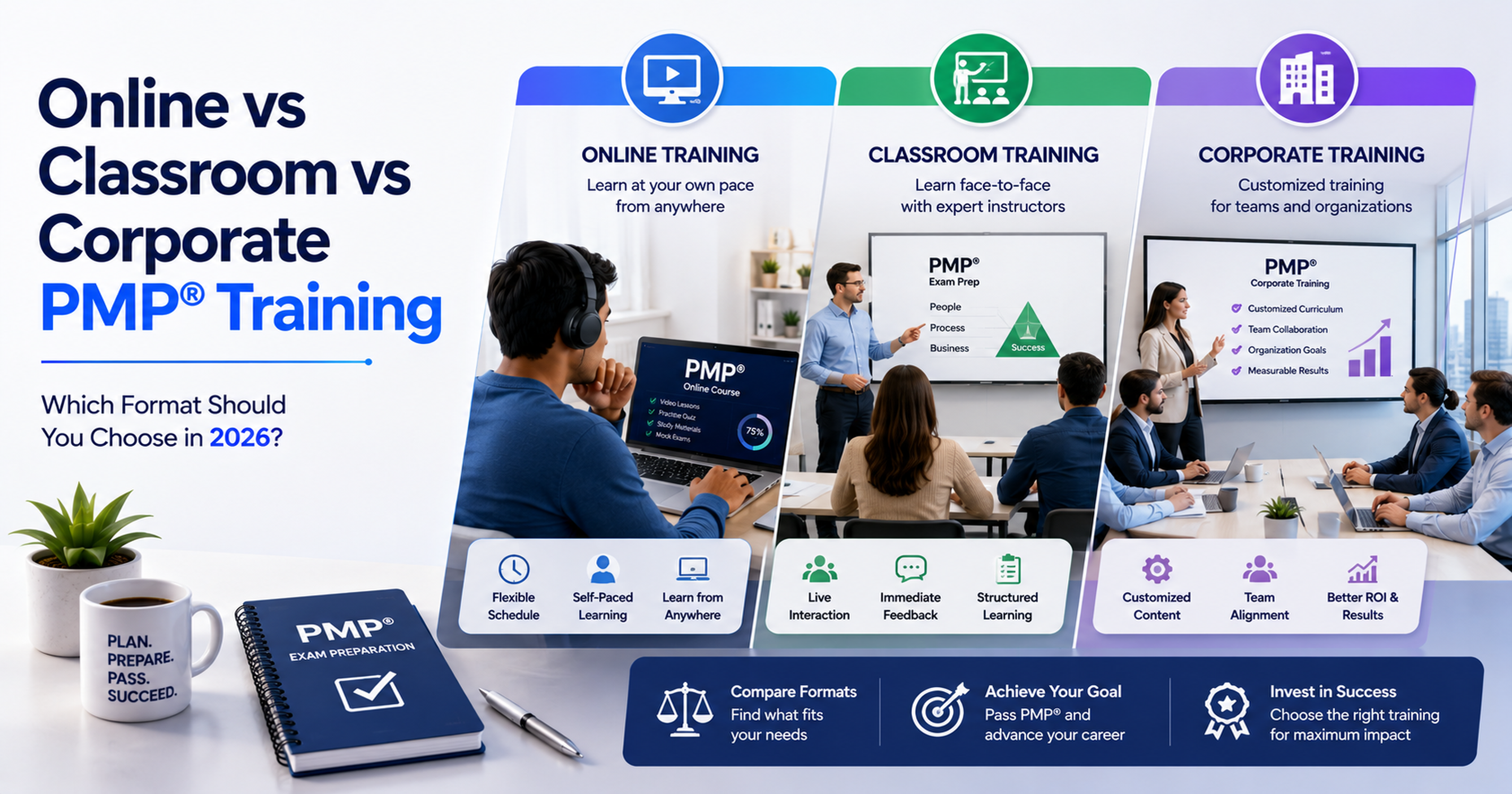
Most working professionals should choose live online PMP training if they want the structure and instructor access of a classroom without travel, self-paced online training if they are disciplined self-learners on a tight budget, in-person classroom training if they learn best through face-to-face discussion and networking, and corporate group training if three or more people from the same organisation are certifying together. All three individual formats can satisfy PMI's mandatory 35 contact hours, so the real decision comes down to your schedule, budget, learning style, and whether you are training alone or as part of a team.
Key Highlights: Online vs Classroom vs Corporate PMP Training
- PMP applicants must complete 35 contact hours of project management education covering all five process groups before they can sit the exam, and this requirement is the same regardless of which format is chosen, according to the Project Management Institute.
- Self-paced online PMP courses typically cost between 200 and 500 US dollars, live online instructor-led courses run 500 to 1,000 US dollars, and in-person classroom bootcamps range from roughly 1,500 to over 2,500 US dollars per seat.
- Corporate or group PMP training is usually priced per organisation rather than per seat, often starting around 5,000 US dollars for a cohort, and becomes more cost-effective than individual seats once a team reaches roughly 8 to 10 participants.
- Structured, instructor-led PMP preparation is consistently associated with higher first-attempt pass rates than unguided self-study, largely because of scheduled accountability and direct access to an instructor.
- Blended or hybrid PMP training, which combines self-paced online modules with live classroom or virtual sessions, is increasingly used to balance flexibility with the discipline of a fixed schedule.
- From late 2026, PMI is moving toward accepting the 35 contact hours only from PMI Authorised Training Partners (ATPs), which makes provider accreditation a more important filter than it was previously.
- Corporate training differs from individual online or classroom training mainly in customisation, minimum group size, and how the content is tailored to an organisation's specific project environment rather than a generic syllabus.
What Are the Three Main PMP Training Formats?
The three formats readers most often compare are online training, in-person classroom training, and corporate or group training, and each one can be delivered in more than one sub-format. Online training splits further into self-paced (on-demand video and reading) and live virtual instructor-led sessions. Classroom training means a physical room with a trainer and fellow candidates, usually run over consecutive days or spread across weekends. Corporate training is not really a fourth delivery method so much as a different buying and customisation model applied to either online or classroom delivery, built around a single organisation's team rather than a mixed public batch. Understanding this distinction matters because "online vs classroom" is a question about how content reaches an individual, while "corporate vs individual" is a question about who is paying, how many people are training together, and how much the curriculum is tailored.
It also helps to separate the format question from the exam itself. Choosing online, classroom, or corporate training changes how a candidate absorbs the material and earns the 35 contact hours, but it does not change the exam content, the exam fee, or PMI's eligibility rules around project experience. Two candidates who chose completely different formats can sit the identical PMP exam on the same day, which is why the comparisons below focus on delivery, cost, and interaction rather than on syllabus differences.
How Each Format Delivers the Mandatory 35 Contact Hours
Every legitimate PMP training format, whether online, classroom, or corporate, must deliver the same 35 contact hours of project management education before PMI will accept an exam application. A contact hour is defined as one actual hour of formal instruction, and the content must span all five process groups: initiating, planning, executing, monitoring and controlling, and closing, as confirmed by PMI's own exam preparation guidance. What changes between formats is not the hour count but how those hours are structured and verified.
Self-paced online courses log contact hours through tracked video completion and assessment checkpoints inside a learning platform. Live online and classroom courses log them through scheduled, dated sessions with an instructor, which is why many providers issue a certificate listing exact dates, topics, and hours at the end of the course. Corporate training logs hours the same way a live classroom or virtual batch would, just against a private roster instead of a public one. One detail candidates frequently miss: contact hours never expire and can be accumulated across more than one course or provider over time, so a candidate is not locked into finishing all 35 hours in a single format, and hours from an old university project management module can even be combined with a newer course to reach the total. Neither informal self-study, such as reading a PMBOK Guide alone, nor attending a local PMI chapter dinner meeting counts toward the 35 hours; the instruction has to be structured and led by a qualified trainer or platform.
It is also worth flagging a change that directly affects format choice going into 2026. PMI has signalled a move toward accepting the 35 contact hours only from PMI Authorised Training Partners, detailed on its page covering the newly updated PMP exam, which makes it worth checking a provider's ATP status before enrolling in any format, online, classroom, or corporate. This detail is covered on Simpliaxis's PMP certification syllabus page, which also breaks down how the 35 hours map onto the current exam content outline domains of people, process, and business environment.
Online vs Classroom vs Corporate PMP Training: Side-by-Side Comparison
The table below lines up the three formats against the factors candidates actually weigh: duration, price, how the 35 contact hours are delivered, how much live interaction is built in, and who each format tends to suit best.
| Format | Typical Duration | Typical Price Range (per participant unless noted) | How the 35 Contact Hours Are Delivered | Interaction Level | Best For |
| Self-paced online | 4 to 8 weeks of self-managed study (flexible) | USD 200 to 500 | Tracked completion of recorded video modules and quizzes covering all five process groups | Low; asynchronous forums or email support only | Disciplined self-learners with tight budgets and unpredictable schedules |
| Live online (virtual instructor-led) | 4 to 6 days, or spread across evenings/weekends over 2 to 4 weeks | USD 500 to 1,000 | Scheduled live sessions with an instructor, dated and certified as they occur | High; real-time Q&A, breakout exercises, cohort discussion | Working professionals who want structure and instructor access without travel |
| In-person classroom | 4 to 5 consecutive days, or two weekends | USD 1,500 to 2,500+ | Scheduled in-room sessions with an instructor, dated and certified as they occur | Very high; face-to-face discussion, networking, immediate feedback | Candidates who learn best in person and value peer networking |
| Corporate / group training | Custom, typically 4 to 6 days delivered onsite or virtually | From roughly USD 5,000 per cohort (organisation-level pricing, not per seat) | Scheduled sessions run against the organisation's own project examples, still covering all five process groups | High to very high; tailored discussion using the team's real projects | Teams of 3 or more certifying together, especially groups of 10+ |
The prices above are indicative ranges drawn from industry-wide reporting on PMP course fees and vary by provider, region, and whether official study materials or an exam pass guarantee are bundled in. For an itemised look at what a specific PMP course covers, Simpliaxis publishes a detailed PMP certification training curriculum breakdown.
Online PMP Training: Self-Paced vs Live Virtual
Online PMP training is not one format but two quite different experiences, and conflating them is the most common mistake candidates make when comparing options.
Self-Paced Online PMP Courses
Self-paced online training suits candidates who can study consistently without external deadlines. It is the most affordable route to the 35 contact hours, typically 200 to 500 US dollars, and lets a candidate study during lunch breaks, evenings, or weekends without committing to fixed session times. The trade-off is that there is no instructor to answer a question in the moment, and candidates who start and stop irregularly tend to retain less and take longer to finish than those on a scheduled course. This format works best for candidates who have already passed a certification exam before and know how they study best independently.
Live Online (Virtual Instructor-Led) PMP Courses
Live online training keeps the flexibility of studying from home while adding a fixed schedule, a real instructor, and a cohort of peers. Sessions are dated and delivered over video conferencing, which means the 35 contact hours are recorded exactly as they would be in a physical classroom. This format has closed much of the gap with in-person training in recent years, particularly when the provider includes breakout exercises, live polling, and direct access to the instructor outside class hours. Candidates who want classroom-level accountability but cannot travel or take a full week off work generally find this the best middle ground; Simpliaxis's PMP certification online training course is built around this live virtual model.
Classroom PMP Training: What It Offers That a Screen Cannot
In-person classroom training remains the highest-interaction format because it removes every barrier between a candidate and an instructor or peer. Being physically present for four or five consecutive days creates a level of focus and discipline that is harder to sustain when training happens around a normal workday, and many candidates specifically choose classroom training because the environment itself reduces procrastination. The networking side matters too: candidates sitting alongside other project managers from different industries frequently build contacts that outlast the course itself and sometimes lead directly to referrals or job opportunities. The main costs are time away from work and travel, and classroom seats are typically the most expensive individual option, often 1,500 to 2,500 US dollars or more depending on location and course length. Candidates based in the United States comparing local options can review Simpliaxis's PMP certification training course in the US for city-specific classroom and live virtual batches.
Corporate and Group PMP Training for Teams
Corporate PMP training answers a different question than individual online or classroom training: not "which format suits me" but "how do we get several employees certified together, efficiently, and aligned to how our organisation actually runs projects."
The core differences from individual training are threefold. First, pricing is structured per organisation or per cohort rather than per seat, which usually becomes more economical than buying individual classroom or live online seats once a team reaches around 8 to 10 participants, since providers price corporate cohorts as a block rather than multiplying an individual rate. Second, most providers set a minimum group size, commonly around 10 participants, before they will schedule a dedicated private batch onsite or virtually, though smaller teams can sometimes be accommodated case by case or folded into blended arrangements. Third, and most importantly, corporate training is customisable in a way public batches are not: trainers can weave in the organisation's own project templates, industry context, and terminology, and scheduling can be arranged around the company's operational calendar rather than a fixed public course date.
The 35 contact hours requirement applies to every individual in a corporate cohort exactly as it would if they trained separately, so the certification maths does not change; what changes is delivery efficiency, consistency of training quality across the team, and the ability to build a shared project management vocabulary across an entire department at once. Organisations planning to certify a project management office or an entire delivery team can review options on Simpliaxis's corporate and group training page, which covers onsite, virtual, and customised delivery for enterprise teams.
Can You Combine Formats? Blended and Hybrid PMP Training Explained
Yes, and for many candidates a blended approach is the most practical answer rather than a compromise. Blended PMP training combines self-paced online modules for foundational content with live virtual or in-person sessions for the harder topics, exam strategy, and group practice, letting a candidate bank contact hours flexibly while still getting scheduled instructor time where it matters most. A typical blended path might involve working through recorded lessons on the process groups independently, then joining a two-day live weekend session to consolidate learning, run through practice questions, and get direct feedback before the exam.
This approach is particularly useful for three groups of candidates: those who cannot commit to a full consecutive week away from work but still want live instruction, corporate teams spread across multiple offices or time zones who complete core content asynchronously before a shared live workshop, and candidates who tried pure self-study, stalled partway through, and want to add structure without starting over. Because contact hours accumulate and never expire, mixing formats does not create any certification risk as long as the total reaches 35 hours across all five process groups and the training is properly documented.
Which Format Should You Choose? A Decision Framework
Use the questions below in order; the first one that clearly applies to you generally points to the right format.
- Step 1: Are you training as part of a team of three or more from the same organisation? If yes, start with corporate or group training rather than pricing individual seats, since cohort pricing and customisation usually deliver more value once a group exists.
- Step 2: Do you need to keep working full time with no travel and no fixed week off? If yes, live online training is usually the best fit, since it delivers instructor access and a fixed schedule without location constraints.
- Step 3: Are you highly self-disciplined, on a tight budget, and comfortable studying without a live instructor? If yes, self-paced online training is the most economical route to the 35 contact hours.
- Step 4: Do you learn best through face-to-face discussion and want to build a peer network alongside certification? If yes, in-person classroom training justifies its higher cost through interaction quality and networking.
- Step 5: Are you unsure and want the safest middle ground? If yes, a blended path, self-paced modules plus a live session, balances flexibility against accountability better than committing fully to either extreme.
Whichever format you choose, verify two things before enrolling: that the provider is positioned to remain compliant with PMI's move toward Authorised Training Partner-issued contact hours, and that the course maps to the current PMP exam content outline rather than an outdated syllabus. Simpliaxis's guide on how to prepare for the PMP certification exam walks through exam readiness once the 35 contact hours are complete.
Conclusion
There is no single best PMP training format in 2026; there is only the format that matches how you learn, how much time you can give it, and whether you are training alone or with a team. Online training, in either its self-paced or live virtual form, wins on flexibility and cost. Classroom training wins on interaction, discipline, and networking. Corporate training wins on economics and customisation once a genuine team exists, and blended approaches let candidates borrow the best of both worlds instead of forcing an either-or decision. All roads lead through the same non-negotiable checkpoint, PMI's 35 contact hours across all five process groups, so the format question is really about how you want to reach that checkpoint, not whether you can skip it.






 Lowest-Price Challenge











 Personalized Path


.webp)


 USA
USA  Canada
 India
India UK
UK Australia
 Singapore


