


 Call Us



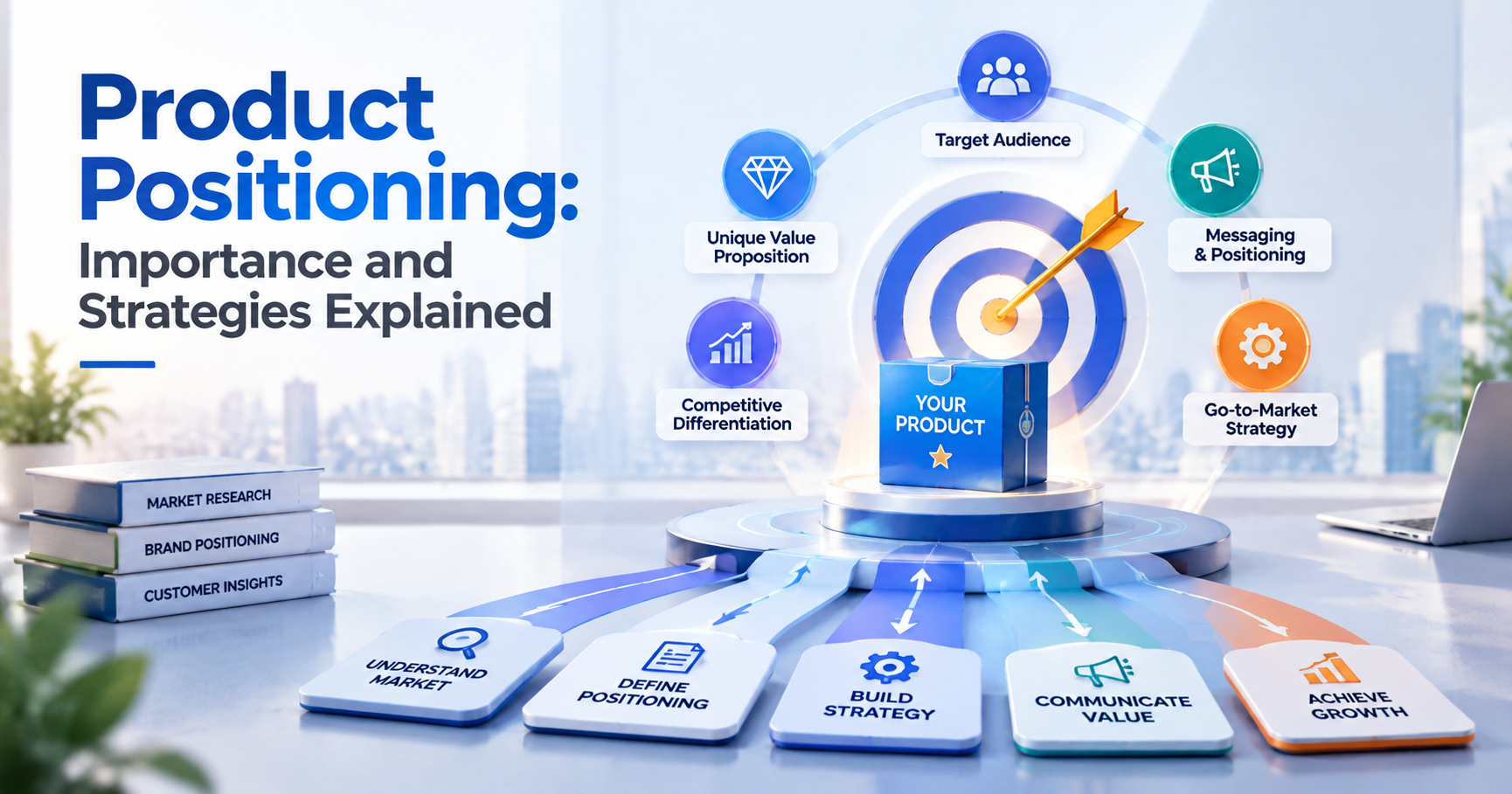
According to April Dunford, product positioning is how your product is the best at delivering specific value that a well-defined set of customers care about. It is similar to context-setting for products. Strong product positioning provides a strategic framework, helping in defining how customers should perceive your product.
Key highlights
- Definition: Product positioning is how the customer sees your product compared to alternatives. This refers to who the product is for, what problem it solves, and what makes it different.
- Five Key Elements: Who your target audience is, the specific customer needs and pain points, market category, product value and benefits, and what makes your product uniquely different from competitors.
- Six-step strategy: Research your target market, analyze the competitors, find the white space opportunities, determine your unique value, select your positioning, and test, assess, and iterate on your positioning.
- Five Positioning Types: Price, Quality, Benefit, Customer/Niche, Competitor.
Introduction
In 1981, Jack Rout and Al Ries introduced the concept of positioning, a unique strategy for brands to shape consumer perceptions. They put their points that products aren't quite required to be objectively different. However, they need to be perceived by customers accordingly.
For example: Apple does not just sell smartphones; they give you a modern experience. Their marketing strategy gets into emotions like innovation, creativity, and empowerment. They showcase their products in a way that helps users to think differently and push boundaries. The organization develops a brand identity that connects with a larger audience, ensuring their products feel aspirational and inclusive.
In this blog, we will talk about the importance of product positioning, how to create a product positioning strategy, what some product positioning strategies are, best practices, and common product positioning mistakes.
What is product positioning?
Product positioning refers to the set of actions and processes that define and communicate how you want your target audience to perceive your product. It is the strategy you use to deliberately create a unique place in the customer’s mind.
Successful positioning strategies don’t just focus on where your product is today; they also consider how it could and should develop in the future. Many brands focus on marketing to communicate their market position.
Why is product positioning important?
Product positioning is important for the following reasons:
1. Boosts alignment and product success:
Positioning is very important so as to ensure that key stakeholders are on the same page. When the internal teams are connected, you’ll likely achieve your goals, fine-tune your strategy, and execute it successfully.
2. Articulate your product’s value proposition to customers:
For clarity purposes, positioning ensures that there is quality communication with your target audience. This will make you stand out from the competition. Apart from this, positioning helps customers learn about the product’s value proposition.
3. Foundation for messaging:
Positioning is foundational for campaigns, copy, and launch plans. Weak positioning leads to a lack of clarity in messaging and a sales team that can’t close.
4. Product decisions:
Product decisions determine what to prioritize and build and what to skip. Without it, roadmaps lose focus. Hence, you need to have a clear idea of what type of product decisions you want to make.
5. Long-term relevance:
As markets change, a clear position allows for adjustments to be made to messaging and features without losing your core identity.
What Are the Key Elements of Product Positioning?
Positioning has five core components, and if one of them is not there, or is not clear, the whole position is weak. Each answers a simple question a buyer has (usually without realizing it).

1. Target audience:
A product that is made for everyone is made for no one. The best way to position a product is to identify who the best customer is. Usually this means looking at age, role, income, location, habits and goals.
Think about why you buy one product at the gym, and another for your school lunch. They are likely similar products, but the audiences are different and require a different position.
2. Customer needs and pain points
Understand your customers' needs and pain points. Often, pain points are an undesirable consequence, such as higher costs or wasted time. The need is the positive consequence the customer wants instead.
Pain points help create positioning. Listen for customer pain points and describe them in your own words. Use their words to talk about the product and why they buy it. Use the negative consequences as yours as well.
3. Market category
Market categories educate your customers on the type of product you sell. If you don't categorize your product, people have a hard time understanding your product and can't place it on a mental shelf.
You can compete within an existing category. People instantly understand what is meant by “project management software.” A new category can be created if your product truly breaks the mold, but this is very difficult to do.
Pick the category that helps buyers understand you the fastest. Then use differentiation to stand out within it.
4. Product Value & Benefits
A feature is something a product has. A benefit is something a customer gains. Value is the difference between the benefits and costs.
Come up with 2-3 benefits that give a summary of what your audience cares about most. A lengthy list of benefits overwhelms your audience and dilutes your message.
5. Competitive Differentiation
Differentiation is the reason customers should select you over your competitors. It needs to be real, relevant and provable.
Direct competitors are products or services similar to yours. Indirect competitors include substitutes or alternatives, or sometimes even doing nothing.
A real difference is something your competitors cannot easily dispute. It can be price, speed, service, design or ingredients. It is best if your difference is provable.
What are the differences between product positioning, value proposition, and messaging?
| Concept | What It Is | Main Audience | Example Focus |
| Product positioning | The strategic decision on where your product fits in the market and why | Internal teams | Target audience, category, differentiation |
| Value proposition | The promise of value a customer receives | Customers | Specific benefit and why it matters |
| Messaging | The words and stories used to communicate across channels | Customers and prospects | Headlines, taglines, ad copy, emails |
How Do You Create a Product Positioning Strategy?
There are many steps in positioning a product that involve research and planning. Follow them in this order to arrive at the best positioning for your product.
1. Identify Your Target Market
The first step to anything in marketing is to outline your evidence. In this case, you want to know who your consumers are and why they make the purchases they do. Be sure to use a combination of quantitative and qualitative data for the best results.
Some methods to gather data include:
- Customer surveys
- Sales and support call recordings
- Search trends and keyword analysis
- Reviews and social posts about your competitors and their products
Look for recurring themes and pull data from many resources to validate your conclusions. If you see many people with the same frustration, it is likely a valid observation.
2. Assess Your Competitors
How do your competitors describe themselves? Write down what they say about their products on their website and other mediums. What do they claim? What is their price? What is their tone? Who is their target audience?
Create a spreadsheet and list your competitors along with their main claim.
- What do you think are their strengths and weaknesses?
- Do you see any gaps?
Assess what your competitors' customers are saying. Negative reviews usually point to why a consumer is frustrated or has an unmet need.
3. Identify market gaps
A market gap is where a consumer need is not being met. Look at your competitor research and your customer research. Where do the two align? Where do the two differ? Where are the gaps?
Gaps can occur in quality, convenience, experience, price, or audience. Focus on a specific gap that you can really address. Gaps that you can’t serve are not really opportunities.
4. Unique Value
First, identify your strengths. What do you do that is better than anyone else for the audience you’ve chosen? Be honest about what you can prove.
Write a simple statement. It should include the customer, the issue, your solution, and what you’ve proven. If you need a paragraph to explain, simplify it.
Write down what you’ve proven. You can use data, get certified, provide references, case studies, or product test reports. Claims without proof can harm trust.
5. Articulate Your Leading Position
With your value defined, articulate your leading position. You can have many strengths, but only one should be your leading position.
What do buyers find most important, what is most unique from the competition, and what can you believably say?
State it and give it to the employees in product, marketing, sales, and support. Employees should all give the same statement when describing your product.
6. Test and Adjust Your Position
Don’t just assume your position is correct. Show your statements to your potential customers and ask what they think it means.
You can use A/B testing on product landing pages, online advertisements, and emails. Track click-through rates, sales, and feedback.
Adjust your positioning based on the findings. Learning your customers and positioning the product for them is key to success.
What are the differences between product strategy and product positioning?
Product strategydescribes the plan for what you will build, whom you will build it for, and how you will ultimately win in the market.
Product positioning describes the narrower decision about how a particular product is perceived. More importantly, how a product is positioned indicates why customers should select it over competing alternatives in the market today. Positioning is a key element of strategy.
What are the different product positioning strategies?
A product can be positioned in different ways. The strategy that is appropriate for you would depend on your market, your resources and your target audience. The following are the most common of these strategies.
1. Price Positioning
This strategy relies on charging the highest or the lowest prices in the market. Achieving low price positioning requires having the lowest costs and the highest volumes.
Low price positioning draws the value-conscious customer. However, it can easily result in price wars. Premium positioning draws the quality-conscious customer, but it can be successful only if there is evidence to justify the price.
In general, don't discount deeply. Discounts convey to the customer that they are getting the product at a deep discount. If the justification for charging a premium is worn away, and the product loses its premium positioning, it loses its market and customers.
2. Quality Positioning
This relies on the product being the best (in terms of reliability, performance, materials, etc) in its category. It is suited to products in categories where the customer cares about the outcome and result of using the product.
To support quality claims, name the relevant tests, standards or warranties.
Positioning a product as a premium, higher-priced product often results in customers being willing to pay a higher price, and increases customer loyalty.
3. Benefit Positioning
The focus is on the main benefit the customer gets from using the product. What is the product doing for the customer? The benefit can be saving the customer time, health, money, risk or other things. Pick the main benefit and repeat it consistently.
This type of positioning usually works when your product is solving an obvious problem.
4. Customer or Niche-Based Positioning
This strategy focuses on a specific segment or case. The message is “built for people like you.”
This can be seen in specific software built for freelancers, or nutrition made for athletes. Usually, being niche means you can own a specific language. This means you can craft more precise positioning statements or messages.
The key trade-off is reaching a smaller audience. A specific niche can mean being more profitable than trying to sell to a mass market.
4. Competitor-Based Positioning
Also known as competitive differentiation. This means positioning yourself relative to a specific competitor. You are focused on how you differ or are better than a known alternative.
This can mean having an outright comparison or saying “we are the simpler alternative to complex tools.”
Use this with caution. A focus on competitors means you are tying your brand to someone else’s and creating a brand only in relation to others. Keep a factual claim and don’t let others define your brand.
How Do You Write a Product Positioning Statement?
A positioning statement is an internal document that focuses on the reasoning behind positioning. It is generally one or two sentences that help explain the rationale to employees. Positioning statements inform taglines that are written for external audiences.
Product Positioning Statement Template
“For [target customer] who [need/problem], [product name] is a [market category] that [key benefit]. Unlike [primary competitor/alternative], our product [key differentiator].”
What are the examples of product positioning?
The examples of product positioning include the following:
- Volvo: Strong safety history and reputation have long helped sell Volvos. Families, in particular, have a high level of trust in Volvo's safety features. This positions the product at the upper end of price and/or quality.
- Apple Watch: Originally positioned around lifestyle and communication. It has transitioned to be centered around health and fitness. Positioning can and should change based on customer needs.
- Slack: Positioned to eliminate work email. By naming the pain of work email, it owned a category.
- Dollar Shave Club:Disrupted the market for expensive razors. Humor and directness made a price based message memorable.
- Tata Nexon: Strong safety ratings in the Indian compact SUV market have been used by Tata to support a benefit based positioning.
In each case, the message is concentrated. The brand has pinpointed and repeated one idea.
What Are the Best Practices for Product Positioning?
Some of the best practices for product positioning include the following
- Start with the customer: Embrace research. Avoid acting on gut feel.
- Be specific: Avoid ambiguity. Use numbers, names and proof to bolster your claims.
- Focus on core ideas: One primary idea makes for better recall.
- Test assumptions: Validate with surveys, interviews and experiments.
- Aligned team: Product, marketing, sales, and support should all be on the same page.
- Consistent: Your position should be this way at all times.
- Own your data: Explain your proof with reviews, data, case studies, etc.
- Recheck and reflect: Look back and see if your positioning still holds.
- Simplify for the teen: Use simple language. If a teenager can’t understand your positioning, edit it.
What Are the Common Product Positioning Mistakes?
Even the most experienced teams make these mistakes. Being aware of them lets you avoid costly detours.
- Targeting everyone: A general audience means generic messaging.
- Led by features: Appeal to outcomes first.
- Blindly following competition: Similar claims lead to being ignored.
- Making unproven claims: Trust is important, and overpromising leads to more returns and bad reviews.
- Never changing: You can fall behind and be out of touch with the market by not evolving your positioning.
- Always changing: Confusing and inconsistent messaging for customers.
- Skipping research: There is a reason why things are the way they are. Don't reinvent the wheel.
- Ineffective Integration: An expensive messaging strategy with lots of discounts sends a poor brand image.
- Keeping positioning within a select few team members: Sales and marketing saying contradictory things about your product is terrible for business.
Conclusion
Good product positioning gives a brand direction and a reason for being. It results in people throughout the organization representing and speaking with one voice about your product.
As you begin, you will want to define one clear position and test it. In the process of advancing your positioning, you will want to ensure your position is kept strongly differentiated from the competitors. A strong position leads to competition becoming irrelevant because your product becomes the obvious choice to your audience.
To learn more about product positioning, importance of product vision, and the product roadmap, consider enrolling in the certified scrum product owner certification course. Here, you will attain product owner skills - backlog management, decision-making, and prioritization.








 Lowest-Price Challenge











 Personalized Path


.webp)


 USA
USA  Canada
 India
India UK
UK Australia
 Singapore


