


 Call Us




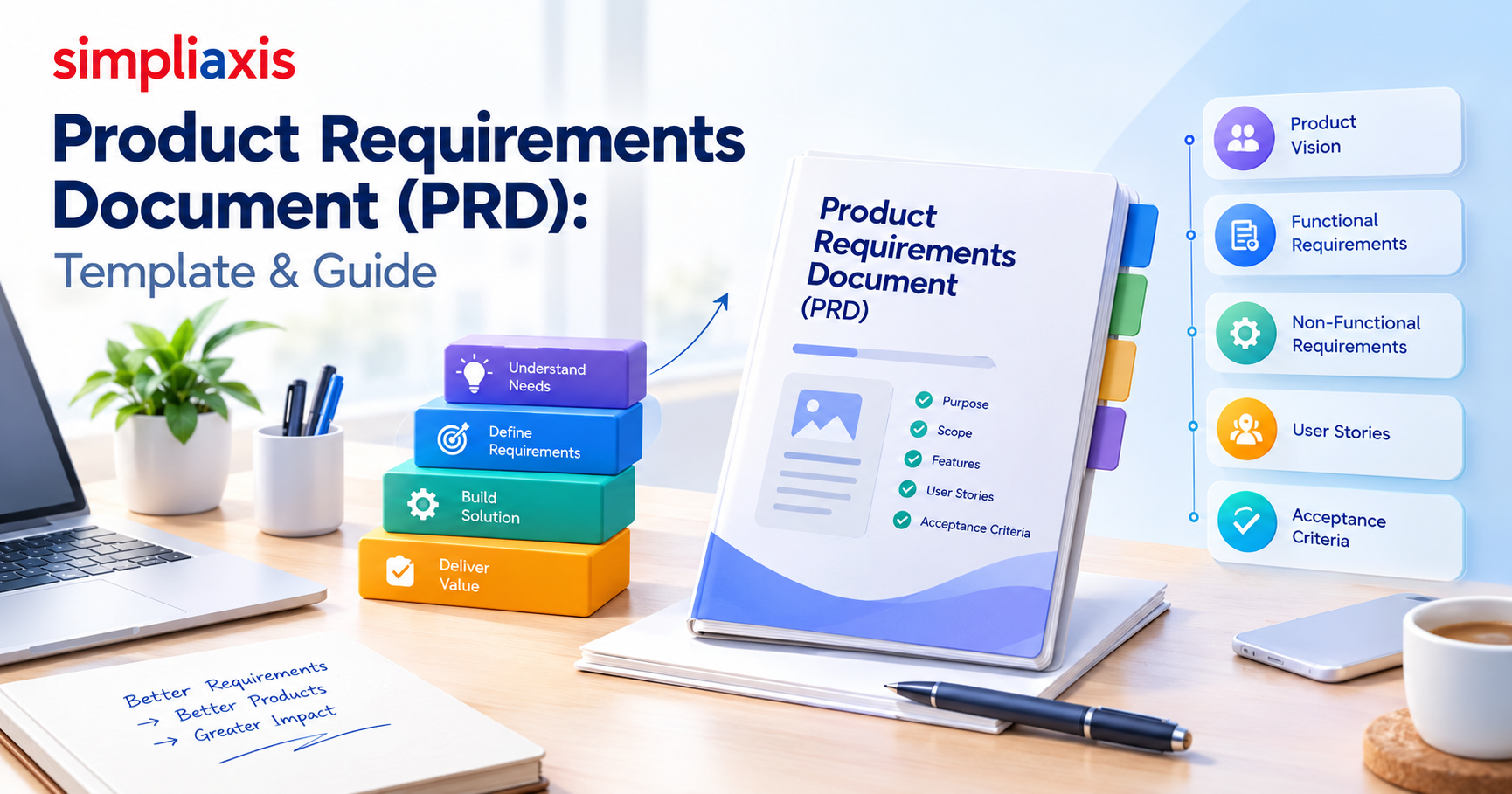
The Product Requirements Document (PRD) defines the actions of a product or feature, the target audience, and the development approach. PRDs help product managers, designers, developers, and other team members to work on the same page with the purpose, scope, features, and expected outcomes of the product.
A typical PRD usually explains the problem to be solved, the goals, target users, user stories, requirements, dependencies, and measures for success. PRDs help product teams set expectations, guide development, and prevent confusion.
Key Highlights of the Product Requirements Document (PRD)
A PRD is a standard reference point for product managers, designers, engineers, and QA professionals who play a key role in product development.
A typical PRD should include the problem statement, the product objectives, the user personas, the functional and non-functional requirements, the assumptions, etc.
The PRD focuses on product requirements, whereas the Business Requirements Document deals with business needs. Similarly, the Market Requirements Document addresses market and customer needs. The Functional Specification Document (FSD) explains the ways specific features should work.
Creating a PRD follows five primary steps, such as defining the problem and goals, identifying users and use cases, writing down the requirements, setting the success criteria and scope, and having the document reviewed by key stakeholders before the outset of the development.
Agile teams rely on brief PRDs instead of lengthy fixed documents.
The PRDs contain the key requirements and decisions and allow the teams to change the details based on product discovery, backlog refinement, stakeholder feedback, and ongoing development.
Introduction
Building a successful product demands a good idea, but that is not enough. Product teams should have a clear understanding of the issues customers usually face, business objectives, what the product should do, and what success means. When this information is spread out over meetings, emails, and chat messages, it can result in confusion, requirements being overlooked, and delays.
A well-structured PRD is going to give you the ability to get better in decision-making and collaborate more effectively every time you are building a new app, improving a feature, or working with an Agile backlog.
What is a Product Requirements Document (PRD)?
PRD Definition
A Product Requirements Document (PRD) is a well-organized document that sets out the purpose of a product or feature, identifies the intended users, lists the features, specifies the requirements and constraints, and states the expected outcomes. The business objectives are requirements that it is possible for product teams to understand, assess, and put into action.
For example, if an e-commerce company wished to introduce a one-click checkout feature, the PRD would have to contain a description of the customer problem, details regarding the target users, an explanation of the checkout function, the payment requirements, the security considerations, and the success metrics.
It could also say that customers should be able to make eligible purchases with fewer steps by using their saved payment and delivery information.
Why a PRD Matters
A product may have a well-defined business aim, but different stakeholders can still have varying interpretations of its requirements, product managers tending to concentrate on customer experience, developers focusing on technical feasibility, and business stakeholders emphasizing timelines and commercial objectives. Documenting the conditions and requirements that have been agreed upon.
1. Creates a Common Product Vision
A PRD explains the problem it addresses, the users of the product, and the functions it must perform. It helps all members of the team understand the significance of features and the team's objectives.
2. Minimizes Miscommunication and Rework
The conditions are unambiguous, so teams do not need to be unsure about how it will be done, what rules are imposed, or what limitations apply. If there are any questions that need to be answered, teams can refer to the PRD without having to guess or make assumptions.
3. Supports Better Scope Management
Features that are present and missing in the product or release are shown in a PRD. This helps teams evaluate change requests with greater accuracy, manage customer expectations, and prevent introducing features towards the end of the process.
4. Enhances cross-functional teamwork
The PRD is often a place that product managers, designers, developers, QA, and business representatives all have in common. It's a place to walk through what's possible, how simple the product is to use, what is important, what is dependent on what, and what can go in the product to get it accepted.
5. Guides Development and Testing
Development teams use functional requirements and nonfunctional requirements to tell them how their product should work. Testers can use these requirements and their acceptance criteria to plan their tests and spot gaps prior to a product launch.
6. Connects Product Delivery With Measurable Goals
Within a PRD, it is possible to set goals like user activation, task completion, conversion rates, or feature adoption. These measures help the team understand whether the solution really solves the original problem; not just whether the work is done.
A PRD is not a replacement for conversations or continuousproduct discovery. Instead, it is a source that provides you a reliable baseline that teams can adapt to changes in needs.
What Goes into a PRD?
A Product Requirement Document is where a team gathers the information needed to understand, develop, and evaluate a product or feature. Even though the structure might differ according to the organization and the development methodology employed, an effective PRD must describe the problem it is intended to solve, the users it is aimed at, the expected functionality, the scope, the constraints, and the success criteria. A product requirements document consists of six essential components.
Even though the structure might differ according to the organization and the development methodology employed, an effective PRD must describe the problem it is intended to solve, the users it is aimed at, the expected functionality, the scope, the constraints, and the success criteria. A product requirements document consists of six essential components.
Purpose, Problem and Objectives
Each product or feature requirement document should start by stating the reasons for needing the product or feature. This section provides the background for the development work and enables the stakeholders to understand the problem prior to looking at possible solutions.
The purpose describes the reason for the initiative, while the problem statement identifies the specific customer or business challenge. Objectives define the improvements the team intends to achieve.
A well-written section should address:
Purpose: Why is the product or feature being developed?
Problem statement: What difficulty are customers experiencing?
Business objectives: Which measurable improvements should this initiative help achieve?
Expected value: How will solving this problem help users or the organization?
Example: An e-commerce platform noticed that many customers leave before completing their purchases because the checkout process is too complicated.
The PRD might set an aim to simplify the checkout process and improve the number of purchases that are completed. This would give a clear guide for assessing possible solutions.
Target Users and Personas
The PRD ought to clarify which people will be using the product and what the users need to achieve. If there is no clear understanding of the target audience, the teams might end up developing features that do not solve real customer problems.
This section usually includes information on different user groups, their relevant characteristics, their objectives, their difficulties, and the situations in which they use the product. If the research supports it, product teams might also incorporate user personas.
For example, a mobile banking application could serve first-time users of digital banking, frequent mobile banking customers, and those customers who have accessibility requirements.
The expectations of each group could vary as to authentication, navigation, and transaction workflows.
A useful user persona might contain:
User role or customer segment
Primary goals and motivations
Common problems or frustrations
Relevant behaviors and usage patterns
Accessibility or usability considerations
Personas must be developed on the basis of customer research, analytics, or some other credible evidence rather than on unsupported assumptions, since this enables the teams to prioritize the requirements that actually meet genuine user needs.
Features and User Stories
The features are the more general areas of functionality, whereas the user stories show the specific needs from the point of view of the user. This section outlines the product capabilities required to deal with the problem identified.
A commonuser storyformat is:
I, as a [type of user], would like to have [capability] so that I might obtain [benefit].
For instance, suppose a learning management platform is introducing a course progress dashboard.
Feature: Course Progress Tracking
The user story is that the learner should be able to see the lessons they have completed and the modules that remain to keep an eye on their progress and to plan their learning activities.
The PRD could also containacceptance criteria, which set out the conditions upon which the functionality can be regarded as acceptable.
For the same example, acceptance criteria could include:
Students have the option of looking at modules that have been completed and those that are still pending.
The system provides updates on progress after a lesson has been completed.
The dashboard displays the progress of the course on the right in which you are enrolled.
The dashboard is available on supported devices.
Functional and Non-Functional Requirements
Functional requirements and non-functional requirements concern different aspects of how a product should function. Functional requirements set out the capabilities, behaviours, and actions that a system must support and inform us of what the product should do.
For example, a food delivery app could ask users to search for restaurants, add items to their cart, place an order, make a payment, and then keep a record of the deliveries. The non-functional requirements, on the other hand, specify the quality attributes and operational constraints of the system. These include security, accessibility, performance, reliability, availability, and scalability.
The following examples show the difference:
Functional requirements | Non-functional requirements |
Users can register and sign in. | Authentication must meet defined security requirements. |
Customers can search for products. | Search results should meet agreed response-time targets. |
Users can complete online payments. | Payment processing must satisfy applicable security and compliance requirements. |
Learners can access course videos. | Video playback should meet defined performance and availability targets. |
Customers can track orders. | Tracking information must be protected from unauthorized access. |
Both kinds are necessary. You might deliver the functionality you expect, and yet it can still be a crummy experience if it's slow, unreliable, inaccessible, or insecure.
As much as possible, requirements should be stated specifically and be testable. A clearly defined response-time requirement under specific operating conditions is much better than a blanket requirement for the application to be "fast."
Success Metrics and Release Criteria
PRD to state how you will measure the success of a product or feature. Success metrics are the indicators that will let you know how a customer or product is performing once it goes out the door. It enables your team to determine whether the solution that was delivered was able to address the issues you raised.
User activation rate
Feature adoption rate
Checkout conversion rate
Task completion rate
Customer retention rate
Time required to complete a key activity
For example, the team is creating an onboarding flow and expects to achieve new-user activation rates of 70% in several months. The release condition lists the conditions needed before a release can go.
Release criteria include passing all critical tests, clearing all release-blocking defects, completing all required security testing and approvals, where appropriate, and obtaining stakeholder approval, where appropriate. However, there's a distinction: Release criteria indicate whether the solution has arrived at the state of readiness. Success criteria indicate whether the solution is providing value.
Scope, Assumptions and Out-of-Scope
Knowing what's in and out of scope guides your team through the work. Scope defines what capabilities are in scope or intentionally left out of the release. Your PRD should also note critical assumptions, constraints, and dependencies that may influence the implementation. For example, a developer releasing a one-click check-out process for an online retailer has to enable stakeholders to assess change requests.
Element | Example |
In Scope | Checkout using eligible saved payment methods and delivery addresses. |
Out of Scope | International payments and new loyalty-program functionality. |
Assumptions | Eligible users have valid saved payment and address information. |
Dependencies | Payment gateway, account services, and security review |
Constraints | Applicable payment-security requirements and release deadlines |
An out-of-scope feature is not necessarily unimportant. It may be out of scope for now but will be considered later; Listing it explicitly as out of scope helps preventscope creep.
How to Write a PRD Step by Step
Preparing a Product Requirements Document involves transforming customer problems and business objectives into specific, actionable requirements. The goal is not to produce excessive documentation but to include enough information so all relevant stakeholders understand what needs to be achieved and how the proposed solution will be evaluated.
The following five steps illustrate how to write a PRD that will support product planning, development, and cross-functional collaboration.
The process of translating customer issues and business goals into well-defined requirements is the creation of the Product Requirements Document.
Step 1: Define the Problem and Goal
First, define the challenge the product/feature is designed to address. Don't come up with a solution until you deeply understand the customer's core requirement.
Gather as much information as you can throughrequirement elicitation techniquessuch as customer interviews, product analytics, research, and stakeholder workshops.
There are a few things that make a problem statement work. First of all, it must correctly specify those people who are dealing with the problem, the exact problem they are dealing with, and why it is important to solve it.
Example:
The online learning platform observes that many freshers register for courses but give up after the first module. Rather than jumping into the choice of building a new dashboard, the team would have identified the challenge as:
Learners new to the course struggled to begin their modules and to complete the initial activities and hence only achieved very low engagement early on. The team could then identify a target, for example, increasing the first-module completion rate from 50 per cent to 65 per cent within a certain timeframe.
It also provides a singular goal for the PRD and makes the team judge what the other options are, which alternative to decide on.
Step 2: Define Users and Use Cases
After diagnosis, determine who is being affected and their roles and what activities are being required. Customer research, behavioral data, and stakeholder input may provide insights into customer conditions, what users should expect, and points of difficulty.
For each major group of users, create documents that specify the use cases, showing how the product supports a specific task. When the learner completes enrollment, they navigate to their course dashboard, locate the suggested first lesson, and start learning.
Other possibilities include learners opening the page with mobile devices and learners coming back after having broken off.
Step 3. Clarify Requirements and Stories
Transform the needs of the users into product features, functional requirements, non-functional requirements, and user stories.
Feature: Course Progress Dashboard
The situation from the user's point of view is that the learner should be able to see how far they have got in the course in order to find out which lessons have been completed and then to continue the course from the point at which they left off.
Functional Requirements:
Show progress of the finished lessons and not finished lessons.
Indicate to the learner what they currently have for each course they are enrolled in.
Proceed with lessons that are permitted.
Progress report after the knowledge work.
Non-Functional Requirements:
It is recommended to support desktop and mobile screen sizes.
Meet defined accessibility requirements.
To keep the learner's information secure, use the access controls.
Define performance targets using assumptions about the usage.
Acceptance Criteria:
Once enrolled in a course, a student can see their progress.
The lessons that have been completed are properly quantified.
Details of the latest progress on another user's private progress following the relevant completion event.
Provide workflow diagrams, wireframes, business rules, and links to the appropriate design specifications as necessary. Requirements should describe expected behavior and constraints, not how to do it.
Step 4: Add Metrics, Scope and Dependencies
After the requirements are documented, create success metrics and boundaries on the work you are planning. Begin by choosing product metrics that are directly related to the problem and goals stated in Step 1. Here are some sample PRDs for the learning platform:
These numbers are and may not be actual industry standards. The PRD should include assumptions, technical limitations, and integrations with other parts of the company, as well as teams needed to implement the feature.
For instance, if the team intends to track its progress against an existing learning management system, it needs to have the data and integration capability in hand. Having that information early on puts teams in a position to judge whether the effort is feasible, what's risky, and how to prioritize appropriately.

Image 1: Example of a PRD Dashboard Showing Product Objectives, Success Metrics, Baseline, Target, Scope Boundaries, and Dependencies.
These figures are illustrative targets, not industry benchmarks. The PRD should also identify assumptions, technical constraints, external integrations, and any teams or systems required for implementation.
For example, if progress tracking depends on an existing learning management system, the team should confirm that the necessary data and integration capabilities are available.
Documenting these details early helps teams assess feasibility, identify risks, and make informed prioritization decisions.
Step 5: Review and Align Stakeholders
The team should go through the PRD collaboratively before moving to implementation. This process reveals requirements that may be ambiguous, contradictory expectations, dependencies that have not been accounted for, and implementation challenges. The manager or product owner can organize the review with interested parties, e.g., the members of the design, engineering, security, test, and operations teams.
Teams should check the following during review:
If the issue and objective are well-documented.
Whether they comprise the user needs that have been identified.
Consider whether the proposed scope is realistic.
Whether the critical technical and business dependencies are captured.
As long as the acceptance criteria are clear and testable.
The suitability of the success criteria and release criteria.
For instance, those in engineering, for instance, might refer to limitations of integration; those working in design could suggest enhancements to usability, while those working in QA might point to missing edge cases.
As these conversations can alter requirements, scope, priorities, or delivery plans, when an agreement is reached, distribute the PRD to the team, designate a person for ownership of this document, and include significant decisions or updates.
Do not let a PRD become a document that is completed and then put on a shelf. In Agile, requirements are often in flux as the team gains experience, explores options, and receives feedback from users. Maintaining a crisp, current PRD supports ensuring product decisions align with user and business needs.
Lightweight PRDs in an Agile World
Most old-fashioned Product Requirements Documents were long and written before the development began. They tried to document everything, all requirements, details, and what they expected to happen. But in Agile development, customer needs, priorities, and solutions tend to shift as teams learn from their experiments.
The project brief: a lightweight product requirements document (PRD) A lightweight PRD contains only the critical information to inform product decisions and ensures you're not drowning in documentation. Instead of defining all requirements in a single list, one to two pages might contain the problem, users, goals, features, boundaries, and what success means.
Lightweight PRDs could be brief descriptions, user stories, acceptance criteria, wireframes, and references to other documents. As teams gather more information, they update this content.
The intention isn't to eliminate documentation but to make it useful, discoverable, and adaptable. The existence of a short PRD allows for the Agile team to see the product needs while enabling an iterative process of developing and improving.
A PRD is a useful document for Agile teams, but not every product needs one. So, to determine if you need a PRD for your product, you should think about how complex your product is, what your stakeholders need, what laws/regulations apply, and how much cross-team work is involved.
Agile teams usually manage requirements in aproduct backlogvia user stories, acceptance criteria, and discussion with stakeholders. A short PRD would provide the context behind each backlog item.
As an illustration of how a PRD might be applied in a team developing a payment feature, the Product Owner could note customer struggles, the need for payment, security factors, dependencies, and metrics for success. User stories will explain what is to be built.
A lightweight PRD is beneficial because:
Avoids misadventures: Ensuring that there are no crossed wires between you and your buyers about what your product needs and requires. Streamlines requirement adjustments Teams can modify requirements as customer feedback is gathered. Optimizes backlog management User stories and features are tied to an internally agreed product vision and scope.
PRD Sample and Template
Product Requirements Document is a guide for a product. It allows teams to maintain requirements while monitoring their completeness prior to and during design. Read on for a sample of how to write a PRD.
Sample Product Requirements Document: Course Progress Dashboard
What if you had a course site where your learners didn't know what lessons they had completed or where to go next? The product team has decided to add a course progress dashboard for clarity and to increase course completions.
PRD Best Practices and Common Mistakes
A quality PRD guides your team to make better decisions, provide clarity to requirements, and remain united as they build. Poor PRD is anything that has the potential to be a requirement, excess of information, or outdated information.

Image 2: Eight Essential PRD Best Practices and Common Mistakes that Product Teams Should Avoid When Documenting Product Requirements
PRD example dashboard showing a first-module completion rate baseline of 50%, target of 65%, three-month measurement period, project scope, and dependencies (Alt text)
The PRD in Agile and SAFe Delivery
The Product Requirements Document supports the delivery of Agile and the Scaled Agile Framework (SAFe) by connecting customer needs, product goals, and requirements to teams' work.
Requirements are uncovered iteratively in a fast-paced environment through collaboration, product discovery, managing the backlog, and feedback. A PRD is the context that helps the team know why those features or user stories are being prioritized.
Product development in SAFe comprises planning and coordination levels such as product management, product ownership, agile teams, and ARTs. A PRD can assist this activity, although SAFe doesn't specify it as a must-have deliverable.
But it's helpful because it provides the power to state product intent and constraints and, at the same time, provides each team the ability to implement with their established Agile practices.
PRD to Feature, Stories and Backlog
The PRD usually covers the overall product problem, the expected features, the specifications, and the overall measure of success. From this, the agile team can determine or develop features and user stories.
Within SAFe, features describe solution functionality that can be delivered by anAgile Release Train within a Planning Interval.
The relationship can be illustrated as follows:
Continuing with the example of the Course Progress Dashboard introduced above.
Goals of PRD: To help learners follow up on their progress in the course and perform learning activities more regularly.
Feature: Track Progress of a Course
Sample User Stories:
I like to look at my finished lessons.
I left off and did not do the work I had already done.
You are going to make me look at pending modules to figure out what I will learn next.
From the backlog, the team can elaborate, prioritize, and carry out those stories, with the work needed to complete the goal defined by the backlog. The PRD gives more background. These can be amended flexibly when requirements or solutions evolve based on feedback from testing, development, or the user.
The Product Owner and Product Manager Role
SAFe Product Managers and Product Owners make sure product requirements meet customer needs and add value using Agile. Product managers at the SAFe level They work on the ARTs by identifying customer needs, defining and communicating product direction, managing the ART backlog, and prioritizing the features.
The product owners work with the Agile teams to elaborate the user stories, to create the team backlog, and to deliver a stable product that satisfies the features' expectations and customers' needs. Here is what the product owners do regarding the contents of the PRD:
Image 3: Product Manager vs. Product Owner: Key Responsibilities in Managing and Translating PRD Information into Actionable Development Work
Product Manager vs. Product Owner responsibilities in PRD development, including product strategy, backlog prioritization, user stories, and stakeholder collaboration. (Alt Text)
A product manager can prepare a PRD for a major product initiative, and a Product Owner can provide the detailed user needs, stories, and acceptance criteria, but SAFe does not assign the responsibility for writing the PRD. Instead, each organization divides up the task of producing the documentation among its members according to its own practices.
For example, when a new checkout feature is being developed, the Product Management team specifies the customer problem, the desired business outcomes, and the priority of the feature.
The Product Owner then works with the Agile Team to improve the stories relating to saved payment methods, checkout validation, and error handling.
Each of the two roles helps to ensure that the requirements remain linked to the value that the product is expected to deliver. Individuals who want to enhance their abilities in these areas can explore theSAFe POPM Certification Training from Simpliaxis.
This course centers on the responsibilities of product owners and product managers in the context of SAFe, including customer-oriented product development, backlog management, prioritization, and value delivery.
A product requirement document is most useful in so far as it connects product intent with the decisions regarding delivery. It makes no difference whether a team adopts a detailed document or a more lightweight Agile PRD, since the aim is always to reach a shared understanding of customer needs, to clarify the requirements, and to help in the delivery of valuable products.
Conclusion
A Product Requirements Document (PRD) is necessary if product ideas are to be turned into clearly defined requirements that can be understood, developed, and evaluated by various teams; it states the product's purpose, who its target users are, what it will do, the scope of the product, and the criteria for success, and thereby helps to avoid misunderstandings and ensures that all stakeholders stay aligned during the development process.
Just listing features or providing thorough documentation is not sufficient when preparing an effective PRD. It is necessary to understand customers' problems, define measurable objectives, identify dependencies, and set requirements that support desired outcomes. A well-structured PRD also allows product managers, product owners, designers, and quality analysis professionals to work together and make data-backed decisions.
In either an Agile or a SAFe environment, PRDs can still be simple and flexible, maintaining their adaptability as the teams collect feedback. Finally, a well-written PRD links customer needs with product requirements and allows the teams to develop solutions that deliver value instead of merely carrying out a list of features.









 Lowest-Price Challenge












 Personalized Path



.webp)


 USA
 Canada
 India
 UK
 Australia
 Singapore


