


 Call Us



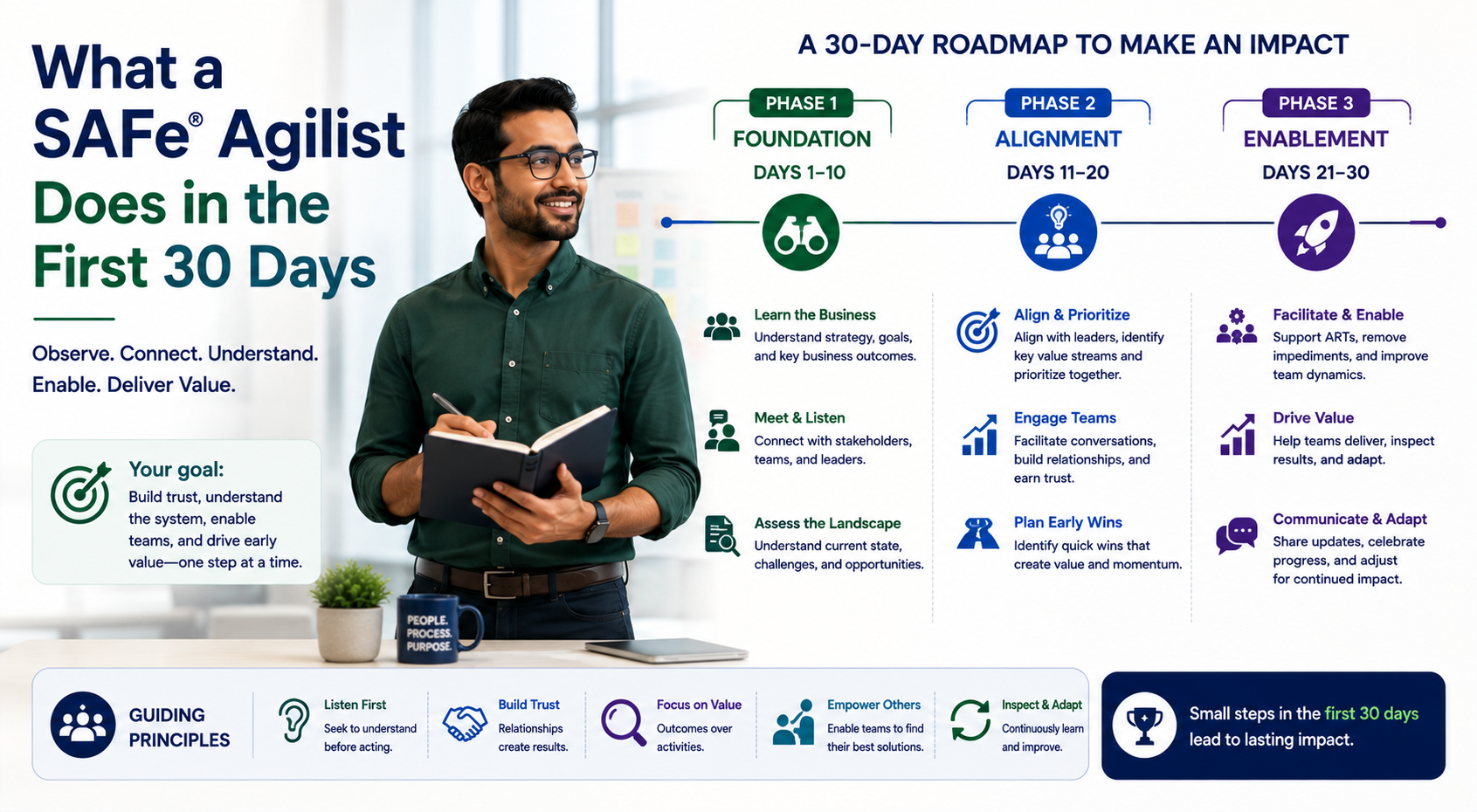
The certification is worth very little on its own and decays quickly. The definitional content, which is what the exam concentrates on, fades within weeks. The judgement, which is what the job needs, only develops through exposure. That gives you roughly a month where the material is fresh and your credibility is highest, and what you do with it largely determines whether the two days produced anything.
Key Highlights
- Scaled Agile classifies SAFe Agilist as foundational, so the credential establishes framework literacy rather than demonstrating delivery experience.
- The definitional content fades fastest, which is why sitting the exam within a week of the class matters more than most people assume.
- Attending a real PI Planning event in any capacity is the highest-value thing available in the first month and usually costs nothing.
- The credential renews annually with a minimum of 12 Continuing Education Units, so the maintenance clock starts immediately.
- Writing a one-page proposal for your own organisation converts the class into something that outlasts the certificate.
- The most common failure is doing nothing for three months, by which point the detail has gone and the internal credibility from having attended has faded with it.
Week one: lock in what fades
Two things, both time-sensitive.
Sit the exam. Within a week if possible. The sizing hierarchy, the event outputs and the role boundaries are the parts the paper concentrates on and the parts that decay fastest. People who defer for a month find they are relearning rather than revising, and our guide to how hard the SAFe Agilist exam is covers why the 80 percent pass mark makes that expensive.
If you are not yet confident, the free Leading SAFe practice test will tell you in a few minutes whether the gap is definitional or applied.
Write down what surprised you. Before it normalises. Most attendees leave with two or three genuine realisations, commonly that the funding model rather than engineering capacity is the constraint, or that the events they thought were reporting are meant to produce commitment. Those observations are the actual output of the class and they evaporate within a fortnight.
Week two: find out what your organisation actually does
The framework describes an ideal. Your organisation does something else. Establishing the gap precisely is the work of the second week and it is entirely free.
How is change funded? Annual budgets, project approvals, who signs off at what threshold. This determines whether anything else is possible.
What happens between planning and delivery? How many approvals, how long each takes. If a train can plan on a twelve-week cadence and still waits eleven weeks for a change board, you have found the binding constraint.
Who are the Business Owners, if the concept exists? Whether anyone senior is genuinely accountable for the value a delivery group produces. Our piece on what Business Owners do in PI Planning covers what the accountability should look like.
What happened to the last set of improvement actions? Whether anything identified in a retrospective or review was funded and delivered. This tells you whether the organisation has a working improvement loop or a recurring complaints list.
Four questions, all answerable in conversations you can have this week, and together they give you a diagnosis rather than an opinion.
Week three: get inside a real event
The highest-value action available and the one most people skip.
Attend a PI Planning event, an Inspect and Adapt workshop, or an ART Sync in whatever capacity is available. Observer is fine. If your organisation is not running these yet, find a part of the business that is, or a peer organisation that will let you sit in.
The reason this matters more than further reading is that the class teaches what the events produce and cannot convey what they feel like when they are not producing it. A planning event where no team's plan changes looks identical on paper to one where three teams renegotiated their objectives. Sitting in one teaches you the difference in two days.
It also tells you something about yourself. Some people find facilitating a room of a hundred people energising and some find it draining, and that reaction determines whether the Release Train Engineer route suits you. Our piece on SAFe Agilist career paths covers where each route leads.
Week four: write one page
Not a summary of the course. A specific proposal for your own organisation.
The structure that works is short. Name one delivery problem people already recognise. State what the framework says causes it. Propose one change, small enough to be reversible. Say what evidence would show whether it worked, and by when.
One page, in the language your organisation already uses rather than in framework vocabulary. Nobody senior wants to read about Program Increments; they want to read about why the thing they asked for in March has not arrived.
This is the single most effective way to convert the class into something durable, for a reason worth naming. A certificate on a profile is a claim about knowledge. A one-page argument your director can act on is a demonstration of judgement, and judgement is what every route after this certification actually rewards.
The four questions in practice
Week two suggested establishing what your organisation actually does. Worth being concrete about how, because these are conversations rather than research.
On funding. Ask someone in finance how a piece of work gets money. Not the policy, the actual path. How long it takes, who signs, what happens when something needs more mid-year. Twenty minutes with the right person tells you more than any document.
On approvals. Ask a delivery manager what they are currently waiting for and how long it has been. The specific answer is usually startling and it is the number you will use in every subsequent conversation.
On accountability. Ask who decides what a delivery group works on next quarter. If the answer is a committee, or nobody can name a person, you have found something significant.
On improvement. Ask what came out of the last retrospective or review at any level, and what happened to it. This is the cheapest possible test of whether the organisation has a working improvement loop.
None of these requires authority or a project. All four are ordinary conversations, and together they produce the diagnosis that makes your one-page proposal specific rather than generic. That specificity is the difference between a proposal that gets acted on and one that gets filed.
What not to do in the first month
Do not propose adopting SAFe. Newly certified leaders frequently return advocating for the framework, which reads as enthusiasm rather than analysis and is usually premature. Propose solving a problem. If the framework is the answer, that will emerge.
Do not correct people's vocabulary. Nothing dissipates goodwill faster than someone returning from a course to explain that what the team calls a feature is technically a capability. The precision matters on the exam and almost never in a corridor.
Do not book the next certification. The instinct after passing is to continue, and it is usually wrong. The constraint on your progression is exposure rather than credentials, and a second certificate acquired before any experience compounds the problem.
Do not wait for permission. Most of what is worth doing in the first month, attending events, asking the four questions, writing the page, requires nobody's approval.
Setting up the renewal clock
Worth handling now rather than discovering in eleven months.
SAFe Agilist renews annually and requires a minimum of 12 Continuing Education Units each year. That is a modest requirement and it has a habit of arriving unnoticed.
Two practical points. If you are likely to take another Scaled Agile course within the year, it will generally cover the requirement, so sequencing matters. And if you are not, it is worth identifying now where the units will come from rather than scrambling near the deadline.
The certification requirements are published separately and worth reading once at the start rather than at renewal.
If your organisation is not adopting SAFe
A common situation and worth addressing, since the advice above assumes an adoption underway.
The framework knowledge is still usable, and the way to use it is diagnostic rather than prescriptive. The four questions in week two apply to any organisation regardless of methodology, and the answers tell you where delivery is actually constrained. That is valuable whether or not anyone ever says the word Agile.
What does not work is trying to introduce the framework into an organisation that has not decided to adopt it. SAFe is an operating model change requiring executive commitment on funding and governance, as our piece on leading the change covers. It cannot be introduced from the middle, and attempting it produces ceremonies without authority, which is the worst of both.
If you took the certification speculatively and the environment has not materialised, treat the framework as a lens rather than a plan and revisit when the context changes.
The thirty-day test
At the end of the month, three questions.
Have you sat the exam? If not, the definitional content has already started going.
Can you name your organisation's binding constraint? Not a general complaint. A specific mechanism: the approval that takes eleven weeks, the funding cycle that fixes scope annually, the fact that improvement items are never resourced.
Does anyone senior know you have an opinion worth hearing? The one-page proposal is how that happens, and without it the certification is invisible inside your organisation regardless of what your profile says.
Three yes answers means the two days produced something. Three no answers means you have a certificate, which decays, and the renewal clock has already started.
What the first month tells you about the route
The four career routes after certification reward different temperaments, and the first month is a cheap way to find out which one fits before committing to it.
If the planning event energised you, the operational route is likely. Facilitating a large room, holding a hundred people to a cadence, tracking dependencies in real time. That work suits some people enormously and exhausts others, and there is no way to know which you are without sitting in one.
If the funding conversation was the interesting part, the transformation route fits better. People who find themselves thinking about why money moves the way it does, rather than about how the event ran, are describing a different job.
If you found yourself watching how people behaved rather than what was decided, that is the coaching instinct. It is the slowest route and the one that rewards patience over structure.
If none of it changed how you see your current job, the honest answer may be that the credential was context rather than a career move, and that is a perfectly reasonable outcome. Our comparison of SAFe Agilist and SAFe Scrum Master covers the adjacent fork if the team-level route looks more appealing.
Noticing your own reaction in the first month is worth more than any amount of reading about the routes, because the descriptions all sound reasonable on paper and only one of them will sound like your week.
For the underlying framework knowledge all four rest on, Leading SAFe certification training covers it across two days with the exam attempt included, and the certification requirements are published separately.
Building the habit that outlasts the month
Thirty days is a useful frame and an arbitrary one. What matters is whether the month establishes a habit or ends as a burst.
Keep the four numbers. Decisions made without escalation, when dependencies surface, improvement items delivered, approval latency. Updating them once per Program Increment takes half an hour and gives you an evidenced position whenever anyone asks how the adoption is going.
Attend one event per increment. Not all of them. One, deliberately chosen, watching for whether it produces its output rather than whether it happened. This is how framework knowledge stays live rather than decaying into vocabulary.
Write one page per quarter. The proposal format from week four works repeatedly. A problem, a small reversible change, the evidence that would show it worked. Four of those a year is a track record.
Revisit the terms annually. The framework changes. SAFe 6.0 renamed several significant terms, and material more than a couple of years old uses the older names. Checking once a year against the framework site takes minutes and prevents the specific embarrassment of using a deprecated term confidently in front of someone current.
The renewal requirement gives you a natural prompt for this, since the minimum 12 Continuing Education Units each year forces some engagement with current material. Treating that as a genuine refresh rather than a compliance exercise is what separates a credential that stays useful from one that becomes a line on a profile.
For the underlying framework, Leading SAFe certification training covers it across two days with the exam attempt included, current certification costs are listed separately, and the free Leading SAFe practice test is a quick annual check on whether your recall has drifted.
If the month does not go to plan
Realistic, since most do not.
No event to attend. Common if your organisation has not started. Ask a peer in another company, or attend a public community session. Failing both, the four diagnostic questions still work and the one-page proposal still lands.
Nobody to send the page to. Then the page is for you. Writing it forces the translation from framework to organisation, which is the actual exercise, and it will be ready when a sponsor appears.
The exam slipped. Sit it anyway, and accept more revision. The definitional content is relearnable; it is simply cheaper within a week. Our guide to the SAFe Agilist exam domains shows where the marks concentrate if you are revising from cold.
You have concluded SAFe is wrong for your organisation. That is a legitimate and valuable outcome. A leader who can explain precisely why the framework does not fit their context has got more from the two days than one who returns as an advocate, and that judgement is what the class was actually for.
The month is a structure rather than a test. What matters is that something happens while the material is live, because the alternative is a certificate with a renewal obligation and nothing attached to it.
Why the first month matters more than the next six
A closing argument for the urgency, since none of this is obligatory and all of it is easy to defer.
Two things are true immediately after certification and are not true later. The definitional material is fresh, which makes the exam cheap and the diagnostic questions sharp. And you have a small amount of internal permission to ask naive questions, because you have just been on a course and people expect it.
That second one is more valuable than it sounds and it expires quickly. Asking finance how work actually gets funded is a natural question from someone who has just spent two days on operating models. The same question six months later requires a reason.
Both windows close within about a month. What replaces them is ordinary work, and the certificate becomes a line on a profile with an annual renewal attached.
None of what is described here needs budget, headcount or permission. It needs about six hours spread across four weeks, and it is the difference between a credential and a position. Our guide to the SAFe Agilist career paths covers where that position leads once established.
The short version
The certification buys you a month of fresh knowledge and mild internal credibility. Both decay, and neither renews on its own.
Spend that month sitting the exam, diagnosing your own organisation, getting inside a real event, and writing one page that someone senior can act on. None of it requires budget or permission, and together it converts two days of training into a position rather than a certificate.
If you have not taken the class yet, Leading SAFe certification training covers the syllabus across two days with the exam attempt included, and current certification costs are listed separately.







 Lowest-Price Challenge











 Personalized Path


.webp)


 USA
USA  Canada
  India
India  UK
UK  Australia
  Singapore


