


 Call Us



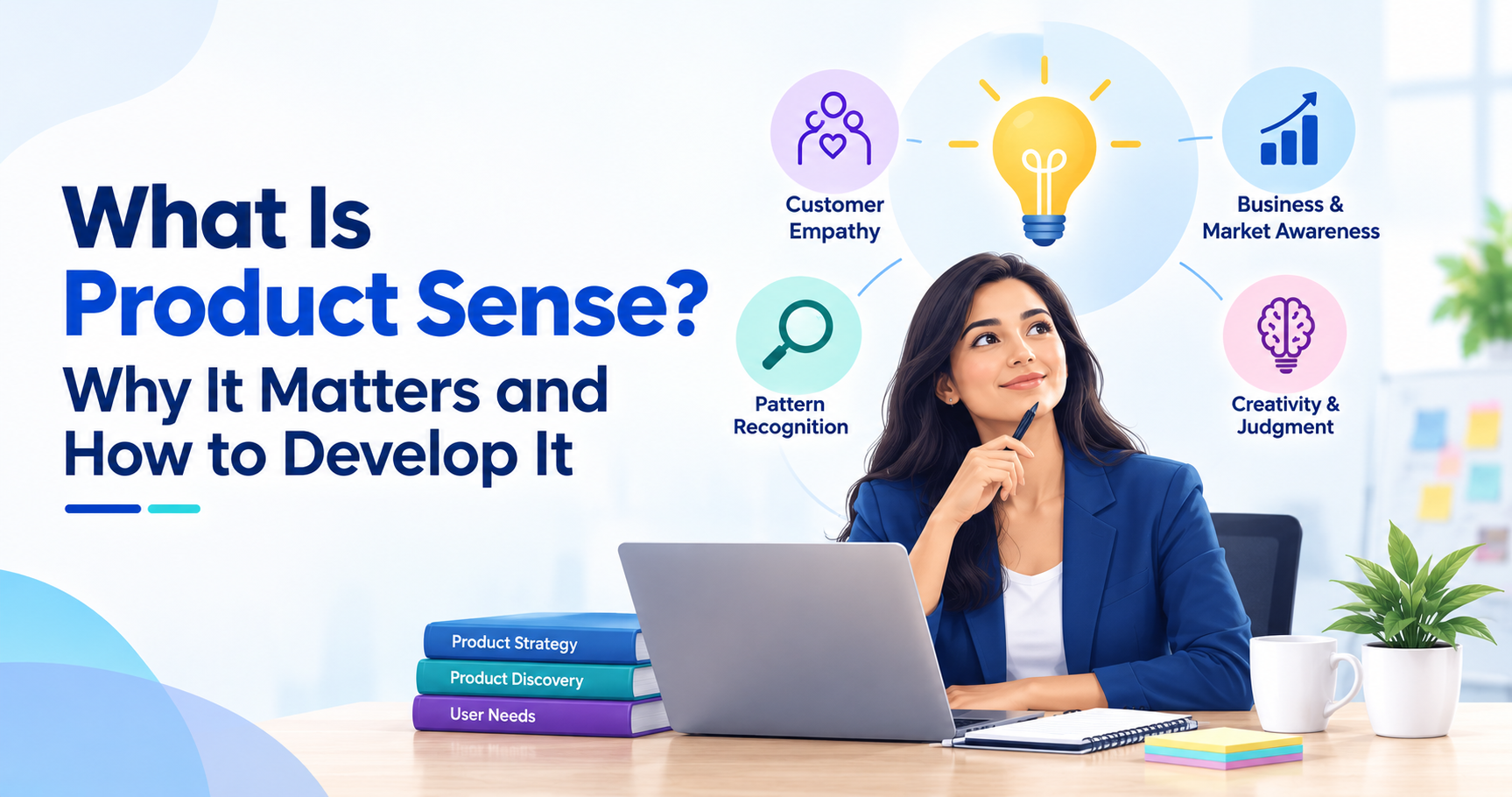
Product sense is the ability to make good product decisions, including understanding customers, finding meaningful problems, assessing trade-offs, and aligning solutions to business goals. It guides product managers through the fog to make decisions about what to build, for whom, and why.
In this blog, we’ll discuss what product sense is, why it’s important, the key building blocks of product sense, and how to build it using practical methods such as product teardowns, user observation, studying successful and failed products, and practicing product decisions. It also has product sense interview questions, useful frameworks, common myths and how product sense helps Product Owners with Agile and SAFe backlog prioritization.
Key Highlights: What Is Product Sense?
- Product sense helps product managers make decisions when requirements, data, and priorities are ambiguous.
- It combines customer empathy, pattern recognition, business awareness, creativity, and judgment.
- A strong sense of product is very close to product discovery, product strategy and customer research.
- Teardowns, user observation, case studies, decision journals, and feedback can help you learn product sense.
- In a product sense interview, interviewers are more interested in how you think than if you can come up with one perfect answer.
- Frameworks like CIRCLES can provide structure, but frameworks should support, not replace, your judgment.
- For Product Owners, product sense helps in better backlog prioritization and connecting individual stories to customer and business outcomes.
Introduction
In essence, product management is the art of making decisions when you have limited information and competing priorities and customer needs. Even with data and analytics, teams still need to figure out what problem to solve, what to build and why.
This is where product sense comes in. For example, if a food delivery app is seeing cart abandonment, the product manager should first figure out why users are leaving before they start suggesting solutions. It could be a question of surprise fees, changing delivery times or restaurant availability.
To summarise, product sense enables teams to go from problem → opportunity → solution → measurable outcome. It enables product professionals to make better decisions, not just execute a roadmap.
What Is Product Sense?
Product Sense Definition
Product sense is the ability to understand what should be built, for whom, why it matters, and what trade-offs should be made.
It brings together several forms of thinking:
- Customer thinking: What problem does the user have?
- Product thinking: What experience could solve that problem?
- Business thinking: Why is solving it valuable to the organization?
- Strategic thinking: Is it part of the product's bigger picture?
- Analytical thinking: What evidence is there to support the choice?
- Judgment: What is to be done when the evidence is incomplete?
For example, take a productivity app with 20,000 users asking for calendar integration. It may be attractive due to the high demand for the request.
But product sense means asking deeper questions:
- Are these users part of the target market?
- What job are they trying to accomplish?
- How frequently do they encounter the problem?
- Are they already using another patch?
- Will integration improve retention/activation?
- What engineering effort would be involved?
- Is calendar integration better than improving the current workflow?
And that’s why product sense is more than just “having good ideas.” It’s about good product decisions.
Product Sense vs Product Judgment vs Product Intuition
These words are related but not identical.
Product intuition is the gut feeling that something will or will not work. It can be helpful, but intuition can be unreliable.
Product judgment is the ability to weigh options and make trade-offs, using the evidence, experience, constraints and strategy context you have.
Product sense is broader. It’s not just about intuition and judgment. It’s about understanding customers, understanding markets, understanding product experiences, understanding business models, understanding patterns across products.
Think of it this way:
Intuition gives you a hypothesis. Judgment helps you evaluate it. Product sense helps you understand the entire product decision.
A strong PM might say, "I think users will prefer a simpler onboarding flow." But rather than stopping there, they investigate the user journey, identify friction, examine activation data, talk to customers, test alternatives, and determine what "simpler" should actually mean.
Why Product Sense Matters
Product sense matters because product teams constantly make decisions under uncertainty.
It affects:
- Feature prioritization (see Agile prioritization techniques)
- Product strategy
- Roadmap decisions
- Product discovery
- User experience
- Pricing and packaging
- Market expansion
- Growth initiatives
- Backlog prioritization
- Product experiments
It also matters during hiring. Product sense interviews are used by several major technology companies and typically present candidates with open-ended design, improvement, growth, launch, or strategy problems.
The interviewer is usually less interested in a magical feature idea than in whether you can clarify the problem, identify the user, explain the need, evaluate alternatives, and communicate trade-offs.
The Building Blocks of Strong Product Sense
Customer Empathy
Customer empathy means understanding what users are trying to accomplish—not merely collecting feature requests.
A user may say, "I want dark mode." The product manager's job is to understand the underlying context.
Perhaps the user works at night and experiences eye strain. Perhaps they use the product in a low-light environment. Perhaps dark mode is simply expected because competing products have it.
A useful technique is to combine user personas with jobs-to-be-done thinking.
Instead of asking, "What feature does this user want?" ask:
"What is this person trying to accomplish, and what is preventing them from doing it effectively?"
You can learn more through this guide to Jobs to be done.
Customer empathy also requires direct exposure to users through product discovery techniques such as interviews and observation. (ProductPlan, State of Product Management).Check the 73% / 45% / 23% figures against the 2024 edition, and use the 2026 report for the prioritization claim.
The lesson is simple: customer understanding should not be delegated entirely to another function.
Pattern Recognition From Experience
Product managers encounter recurring patterns.
For example:
- Users say they want more features when the real problem is usability.
- A high-volume customer request may come from a small but vocal segment.
- If engagement is low, it might be due to onboarding friction, not a weak core product. A competitive feature may look good but not fit your product positioning.
- A roadmap filled with features may produce output without meaningful outcomes, which is why teams increasingly use outcome-focused Agile OKRs.
The more products you study, the more these patterns become recognizable.
This is one reason experienced PMs can sometimes reach useful hypotheses quickly. They are not necessarily guessing. They are drawing on a larger library of previous observations.
Business and Market Awareness
Great products must create value for customers and make sense for the business.
Strong product sense therefore includes awareness of:
- Market size and growth
- Competitive positioning
- Revenue model
- Acquisition costs
- Retention
- Distribution
- Regulation
- Operational constraints
- Company capabilities
Suppose customers want a premium feature that costs $2 million a year to operate but generates only marginal additional value. Customer demand alone does not make it the right decision.
This is where product sense connects directly to product strategy, and it’s increasingly important for an AI product manager weighing costly model features against value.
You can explore the broader discipline through this guide to Product strategy.
Creativity and Judgment Under Ambiguity
Creativity is not simply brainstorming dozens of features.
Good product creativity means finding useful solutions within constraints.
Imagine a public-transport app wants to improve accessibility. Rather than creating a whole new experience right away, the team might look at things like better text contrast, voice navigation, clearer alerts, simplified route instructions or compatibility with existing assistive technologies.
The best idea depends on the user’s specific problem.
Judgment then decides which solution is feasible, valuable, strategically appropriate and measurable.
How to Develop Product Sense (Practical Ways)
Jules Walter’s widely cited guide, How to develop product sense, breaks it into customer empathy, domain knowledge and creativity.Product sense improves through deliberate exposure to products and decisions. The following practices can turn it from an abstract concept into a repeatable skill.
Do Product Teardowns
Choose one product every week and analyze it.
Ask:
- Who is the target user?
- What core problem does it solve?
- Even today, product organizations are still challenged with alignment and prioritization. ProductPlan’s 2026 research shows that the top areas of concern for product leaders are prioritization breakdowns and strategy alignment. Strategy, market awareness, creativity, analytical thinking and reasoning. It helps product managers figure out which problems are worth paying attention to. It helps Product Owners to prioritize backlogs and link their daily work to customer needs and market conditions, and understand product constraints and trade-offs so they can make effective product decisions. It helps product pros figure out what problems to solve, what solutions to
- What is its primary value proposition?
- What is the activation moment?
- How does it make money?
- What are its likely competitors?
- What would you improve?
- What would you not change?
- What metric might the team optimize?
For example, take a food-delivery application. Follow the process from opening the app to receiving the order. Identify friction points, moments of delight, business incentives, and potential drop-offs.
Do not limit yourself to digital products. Study supermarkets, airports, banking services, gyms, restaurants, and physical products too.
These product sense exercises train you to notice why experiences work.
Observe Real Users
You can see things you can’t see in a dashboard when you watch someone use a product.
Ask a colleague, friend or customer to do a realistic task while you watch.
For example:
“Walk me through how you would set up a meeting with someone external”
Do not immediately help them. Observe where they hesitate, what they misunderstand, what they ignore, and what they expect to happen.
Then ask why.
This supports product discovery because you are observing actual behavior rather than relying entirely on what users say they do.
Study Great and Failed Products
Do not study only successful products.
For successful products, ask:
- What made adoption possible?
- What problem did the product solve particularly well?
- What was difficult to copy?
- What strategic choices created an advantage?
For failed products, ask:
- Was the problem real?
- Was the target audience wrong?
- Was the timing poor?
- Was the product too complicated?
- Was distribution the problem?
- Did the business model work?
- Did the product solve a problem users cared enough to pay for?
Failure analysis is particularly valuable because it teaches you that good execution cannot rescue a fundamentally weak problem or market.
Practice Decisions and Seek Feedback
Create a decision journal.
For every major product decision, record:
- The problem
- The assumptions
- The evidence
- The options considered
- Your decision
- The expected outcome
- The metric you will monitor
Revisit the decision after the outcome becomes visible.
This turns experience into learning.
You can also practice with peers by taking one ambiguous product problem and giving yourself 10–15 minutes to structure a response. Ask someone to challenge your assumptions afterward.
Over time, this develops the product sense skills that are difficult to learn from theory alone.
Product Sense Interview Questions and How to Answer Them
A product sense interview tests how you approach ambiguous product problems, and it’s a standard step in most product manager career paths.
Common product sense interview questions include:
- "How would you improve our product?"
- "Design a product for a particular user group”
- “What would you build for people with a particular problem?”
- “How would you increase revenues?”
- “What feature would you prioritize?”
- “How does this product work?”
- “What would you alter about a product you use daily?”
There is not a single correct answer to these questions. Typically interviewers are looking for structured thinking, customer empathy, creativity, prioritization, and communication.
A practical approach is:
1. State the purpose.
Ask what success is and what the boundaries are.
2. Determine the user.
Don’t try to solve everybody’s problem all at once.
3. Grasp the problem.
Research pain points, context, frequency and alternatives.
4. Prioritize
Select the most important problem and justify your selection.
5. Formulate solutions.
Give them a couple of options and choose one.
6. Consider trade-offs.
Discuss strategic fit, impact, risks and feasibility.
7. Define Success
Select metrics that show the solution delivered real value.
For example, if I asked, "What would you do to improve a ride-sharing app?" don’t at once say, “I’d put in a subscription.
Instead, you could say:
"Before I come up with a solution I would want to understand what the goal is: improve rider retention, increase trip frequency, reduce cancellations, or improve driver economics.
That single clarification shows product thinking.
When practicing writing out product sense interview questions and answers, exercise explaining the reasoning behind each decision you make, not just what you would build.
Frameworks That Support Product Sense
A product sense framework can help organize thinking, especially under interview pressure.
One commonly used approach is CIRCLES:
- Comprehend: Clarify the situation and objective.
- Identify: Identify the target customer.
- Report: Describe the customer's needs.
- Cut: Prioritize the most important need.
- List: Generate possible solutions.
- Evaluate: Compare solutions and trade-offs.
- Summarize: Present the recommendation and success metrics.
CIRCLES is particularly useful for product design questions because it creates a logical sequence from problem definition to solution.
However, frameworks should not become scripts.
If you mechanically run through every step, your answer can sound rehearsed. Use the framework to make your thinking clearer, then adapt it to the situation.
The same principle applies outside interviews. Real product teams rarely have enough time to complete a framework perfectly. The goal is better decisions—not framework compliance.
Product Sense for Product Owners in Agile and SAFe
Product sense is highly relevant to Product Owners working in Agile environments because backlog management involves continuous trade-offs.
Product Owners are responsible for defining stories and prioritizing the Team Backlog ensuring conceptual and technical integrity of the features or components. Product Management, meanwhile, focuses on desirable, feasible, viable, and sustainable products across the product-market lifecycle.
This distinction makes product sense especially useful.
A Product Owner with strong product sense does not simply ask:
"Which story should we develop next?"
They ask:
"Which piece of work creates the most valuable customer or business outcome given our current constraints?"
If you are building your career in this area, SAFe POPM Certification Training can provide structured learning around the Product Owner/Product Manager role.
You can also explore SAFe POPM roles and responsibilities to understand how responsibilities are divided across the role.
Making Better Backlog and Prioritization Calls
Suppose you’re prioritizing a product backlog that contains:
- Understand. Explain the situation and the objective.
- Identify the target customer.
- Report: Explain the needs of the customer.
- Cut: Focus on the most important need.
- List: Brainstorm possible solutions.
- Evaluate: Compare solutions and trade-offs
Key Performance Indicators: Suggestion
- A reporting feature often requested
- A significant accessibility enhancement
- Small performance fix
- Sales asked for new integration
- Technical debt that impacts development speed
- In a feature-by-feature mindset, the loudest stakeholder wins.
- Product sense adds another level of questioning:
- Who profits from this?
- How big is the problem?
- How often does it happen?
- What is the expected business impact?
- What is the effort and risk?
- Does the work support our product strategy?
- What happens if we delay it? (This is the idea behind Cost of Delay and WSJF.)
The answer may still be the sales-requested integration, but now it is a conscious decision rather than a reaction.
This is particularly important because product organizations continue to struggle with prioritization and alignment. ProductPlan's 2026 research highlights prioritization breakdowns and strategy alignment as major areas of concern for product leaders.
Product sense helps turn backlog prioritization from a list-management exercise into a value-management exercise.
Common Myths About Product Sense

Myth 1: Product sense is an innate talent.
Some people might be inherently more curious or empathetic, but product sense is a skill you can cultivate. You learn the craft by observing, deconstructing products, studying users, trial and error and thinking.
Myth 2: Product sense means knowing what users want.
Users are a valuable source of information, but are not always the decision-maker. Product managers need to blend user evidence with business strategy, technical feasibility, market context and organizational goals.
Myth 3: Data eliminates the need for product sense.
Data tells you what happened. It does not always tell you what should happen next.
A retention graph may tell you that users are leaving. Product sense helps you investigate why and decide what to test.
Myth 4: A framework guarantees a great interview answer.
Frameworks provide structure, but they cannot replace reasoning. Interviewers want to understand how you think through ambiguity.
Myth 5: Product sense means building more features.
It gives candidates the foundation to approach ambiguous product sense interview questions with confidence.
Conclusion
Product sense is ultimately about making better decisions when certainty is unavailable. It combines customer empathy, product strategy, market awareness, creativity, analytical thinking, and judgment. For product managers, it helps determine which problems deserve attention. For Product Owners, it helps with backlog prioritization and connects daily work to customer and business outcomes. It gives candidates the foundation they need to feel confident when tackling ambiguous product sense interview questions.
The good news is that product sense does not require a special personality or years of experience before you can start developing it.
Study products. Talk to users. Analyze successful and failed products. Practice product teardowns. Write down your decisions. Ask for feedback. Revisit your assumptions when reality proves you wrong.
Over time, you build a mental library of patterns that makes future decisions faster and, more importantly, better.
That is the real goal of product sense: not predicting the future perfectly, but consistently improving the quality of the decisions that shape it.







 Lowest-Price Challenge











 Personalized Path


.webp)


 USA
USA  Canada
  India
India  UK
UK  Australia
  Singapore


