


 Call Us



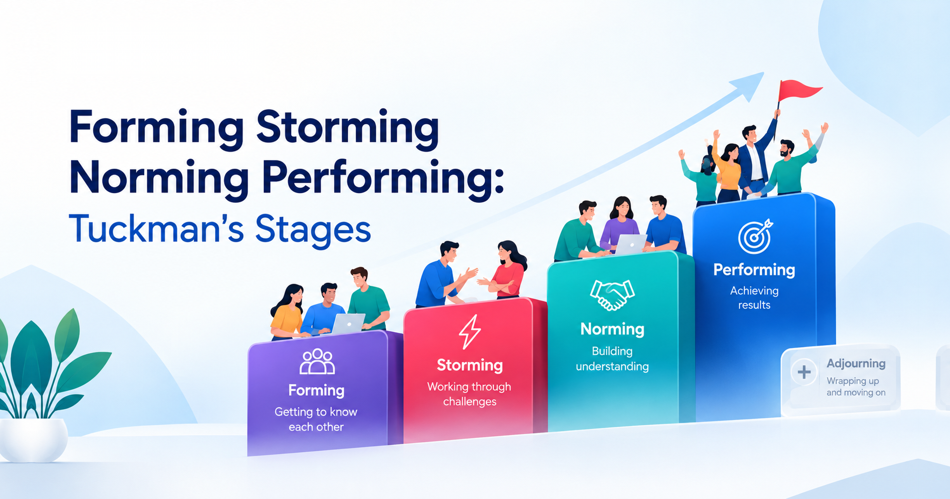
Forming, storming, norming, and performing are the four stages described by a famous psychologist, Bruce Tuckman, in 1965. Later on (in 1977), the Tuckman model gained a fifth stage, adjourning. These five stages help leaders to adapt their style to build high-performing teams.
Forming: Members orient themselves, build trust, and define initial goals.
Storming: Friction arises as personality clashes and role disputes emerge.
Norming: The team resolves differences, establishes routines, and builds cohesion.
Performing: The group operates autonomously, delivering high-quality results efficiently.
Adjourning: The team wraps up its objectives, celebrates, and disbands.
Which stage is your team currently stuck in? Get to know the tailored leadership strategies to transition your team into peak performance.
Key Highlights of Forming, Storming, Norming, Performing
- The forming, storming, norming, and performing stages describe how a group grows into an effective team.
- Forming is about orientation, storming is about friction, norming is about agreement, and performing is about results.
- Adjourning, added in 1977, covers wrapping up and moving on.
- Teams rarely move in a straight line, and new members or goals can send them back.
- Team norms and psychological safety decide how fast a team gets through storming.
- A Scrum[a] Master or leader should change their approach as the team matures.
Introduction
Have you ever wondered why a team that starts completely aligned can suddenly dissolve into conflict just a few weeks later? Building a team is rarely a smooth, linear journey. In fact, most managers quickly discover that even the most talented groups of people do not automatically know how to work together.
Let us imagine a team that meets on Monday. Everyone in the team is polite, and nobody disagrees with each other. By week five, two people are arguing about code reviews, a third has stopped speaking in meetings, and then the manager wonders what was wrong.
Nothing went wrong. That pattern is so common that Bruce Tuckman mapped it in the 1960s. His model explains why teams behave the way they do at different points, and what leaders can do about it.
You will get to know the stages of team development one by one. You will see what each stage looks like, how to lead through it, and how the model applies to agile and Scrum teams. A worked example, common mistakes, and a Scrum Master's role close the guide.
Infographic (1): The Five Stages of Team Development.png
What Is Tuckman's Model of Team Development?
Tuckman's model of team development is a framework that describes how a group moves from a collection of individuals into a cohesive, productive team. It names stages that teams commonly pass through: forming, storming, norming, performing, and, in later versions, adjourning. Leaders use it to understand current team behavior and choose a suitable response.
Definition and Origins (Bruce Tuckman, 1965)
Bruce Tuckman first proposed the model in his 1965 paper, "Developmental Sequence in Small Groups," published in Psychological Bulletin. He reviewed a collection of fifty published articles on group development and used that analysis to form the four-stage model.
The Tuckman model is sometimes called the Tuckman Ladder. People use it widely in project management, education, and Agile coaching, even though it began as a literature review.
Why Teams Move Through Predictable Stages
Each stage solves a different problem. First, people need to understand the task and each other. Next, they test boundaries and sort out status. Then they build shared habits, and only after that can they focus fully on the work.
Tuckman's model presents these stages as a way to understand how group relationships and task-related behavior can develop over time. However, teams do not always follow a uniform sequence. The original research reviewed different types of groups, and its findings should not be treated as proof that every workplace team experiences all four stages in the same way. Use the model as a practical framework for recognizing team challenges, not as a rigid rule.
Tuckman [c]did not describe stages as moods. He tracked two realms at once. They are,
- Group Structure: How members relate to each other.
- Task Activity: How they approach the work.
He labeled the structure stages testing and dependence, intragroup conflict, development of group cohesion and functional role relatedness, and the matching task stages orientation to task, emotional response to task demands, open exchange of relevant interpretations, and emergence of solutions.
| Stage | Group structure (relationships) | Task activity (the work) |
| Forming | Testing and dependence | Orientation to the task |
| Storming | Intragroup conflict | Emotional response to task demands |
| Norming | Development of group cohesion | Open exchange of relevant interpretations |
| Performing | Functional role relatedness | Emergence of solutions |
Reading across a row explains behavior. A storming team is not only arguing, but also reacting emotionally to what the task demands of each person. That is why a team can look busy yet produce little: the relationships and the work are stuck at the same stage.
The Later Addition of Adjourning
In 1977, Tuckman and Mary Ann Jensen added a fifth stage, adjourning, after reviewing 22 further studies. It covers the end of a team's life: finishing the work, reflecting, and breaking up.
That addition turned the model into the five stages of team development that most training materials use today. Some texts call the stage "mourning" to reflect the mixed emotions members feel.
Limits of the Tuckman Model
Before you apply the model, know where it is weakest. Verify whether the weaknesses below are there:
- The evidence base is narrow: Tuckman's own summary describes a review of 50 articles about therapy groups, training groups, natural groups, and laboratory groups. Those are not modern workplace project teams. He also noted that few studies since 1965 have reported empirical data on the stages.
- Change is gradual, not stepped: Psychologist Donelson Forsyth observed that as conflict wanes, cohesion may rise, but these changes do not occur in a discontinuous, step-like sequence. In practice, a norming team can still storm over a single decision.
- It describes groups, not individuals: The model tells you about team patterns. It does not explain why one person behaves a certain way.
The practical takeaway is simple. Use the stages as a lens for asking better questions, not as a verdict on your team.
Stage 1: Forming
The first stage of team development is forming. In this stage, the group has just come together, and people are working out the purpose, the rules, and where they fit exactly.
What happens in the forming stage?
During this phase, the members are usually polite, curious, and a little cautious. They look to the leader for direction. Questions about goals, roles, and expectations dominate, and real disagreement stays below the surface.
Here, the productivity is low, but this is normal. People are collecting information, not solving problems yet.
Signs Your Team Is Forming
- Meetings are courteous, and few people challenge ideas.
- Members ask many clarifying questions about scope and responsibilities.
- People rely on the manager for decisions.
- Conversations stay on safe topics.
- Work is divided by habit or title, not by agreement.
How to lead a forming team?
First of all, give clear direction and make the purpose concrete. Share the goal, the deadline, and the success criteria in the first meeting.
Then build trust early. Run introductions that cover working styles, not only job titles. Following that, encourage questions, because psychological safety starts with one visible moment when someone asks a "silly" question, and nobody punishes it. You can read more about how psychological safety develops in teams.
Stage 2: Storming
Storming is where most leaders feel the pressure. The politeness fades, and differences in opinions, working styles, and priorities come into the open.
What happens in the storming stage?
In the storming stage of team development, people challenge ideas, the leader, and each other. Status and influence get sorted out. Members who stayed quiet during forming now push back.
Disagreements about priorities, responsibilities, and working styles can slow a team down if they remain unresolved. Some teams struggle to move forward because members avoid difficult conversations or lack clear decision-making rules. However, storming does not automatically mean a team is failing. When members address differences constructively, they can develop clearer expectations and stronger ways of working.
Signs of Storming and Common Conflicts
You may notice the following points:
- Open disagreement about priorities, methods, or ownership
- Cliques forming, or members withdrawing from discussion
- Frustration with the leader's decisions
- Missed handoffs and finger-pointing
- Arguments about "how we do things here"
Typical conflicts fall into three groups. Task conflicts concern what to build. Process conflicts concern how to work. Relationship conflicts concern trust and communication style.
How to lead a team through storming?
Do not suppress the conflict; name it, normalize it, and channel it. Practical conflict management skills help here.A calm, coaching style works better than directing here. Use these moves:
- Separate people from problems: Ask what each person needs, not who is right.
- Make decision rules explicit: Clarify who decides what.
- Protect psychological safety: Respond to dissent with curiosity, not defensiveness.
- Start writing team norms: Turn each recurring friction into a rule everyone can follow.
The Tuckman model suggests this stage is uncomfortable but productive. Teams that skip it usually meet the same problems later, under more pressure.
Stage 3: Norming
Norming is where the team starts to feel like a team. The conflicts of storming settle into agreements, and trust grows.
What happens in the norming stage?
Resolved disagreements bring greater closeness, and a spirit of cooperation emerges. Roles become clear, communication improves, and members begin to value each other's strengths.
The risk now is the opposite of storming. Members may avoid disagreement to protect the new harmony, and they may hold back controversial ideas.
Establishing Team Norms and Working Agreements
Team norms are the shared expectations that guide how members behave. Good team norms cover:
- How the team communicates and how fast people reply
- How decisions get made, and who makes them
- How meetings run and what "on time" means
- How members give and receive feedback
- How the team handles disagreement
Here is what that can look like in practice. This hypothetical set suits a six-person product team:
- We answer direct questions within one working day. Urgent items go in the team channel with a clear "urgent" label.
- We disagree in the open and decide in the room. Once we decide, everyone supports the decision.
- Anyone can call a pause when a discussion goes in circles. We timebox ten more minutes, then the owner decides.
- We critique work, not people.
- Meetings start on time and end with actions and owners.
- If you are blocked for more than a day, you say so at standup.
Keep the list to five or six items. Each norm needs an observable behavior, so the team can tell when someone follows it or breaks it.
Write them down, and let the team author them. A guide on team norms can help you draft a first set. Review them every few weeks, because norms that nobody revisits turn into wallpaper.
How to reinforce Norming?
Shift from coaching to facilitating. Hand over more decisions, and let the team run its own meetings.
Following that, praise the behaviors you want repeated. Keep psychological safety active by inviting dissent explicitly, for example, by asking, "What could go wrong with this plan?" That question keeps harmony from becoming groupthink.
Stage 4: Performing
Performing is the stage most teams want to reach. Roles and norms are settled, so energy goes into the work.
What does a performing team look like?
In a performing team, members:
- Make most decisions without waiting for a manager, the hallmark of self-organizing teams.
- Resolve disagreements directly and quickly
- Share knowledge and cover for each other
- Hold themselves accountable for results
- Tolerate dissent when it follows the team's norms
Dissent is expected and allowed, as long as it is channeled through means acceptable to the team. The leader steps back into a supporting role.
Sustaining High Performance
Performance does not run on autopilot. High-performing teams stay that way by keeping psychological safety high, so people still raise risks and question assumptions. They also keep learning through retrospectives and honest reviews of mistakes.
Watch for complacency. The sequence of the four stages is not a ladder you climb once. Even strong teams drift when goals shift, or members leave, so keep reviewing goals and norms.
Stage 5: Adjourning
Adjourning is the final stage, and teams often ignore it. The work is done, or the team is being reorganized, and members prepare to move on.
Wrapping up and celebrating
Close the work deliberately. Thereafter, finish handovers, document what was learned, and run a final retrospective. Celebrate what the team achieved, because recognition affects how people feel about the next team they join.
Treat this as part of the five stages of team development, not an afterthought. Teams that end well carry good habits forward.
A short closing checklist keeps nothing from slipping:
- Hand over documents, access, and open items to the next owner.
- Capture lessons in a place the next team will actually find.
- Thank people by name for specific contributions.
- Confirm each member's next assignment before the team disbands.
For the final retrospective, five questions work well. What did we do well? What slowed us down? What would we change if we started again? Which team norms should travel with us? Who deserves recognition?
Supporting Members Through Transition
Members often feel mixed emotions: pride, relief, and some loss. The final stage involves disbanding the team after it has achieved its goals, and members reflect on their accomplishments with mixed emotions.
Help people with next steps. Share feedback, discuss new assignments, and keep relationships alive. Leaders who handle this well build loyalty that outlasts the project.
How to Move a Team From Forming to Performing
The Tuckman team development model works best as a guide to understanding team behavior, not as a fixed schedule. Teams may move through the stages at different speeds, revisit earlier stages, or show characteristics of more than one stage at the same time. Leaders can help teams address challenges sooner by clarifying expectations, resolving disagreements, and building shared working agreements. These are core steps in learning how to build an Agile team.
How to Tell Which Stage Your Team Is In
You cannot adjust your leadership style until you know the stage. Start with observation, not a label. Ask yourself these four questions, then match your answers to the table.
| Question | Forming | Storming | Norming | Performing |
| How are disagreements handled? | Avoided | Heated or personal | Raised and settled by agreed rules | Settled quickly and directly |
| Who makes decisions? | The leader | Contested | Shared, by agreed rule | Whoever owns the work |
| How clear are roles? | Unclear | Disputed | Clear and accepted | Flexible, with members covering for each other |
| What do retrospectives sound like? | Polite, few ideas | Blame or silence | Specific improvements | Experiments and stretch goals |
Most teams show a mix. Pick the column that fits most rows, and note the outliers, because they show where the team is moving. Re-check after every major change, such as a new member, a new goal, or a reorganization.
Leadership Style at Each Stage
Infographic (2): Leadership Styles Across Team Stages.png
Leadership has to change as the team grows. One study of nurse leaders matched the stages to leadership behaviors, and the pairing is a useful starting point.
Use these as guides, not scripts. A team in the middle of storming may need clear direction on one issue and full autonomy on another.
Common Reasons Teams Get Stuck in Storming
The storming stage of team development is where teams most often stall. The common causes include:
- Unclear goals or roles: People fight because nobody knows who owns what.
- Avoided conflict: The leader keeps the peace, and the issues never get resolved.
- Low psychological safety: Members stay quiet, and problems fester.
- Constant membership changes: Every newcomer resets the dynamics.
- Unresolved personality clashes: Tension between two people spreads to the group.
- Weak decision rules: Debates never end because nobody can close them.
To get unstuck, name the real issue in a retrospective, agree on decision rights, and write norms the team will actually follow.
Forming Storming Norming Performing Example (Worked)
The following forming, storming, norming, performing example is hypothetical. It follows a newly assembled team through all five stages.
A mid-size insurer creates a seven-person cross-functional team to build a customer onboarding app. The team includes two developers, a tester, a designer, a business analyst, a product owner,[g] and a Scrum Master.
| Stage | Timing | What the team did | What the leader did |
| Forming | Weeks:1 to 3 | Introduced themselves, asked about scope, and waited for the product owner to assign work | Shared the product goal, drafted a first Definition of Done, and set up introductions |
| Storming | Weeks:4 to 9 | Developers argued about architecture, the tester felt ignored in refinement, and priorities shifted mid-sprint | Facilitated conflict, ran retrospectives on the real issues, and started a list of recurring frictions |
| Norming | Weeks:10 to 16 | Agreed on review turnaround, decision logging, and who breaks ties | Turned the friction list into written working agreements and handed over facilitation |
| Performing | Months: 5 to 6 | Resolved disagreements alone, delivered predictably, took on stretch goals | Removed obstacles and stayed out of day-to-day decisions |
| Adjourning | Month: 7 | Handed the app to a run team, held a final retrospective | Supported reassignments and recorded lessons |
What the example shows. Storming was not a failure. It produced the working agreements that made performing possible. When a developer left in month six, the team briefly slipped back, questioned its norms, and recovered within two sprints because the agreements already existed.
Tuckman's Model in Agile and Scrum
Agile teams work in short cycles and depend on collaboration, so the model fits well. Scrum.org trainer Mary Iqbal notes that a Scrum Master's goal is to move teams through forming, storming, and norming as quickly as possible so they reach performing. Understanding what a Scrum team is in agile gives useful context for why this matters.
Scrum already contains tools for each stage. The Product Backlog [h] and Product Goal reduce goal confusion in forming, and team agreements and the Definition of Done reduce role confusion. The Sprint Retrospective and Scrum values[i] help with storming. As a result, agile teams often move through the early team development stages faster than ad hoc groups.
Why Stable Teams Reach Performing Faster
Stable membership gives the team time to finish storming and norming. Every sprint adds shared history, so trust, habits, and norms compound.
Teams that swap people between projects keep restarting the clock. Keep a team together long enough to learn how it works, and the benefits show up in predictability and quality.
How Reforming Happens When Membership Changes
The forming, storming, norming, performing model is not one-way. A change in leadership can send a team back to storming as new people challenge existing norms. The same goes for a new member, a new product goal, or a reorganization.
When this happens, treat the change as a mini-forming. Onboard the newcomer with the team agreements, revisit norms together, and expect a short dip. A prepared team recovers quickly.
Tuckman Stages in Remote and Hybrid Teams
Tuckman's research predates remote work by decades, yet the stages still show up. They just look different on a screen.
- Forming takes longer: Without hallway chats, people learn each other's habits slowly. Schedule a short non-work call each week at first, and ask everyone to share a one-page note on how they like to work.
- Storming hides: Conflict appears as silence on video calls, curt chat messages, or work done in isolation. Check in one-to-one, and move heated threads to a call.
- Norming needs explicit rules: Agree on response times, overlap hours, when to use video, and where decisions live. Written norms matter more when nobody can read the room.
- Performing needs rituals: Keep retrospectives and demos regular, so the team does not drift into parallel solo work.
The Scrum Master's Role Across the Stages
A Scrum Master reads the team's stage and adjusts. They do not push the team through stages. They create conditions that help it move.
Flexing Facilitation to the Team's Stage
Using the forming, storming, norming, performing model as a guide, the Scrum Master can adapt:
- Forming: explain the framework, clarify the product goal, and help the team write its first agreements.
- Storming: facilitate hard conversations, reinforce the Scrum values, and protect psychological safety.
- Norming: step back, let the team facilitate its own events, and encourage self-management.
- Performing: remove impediments and challenge the team to grow.
Scrum Masters who want structured practice in this kind of facilitation can explore SAFe Scrum Master Certification Training, which covers team coaching in a scaled agile [j] setting.
Using Retrospectives to Accelerate Growth
The Sprint Retrospective is the Scrum Master's best tool.[k] Teams use it to adjust agreements and the Definition of Done and to commit to at least one actionable improvement.
Use it to surface team norms that are working and ones that are not. Ask open questions about trust and communication. Teams that discuss these issues openly build the psychological safety that performing depends on.
Common Mistakes and Best Practices
Common mistakes
- Treating the model as a rigid timeline: Teams move at different speeds and sometimes skip or repeat stages.
- Rescuing the team from storming: Suppressing conflict leaves the root cause in place.
- Ignoring norming: Without written team norms, storming conflicts return.
- Over-managing a performing team: Micromanagement pushes a mature team back into frustration.
- Forgetting adjourning: Abrupt endings damage morale and waste learning.
- Labeling people instead of behavior: The model describes team dynamics, not personal traits.
Best practices
- Check the team's stage regularly, using observed behaviors, not guesses.
- Adjust your style to the stage instead of using one approach throughout.
- Write team norms together, and review them every few weeks.
- Build psychological safety from day one, and protect it during conflict.
- Keep teams stable where you can, and plan onboarding when you cannot.
- Close projects deliberately with a retrospective and recognition.
Conclusion
The forming, storming, norming, and performing stages help explain why teams do not become high-performing overnight. People need time to understand their roles, work through disagreements, build shared habits, and learn how to collaborate effectively. And when the team changes, it may need to revisit some of these stages before finding its rhythm again.
So, what does this mean for your team? Do not treat the Tuckman model as a fixed timeline. Instead, pay attention to how your team communicates, handles conflict, and makes decisions. If disagreements keep returning, clarify responsibilities and agree on team norms. If people hesitate to speak up, create an environment where they can share concerns without fear of blame. And when a project ends, take time to recognize contributions and capture lessons for the next team.
Start with one small step this week: identify the challenge your team is facing and choose one action that can help it move forward. You do not need to fix everything at once. Consistent improvements in communication, trust, and accountability can help your team work together more effectively.






 Lowest-Price Challenge











 Personalized Path



.webp)


 USA
 Canada
 India
 UK
 Australia
 Singapore


