


 Call Us



TL;DR
- The RTE job is the same SAFe role in a GCC, but the context differs: your ART often spans a time zone gap with the parent organization.
- India has 2,117 GCCs employing 2.36 million professionals (NASSCOM, 2026), and many are moving from execution to product ownership.
- That shift changes which impediments an RTE can resolve locally and how PI Planning should be scheduled.
- Before taking a GCC RTE role, ask where the centre sits between execution and ownership, what the real overlap window is, and who sets the PI calendar.
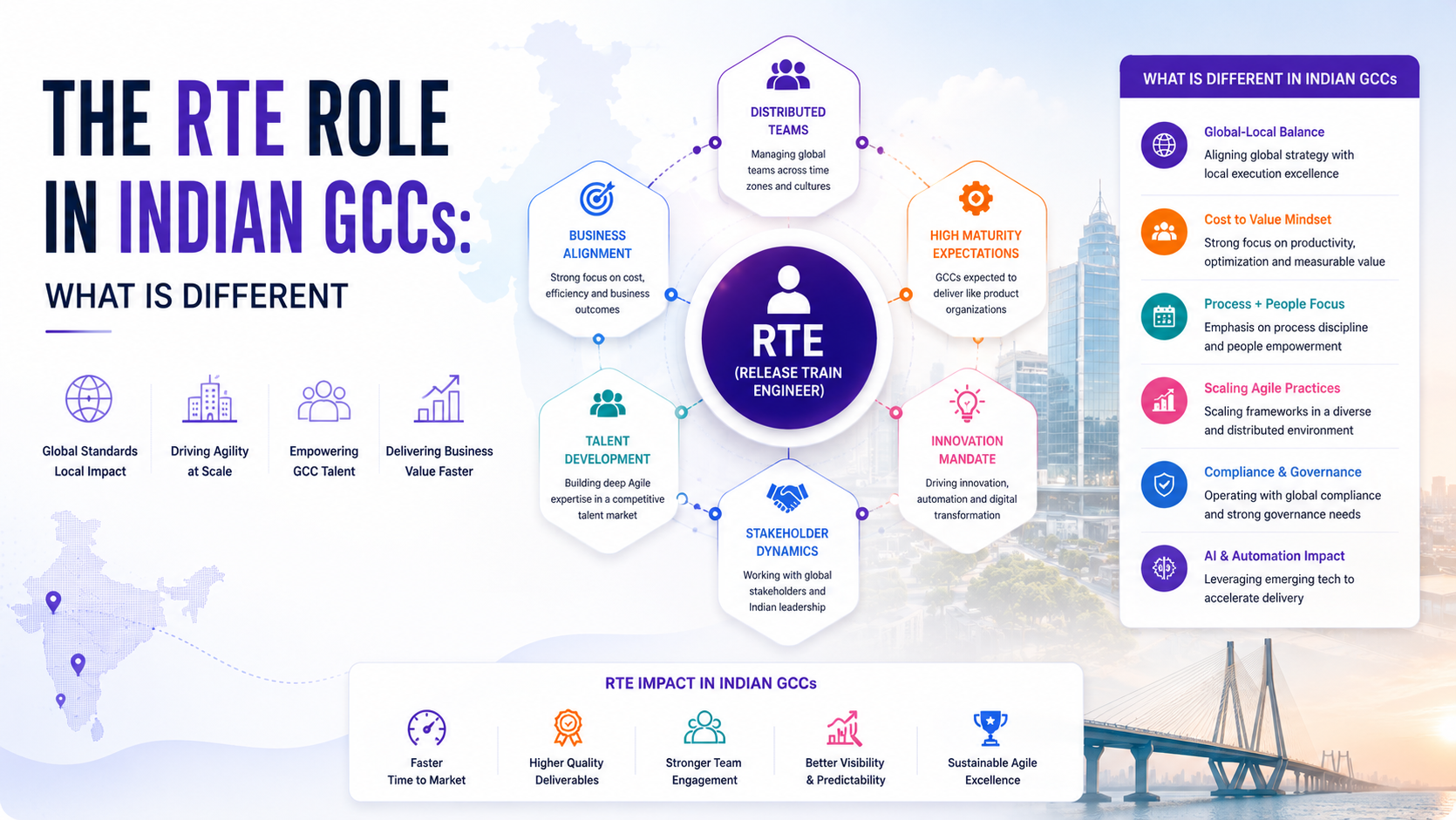
Running an Agile Release Train inside an Indian Global Capability Centre (GCC) is structurally different from running one in a single-site organization, mainly because of two things: your Agile Release Train is often split across a time zone from the parent company, and the scope of what your GCC actually owns is changing fast. NASSCOM's own 2026 data counts 2,117 GCCs in India employing 2.36 million professionals, and describes India centers shifting from execution hubs to full product ownership. That shift changes what an RTE in a GCC is actually accountable for.
What is the role of a Release Train Engineer in an Indian GCC?
A Release Train Engineer (RTE) in an Indian Global Capability Centre (GCC) facilitates an Agile Release Train whose teams, stakeholders or decision makers often sit in a different time zone from the India centre. The core SAFe role is unchanged. What changes is how planning is scheduled across time zones, where decision authority sits, and how stable the team stays from one Program Increment to the next.
What is a Global Capability Centre?
A Global Capability Centre (GCC) is an India-based centre owned by a multinational parent company that delivers technology, operations or business capability for that parent. NASSCOM counts 2,117 GCCs in India in 2026, employing 2.36 million professionals.
What does a Release Train Engineer do?
A Release Train Engineer is the servant leader and coach of an Agile Release Train in the Scaled Agile Framework (SAFe). The RTE facilitates PI Planning and other ART events, tracks progress, manages risks and dependencies, removes program level impediments and drives continuous improvement across the teams on the train.
Key Highlights
- India now has 2,117 Global Capability Centres employing 2.36 million professionals and generating close to USD 98.4 billion in revenue, according to NASSCOM's own 2026 reporting.
- More than 506 Forbes Global 2000 companies operate a GCC in India, per the same NASSCOM data, meaning most large multinational Agile Release Trains with an India component now run through this model.
- NASSCOM's 2026 report describes a structural shift: India GCCs moving from delivery execution to product ownership, business decision-making, and global leadership mandates.
- For an RTE, that shift means your ART's product decisions increasingly get made inside the same building you facilitate in, not exclusively at a distant headquarters.
- The practical RTE challenges that follow from this model, timezone overlap windows, distributed PI Planning, and stakeholder distance, are not unique to India, but they are close to universal for GCC-based ARTs specifically.
If you are an RTE working inside an Indian GCC, or considering a move into one, the generic "how to run an ART" content most training providers publish misses a real structural difference: your program almost certainly spans at least one meaningful time zone gap with a parent organization, and the scope of authority your center holds is shifting under you. This guide covers both, grounded in the most current India-specific data available.
Why India's GCCs are a genuinely different environment for an RTE
The scale alone changes the operating context. NASSCOM's 2026 reporting puts the number of GCCs in India at 2,117, employing 2.36 million professionals and generating nearly USD 98.4 billion in revenue. Over 506 Forbes Global 2000 companies now run a GCC in India. That is not a niche delivery model; for a large share of enterprise SAFe transformations with any India presence, it is the default one.
NASSCOM's own framing for 2026 describes GCCs undergoing "their most significant transformation since the rise of offshoring two decades ago," moving from pure execution to what the report calls an "enterprise nerve center," with product ownership, AI-led transformation, and business decision-making increasingly sitting inside the India center itself.
What structurally changes for an RTE in this model
The following points are reasoned analysis grounded in standard SAFe Agile Release Train mechanics applied to the GCC operating model described by NASSCOM above, not a formal published study of RTE-specific GCC behavior, which does not appear to exist publicly yet.
- Time zone overlap becomes a hard constraint, not a scheduling inconvenience. When your Business Owners or Product Management function sit with the parent organization outside India, your effective synchronous working window with them may be a few hours a day, which directly limits when PI Planning, System Demos, and ART Sync can realistically happen with full participation.
- Parent-company cadence often still sets the calendar. Even as GCCs gain more ownership, PI boundaries, release calendars, and planning cadences are frequently still set by the parent organization's fiscal year and reporting cycle, not by the India center independently.
- The ownership shift changes what "impediment" even means. As NASSCOM describes India centers taking on more product ownership, some impediments that used to require escalating to a distant headquarters can now potentially be resolved inside the India ART itself, if the RTE recognizes that the authority has actually moved.
- Talent pipeline and attrition dynamics differ from single-site organizations. GCCs operate in a dense local talent market with active cross-poaching between centers, which affects team stability and continuity across Program Increments in ways a single-site ART does not experience in the same way.
How to run PI Planning when your ART spans India and a parent time zone
Standard SAFe PI Planning is a two day event held every 8 to 12 weeks. That format assumes everyone is awake and in the room for the same eight hours. In a GCC with stakeholders in the US or Europe, that assumption breaks first. The practical fix is to keep the agenda and outcomes the same but spread them across more, shorter sessions.
Start by checking the time gap between India Standard Time (UTC plus 5:30) and your parent location. The gap changes with daylight saving time, so check it for the month of your PI Planning.
Table 1. Typical time gap between IST and common parent locations (illustrative)
| Parent location | Gap vs IST | What it means for PI Planning |
|---|---|---|
| Central Europe | 3.5 hours (summer) or 4.5 hours (winter) | Good overlap: India afternoon matches European morning. Two full days may still work with adjusted hours. |
| United Kingdom | 4.5 hours (summer) or 5.5 hours (winter) | Workable overlap in the India afternoon. Shift start times for India teams. |
| US East Coast | 9.5 hours (summer) or 10.5 hours (winter) | Overlap only in India late evening and US morning. Use half day blocks across several days. |
| US West Coast | 12.5 hours (summer) or 13.5 hours (winter) | Very narrow overlap. Plan short joint sessions and let teams work asynchronously between them. |
A four block structure keeps the standard SAFe agenda intact while respecting time zones:
Table 2. Illustrative four block distributed PI Planning agenda
| Block | Content | Note |
|---|---|---|
| Block 1 | Business context, product vision, architecture vision | Record it so teams outside the overlap can watch later. |
| Block 2 | Team breakouts and draft plans, draft plan review | Breakouts run in each team's own working hours. |
| Block 3 | Planning adjustments, management review and problem solving, second round of breakouts | Joint session where decision makers must be present. |
| Block 4 | Final plan review, risk review, confidence vote, retrospective | Confidence vote passes if the room average is at least 3 out of 5. |
Two GCC specific points to settle before the first block. First, confirm which decisions can be made in the India centre during planning and which need the parent organization, so the management review does not stall waiting for someone who is asleep. Second, agree who owns the calendar: if the parent company's fiscal cycle sets PI boundaries, publish the dates well in advance so business owners can block time. Add more facilitators than a co-located event needs and test every tool before the event.
The 2026 shift from delivery to ownership, and what it means for your career
NASSCOM's report frames this as one of three structural shifts happening in India's GCC landscape for FY2026, alongside an AI adoption operating-model gap and what it calls "the collapse of the GCC maturity timeline," meaning centers are reaching strategic maturity faster than earlier waves of GCCs did.
For an RTE, this is directly relevant to career positioning. An RTE role in a GCC that is still primarily an execution center looks different from an RTE role in a GCC that NASSCOM's own data suggests is increasingly common: one with real product ownership and business decision authority. If you are evaluating a GCC-based RTE opportunity, ask directly where your specific center sits on that spectrum, since the answer changes what the role actually involves day to day.
RTE, Scrum Master, Program Manager and Release Engineer compared
Job titles in GCCs are used loosely, and the same person may be called an RTE, a program manager or a delivery manager. This table separates the roles by what they actually do.
Table 3. Role comparison
| Role | Scope | Main focus | Source |
|---|---|---|---|
| Release Train Engineer | One Agile Release Train, typically 5 to 12 teams | PI Planning, Scrum of Scrums, program level impediments, risks, dependencies, coaching | Learners Ink, Agilemania |
| Scrum Master | One team | Team ceremonies and team level impediments | Agilemania, Learners Ink |
| Project Manager | A project | Schedule, scope and cost | Agilemania |
| Program Manager | Multiple projects | Roadmaps, resource allocation, strategic alignment | Agilemania |
| Release Engineer | The build and release pipeline | Building, testing and deploying software, CI/CD, troubleshooting builds | Agilemania |
What RTE job postings in India ask for
Our analysis of the GCC context is reasoned, not a formal study. Job postings give a more observable picture of what employers actually expect. The postings below were found in October 2026 and will change, so refresh this table every quarter.
Table 4. Requirements in recent India RTE postings
| Employer and city | Work mode | Stated requirements |
|---|---|---|
| Caterpillar, Chennai | Not stated in the fetched text | 3 or more years as RTE, Solution Train Engineer or equivalent. SAFe RTE certification. SAFe Agilist or SPC certification. |
| Siemens Healthineers, Bangalore | Office or site only | Global ART with 5 to 6 teams across Europe and India. 3 to 5 years as RTE or in project and program management. Flexible working across global time zones. |
| S&P Global, Hyderabad | Onsite | SAFe RTE certification. 8 or more years in a Scrum Master role. 2 or more years as an RTE. Azure DevOps expertise. |
| Cisco, Bangalore | Not stated in the fetched text | 3 or more years in Agile operations leadership and SAFe. SPC or RTE certification preferred. |
What stands out: the Siemens Healthineers posting describes exactly the GCC pattern this guide is about, a train split between Europe and India, and calls out global time zones in the requirements. Treat it as supporting evidence, not proof that every GCC works this way.
Your first 90 days as an RTE in a GCC (analysis)
This plan adapts the generic first 90 days advice to a GCC. It is applied analysis, not a published study.
- Days 1 to 30: map the overlap window between the India teams and every stakeholder group. Write down which decisions the India centre can make and which go to the parent. List the top three impediments and note which ones are local.
- Days 31 to 60: run your first ART Sync and System Demo at times that work for the stakeholders who matter most. Meet each business owner. Publish the next PI Planning dates and the block schedule early.
- Days 61 to 90: run PI Planning in the agreed distributed format. Hold a retrospective on the format itself, and record what to change for the next PI. Publish an RTE dashboard that includes attrition and team stability alongside delivery metrics.
Scale data is from NASSCOM's 2026 GCC reporting. The RTE implications in this guide are applied analysis of standard SAFe practice, supported by recent India job postings, and are not drawn from a formal study.
Practical implications if you are running or considering a GCC-based ART
- Map your actual synchronous overlap window with every key stakeholder group before you commit to a PI Planning cadence, rather than assuming standard SAFe timing will work unmodified.
- Clarify explicitly, with your Business Owners, which decisions now sit with the India center versus the parent organization, given how fast NASSCOM describes this boundary moving.
- Build continuity practices that assume higher local market mobility than a single-site ART would, since GCC talent markets see more active cross-company movement.
- If you are earlier in your RTE journey and considering a GCC role specifically, the core role mechanics do not change; see Release Train Engineer jobs and career path for the broader hiring picture, and Scrum Master to Release Train Engineer if you are transitioning into the role itself.








 Lowest-Price Challenge











 Personalized Path


.webp)


 USA
USA  Canada
 India
India UK
UK Australia
 Singapore


