


 Call Us



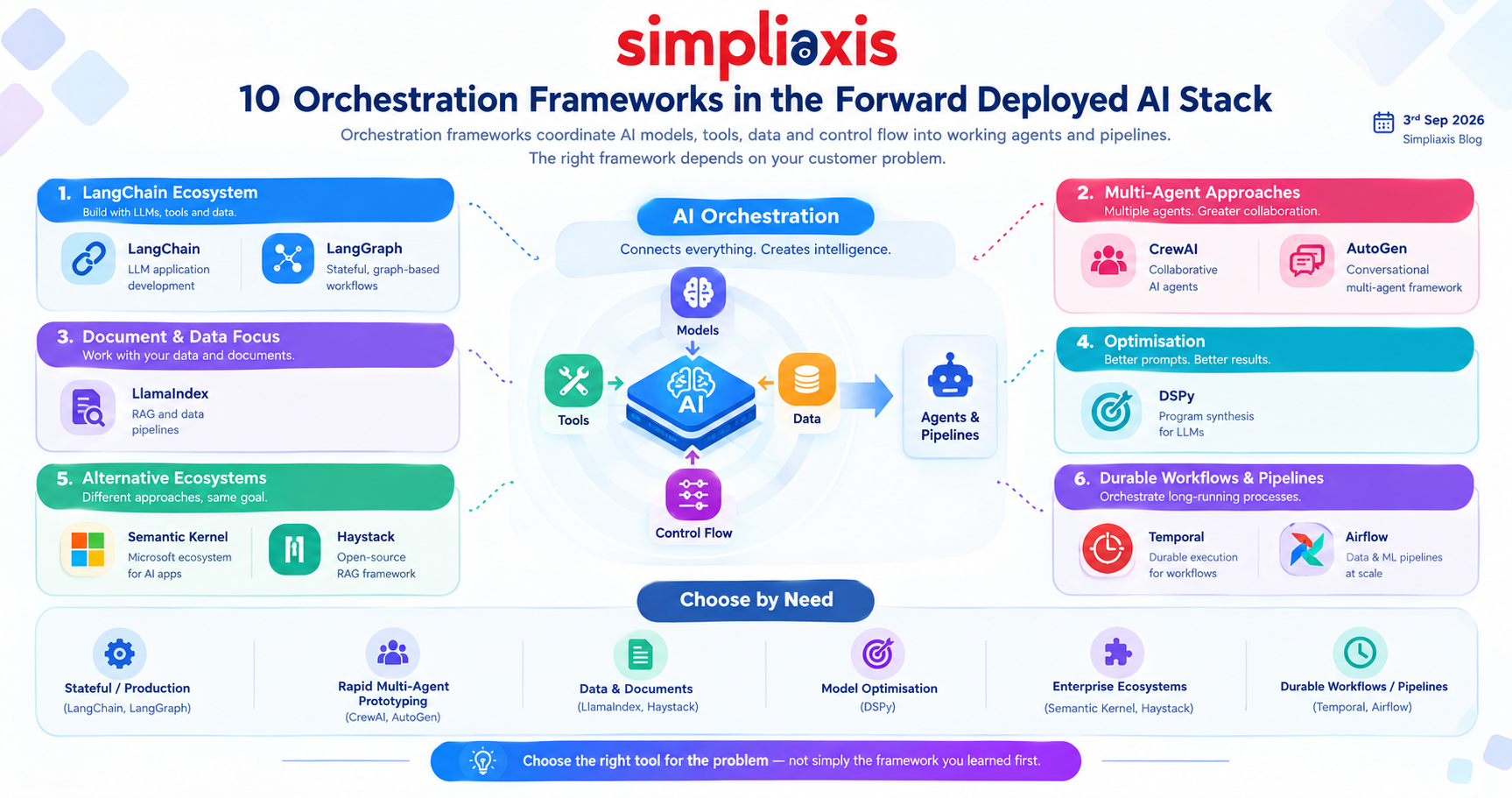
When a forward deployed engineer builds an AI system that does more than answer a single question, they reach for an orchestration framework, the software that coordinates models, tools, data, and control flow into a working agent or pipeline. The choice of framework shapes how the system is built, how it behaves, and how maintainable it is, which makes fluency across the main options a genuinely useful part of the toolkit. This piece walks through ten orchestration frameworks that show up in modern forward deployed AI work, what each is good for, and how to think about choosing between them, so you can pick the right tool rather than defaulting to whichever one you learned first.
Knowing the landscape matters because no single framework is right for every job, and the ability to choose well is part of building systems that actually work in production. Developing real command of the modern AI stack, through the Forward Deployed Engineering Program, includes understanding these frameworks well enough to select and use the right one for a given customer's problem.
Key Highlights
- Orchestration frameworks coordinate models, tools, data, and control flow into working agents and pipelines, and the choice shapes the whole system.
- LangGraph has become a leading choice for stateful, production-grade multi-agent systems, while CrewAI excels at fast role-based prototyping.
- LlamaIndex is strong for document-heavy, data-intensive pipelines, and DSPy takes a distinctive optimisation-based approach to building with models.
- Established workflow engines like Temporal and Airflow appear where durability and pipeline orchestration matter beyond the AI-specific frameworks.
- No framework is right for every job, so the ability to choose the right one for the problem is part of the skill.
LangChain and LangGraph: the dominant ecosystem
LangChain was the framework that popularised the idea of composing models, tools, and data into applications, and it remains a widely used foundation, providing the building blocks for connecting models to the rest of a system. It is broad, well known, and a common starting point, and much of the ecosystem grew up around it. For many forward deployed engineers, LangChain or its concepts are the baseline vocabulary of building AI applications.
LangGraph, from the same ecosystem, has become one of the most important frameworks for serious agent work, because it models an agent's workflow as a graph, a state machine, which gives precise control over stateful, multi-step agent behaviour. This graph-based approach suits production-grade multi-agent systems where you need reliable control over how the agent moves through its steps, and it pairs with strong observability and evaluation tooling. LangGraph has gained rapid enterprise adoption for exactly this reason, becoming a leading choice when you need stateful orchestration with deep control. Understanding the graph-as-control-flow model is also directly relevant to loop engineering, since the graph is one of the main ways an agent's loop is structured. For forward deployed engineers building real production agents, LangGraph is often the tool of choice.
CrewAI and AutoGen: multi-agent approaches
CrewAI takes a different, more accessible approach to multi-agent systems, organising them around roles, where you define agents with particular roles that collaborate to accomplish a task. This role-based mental model is intuitive and gets multi-agent prototypes up and running quickly, which makes CrewAI popular for rapidly exploring an idea or standing up a working demo. Its strength is ergonomics and speed to a prototype, though it trails the more production-focused frameworks on observability and error recovery, so it is often a prototyping choice rather than a production one.
Microsoft AutoGen is another prominent multi-agent framework, with particular strength in research and more sophisticated multi-agent patterns like agents debating or verifying each other's work. It leads in academic and research adoption and offers mature patterns for agents that interact in complex ways. For forward deployed engineers, AutoGen is worth knowing when a problem genuinely calls for multiple agents interacting in structured ways, though many production problems are better served by the more controllable single-agent-with-tools approach of a framework like LangGraph. The broader point is that multi-agent frameworks like CrewAI and AutoGen are powerful for the right problems but are not always the right default, and knowing when a problem truly needs multiple agents versus one well-orchestrated agent is part of the judgement the role requires.
LlamaIndex: data-heavy pipelines
LlamaIndex is a framework built with a particular strength in connecting models to data, which makes it especially relevant for the document-heavy, data-intensive work that forward deployed engineers so often do. Where some frameworks focus on agent orchestration in general, LlamaIndex has deep capabilities for ingesting, indexing, and retrieving over data, which is central to building retrieval systems on a customer's documents and knowledge.
For forward deployed work, this data focus matters because so much of the job involves making a model useful over a customer's specific documents and data, which is fundamentally a retrieval and data problem. LlamaIndex's workflows also support event-driven orchestration for these data-heavy pipelines, giving structure to systems that process and reason over large bodies of information. When a forward deployed engineer is building something like an enterprise retrieval system over a customer's messy documents, LlamaIndex is frequently a strong fit, because it is built for exactly that data-connection challenge. This connects directly to the difficulty of enterprise RAG, where the data-handling capabilities a framework like LlamaIndex provides are part of what it takes to build retrieval that works on real enterprise data.
DSPy: optimisation instead of prompting
DSPy, from Stanford, takes a genuinely different approach that is worth understanding because it points toward where the field may be heading. Instead of writing prompts by hand, you define modules with typed inputs and outputs, and DSPy's compiler optimises the prompts automatically, through a process analogous to training, but operating at the level of prompts rather than model weights. This shifts the engineer's work from crafting prompts to defining the structure of the system and letting the framework optimise the details.
For forward deployed engineers, DSPy is interesting because it addresses one of the fragilities of building with models, the brittleness of hand-tuned prompts, by making the prompting systematic and optimisable rather than manual and fragile. It represents a more principled, engineering-oriented approach to building with models, and while it is less ubiquitous than the LangChain ecosystem, it is influential and worth knowing. DSPy also illustrates the broader movement the prompt-context-loop-harness stack describes, away from hand-wording individual prompts and toward engineering the systems around models, which is exactly the direction serious AI engineering is heading. For an engineer who wants to build robust rather than brittle systems, DSPy's approach is a valuable one to have in the toolkit.
Semantic Kernel and Haystack: alternative ecosystems
Semantic Kernel, from Microsoft, is an orchestration framework designed to integrate AI capabilities into applications, with particular appeal in enterprise and Microsoft-centric environments. For forward deployed engineers working with customers who are heavily invested in the Microsoft ecosystem, Semantic Kernel can be a natural fit, because it aligns with the tools and platforms those customers already use, which matters when you are building inside their environment rather than a greenfield one.
Haystack, from deepset, is another established framework with particular strength in building search and retrieval systems, and a solid, production-oriented reputation. It offers a mature alternative to the more hyped frameworks for building the retrieval-heavy systems that forward deployed work often demands. The existence of these alternative ecosystems matters because forward deployed engineers do not always get to choose a greenfield stack, they often have to work within the customer's existing technology choices, and knowing frameworks beyond the most fashionable ones lets you fit into the customer's world rather than imposing an unfamiliar stack on it. Being fluent across several ecosystems, rather than loyal to one, is part of the adaptability the role rewards, because the right framework is often the one that fits the customer's environment.
Temporal and Airflow: durability and pipelines
Not all orchestration in a forward deployed AI system is AI-specific, and two established workflow engines, Temporal and Airflow, appear where durability and pipeline orchestration matter beyond the model-focused frameworks. Temporal is a durable execution framework that ensures long-running workflows complete reliably even in the face of failures, which matters for AI systems that run over extended periods and must not lose their place when something goes wrong. For production agents that operate over long horizons, the durability guarantees of a framework like Temporal can be exactly what keeps them reliable.
Airflow is a widely used pipeline orchestration tool, common for scheduling and managing data pipelines, which appear constantly in the data-heavy work of forward deployed AI. When a system involves regular data processing, ingestion, or transformation feeding an AI application, a pipeline orchestrator like Airflow is often part of the picture. These tools are not AI frameworks in the way the others are, but they are part of the broader orchestration landscape, handling the durability and pipeline concerns that production AI systems depend on. A forward deployed engineer building robust production systems benefits from knowing these established tools alongside the AI-specific frameworks, because real systems often combine both, and the reliability of the whole depends on the unglamorous orchestration underneath.
When to use a framework and when to skip it
An important judgement that separates experienced engineers from beginners is knowing when a framework helps and when it gets in the way, because reaching for a heavy framework is not always the right move. Frameworks add abstraction, which is valuable when it saves you from reinventing complex coordination logic, but costly when it hides what is happening and makes debugging harder. For a simple task, a framework can be more trouble than it is worth, adding layers of indirection over what could have been a few direct model calls, and an engineer who reaches for a framework reflexively can end up with a system more complicated than the problem requires.
The judgement, then, is to match the tool to the complexity. A simple, single-step task often needs no orchestration framework at all, just direct model calls. A moderately complex agent benefits from a framework that provides structure without too much overhead. A genuinely complex, stateful, multi-agent system justifies a powerful framework like LangGraph that gives real control. Choosing the lightest tool that adequately handles the complexity keeps systems maintainable and debuggable, which matters especially in forward deployed work where the customer's team has to maintain what you build. This is the same principle that runs through all forward deployed technology choices, matching the tool to the actual need rather than defaulting to the most powerful or fashionable option, and it is part of building systems that are maintainable and handoff-friendly rather than needlessly complex. Building the judgement to choose well, through the Forward Deployed Engineering Program, matters as much as knowing the frameworks themselves.
Fitting into the customer's existing framework choice
A reality of forward deployed work that shapes framework decisions is that you often inherit the customer's existing choices rather than starting fresh, and adapting to what is already there is frequently more valuable than imposing your preference. A customer may already have systems built on a particular framework, a team that knows it, and infrastructure around it, in which case building on that framework, even if it is not your favourite, keeps the system coherent and maintainable by the customer's team after you leave. Insisting on your preferred framework in that situation can create a system the customer cannot maintain, which is a failure regardless of the technical merits.
This is why fluency across frameworks matters so much more than loyalty to one. The forward deployed engineer who can work productively with whatever framework the customer has adopted can fit into their world, while one who only knows a single framework is limited to customers who happen to use it or forced to impose an unfamiliar stack. Being able to assess a customer's existing framework choices, work within them where sensible, and recommend changes only where genuinely warranted, is part of the adaptability the role rewards. The goal is a system that fits the customer's environment and can be maintained by their team, which often means using their framework rather than yours, and it connects to the broader skill of fitting into the customer's whole existing technology stack rather than replacing it.
The ten frameworks at a glance
To help you choose, here is how the ten frameworks compare across what they are best suited for.
| Framework | Best for | Character |
| LangChain | General composition of models, tools, data | Broad, foundational, widely known |
| LangGraph | Stateful, production multi-agent systems | Graph-based, precise control |
| CrewAI | Fast role-based multi-agent prototypes | Intuitive, quick to prototype |
| AutoGen | Complex multi-agent interaction patterns | Research-strong, sophisticated |
| LlamaIndex | Document-heavy, data-intensive pipelines | Deep data and retrieval focus |
| DSPy | Systematic, optimised building | Optimisation instead of hand-prompting |
| Semantic Kernel | Microsoft-centric enterprise environments | Enterprise integration |
| Haystack | Production search and retrieval | Mature, retrieval-focused |
| Temporal | Durable, long-running workflows | Reliability under failure |
| Airflow | Data pipeline orchestration | Established scheduling and pipelines |
Read the table as a guide to matching a framework to a problem rather than a ranking. LangGraph for controlled production agents, CrewAI for quick prototypes, LlamaIndex for data-heavy retrieval, DSPy for systematic optimisation, and the established engines where durability and pipelines matter. The skill is choosing well for the specific job, not defaulting to one framework for everything.
It is worth remembering that this landscape moves quickly, with new frameworks appearing and existing ones evolving, so the durable skill is understanding the underlying concepts of orchestration rather than memorising any one framework's current API. An engineer who grasps how agents, state, control flow, and tools fit together can learn whatever framework a situation calls for, while one who has only memorised a single framework's specifics is left behind when the field moves. Investing in the concepts beneath the frameworks is what keeps your skills current as the specific tools churn.
The bottom line
Orchestration frameworks coordinate models, tools, data, and control flow into working AI systems, and the choice shapes how the system is built and how it behaves. The landscape spans the dominant LangChain ecosystem and its powerful LangGraph for stateful production agents, the multi-agent frameworks CrewAI and AutoGen, the data-focused LlamaIndex, the optimisation-oriented DSPy, alternative ecosystems like Semantic Kernel and Haystack, and established workflow engines like Temporal and Airflow for durability and pipelines. Each is suited to different problems, and no single one is right for every job.
For a forward deployed engineer, fluency across these frameworks is valuable because you often have to fit into a customer's existing stack rather than choose a greenfield one, and because choosing the right tool for the specific problem is part of building systems that work in production. Developing real command of the modern AI stack, including the judgement to select and use the right framework, through the Forward Deployed Engineering Program, is part of becoming an engineer who builds reliable systems rather than one who forces every problem into a single familiar tool.
Building the judgement, not just the knowledge
Knowing the frameworks is the easy part, and the harder, more valuable skill is the judgement to choose and use the right one for a given customer's problem. Developing that judgement through hands-on building, in agentic AI foundations and applied engineering with agents, is what turns a list of framework names into the ability to build systems that actually work and that a customer's team can maintain. The engineers who stand out are not the ones who know the most frameworks but the ones who choose the lightest tool that solves the problem and fits the customer's environment.
The engineers who navigate this landscape best treat frameworks as means rather than ends, reaching for whichever one genuinely serves the customer's problem and never letting loyalty to a tool override the needs of the system they are building.






 Lowest-Price Challenge










 Personalized Path


.webp)


 USA
USA  Canada
 India
India UK
UK Australia
 Singapore


