


 Call Us



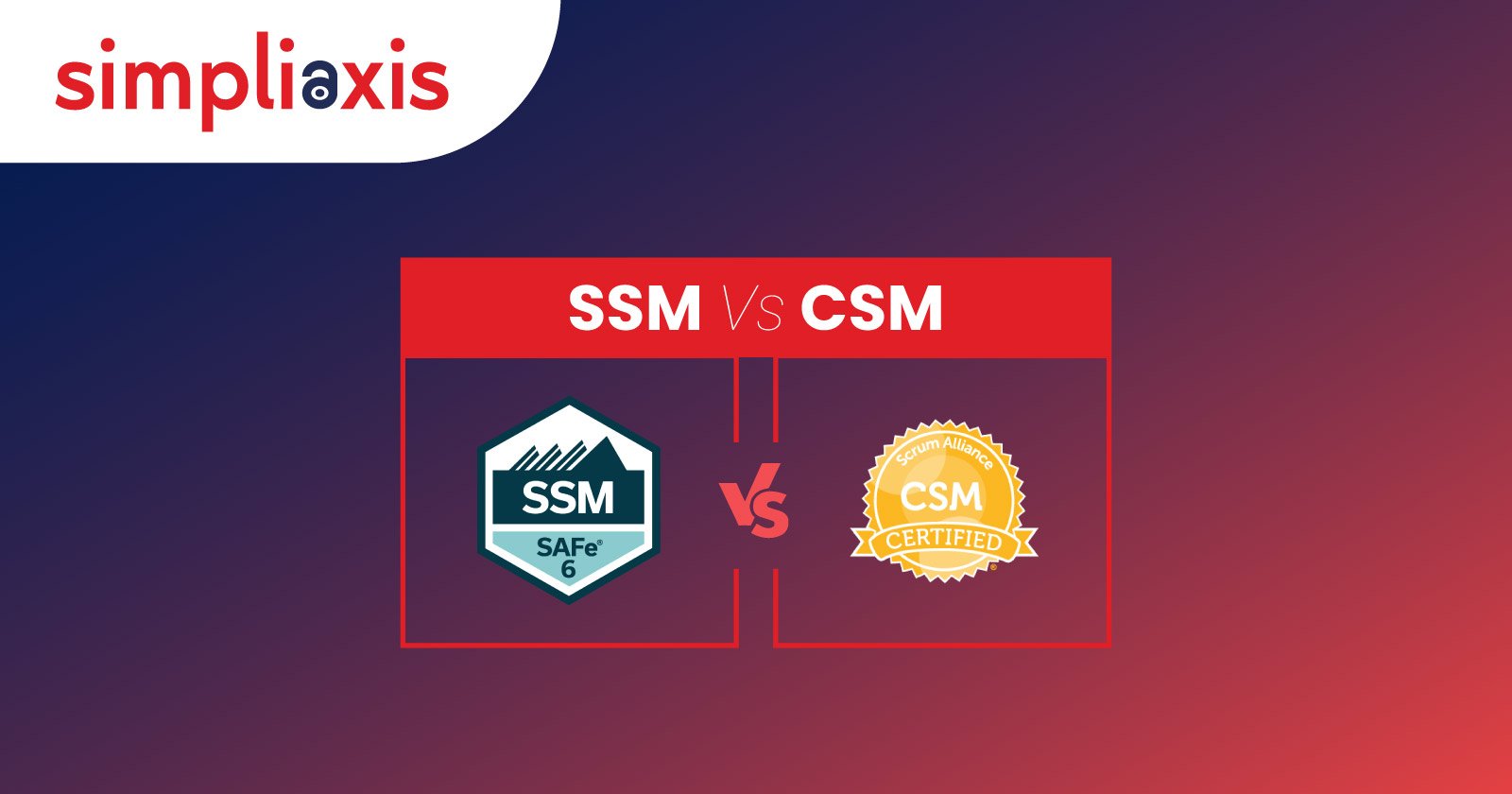
CSM teaches Scrum itself and requires attending a course from an approved trainer. SAFe Scrum Master teaches the Scrum Master role inside a Scaled Agile environment and does not require a course at all, since you can sit the exam independently. Pick CSM if you are new to Scrum or your organisation runs Scrum on its own. Pick SAFe Scrum Master if your organisation runs SAFe and you will be working on an Agile Release Train.
Key Highlights
- The biggest practical difference is the course requirement. CSM mandates an approved course; SAFe Scrum Master states that training is not required to take the exam.
- CSM covers Scrum as a framework. SAFe Scrum Master covers operating as a Scrum Master within SAFe, including PI Planning and iteration execution.
- Both renew on a two-year cycle, with different units: 20 SEUs plus a fee for CSM, and a minimum of 24 CEUs for SAFe Scrum Master.
- The exams are comparable in difficulty. CSM is 50 questions requiring 37 correct; SAFe Scrum Master is 45 questions in 90 minutes at 73% to pass.
- Neither is more advanced than the other. They are foundational credentials from different bodies covering different contexts.
- The decision is usually made by your employer's environment rather than by the credentials themselves.
The Fundamental Difference
These are not two versions of the same certification, which is the assumption behind most of the confusion.
CSM teaches Scrum: The framework, the accountabilities, the events, the artefacts, and how a Scrum Master serves one team. It assumes nothing about scale and nothing about what else your organisation runs. It is awarded by Scrum Alliance.
SAFe Scrum Master teaches the role inside SAFe: The course covers introducing Scrum in SAFe, characterising the Scrum Master role, participating in PI Planning, facilitating iteration execution, and finishing the Programme Increment. It assumes you are working on an Agile Release Train alongside other teams. It is awarded by Scaled Agile.
The consequence is that they are useful in different places. Someone joining a five-person team running Scrum gains little from PI Planning content. Someone joining a train of ten teams needs it on day one and will find generic Scrum training leaves out most of what their week actually involves.
If you are weighing this up and want to check your Scrum foundation first, our free CSM practice test takes a few minutes.
Side by Side
| CSM | SAFe Scrum Master | |
| Awarding body | Scrum Alliance | Scaled Agile |
| Course required | Yes, approved trainer, mandatory | No, training is optional |
| Prerequisites | None | None stated |
| Exam | 50 questions, 37 correct to pass | 45 questions, 90 minutes, 73% to pass |
| Focus | Scrum framework, single team | Scrum Master role within SAFe, on an ART |
| Renewal cycle | 2 years | 2 years |
| Renewal requirement | 20 SEUs plus 100 USD | Minimum 24 CEUs, 12 per year |
| Best for | New to Scrum, single team environments | Organisations running SAFe |
Two rows deserve attention.
The course requirement is the real cost difference: CSM bundles the certification into a mandatory course, which is why the price sits where it does. Scaled Agile states that a training course is not required for the SAFe Scrum Master exam, so in principle you can study independently and register. In practice, most people take the course anyway, because the material assumes SAFe context that is hard to absorb alone, but the option genuinely exists, and it changes the entry cost.
The exams are more similar than people expect: Fifty questions at 74 percent against 45 questions at 73 percent. Neither is a serious barrier for someone who attended the course and paid attention. Anyone choosing between them on exam difficulty is optimising the wrong variable.
Which One Your Employer Wants
The honest answer to which is better, and it has little to do with the credentials themselves.
If your organisation runs SAFe, take SAFe Scrum Master. Job postings will name it, internal progression will assume it, and you will spend your working life in PI Planning and ART sync. A CSM in that environment is respectable and it does not cover the mechanics you use daily.
If your organisation runs Scrum without a scaling framework, take CSM. SAFe content about Programme Increments describes a structure you do not have, and a large portion of the course will not apply.
If you are between roles or changing employers, CSM is the safer default. It is recognised more widely across Scrum roles generally, and it is the more portable of the two because it does not assume a particular scaling framework. SAFe Scrum Master is strongly recognised specifically within organisations that have adopted SAFe.
If you do not know yet, check actual job postings in your market rather than asking which is more respected. Count how many name each credential. That takes ten minutes and settles the question more reliably than any comparison.
Our overview of the SAFe Scrum Master role covers what the job involves in a SAFe environment, and the Scrum Master roles and responsibilities guide covers the general version.
Cost and Renewal
Both are ongoing commitments rather than one-off purchases, and the shapes differ.
CSM. The course fee covers the certification and two exam attempts, and ranges from 250 to 2,495 US dollars depending on delivery format, location, and provider. Renewal is 100 US dollars plus 20 SEUs every two years. Details are in our breakdown of CSM certification cost and CSM renewal cost.
SAFe Scrum Master. Because the course is optional, the cost structure is different: an exam fee, plus a course fee only if you take one. Renewal runs on a two-year cycle requiring a minimum of 24 continuing education units, which works out to 12 a year. Current pricing is covered in our guide to SAFe Scrum Master certification cost and the renewal requirements.
Two points people miss when comparing.
The continuing education requirements are similar in weight. Twenty SEUs over two years against 24 CEUs over the same period. Both amount to roughly ten to twelve hours a year, and both are satisfied by ordinary professional activity in most cases.
Holding both means two renewal cycles. Some people do hold both, and it is worth knowing that the cost and the continuing education obligations run in parallel rather than combining.
What the Course Requirement Actually Changes
Worth expanding, because it is the difference with the largest practical consequence and most comparisons mention it in passing.
For CSM, the course is the product. Scrum Alliance requires attendance because the credential attests that you learned the material with a Certified Scrum Trainer in the room. You cannot study a book and register for the exam. That is why the price sits where it does, and it is also why the CSM experience is fairly consistent: everyone who holds one sat through two days of the same core content.
For SAFe Scrum Master, the course is optional. Scaled Agile states plainly that training is not required to take the exam. That produces a lower entry cost for anyone confident studying alone, and it produces more variance in what holders actually know, since two people with the same credential may have had very different preparation.
Three practical consequences.
Budget. Someone paying their own way can reach SAFe Scrum Master for the exam fee alone. Reaching CSM without a course is not possible at any price.
Time. CSM takes two days of your calendar, blocked out, usually consecutive. Independent study for SAFe Scrum Master fits around a working week.
What you get beyond the certificate. The CSM course puts you in a room with a trainer and a group of practitioners from other organisations, and for people new to the role that exposure is frequently the most valuable part. Self-study delivers the syllabus and none of that.
The honest read is that the mandatory course is simultaneously CSM's main cost and its main benefit, depending entirely on where you are starting from. For someone new to Scrum, it is worth the money. For an experienced practitioner who needs a credential to satisfy a job requirement, it can feel like an expensive formality.
Can You Hold Both
Yes, and it is a common combination, particularly for people who started in a Scrum team and later joined an organisation running SAFe.
The sequence that makes sense is CSM first, then SAFe Scrum Master. The reason is that SAFe assumes you understand Scrum. Someone arriving at PI Planning content without a solid grasp of what a Sprint is for, or why the Retrospective matters, is learning the scaled version of something they have not yet learned the basic version of.
Doing it the other way round is possible and tends to produce gaps. People certified only in SAFe sometimes struggle when they move to a single team environment, because a good deal of what they learned was about coordination between teams rather than about how one team works.
The reverse concern, that CSM leaves you unprepared for SAFe, is less serious. Scrum fundamentals transfer directly, and the SAFe-specific material is largely additional structure layered on top.
For anyone planning the full path, CSM Certification Training covers the foundation, and the SAFe Scrum Master certification covers the scaled context.
What Each One Will Not Teach You
Worth stating, because both are foundational credentials and neither makes anyone a competent Scrum Master on its own.
CSM will not prepare you for scale. Cross-team dependencies, coordinating a release across ten teams, or operating within a Programme Increment are not covered, because they are outside what the framework describes.
SAFe Scrum Master will not make you a Scrum expert. It covers Scrum within a specific context, and someone who has only done this route often has a thinner grasp of the framework itself than the credential implies.
Neither teaches facilitation depth. Both introduce it. Getting genuinely good at running a difficult Retrospective, coaching a Product Owner who will not prioritise, or handling a team in conflict takes practice and usually further training.
Neither substitutes for experience. Both are two or three-day courses. They give vocabulary, structure and enough understanding to be useful, and the competence comes from doing the job.
This is the honest framing for anyone deciding between them. The choice matters less than most comparison articles imply, because the gap between either certification and being effective is larger than the gap between the two credentials.
Deciding in Five Minutes
If the comparison above has not settled it, these questions will.
Does your organisation run SAFe? If yes, and you intend to stay, take SAFe Scrum Master. Nothing else in this article outweighs that.
Are you new to Scrum? If yes, take CSM regardless of environment. Learning the framework properly first makes everything afterwards easier, and it is the one thing SAFe training assumes rather than teaches.
Are you job hunting across different organisations? Take CSM. It travels better because it does not presuppose a scaling framework.
Is your employer paying? Ask which they want. Organisations usually have a preference tied to their own environment, and it is a short conversation that removes the question entirely.
Are you paying yourself and money is tight? SAFe Scrum Master has the lower floor, since the exam can be taken without a course. Be honest with yourself about absorbing the material alone, because a failed exam is a false economy and the resit is not free.
Is there a deadline? A job application closing in three weeks favours whichever you can complete in time. CSM depends on finding a course date that fits; the SAFe exam can be booked independently and sat sooner.
Do you want the credential or the capability? If it is the credential, take whichever your market names. If it is the capability, the mandatory CSM course with a trainer and a room of practitioners delivers more, and that is worth paying for once.
One question deliberately not on this list is which is more respected. Both are legitimate, both are widely recognised in their own contexts, and neither carries a reputational problem. Time spent on that comparison is time not spent on the question that actually matters, which is what your next role will require you to do on a Monday morning.
A final note for people who feel stuck between them. The decision is reversible and reasonably cheap to reverse. Plenty of practitioners hold both, most acquired them years apart, and nobody has been harmed by starting with the one their situation called for at the time. Deferring the decision for months while researching costs more than choosing imperfectly and adding the other later.
Salary and Career Impact
Frequently asked, and the differences are smaller than the marketing on either side suggests.
Scrum Master salaries are driven primarily by location, years of experience and industry, with the specific certification a long way down the list. Someone with three years of practice and either credential will out-earn someone with both and no experience.
Where a specific certification does affect earnings is through access. In an organisation running SAFe, the SAFe credential may be a filter on internal roles, and not holding it can exclude you from consideration regardless of capability. That is an access effect rather than a premium.
Current figures are in our guides to Scrum Master salary ranges and SAFe Scrum Master salary, and the pattern in both is that experience and market dominate.
The Daily Work Each One Prepares You For
Comparing syllabuses is abstract. Comparing the weeks is not.
A CSM-prepared Scrum Master's week. Facilitating the four Scrum events for one team. Working with the Product Owner on backlog health. Coaching two developers through a disagreement about the Definition of Done. Chasing a blocker with another team's lead. Watching the Daily Scrum turn into a status report and quietly correcting it. The unit of concern is the team and the Sprint.
A SAFe-prepared Scrum Master's week. The same team-level work, plus ART sync with the other teams' Scrum Masters, tracking dependencies that cross team boundaries, contributing to the programme board, and every ten weeks or so a two-day PI Planning event that requires substantial preparation. The unit of concern is the team, held inside a train.
The overlap is large. Both spend most of their time facilitating events, coaching a team and removing impediments. What SAFe adds is the coordination layer, and what CSM covers more thoroughly is the framework underneath it.
That is why the sequence CSM then SAFe works well and the reverse often leaves gaps. The coordination layer only makes sense once the thing being coordinated is understood, and someone who learned PI Planning before they learned why a Sprint is a fixed container tends to treat the ceremonies as the point.
It is also why the choice is less consequential than it appears. Neither credential changes what the job is, which is helping a team work well. They change how much of the surrounding structure you arrive already understanding, and the rest comes from doing it. Building that underlying capability is what CSM Certification Training is aimed at, whichever direction you take afterwards.
Frequently Asked Questions
1. Which is better, SAFe Scrum Master or CSM?
Neither is better in general. CSM suits people new to Scrum or working in single team environments. SAFe Scrum Master suits people in organisations running SAFe. Your employer's environment usually decides it.
2. Is SAFe Scrum Master more advanced than CSM?
No. Both are foundational credentials from different bodies. SAFe Scrum Master covers a wider organisational context, and that is a difference in scope rather than in level.
3. Do I need CSM before SAFe Scrum Master?
Not formally. It is the more sensible order, because SAFe assumes an understanding of Scrum that the SAFe course does not teach from first principles.
4. Can I take the SAFe Scrum Master exam without a course?
Scaled Agile states that a training course is not required for the exam. Most people take one anyway, since the material assumes SAFe context that is difficult to pick up independently.
5. Can I take the CSM exam without a course?
No. Scrum Alliance requires attendance at a course delivered by an approved Certified Scrum Trainer. There is no self study route.
6. Which is harder to pass?
They are comparable. CSM is 50 questions needing 37 correct. SAFe Scrum Master is 45 questions in 90 minutes at 73 percent. Neither is a significant barrier after the relevant course.
7. Which is recognised more widely?
CSM, across Scrum roles generally, because it does not assume a particular scaling framework. SAFe Scrum Master is strongly recognised specifically within organisations that run SAFe.
8. Do both expire?
Both renew every two years. CSM requires 20 SEUs plus a fee, and SAFe Scrum Master requires a minimum of 24 CEUs.
Closing Thoughts
The comparison people expect is which credential carries more weight. The more useful question is which context you are working in, because these two certifications describe different jobs rather than different levels of the same one.
A Scrum Master on one team, in an organisation that has not adopted a scaling framework, gets more from CSM. A Scrum Master on an Agile Release Train, with PI Planning every ten weeks and eight other teams to coordinate with, gets more from SAFe Scrum Master. Choosing on prestige rather than context is how people end up with a credential that does not match their week.
The other thing worth keeping in view is that both are entry points. Neither is the finish line, and the difference between holding either certification and being genuinely effective is considerably larger than the difference between the two.
If Scrum fundamentals are what you need, CSM Certification Training is the two day route and covers the framework properly, which is the foundation everything scaled sits on top of. Request the curriculum to see the agenda and upcoming dates, or start with the free CSM practice test to see where your gaps are. If you are already in a SAFe environment, the SAFe Scrum Master practice test is the equivalent starting point.


HowtoEstablishOne_1788350087.png)
_1788349430.jpeg)




 Lowest-Price Challenge











 Personalized Path


.webp)


 USA
USA  Canada
  India
India  UK
UK  Australia
  Singapore


