


 Call Us




Banner Link: Scrum Master Job Description Duties, Skills and Template.png
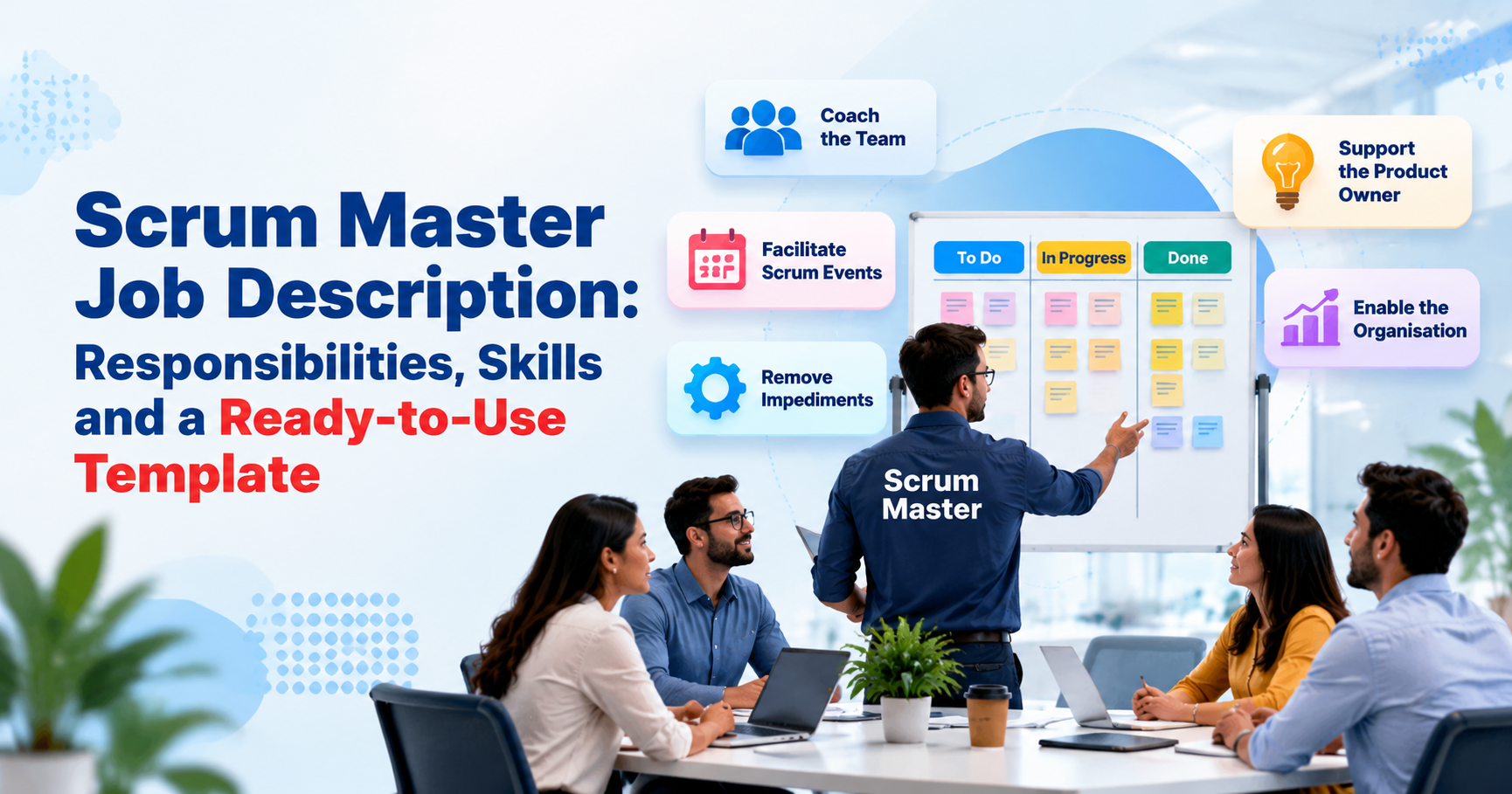
Scrum Master Job Description: Responsibilities, Skills, and a Ready-to-Use Template

A Scrum Master job description shows how a professional will guide an Agile team to embrace Scrum, remove obstacles and enhance how it delivers products. Often the role involves coaching team members, facilitating Scrum events, removing impediments, and working with the product owner and stakeholders. Employers are usually looking for strong communication, facilitation, conflict resolution, and Scrum knowledge.” Depending on the career path, certifications like CSM or PSM may also be required. Most of all a good Scrum Master helps the team to become more effective, rather than just tracking tasks or arranging meetings.
Key Highlights of Scrum Master Job Description
- A Scrum Master helps the team to understand Scrum and to take more ownership of its work.
- Key Scrum Master Responsibilities: Coaching, facilitation of Scrum events, impediment removal, collaboration improvement.
- Employers should look for practical skills in addition to knowledge of Scrum and relevant certifications.
- Requirements differ for junior, mid-level, senior and lead positions.
- Remote roles need clear expectations around communication, time zone overlap and virtual collaboration.
- Success should be measured by team effectiveness and continuous improvement, not just velocity.
Introduction
It’s not always a lack of technical skills that causes an Agile team to miss its goals. Sometimes work gets stuck because of vague requirements, competing priorities, slow approval processes, or miscommunication between departments. A Scrum Master helps the team to see these problems and find better ways to work together.
That’s why the Scrum Master job description is such an important part of the recruitment process. It should describe what the person will actually do, what skills they need and how their contribution will be assessed. You don't get the full picture of the role by just asking someone to have daily meetings and update project trackers.
A clear description helps employers to find the right candidate with the right experience. It’s easier for job seekers to distinguish between a real Scrum Master position and a project coordinator position with an Agile title rebrand.
This guide describes the key Scrum Master responsibilities, skills, qualifications and experience requirements, plus a practical job description template, which hiring managers can adapt to their teams.
What Does a Scrum Master Do?
A Scrum Master helps a Scrum Team to understand and enact Scrum in its daily work. This includes coaching people, facilitating discussions, working through obstacles and helping the team improve over time.
According to The Scrum Guide (the official Scrum language), the Scrum Master is responsible for the effectiveness of Scrum and for ensuring Scrum. This is the practical equivalent of helping people use the framework correctly, rather than enforcing a strict set of procedures.
For example, let’s say you have a software team that consistently carries unfinished work into the next Sprint. A Scrum Master wouldn’t immediately ask the developers to work faster or longer hours. Or they could help the team look into why this is happening. Are the demands too great? Are external dependencies slowing progress? Is testing happening too late?
Once the team understands the problem, it can experiment with changes and review the results.
A Typical Day in the Life of a Scrum Master
There is no fixed daily schedule for every Scrum Master. The work depends on what the team needs at a particular time.
| Activity | What it might involve |
| Team collaboration | Helping team members discuss progress and current obstacles. |
| Resolving impediments | Working with IT or another department to remove a blocker. |
| Product Owner support | Helping clarify backlog items before Sprint Planning. |
| Stakeholder communication | Discussing dependencies or risks that could affect delivery. |
| Continuous improvement | Following up on changes agreed during a retrospective. |
These activities do not have to follow the same routine every day. A mature team may need very little intervention, while a team facing organizational or communication problems may require more coaching.
The distinction matters: the Scrum Master should respond to the team's needs, not create work simply to remain occupied.
For a broader explanation of the role, see our guide on what is a Scrum Master.
Core Responsibilities
The Scrum Master's responsibilities go beyond conducting meetings. A Scrum Master helps the team use Scrum effectively, supports the Product Owner, and works with the organization to address problems that affect delivery.
The following areas are worth including in a job description.For a deeper look at each, read our guide to Scrum Master roles and responsibilities.
Coaching the Team
A team may understand the terminology of Scrum without knowing how to put its principles into practice. Coaching helps bridge that gap.
The Scrum Master encourages team members to manage their work, communicate openly, and take shared responsibility for achieving their goals. This might involve helping people to challenge ineffective habits, or to deal with conflict differently.
For example, a dev team may rely on their technical lead to hand down every task. The Scrum Master can help the team find ways it could coordinate work without being dependent on others but still asking for technical guidance when needed.
Typical responsibilities include:
- Promoting self-management and cross-functional collaboration.
- Coaching team members to understand Scrum values and practices.
- Sharing progress, risks and difficulties in an open way.
- Supporting positive dialogues where there are disagreements.
- Encouraging experiments to improve the team’s work practices.
A coach should be helping the team become more independent over time, not making the Scrum Master the one that everyone comes to for every decision.
A good job description statement is:
"Improve team effectiveness by training team members in Scrum practices, self-management, collaboration and continuous improvement.
Facilitating Scrum Events
Scrum events provide the team with regular opportunities to plan, inspect its progress, gather feedback and decide what needs to change. The Scrum Master helps ensure these events are valuable, not just calendar obligations.
The Sprint is the container for all other Scrum Events. All of the other Scrum Events, Sprint Planning, the Daily Scrum, Sprint Review, and Sprint Retrospective, are contained within the Sprint.
The Scrum Master might facilitate these events, but they don’t have to lead all the discussions. For example, the Daily Scrum is owned by the Developers and the Scrum Master helps to ensure that Scrum events are useful for their purposes.
Responsibilities may include:
- Helping the team prepare for Sprint Planning.
- Supporting meaningful discussions about the Sprint Goal.
- Helping the team keep the Daily Scrum focused on progress and adaptation.
- Encouraging useful feedback during Sprint Reviews.
- Facilitating retrospectives that lead to practical improvements.
- Identifying unnecessary meetings that interrupt focused work.
Take a team that always gets the same feedback in retrospectives about changing requirements. Rather than letting the conversation stall, the Scrum Master can help the team run a Sprint Retrospective that gets to the root cause, agree on a small experiment, and then check in a later Sprint to see if it worked.
The job description could read:
"Support team members in participating in effective Scrum events that enable collaboration, transparency, inspection, adaptation, and actionable improvements.
Removing Impediments
A blocker could be something as simple as a missing software license, or something as complex as an approval process that involves multiple departments. In both cases, lingering obstacles can impede a team’s progress.
The Scrum Master helps to uncover these impediments and works with the right people to get them removed. They don’t have to solve every technical problem themselves.
Common responsibilities include:
- Identifying recurring blockers and investigating their causes.
- Coordinating with other teams to resolve dependencies.
- Escalating issues that are outside the team's control.
- Following up on unresolved problems.
- Helping reduce unnecessary administrative delays.
- Encouraging changes that prevent the same issues from returning.
For example, a team may be ready to release a feature but cannot obtain a security review until late in the Sprint. The Scrum Master can bring the relevant teams together to discuss an earlier review process.
The immediate blocker may be resolved, but the larger benefit comes from improving the process for future releases.
A suitable job description statement is:
"Identify and help resolve impediments affecting team progress, working with stakeholders to address recurring barriers and cross-team dependencies."
Supporting the Product Owner
The Product Owner is charged with maximizing the value of the product. The Scrum Master helps the Product Owner work effectively with Developers and stakeholders without taking over product decisions.
This should be clear from the job description. Scrum Master doesn’t own the product roadmap or alone decide what the highest priority backlog items are.
The role may instead involve:
- Help improve clarity and transparency of the Product Backlog.
- Assisting in driving conversations around product goals and priorities.
- Supporting collaboration between Product Owner and Developers.
- Helping the team understand evolving needs.
- Good backlog management practices are promoted.
- Supporting planning and decision-making under uncertainty.
Let’s say a Product Owner has a lot of large features in the backlog, but the team doesn’t really know what the users want from them. The Scrum Master can facilitate a conversation where the Product Owner and Developers clarify what they want and find smaller, more understandable items.
This enables collaboration without transferring product ownership.
A job description might read:
"Help the Product Owner maintain a transparent Product Backlog, collaborate with interested parties, and help the team understand the product goals.
Supporting the Organization
There are some things that cannot be solved in a team. Outdated approval processes, competing departmental priorities, and management practices can impact the effectiveness of Scrum.
A Scrum Master helps raise these problems to the attention of the people who can fix them. This is especially important in larger organizations where different teams rely on common systems, resources or decisions.
Responsibilities may include:
- Assist stakeholders in understanding Scrum and Agile practices.
- Encourage managers to create self-managing teams
- Finding organizational processes that often hold up work.
- Facilitating better collaboration among departments and teams.
- Sharing good practices with other Scrum Masters.
- Helping stakeholders manage dependencies affecting delivery.
A company might expect teams to deliver in brief Sprints but demand lots of management approvals for each little release. The Scrum Master can help facilitate conversations around how to maintain necessary controls without creating unnecessary delays.
A good job description statement is:
"Coach stakeholders to drive Scrum adoption throughout the organization, foster inter-team collaboration and help remove systemic impediments."
Skills and Competencies Employers Look For
Top candidates show the characteristics of a successful Scrum Master: they work with diverse personalities and facilitate difficult conversations and help teams come to practical solutions.
When writing job descriptions, employers should be specific about the skills they actually need, instead of using broad terms like "excellent leadership skills."
Facilitation and Coaching
The Scrum Master needs to be facilitating, but not leading the conversations. It means asking useful questions, giving team members room to contribute, and helping the group reach decisions it can act on.
Key skills include designing retrospectives, facilitating workshops, encouraging participation and knowing when a team needs coaching rather than direct instruction.
How an employer can evaluate this: Ask candidates to describe a retrospective that led to a change in the team’s working practices. A helpful answer would talk about the problem, how the team went about exploring it, and what happened after the change.For more evaluation prompts, use these Scrum Master interview questions and answers.
Agile Knowledge
Scrum Master must understand the Scrum theory, values, accountabilities, events and artifacts. They should also be aware of the distinction between Scrum requirements and techniques an organization decides to apply alongside the framework.
The relevant knowledge includes Sprint Goals, Product Backlog management, creation of usable Increments, empirical process control and continuous improvement.
Tools like Jira and Azure DevOps can be helpful but knowing how to use these tools doesn’t mean you understand Scrum.
How employers can evaluate this: How would you deal with a team that never finishes what it planned to do? Don't just look for an immediate recommendation for more working hours. Look for questions around dependencies, work size, quality and planning.
Communication and Conflict Handling
Scrum Masters work with people who frequently disagree on priorities, delivery expectations or the best way to solve a problem. Good communication and conflict management can prevent these disagreements from becoming long-term obstacles.
Employers should be looking for active listening, negotiation, stakeholder management, empathy and the ability to influence people without using formal authority.
How employers can measure this: Ask candidates how they would deal with a situation where a Product Owner wants to add more scope and Developers care about quality. Good answers will describe how the candidate helped the team understand the trade-offs and make an informed decision.
These skills are particularly helpful for remote teams where miscommunications can be left uncorrected if communication is sporadic.
Qualifications and Certifications
A Scrum Master doesn’t need to have one specific university degree to get into the profession. Employers usually look for relevant experience, knowledge of Scrum, communication skills and the ability to help teams improve.
A degree in computer science, IT, business or engineering may be desirable for some roles, particularly those with technical products. However, other candidates might be suitable if they have the necessary skills.
Common Qualification Requirements
Depending on the position, employers may look for:
- A working understanding of Scrum and Agile principles.
- Experience working with or supporting cross-functional teams.
- The ability to facilitate meetings and workshops.
- Experience identifying impediments and supporting improvement.
- Strong interpersonal and communication skills.
- Familiarity with Agile tracking tools.
- Relevant experience for the level of responsibility.
Someone transitioning from software development, testing, business analysis or project coordination could be a good fit for an entry-level position. With more senior roles, you’ll usually need to show you can coach teams through more complex challenges.
Scrum Master Certifications
Certifications can help show a base level of knowledge, especially for candidates who are new to the position. But they should be taken in conjunction with practical experience.
Certified ScrumMaster (CSM): Offered by Scrum Alliance: Certified ScrumMaster, CSM is a common starting point for professionals learning about Scrum Master responsibilities.
Explore Certified ScrumMaster training.
Professional Scrum Master (PSM): Scrum.org: Professional Scrum Master I offers assessments at different levels to evaluate knowledge of Scrum and, at higher levels, its application in more challenging situations.
Advanced Certified ScrumMaster (A-CSM): This Scrum Alliance credential is aimed at Scrum Masters seeking to build their coaching and facilitation capabilities. Eligibility requirements apply.
Learn more about Advanced Certified ScrumMaster training.
For an overview of certification options, visit the Scrum Master certification guide.
Should Certification Be Mandatory?
That depends on the role. Employers recruiting junior Scrum Masters may accept foundational knowledge and relevant experience without requiring certification. Mid-level positions may ask for a recognized credential, while senior roles often place greater emphasis on coaching ability and organizational experience.
A certification requirement should serve a purpose rather than simply narrow the applicant pool. Someone who can explain how they helped a team resolve a persistent problem may demonstrate valuable practical skills that a certificate alone cannot establish.
Scrum Master Job Description Template
A useful Scrum Master job description template should tell candidates what the organization expects, which qualifications matter, and how the role fits into the team.
The template below can be adapted for software development, technology, financial services, healthcare technology, or other organizations using Scrum.
Ready-to-Use Scrum Master Job Description
Job Title: Scrum Master
Department: Product Development / Engineering / Technology
Reports To: Engineering Manager, Agile Delivery Manager, or another relevant leader
Employment Type: Full-time
Work Arrangement: On-site, hybrid, or remote
Location: [Insert location]
Job Description Components
| Section | What to Include | Example Line |
| Summary | The purpose of the role. | We are seeking a Scrum Master to help Agile teams improve collaboration and apply Scrum effectively. |
| Responsibilities | Coaching, facilitation, and impediment resolution. | Facilitate Scrum events and help the team address obstacles affecting progress. |
| Requirements | Relevant experience and essential skills. | Demonstrated Scrum knowledge, strong communication skills, and experience supporting cross-functional teams. |
| Good to have | Additional experience or credentials. | CSM or PSM certification, Jira experience, and familiarity with remote Agile teams |
Full Scrum Master Job Description Template
Job Summary
We are looking for a Scrum Master who can help our Agile teams use Scrum and improve their way of working. The successful candidate will assist the team to remove impediments, facilitate productive Scrum events and improve collaboration between the Developers, the Product Owner and the stakeholders.
The role demands a solid grasp of Scrum, outstanding communication skills and the capacity to drive continuous improvement without owning the team’s decisions.
Key Responsibilities
- Train team members on Scrum principles and practices.
- Help with Sprint Planning, Daily Scrum, Sprint Review and Sprint Retrospective.
- Foster self-management and cross-functional collaboration.
- Identify and remove impediments.
- Assist the Product Owner in clarifying the backlog and collaborating with the stakeholders.
- Follow up on agreed improvement actions with the team.
- Help stakeholders understand Scrum and how to work well with the team.
- Spot Repeating Bottlenecks and Opportunities to Improve Delivery.
- Encourage sustainable working practices and product quality.
- Help resolve dependencies with other teams.
Required Qualifications and Skills
- Scrum and Agile principles knowledge.
- Experience working with and/or supporting cross-functional teams.
- Excellent communication and facilitation skills.
- Ability to coach teams to self-management.
- Experience with disagreements and delivery roadblocks.
- Practical experience with Jira or Azure DevOps tools.
- Collaborate with Product Owners, Developers and stakeholders.
- Experience relevant to the seniority of the position.
Nice-to-Have Qualifications
- CSM, PSM or other relevant Scrum credential.
- Experience in supporting remote or distributed teams, proven.
- Experience with Lean, Kanban or other Agile-related complementary practices.
- Business analysis or product management, development or testing experience.
- Experience in mentoring Scrum Masters or supporting multiple teams.
- Understanding of cycle time, throughput and delivery predictability.
Expected Outcomes
The Scrum Master helps the team to collaborate better, make impediments visible, learn from feedback and deliver valuable product increments more effectively.
Hiring Note: Adjust the responsibilities and requirements to fit the actual position. Direct people leadership, budget ownership, and project scheduling, if these are real aspects of the role.
Scrum Master Job Description by Seniority Level
The scrum master roles and responsibilities change as professionals gain experience and take on more complex challenges. The following levels are common hiring categories, not formal grades defined by Scrum.These levels map closely to the typical Scrum Master career path, from junior roles to organizational coaching.
1. Junior Scrum Master
Typical Experience Required: Entry-level to 2 years (depending on employer).
Junior Scrum Masters generally focus on learning the framework and help a team with good guidance.
They may assist with Scrum events, track impediments, follow up on action items, and facilitate communication between team members. Employers may also be sympathetic to those from testing, development or business analysis.
What we are looking for: Someone who is comfortable with Scrum, eager to learn, communicates well and welcomes feedback.
2. Mid-Level ScrumMaster
Experience required: 2-5 years (depending on position).
A Mid-level Scrum Master should be able to support a team on their own and solve repetitive problems.
Responsibilities might include coaching self-management, facilitating useful retrospectives, coordinating dependencies, and assisting the team in improving working practices.
Hiring focus: Ask candidates to describe how they removed a blocker, managed a conflict or helped a team change an ineffective practice.
3. Lead Scrum Master
Typical experience: Usually 5+ years, but ability is more important than time alone.
Senior Scrum Masters are likely to be working with complex teams, coaching junior team members and assisting stakeholders with problems beyond the boundaries of a single team.
They may also help facilitate collaboration between teams, coach leaders, and identify organizational practices that make effective Scrum difficult.
Hiring Focus: Seek out evidence of sustained improvement, strong stakeholder relationships, and the ability to coach others through tough situations.
4. Chief Scrum Master or Agile Coach
This role is often found within larger organizations that have multiple Scrum Teams or wider Agile improvement initiatives. Responsibilities might extend beyond those of a single Scrum Master.
This work can include mentoring Scrum Masters, coaching leaders, removing organizational impediments and helping teams share good practices.
Hiring for this level? Understand the differences in Agile Coach vs Scrum Master before you finalize the title
Professionals may opt for a career as a Scrum Master to move ahead in their careers. For an overview of salary, you can visit the Scrum Master salary page.
Red Flags in a Scrum Master Job Post
A job ad can say a lot about how an organization understands Scrum. Some requirements may indicate the company is looking for a traditional project manager rather than someone who supports team effectiveness.
1. The Scrum Master Must Assign Every Task
Scrum promotes self-organization of the team. If the job description asks the Scrum Master to assign all the work and track every single task, the organization has misunderstood the role of a Scrum Master.
2. Delivery Dates Must Be Guaranteed Regardless of Changes
A Scrum Master can help improve transparency and assist teams with risk management, but cannot guarantee fixed outcomes when requirements and dependencies are in constant flux. Have realistic expectations about planning, adaptation and communication.
3. Most Scrum Master Duties Involve Scheduling Meetings
It’s not just about meeting coordination. If the description concentrates on calendars, status reports, and tracker updates, it might miss coaching, impediment removal, and ongoing improvement.
4. One Person Must Support Too Many Teams
However, the workload depends on the maturity, complexity and support needs of the teams and in some environments it may be appropriate to support multiple teams. Employers need to clarify the scope. It should not be assumed that one Scrum Master can intensively coach everywhere.
5. Every Tool and Certification Is Mandatory
Requiring experience with every Agile tool or certification is a sure-fire way to rule out good candidates. Employers should distinguish between bona fide requirements and those skills that can be acquired on the job.
6. Accountability Comes Without Organizational Support
A Scrum Master can’t remove all organizational impediments himself/herself. If the role is charged with fixing systemic problems but has no means of engaging decision-makers, the expectations may be unrealistic.
A useful question for both employers and candidates is whether the description measures success through team effectiveness and improvement or mainly through deadlines, task assignments, and meeting attendance.
How to Tailor the Job Description for Remote Roles
Remote teams have a lot of the same problems as office-based ones, but communication gaps can be more difficult to spot. The job description for a remote Scrum Master should describe how this role facilitates collaboration across locations and time zones.
Include Remote-Specific Responsibilities
It may include facilitating virtual Scrum events for some teams, encouraging asynchronous communication, enabling visibility of dependencies, and providing the opportunity for distributed team members to contribute.
The Scrum Master can help the team create some working agreements as it pertains to documentation, channels of communication and response times.
Specify Relevant Tools
Don’t list a bunch of platforms you need to use, but do mention tools the team actually uses. This could be communication tools such as Microsoft Teams, Slack or Zoom, work tracking tools such as Jira or Azure DevOps and knowledge management tools such as Confluence or shared documents.
It's less important to know every tool, but more important to be able to work together effectively. Experience with a given product is helpful, though.
Set Clear Expectations for Time Zones
If the team is cross-regional, describe any necessary overlap with colleagues or stakeholders.
For example, the description might say:
"The Scrum Master will be supporting a distributed team across multiple time zones. Implementing virtual Scrum events, asynchronous communication and agreed working practices to ensure effective collaboration.
This allows candidates to have a better feel of the working arrangement before they apply.
Measure Outcomes, Not Online Presence
In traditional remote employment, the Scrum Master should not be an online attendance checker. The question is not whether the team can follow the rules, but whether they can communicate effectively, remove blockers, learn from feedback, and deliver value with Increments.
Clear expectations regarding responses and shared communication practices are more useful than demanding 24/7 availability.
Scrum Master vs Project Manager in Job Posts
The Scrum Master and project manager can both help work move forward, but their primary responsibilities differ. A job description should make clear which role the organization needs.
| Area | Scrum Master | Project Manager |
| Main focus | Scrum adoption and team effectiveness. | Coordinating project objectives and constraints. |
| Team approach | Coaches self-management and collaboration. | May coordinate work, resources, and responsibilities. |
| Planning | Supports Scrum planning and adaptation. | May manage milestones, schedules, and project plans. |
| Risks | Helps address impediments and systemic barriers. | Coordinates project risks and mitigation plans. |
| Scope | Supports the Product Owner and team collaboration. | May coordinate scope changes through project governance. |
| Success | Team effectiveness, improvement, and valuable delivery. | Project outcomes, schedule, budget, and scope, where applicable. |
These distinctions can vary between organizations, and some positions combine both sets of responsibilities.For a fuller comparison, read Project Manager vs Scrum Master.
When Should You Hire a Scrum Master?
Hire a Scrum Master when the priority is helping a team adopt Scrum, improve collaboration, strengthen self-management, and address obstacles that affect its work.
When Should You Hire a Project Manager?
If the organization needs mostly someone to coordinate budgets, schedules, resources, dependencies and formal project governance, then a project manager may be more appropriate.
Can One Person Perform Both Roles?
Yes, if the responsibilities are clearly defined and the workload is reasonable. But someone who is supposed to give every task and hard deadline may have trouble cultivating team self-management at the same time.
Organizations considering a dual role need to be very clear about what decisions are in the domain of the Scrum Master, Product Owner, team and project leadership.
Conclusion
The first step in hiring the right Scrum Master is understanding what the team needs. Some teams require assistance in learning Scrum, others need someone who can remove the constant blockers, enhance stakeholder collaboration, or coach people through complex challenges.
Those needs should be reflected in a clear Scrum Master job description. It should include the responsibilities, include the skills needed, differentiate between essential and desirable qualifications, and set realistic expectations on the seniority of the role.
Employers can use the above template as a starting point and adapt it to suit their teams and working arrangements. The same information can be useful for candidates in assessing job opportunities and identifying areas for professional development.
The goal isn’t to hire someone who can run Scrum events. Looking for someone who can help the team function better and continue to improve over time.








 Lowest-Price Challenge












 Personalized Path



.webp)


 USA
 Canada
 India
 UK
 Australia
 Singapore


