


 Call Us



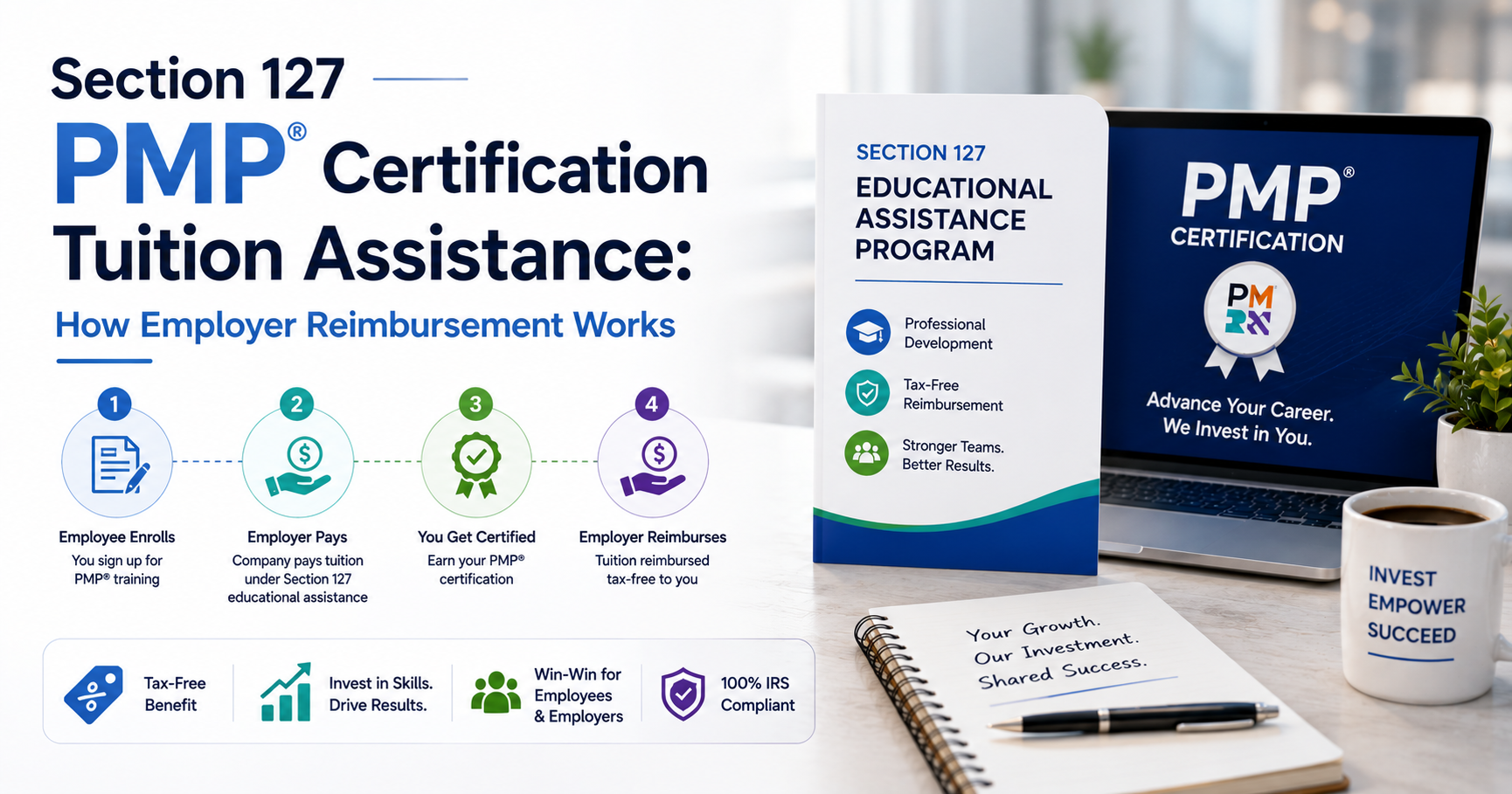
Yes, employer tuition assistance can cover PMP certification training and exam costs tax-free, provided your employer runs a qualified educational assistance programme under Internal Revenue Code Section 127. The current annual tax-free exclusion is 5,250 dollars per employee, a figure the IRS reconfirmed in its updated Section 127 guidance and which Congress made permanent, along with student loan repayment coverage, under the One Big Beautiful Bill Act (OBBBA) signed in July 2025. This is different from simply asking your manager for a favour: it requires a written plan, employer sign-off, and proper documentation, but when it exists it can wipe out federal income tax and payroll tax on the entire cost of most PMP training packages.
Key Highlights: Section 127 PMP Certification Tuition Assistance Guide
- The Section 127 tax-free limit is 5,250 dollars per employee per year, unchanged for 2025 and 2026, and set to be indexed for inflation starting in 2027 under the OBBBA.
- Qualifying expenses typically include tuition, exam fees, required books, and course materials; meals, travel, and equipment you keep afterwards generally do not qualify.
- Unlike Section 132 working-condition fringe benefits, Section 127 assistance does not need to be job-related, so PMP training can qualify even for a career-change scenario.
- A full PMP certification path, training plus PMI membership plus the exam fee, commonly runs well under the 5,250 dollar cap, meaning most candidates can have the entire cost excluded from taxable income in a single year.
- Section 127 only works if the employer has adopted a separate written plan document that meets Treasury Regulation 1.127-2; without one, reimbursement is just taxable wages.
- Unused annual limit cannot be carried over to the next year, and expenses reimbursed tax-free under Section 127 cannot also be claimed for the Lifetime Learning Credit.
- Employers weighing several PMP candidates at once often find it more efficient to buy a group training seat block directly rather than process individual reimbursements.
What Is Section 127 and Why Does It Matter for PMP Candidates?
Section 127 of the Internal Revenue Code is the provision that lets an employer pay for an employee's education and exclude that payment from the employee's taxable wages, up to an annual dollar cap. For a PMP candidate, this matters because the full certification path, the PMI-authorised training course, PMI membership, the exam fee, and study materials, can often be paid entirely through this channel rather than coming out of take-home pay or being treated as reportable income at tax time.
This is a materially different mechanism from an employer simply agreeing, informally, to "cover the cost." An informal reimbursement that is not run through a Section 127 plan is usually still taxable to the employee as supplemental wages, subject to income tax withholding, Social Security, and Medicare. A properly structured Section 127 plan removes that tax exposure entirely, which is why HR and finance teams treat it as a distinct compliance process rather than a discretionary perk.
What Is the Current Section 127 Annual Limit?
The current tax-free limit under Section 127 is 5,250 dollars per employee per calendar year, a figure confirmed in the IRS's updated frequently asked questions on educational assistance programmes. This cap has applied for years without an increase, but the OBBBA, signed into law in July 2025, changed the trajectory going forward: the law provides that the excludable amount will be adjusted for inflation for taxable years beginning after 2026, so the 5,250 dollar figure is expected to rise gradually starting in 2027 rather than remaining fixed indefinitely.
The same legislation also made permanent a feature that had previously been temporary: employers can use part or all of that 5,250 dollar annual allowance to pay an employee's qualified student loan principal and interest, not just current tuition. That provision had been set to expire at the end of 2025 after being extended by earlier COVID-era relief laws; the IRS has since removed the expiration language from its guidance, confirming the student loan repayment option is now a permanent feature of Section 127 rather than a temporary allowance.
Section 127 feature | Current status |
| Annual tax-free exclusion | 5,250 dollars per employee per year |
| Rollover of unused amount | Not permitted; the allowance resets each year |
| Inflation indexing | Begins for tax years after 2026, under the OBBBA |
| Student loan repayment coverage | Permanent, within the same 5,250 dollar cap |
| Written plan document required | Yes, per Treasury Regulation 1.127-2 |
| Overlap with Lifetime Learning Credit | Expenses paid tax-free under Section 127 cannot also be used for the credit |
What Expenses Actually Qualify for PMP Training?
Qualifying expenses under a Section 127 plan generally include tuition and course fees, required books and study materials, and supplies needed for the course, according to IRS Publication 970 on tax benefits for education. Applied to a PMP journey, this typically covers the PMI-authorised training course fee, official study guides and practice exam question banks, and, in most employer plans, the PMI certification exam fee itself, since it is a fee directly tied to completing the credential.
What does not qualify is narrower than most people expect. Meals, lodging, and transportation connected to attending a course are excluded from the tax-free benefit even when the employer voluntarily reimburses them. Equipment you keep after the course, such as a laptop, is excluded unless it is a textbook. Courses that amount to a sport, game, or hobby rather than a bona fide business-related or degree-related subject also fall outside the exclusion, though this rarely affects a professional certification like PMP.
One detail that surprises many employees: Section 127 does not require the training to be job-related at all. Payments do not have to be for work-related courses, and can even apply to a course leading to a degree, which means an employee moving into project management from an unrelated field can still have PMP training covered tax-free under an employer's Section 127 plan, something that would not be possible under the separate Section 132 working-condition fringe benefit rule, which does require the education to relate to the employee's current job.
How Much Does PMP Certification Actually Cost, and Does It Fit Under the Cap?
A realistic first-attempt PMP budget commonly falls between roughly 900 and 2,100 dollars for a PMI member, once training, membership, the exam fee, and study materials are added together, based on current published cost breakdowns from PMI-authorised training providers. PMI itself raised its exam fee in August 2026, moving the member rate to 445 dollars and the non-member rate to 675 dollars, up from 405 and 555 dollars respectively, a change also reflected in Simpliaxis's own PMP Exam Fee breakdown.
PMI membership runs roughly 139 to 160 dollars a year, and joining before registering for the exam is usually cheaper overall because the membership discount on the exam fee exceeds the cost of membership itself.
Because the Section 127 exclusion resets at 5,250 dollars every year, a single PMP certification attempt, even including a higher-end instructor-led course such as Simpliaxis's PMP Certification Training package, fits comfortably within one year's allowance for the large majority of candidates. That means an employee is not choosing between "training or exam fee" when a properly documented Section 127 plan is in place; both, plus PMI membership and study materials, can typically be covered in the same tax year without exceeding the cap.
Cost component | Typical 2026 range | Section 127 eligible |
| PMI membership (annual) | 139 to 160 dollars | Generally yes, as a required fee tied to exam eligibility discounts |
| PMP exam fee (member) | 445 dollars | Yes, in most employer plans |
| PMP exam fee (non-member) | 675 dollars | Yes, in most employer plans |
| PMI-authorised training course | 300 to 1,500 dollars | Yes, tuition and course fees are core qualifying expenses |
| Study materials and practice exams | 0 to 400 dollars | Yes, if required course materials |
| Travel or exam-day meals | Varies | No, excluded regardless of employer generosity |
How Should an Employee Request Section 127 Reimbursement from HR?
The direct answer is that an employee should confirm the plan exists, get written pre-approval before paying for or starting the course, and keep every receipt and completion record for payroll and tax documentation. Because a Section 127 exclusion depends on the employer's written plan, an employee cannot simply pay for PMP training and expect automatic tax-free treatment; the mechanics run through HR and payroll, not through a personal tax return line item.
- Ask HR whether a Section 127 plan exists. Some companies label this "tuition assistance," "tuition reimbursement," or "educational assistance program" internally; ask specifically whether it is structured under Section 127 so you know the tax treatment, not just whether a benefit exists.
- Request the plan document and eligibility rules. A qualified plan must meet Treasury Regulation 1.127-2 and cannot discriminate in favour of highly compensated employees, so eligibility is usually broad, but caps, waiting periods, or a requirement to stay employed for a set period after completion are common conditions worth confirming upfront.
- Get pre-approval before enrolling or paying. Most corporate tuition programmes, and the sample plan structure the IRS itself has published, expect the request and approval to happen before the course begins; retroactive reimbursement for a course already completed is frequently denied.
- Submit an itemised request. Include the training provider name, course dates, the PMI exam fee, membership fee if applicable, and receipts, mirroring the documentation categories used in standard tuition reimbursement request forms.
- Confirm how it will appear on your pay records. Amounts within the 5,250 dollar annual limit should not appear as additional taxable wages on your Form W-2; anything reimbursed above that limit, or reimbursed outside a qualifying plan, is added to taxable wages and subject to normal withholding.
What Happens If the Employer Has No Formal Section 127 Plan?
Without a written Section 127 plan, any employer payment toward PMP training is simply taxable compensation to the employee, added to wages and subject to income tax withholding along with Social Security and Medicare, regardless of how the payment is described internally. This is the single most important distinction between a genuine Section 127 benefit and an informal "the company will pay for it" arrangement: the tax-free treatment is not automatic just because an employer is generous, it is conditional on the formal plan structure existing.
For an employee at a company without such a plan, there are still three practical paths. The first is to ask HR to formalise a plan, since the IRS has made this easier by publishing a sample plan document that employers can adopt with minimal customisation, lowering the administrative barrier that previously discouraged smaller employers from setting one up.
The second is to see if the training can instead be justified as a Section 132 working-condition fringe benefit, which does not require a written plan but does require the training to be directly job-related, meaning an employee already working in project management has a stronger case than someone changing careers into it. The third is to accept that any reimbursement will be taxable income and factor that into the net value of the offer, since even taxed reimbursement is still meaningfully cheaper than paying entirely out of pocket.
How Does Individual Reimbursement Compare to Employer-Purchased Group Training?
When more than a handful of employees on the same team need PMP or related project management credentials, many employers find it administratively simpler and often cheaper to purchase training directly for the group rather than processing individual Section 127 reimbursements for each person.
Buying seats in a scheduled cohort, or commissioning a private cohort, shifts the invoice to the employer directly, avoids per-employee tracking against the 5,250 dollar cap, and can be negotiated at a volume rate. Organisations exploring this route for their teams can review options through Simpliaxis's Corporate Group Training programme, which is built specifically for employer-funded, organisation-wide certification training rather than individual reimbursement claims.
The trade-off is flexibility. Individual reimbursement through a Section 127 plan lets each employee choose their own training provider, schedule, and format within policy limits, while a direct group training purchase standardises the experience and timeline for everyone enrolled. Neither approach is inherently better; the right choice depends on whether the employer is funding one employee's request or building project management capability across a team.
Worked Example: What a 5,250 Dollar Allowance Actually Buys
Consider an employee whose employer has a Section 127 plan and who enrols in a PMI-authorised live online PMP course such as Simpliaxis's US PMP Certification Training programme, priced in the few-hundred to low four figures range depending on package. Add PMI membership, the member exam fee, and a practice exam bundle, and the total typically lands in the 900 to 2,100 dollar range referenced earlier in this guide.
Because that entire figure sits below the 5,250 dollar annual cap, the employee owes no federal income tax, and no Social Security or Medicare tax, on any part of the reimbursement, and the amount does not appear as additional income on the employee's Form W-2.
A full itemised comparison of what each cost component runs to is available on Simpliaxis's PMP Certification Cost page, which is a useful reference to bring into the HR conversation when itemising a reimbursement request. Compare that to the same employee paying out of pocket and later trying to claim education tax credits. Expenses covered tax-free through an employer's Section 127 plan cannot also be used to claim the Lifetime Learning Credit, so there is no way to "double dip." For most PMP candidates, the employer route, when available, is straightforwardly the better financial outcome because it removes tax exposure entirely rather than offering a partial credit against tax owed.
Scenario | Approximate cost | Tax treatment |
| Employer Section 127 plan covers full PMP path | ~900 to 2,100 dollars, within 5,250 dollar cap | Fully tax-free to employee |
| Informal employer reimbursement, no written plan | Same cost | Added to taxable wages, withholding applies |
| Employee self-pays, no employer involvement | Same cost, out of pocket | May qualify for Lifetime Learning Credit, subject to its own income and eligibility limits |
What If the Employer's Training Budget Is a Fixed Stipend Instead of a Section 127 Plan?
Some employers, instead of running a formal Section 127 plan, offer a flat annual learning and development stipend that employees can apply toward any approved course, including a PMP programme such as Simpliaxis's PMP Certification Guide resources or its training course directly. Whether that stipend is tax-free depends entirely on how the employer structures it: a stipend paid through payroll without reference to a qualifying Section 127 plan is typically treated as taxable income, while the same stipend routed through a compliant plan document retains the tax-free treatment up to the annual cap.
Employees should ask HR directly which structure applies rather than assuming a "training budget" is automatically tax-free, since the label an employer uses internally does not determine the tax outcome, the underlying plan structure does.
Conclusion
The financial case for using employer tuition assistance to fund PMP certification is strong precisely because the mechanism is tax law, not employer goodwill. When a company maintains a written Section 127 plan, an employee can typically have the entire realistic cost of PMP training, PMI membership, and the exam fee excluded from taxable income within a single year, since that total sits comfortably under the current 5,250 dollar annual cap confirmed by the IRS and locked in permanently, alongside student loan repayment coverage, by the 2025 One Big Beautiful Bill Act.
The distinction that matters most is between a formal Section 127 plan and an informal payment arrangement: only the former removes tax exposure entirely, which is why the first step for any employee is not asking a manager for money, but asking HR whether a compliant written plan exists and getting pre-approval before spending a dollar. For employers weighing whether to reimburse individuals or fund training centrally, the calculation shifts once several employees need the same credential, at which point purchasing group training directly often becomes the simpler path.






 Lowest-Price Challenge











 Personalized Path


.webp)


 USA
USA  Canada
 India
India UK
UK Australia
 Singapore


