

 Call Us



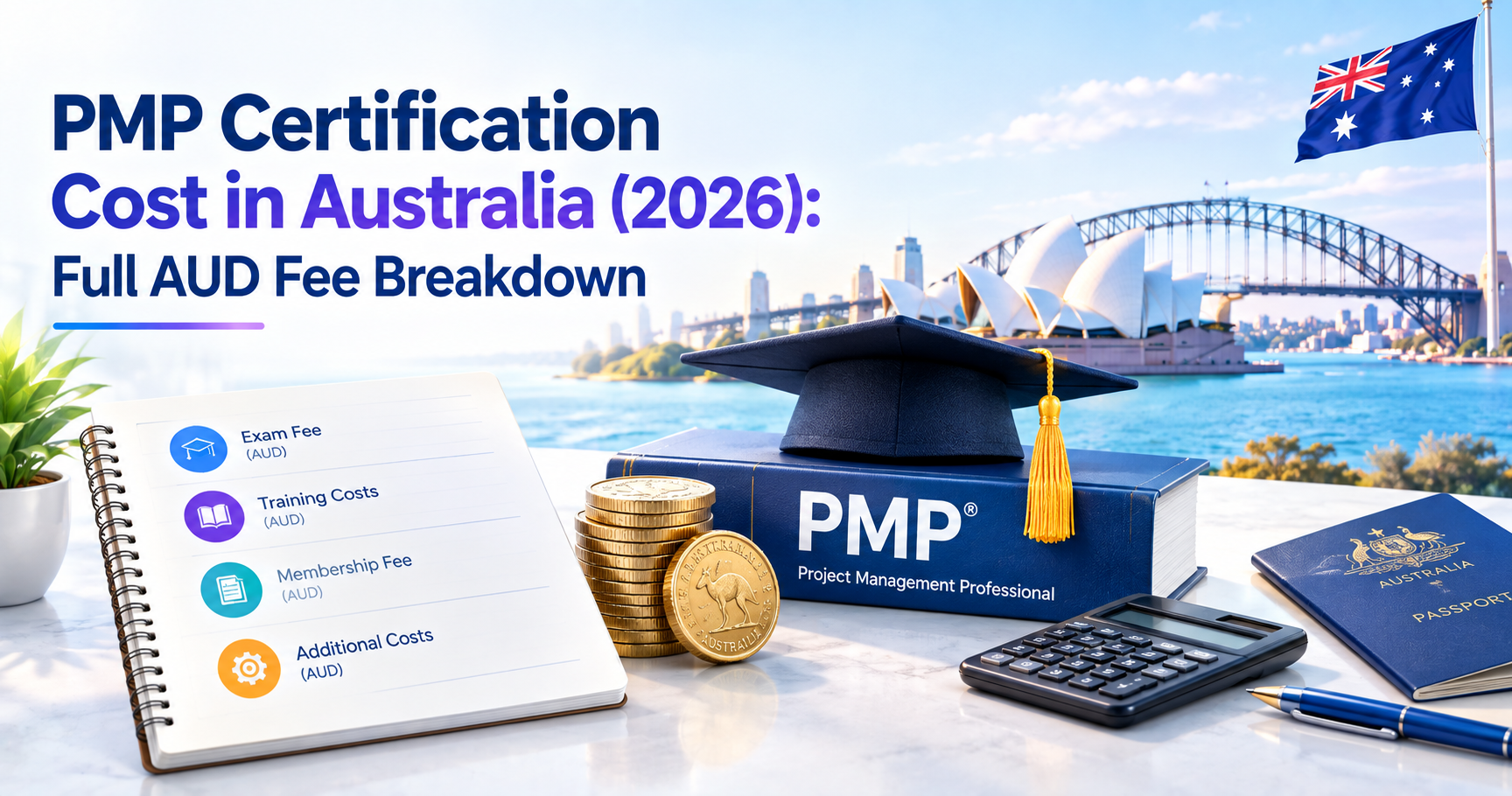
As of September 2026, the PMI exam fee for PMP certification is USD 425 for PMI members and USD 675 for non-members, which converts to roughly AUD 590 to AUD 945 depending on the exchange rate applied on the day of payment. Add PMI membership, which runs about USD 164 in the first year, or roughly AUD 230, plus Australian training fees that typically range from AUD 700 for self-paced courses to AUD 3,500 or more for classroom bootcamps in Sydney or Melbourne, and most Australian candidates should budget between AUD 1,500 and AUD 4,000 for the complete certification. Renewing PMP certification every three years adds a further AUD 84 to AUD 210 in PMI fees, plus whatever it costs to earn the required 60 PDUs.
Key Highlights
- The PMI exam fee rose on 6 August 2026 to USD 425 for members and USD 675 for non-members, widening the member versus non-member gap to USD 250, which is now larger than a full year of PMI membership.
- At typical September 2026 exchange rates, around 1 USD to 1.40 AUD, the exam alone costs roughly AUD 590 for members and AUD 945 for non-members, before any card foreign transaction fee.
- PMI membership costs USD 164 in the first year, including a one-off USD 10 application fee, then USD 149 to renew annually, working out to roughly AUD 210 to AUD 230.
- Formal PMP training in Australia ranges from around AUD 700 to AUD 1,200 for self-paced online courses up to AUD 2,000 to AUD 3,500 or more for in-person classroom bootcamps.
- A realistic all-in budget for a PMI member sitting the exam once, including membership, the exam fee and a live online course, sits between roughly AUD 2,050 and AUD 3,050.
- PMP renewal costs USD 60 for members and USD 150 for non-members every three years, on top of the effort of earning 60 PDUs during that cycle.
- Organisations certifying several staff at once can usually negotiate lower per-seat training pricing through corporate and group training arrangements rather than paying individual course fees one at a time.
How Much Does the PMP Exam Cost in Australia in 2026?
The PMP exam itself costs USD 425 for PMI members and USD 675 for non-members, following the fee change PMI applied on 6 August 2026. Because PMI bills every candidate in US dollars regardless of where they sit the exam, Australian candidates pay whatever this converts to in AUD on the day their card is charged. There is no separate, lower "Australian price" for the PMP exam. The figure that lands on your statement depends on the exchange rate your bank applies at the moment of the transaction and, in many cases, a foreign transaction fee of around 2 to 3 per cent that some Australian cards and accounts charge on any USD purchase.
The table below sets out the current USD fees alongside an indicative AUD estimate. These AUD figures are not official PMI numbers; PMI does not publish an AUD price list. They are an estimate based on a prevailing USD to AUD rate of approximately 1:1.40 in September 2026, and the actual amount you pay will move with the exchange rate on your payment date.
| Fee Type | USD Amount | Approx. AUD Estimate | Notes |
| PMP exam, PMI member | $425 | ~AUD 590 | Paid to PMI once your application is approved |
| PMP exam, non-member | $675 | ~AUD 945 | No PMI membership required first |
| PMP retake, PMI member | $275 | ~AUD 385 | Up to three attempts within one eligibility period |
| PMP retake, non-member | $375 | ~AUD 525 | Same eligibility period rules apply |
Candidates who paid before 6 August 2026 locked in the previous, lower fee schedule. Anyone registering after that date is on the current schedule shown above. For a fuller history of exactly what changed and why, Simpliaxis has published a dedicatedPMP exam fee increase breakdownthat tracks the old and new fee tiers side by side.
Is PMI Membership Worth It for Australian Candidates?
Yes, for almost every Australian candidate planning to sit the PMP exam, PMI membership pays for itself the first time you register. JoiningPMI costs USD 164 in the first year, which includes a one-off USD 10 application fee on top of the USD 154 membership dues, and then USD 149 per year after that. Once you are a member, the PMP exam costs USD 425 instead of USD 675.
Run the numbers, and the case is clear. A non-member pays USD 675 for the exam and nothing else. A member pays USD 164 to join plus USD 425 for the exam, a combined USD 589, which is USD 86 cheaper even in year one, before counting anything else membership includes. In AUD terms at current rates, that is a saving of roughly AUD 90, purely from the exam transaction itself.
| Path | Membership (USD) | Exam Fee (USD) | Total (USD) |
| Non-member | $0 | $675 | $675 |
| PMI member | $164 | $425 | $589 |
Beyond the raw arithmetic, membership also unlocks a free digital copy of the PMBOK Guide and related standards, discounted access to PMI templates and webinars that count towards PDUs later, and, for many Australian candidates, access to a local PMI chapter such as PMI Sydney, PMI Melbourne or PMI Canberra for networking and study groups. The saving repeats at renewal time too: a member pays USD 60 to renew certification every three years against USD 150 for a non-member, so staying a member through your full career as a certified PMP compounds the original saving rather than being a one-off benefit.
What Does PMP Training Cost in Australia?
PMP training in Australia is priced across four broad formats, and the gap between the cheapest and most expensive option is wide enough that format choice is usually the single biggest lever in your total budget. Self-paced online courses sit at the bottom of the market, live online instructor-led courses sit in the middle, in-person classroom bootcamps in cities such as Sydney, Melbourne, Brisbane, Perth and Canberra sit at the top, and corporate or group cohorts sit outside this ladder entirely because pricing is negotiated per organisation rather than published as a fixed rate.
| Training Format | Typical AUD Price Range | Best Suited To |
| Self-paced / on-demand video | AUD 700 to AUD 1,200 | Disciplined self-learners on a tight budget |
| Live online, instructor-led | AUD 1,200 to AUD 2,200 | Working professionals who need structure with flexibility |
| In-person classroom bootcamp | AUD 2,000 to AUD 3,500+ | Candidates who want an intensive, coach-led week |
| Corporate / group cohort | Custom quote, typically 15 to 30 per cent lower per seat | Organisations certifying three or more staff together |
Candidates evaluating options directly can see how this plays out on Simpliaxis's own PMP certification training in Australia page, which lists live online and city-specific delivery, including a dedicated course page for candidates based in and around Sydney.
Organisations sending multiple project managers, or an entire PMO team, through PMP certification rarely pay the individual list price shown above. Providers such as Simpliaxis run dedicated corporate and group training programmes that let PMO and learning and development managers batch-book a cohort, negotiate per-seat pricing and align delivery dates across a whole team, which is usually the most cost-efficient route once three or more staff need certifying within the same cycle. Whatever format you choose, remember that the 35 contact hours PMI requires must come from an authorised training source; a cheaper unaccredited course that PMI will not accept at application review is not actually cheaper once you account for the wasted spend.
Price alone rarely tells the full story either. Two courses quoted at a similar AUD figure can differ substantially in what is actually included, so it is worth checking whether the quoted price covers the full 35 contact hours needed for your PMI application, a current mock exam question bank, an instructor you can actually ask questions of rather than a pre-recorded voiceover, and any post-course access to recordings or updated content if the exam outline changes again. A slightly higher headline price that includes all of this is often better value than a lower one that leaves you paying separately for materials later.
Total Cost of PMP Certification in Australia: The Full Budget Table
Combining the PMI exam fee, PMI membership and training, most Australian candidates should budget somewhere between AUD 1,500 and AUD 4,350 for a complete first-time PMP certification, depending entirely on which training format they choose. The table below lays out four realistic scenarios so you can see where your own plan is likely to land.
| Scenario | Membership | Exam Fee | Training | Estimated Total (AUD) |
| Budget: member, self-paced training | ~AUD 230 | ~AUD 590 | AUD 700 to 1,200 | ~AUD 1,550 to 2,050 |
| Mid-range: member, live online training | ~AUD 230 | ~AUD 590 | AUD 1,200 to 2,200 | ~AUD 2,050 to 3,050 |
| Premium: member, classroom bootcamp | ~AUD 230 | ~AUD 590 | AUD 2,000 to 3,500 | ~AUD 2,850 to 4,350 |
| Non-member, self-paced training | AUD 0 | ~AUD 945 | AUD 700 to 1,200 | ~AUD 1,645 to 2,145 |
Notice that the non-member, self-paced row is not actually the cheapest option overall, despite skipping the membership fee. This is a direct consequence of the widened member versus non-member exam fee gap discussed earlier: paying for membership first almost always brings the total down rather than up. These figures exclude optional extras such as printed study guides bought separately from a course, mock exam question banks not bundled into the course price, a retake fee if a second attempt is needed, and any travel or accommodation cost if you attend an in-person session outside your home city. For a broader, non-Australia-specific view of how these numbers compare globally, Simpliaxis maintains a general PMP certification cost reference that breaks down exam and training fees across multiple countries.
Currency, GST and Payment Considerations for Australian Candidates
Because PMI is a US-headquartered body, every PMP exam and membership payment is billed in US dollars, so the amount that actually lands on an Australian candidate's card statement depends on the exchange rate applied that day plus any margin the card issuer adds. Many Australian debit and credit cards charge a foreign transaction fee of around 2 to 3 per cent on USD purchases, which quietly adds another AUD 15 to AUD 25 on top of the exam fee alone. Paying with a low-FX-fee card, a multi-currency travel card, or a provider that passes through the mid-market rate can shave a small but real amount off the total, and it is worth checking before you enter your card details on PMI's site.
GST works differently and applies to a different part of the bill. Australia's Goods and Services Tax adds 10 per cent to most goods and services sold domestically, and PMP exam-prep training delivered by an Australian-based provider is generally treated as a taxable supply rather than a GST-free education course, because it does not fall under the specific exemptions that apply to recognised tertiary or vocational qualifications. In practice, this means the AUD training price you are quoted by a local provider may be shown inclusive or exclusive of GST, and that distinction alone can shift your real cost by 10 per cent, so it is worth confirming which basis a quote uses before you compare providers. This is a separate question from the tax treatment of the PMI exam and membership fees themselves, which are paid directly to a US entity and do not carry Australian GST in the way a local invoice would. For a general explanation of how GST applies to training and education services in Australia, see thisGST and education sector guide.
Some Australian candidates can also claim eligible self-education expenses, potentially including PMP training costs, as a tax deduction where the certification is sufficiently connected to their current role, which effectively lowers the net cost after tax. The rules around what qualifies are specific enough that this article treats it only as a cost-offset lever to be aware of, not as a guaranteed discount, since the detailed eligibility criteria sit outside a straightforward fee breakdown.
One further practical point worth budgeting for is timing risk around exchange rate movement. Because the exam fee, membership fee and any USD-denominated study materials are all charged at the point of transaction, a candidate who registers today and one who registers in three months could end up paying noticeably different AUD amounts for the exact same USD fee if the exchange rate shifts in that window. There is no way to lock in a rate with PMI directly, so the practical response is simply to treat the AUD figures in this guide as a planning estimate, check the live rate on the day you intend to pay, and avoid registering right before you know a payment is due if the rate happens to be unusually unfavourable that week.
How to Reduce Your PMP Certification Cost in Australia?
Australian candidates who plan the order of their spending can lower their total PMP outlay by several hundred dollars without cutting corners on preparation. The sequence below reflects the order most candidates should actually work through it in.
- Join PMI before you register for the exam. Paying the USD 164 first-year membership fee before booking turns a USD 675 non-member exam charge into a USD 589 member-path total, and it unlocks a digital PMBOK Guide and templates you would otherwise have to buy separately.
- Get your 35 contact hours from one accredited course. PMI requires 35 hours of project management education from an authorised source, and buying one properly accredited course rather than stitching together cheaper, unaccredited content avoids wasted spend on material PMI will not accept when it reviews your application.
- Match the training format to your own study discipline. A self-paced course only saves money if you actually finish it. Candidates who need external structure often end up spending less overall by paying more for a live cohort and passing on the first attempt, because a retake adds a further USD 275 to USD 375 to the bill.
- Ask your employer about funding before paying out of pocket. Many Australian employers will cover part or all of PMP training and the exam fee as professional development, particularly when it is requested through a learning and development budget in advance rather than raised as a reimbursement after the fact.
- Use corporate or group training if you are certifying a team. PMO and L&D managers coordinating three or more candidates typically secure a lower per-seat rate and shared scheduling through a dedicated corporate and group training programme, rather than paying each person's individual course fee separately.
- Treat the first attempt as the only attempt you plan for. The single biggest avoidable cost in this entire budget is a retake, so use your 35 hours of accredited training and PMI's published exam content outline as the minimum standard of preparation, not the ceiling.
PMP Renewal and PDU Costs: The Ongoing Investment After Certification
PMP certification is not a one-off purchase. It must be renewed every three years by earning 60 professional development units, known as PDUs, and then paying a renewal fee of USD 60 for PMI members or USD 150 for non-members, which works out to roughly AUD 84 to AUD 210 at current exchange rates. This three-year window is called the Continuing Certification Requirements, or CCR, cycle, and it starts on the day you pass the PMP exam.
PMI will not let you pay the renewal fee early or on a partial basis. The payment option only appears on your dashboard once the system confirms all 60 PDUs have been logged for that cycle, so the fee and the education effort are tied together rather than being separate decisions. PDUs themselves can be earned at no direct cost through options such as volunteering for a PMI chapter, giving presentations, or attending free PMI webinars, or through paid routes such as formal courses, conference attendance and additional accredited training, so the real cost of the "education" side of renewal varies enormously depending on how you choose to earn your hours.
The membership maths from earlier in this guide compounds here too. Staying a PMI member through your renewal cycle costs USD 149 a year in dues but saves USD 90 on the renewal fee alone every three years compared with letting membership lapse, on top of ongoing access to free PDU-eligible webinars that make the 60-hour requirement easier to hit without additional spend. For Australian candidates weighing whether the ongoing certification maintenance cost is worth it against typical local project management salaries, Simpliaxis's separate PMP salary in Australiaresource sets out current pay benchmarks by city and role.
Conclusion
The honest answer to "how much does PMP certification cost in Australia" is that the PMI fee side of the equation is fixed and published in US dollars, while the training side is genuinely negotiable and format-dependent, and the two combine differently depending on decisions you make before you ever sit the exam. Joining PMI ahead of registering, choosing a training format that matches how you actually study rather than the cheapest one on paper, and treating a first-attempt pass as non-negotiable are what separate a candidate who spends close to AUD 1,550 to AUD 2,050 in a well-run budget scenario from one who spends AUD 4,000 or more after a retake and an unnecessary lapse in membership. For individuals, that means running the exact numbers in this guide against your own study style before committing to a course. For PMOs and L&D teams funding several staff at once, it means the per-seat economics of group training change the calculation entirely, which is exactly the scenario corporate and group training arrangements exist to solve. Either way, the total PMP certification cost in Australia in 2026 is manageable and predictable once you separate what PMI charges from what your training provider charges, and budget for both with a realistic exchange rate and GST position rather than a single headline number.







 Lowest-Price Challenge











 Personalized Path


.webp)


 USA
USA  Canada
 India
India UK
UK Australia
 Singapore


