


 Call Us



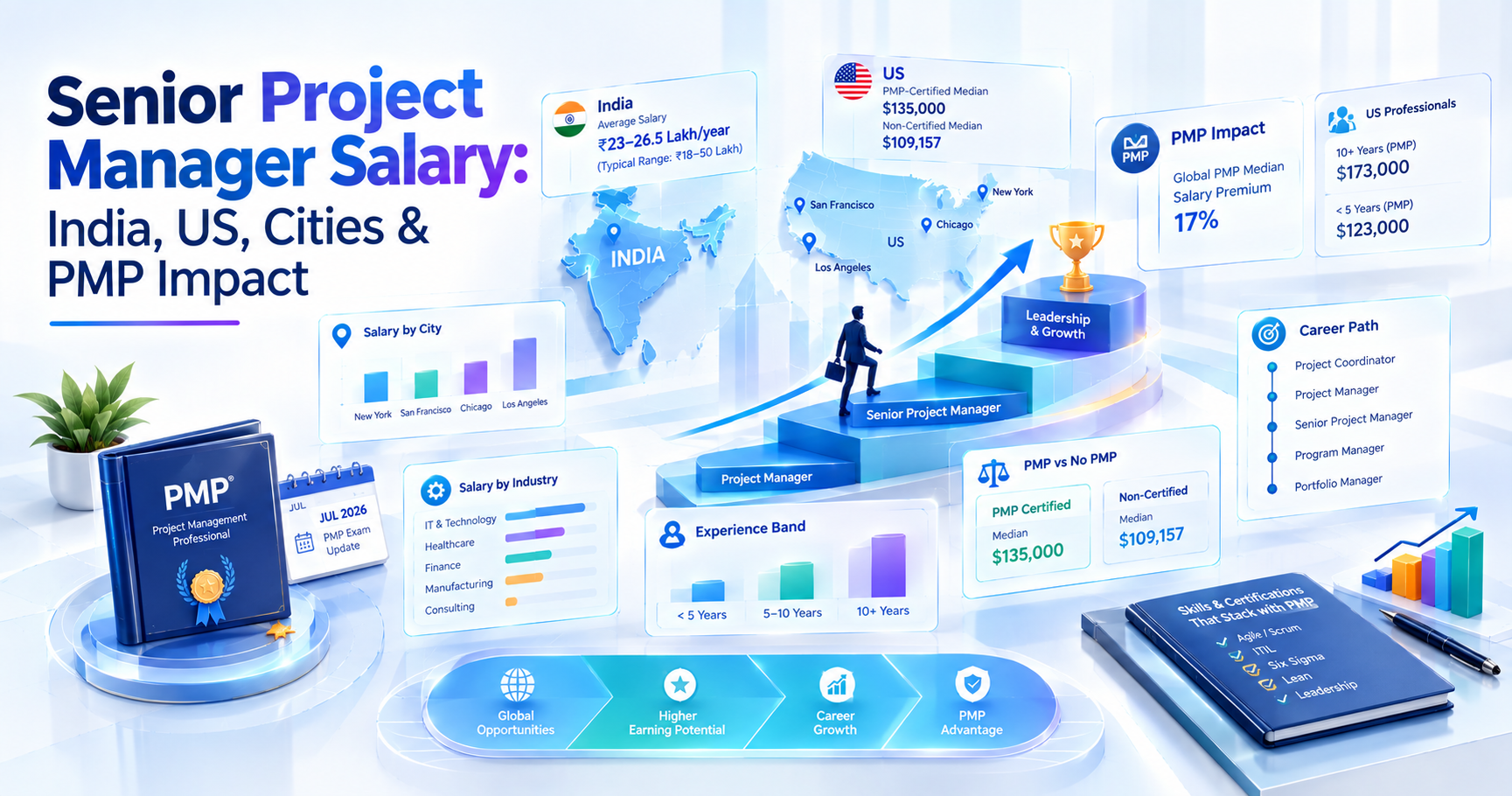
A senior project manager in India earns an average of ₹23-26.5 lakh per year, with a typical range of ₹18-50 lakh depending on city, industry, and employer, according to Glassdoor and PayScale 2026 data. PMP certified salary data also shows a measurable premium, with PMI reporting higher median earnings for PMP-certified professionals. Globally, PMI's 14th edition Earning Power Salary Survey found PMP-certified professionals earn a 17% higher median salary than non-certified peers, with the US median for certified holders reaching $135,000.
Key Highlights of Senior Project Manager Salary:
- ₹23-26.5 lakh average senior project manager salary in India (Glassdoor/PayScale, 2026)
- $135,000 US median salary for PMP-certified professionals vs. $109,157 for non-certified (PMI 14th Edition Salary Survey, Nov 2025)
- 17% global median salary premium for PMP certification across 21 countries surveyed
- $173,000 median for US professionals PMP-certified 10+ years, vs. $123,000 for those certified under 5 years
- 60% weighting on Business Environment + Process domains under the new July 2026 ECO, reflecting the business-judgment skills senior roles actually pay for
- Typical career runway: 5+ years of PM experience before "senior" titling, per multiple industry job-description sources
If you've searched for "senior project manager salary," you're probably trying to answer one of two questions. Either you want to know if your current pay is fair, or you're deciding whether the jump to "senior" is worth chasing, and whether a credential like PMP actually moves the needle or just looks good on LinkedIn.
Both are reasonable questions, and both deserve a real answer instead of a vague "it depends." So this article does two things. First, it lays out what senior project managers actually earn, in India and globally, using named salary-survey sources rather than guesswork. Second, it walks through exactly why PMP certification correlates with higher pay at this level, what changed in the exam itself as of July 2026, and what a realistic timeline looks like if you're starting from where you are today.
What Does "Senior Project Manager" Actually Mean?
A senior project manager isn't just a project manager with a longer job title. The role typically means you're trusted with larger budgets, more complex or higher-risk projects, and often a mentoring responsibility over junior PMs. You're expected to work with less oversight, make judgment calls under ambiguity, and speak the language of business outcomes, not just task lists.
That distinction matters for salary, because pay isn't rising just because you've survived more years in the chair. It rises because the scope of what you're trusted to own has expanded. Most job descriptions for the role ask for five or more years of hands-on project management experience, a track record of delivering complex or cross-functional projects, and increasingly, a recognized certification like PMP as either a requirement or a strong preference.
Senior Project Manager Salary in India: The Real Numbers
Let's start with the number most Indian readers actually want.
According to Glassdoor's 2026 India data, the average salary for a Senior Project Manager is approximately ₹26.5 lakh per year, with a typical range between ₹16 lakh (25th percentile) and ₹34 lakh (75th percentile), and top earners reporting up to ₹45 lakh. PayScale's India-specific data for Senior Project Manager, IT roles puts the average closer to ₹25.6 lakh. A third estimate places the average around ₹23 lakh, with 70% of reported salaries falling between ₹18 lakh and ₹50 lakh. Taken together, a realistic working number for India in 2026 is an average in the ₹23-26.5 lakh range, with real variation depending on where you work and in which industry.
By City
City | Typical Range (per year) | Notes |
| Bangalore | ₹17-32.5 lakh | Highest concentration of senior PM roles nationally; IT and product-heavy market |
| Hyderabad | ₹19.5-29 lakh | Growing PMO and GCC (global capability center) demand |
| Mumbai | ₹18.25-28 lakh | BFSI and consulting-heavy senior PM demand |
| Pune | ₹19-31.5 lakh | Manufacturing and IT mix |
| Delhi NCR | ₹18.6-27.5 lakh | Strong government, infrastructure, and corporate demand |
Tier-1 cities generally pay 30-50% more than Tier-2 cities for the same title, largely reflecting cost of living and the concentration of large enterprises and global capability centers.
By Industry
Industry matters as much as city, and the gap between sectors is often wider than the gap between cities.
- IT and software: Consistently at the top of the range, with senior PM salaries starting around ₹15 lakh and climbing past ₹30 lakh for professionals managing large product or platform delivery. Major IT services employers report average project management salaries in the ₹15-19 lakh band, with senior and principal-level roles well above that.
- BFSI (banking, financial services, insurance): A close second, particularly for PMs who can speak to regulatory and compliance-heavy delivery. Salary bands here often run from ₹6 lakh at entry level up to ₹32 lakh for senior roles managing digital transformation or core banking migrations.
- Pharmaceuticals and healthcare: Regulatory stakes are high, and so is the pay. Reported ranges run from ₹5 lakh to ₹33 lakh, with an average closer to ₹19 lakh, reflecting the complexity of managing clinical, manufacturing, or compliance-driven projects.
- Construction and engineering: Large infrastructure projects can pay well above the sector median, with reported ranges of ₹5.9-30 lakh and an average around ₹18 lakh, though this sector tends to reward specialized technical certifications alongside PMP more than pure tenure.
- Manufacturing: Generally the most conservative of the major sectors, with ranges around ₹5.4-31 lakh and an average near ₹17.7 lakh, though automation and Industry 4.0 initiatives are pushing senior PM demand and pay upward in this space.
The practical takeaway: if you're benchmarking your own offer, compare within your industry first. A ₹22 lakh offer might be strong in manufacturing and merely average in IT. For a wider view of which titles and sectors top the pay scale,Highest Paying Project Management Jobs is a useful cross-check.
By Experience Band
- 5-7 years: Entry into "senior" titling, typically ₹14-18 lakh
- 8-10 years: ₹18-24 lakh, with PMP-certified professionals trending toward the higher end
- 10+ years: ₹20-35 lakh+, with the ceiling largely set by industry and company size rather than tenure alone
Senior Project Manager Salary Globally: US and Beyond
If you're benchmarking against the US market or considering a global role, the picture shifts in absolute dollar terms but tells a similar relative story.
PMI's most recent Earning Power: Project Management Salary Survey (14th edition, published November 2025, based on 14,628 respondents across 21 countries) found that PMP-certified professionals in the US reported a median salary of $135,000, compared to $109,157 for non-certified professionals, a difference of nearly 24%. For context, that's more than 60% above the US median household income at the time of the survey. Professionals certified for more than 10 years reported an even wider gap, with a median salary of $173,000, compared to $123,000 for those certified less than five years.
City-specific data reinforces this. In Houston, for example, senior project managers average $144,015 per year, with PMO managers and directors earning $171,408 and $187,480 respectively, according to Simpliaxis's own market research on Houston's energy-sector PM roles.
Globally, across all 21 countries surveyed, PMP-certified respondents reported a 17% higher median salary than their non-certified peers. That premium isn't uniform. It has ranged higher in some markets in past survey editions (for instance, the 13th edition noted premiums exceeding 30% in countries like Colombia and South Africa), which tells you the certification effect is real but shaped heavily by local market dynamics.
Senior Project Manager Salary and the PMP Certification Connection
Here's the part most salary round-ups skip: why does a certification move a title-based salary number at all? For the broader, certification-wide view of this question rather than the senior-title-specific numbers covered here, Simpliaxis'sPMP Certified Salary breakdown is a useful companion read.
What PMI's Latest Salary Survey Actually Found
The 14th edition survey is PMI's most current word on this, and it's unambiguous on direction, even if the exact percentage varies by country and role. PMP-certified professionals reported not just a wage premium, but faster raises: nearly two-thirds of certified respondents reported a compensation increase in the past 12 months, and three-quarters of those received raises of 5% or more.
Why the Premium Exists
It's tempting to think of PMP as a line on a resume that recruiters reward on sight. That's part of it, but not the whole story. The more useful way to think about it: the PMP exam itself has shifted toward exactly the skills senior roles are paid for.
The July 2026 update to PMI's Examination Content Outline (ECO) rebalanced the exam's three domains. People dropped from 42% to 33% of the exam, Process dropped from 50% to 41%, and Business Environment jumped from 8% to 26%, the largest structural shift in the exam's history. That Business Environment domain now covers financial management (NPV, IRR, benefit-cost ratios), strategic alignment, sustainability, and organizational change management, precisely the vocabulary a senior project manager is expected to use with executives and finance teams.
In other words, the certification isn't rewarded because it's a hoop to jump through. It's rewarded because passing it now more closely mirrors the judgment a senior role actually requires.
How Long Does It Take to Reach This Salary Band?
There's no single formula, but the typical path looks like this:
- Build a genuine track record first (years 0-3). Most PMP eligibility paths require real project-leading experience before you can even apply, 36 months with a four-year degree, or 60 months without one, within a defined window. This stage is about substance, not paperwork.
- Complete your 35 hours of project management education (any point before applying). This is a flat requirement across every eligibility path (the one exception: holding an active CAPM certification satisfies it automatically). A structured, PMI Authorized Training Partner course, like Simpliaxis'sPMP Certification Training, covers this requirement in one sitting rather than assembling scattered hours.
- Apply and pass the PMP exam (typically a 2-4 month runway from application to exam day). PMI allows up to three attempts within a one-year eligibility window if you don't pass on the first try.
- Use the certification actively for 2-3 years before expecting the full salary effect. PMI's own data shows the gap between "certified under 5 years" ($123,000 median in the US) and "certified 10+ years" ($173,000 median) is substantial, the credential compounds with continued, demonstrated delivery, not on the day you pass the exam.
- Target roles and internal moves that specifically use "senior" in the title, since salary bands are frequently tied to formal leveling structures, not informal seniority.
Realistically, for someone with 4-5 years of solid PM experience, a focused PMP certification effort can meaningfully shorten the path to a senior-level offer or promotion within 12-18 months, though this varies by employer, industry, and internal promotion cycles.
PMP vs. No PMP: A Side-by-Side Comparison
Factor | Without PMP | With PMP |
| US median salary (certified vs. not, PMI 14th Ed.) | $109,157 | $135,000 |
| Global median salary premium | Baseline | 0.17 |
| Typical hiring screen for senior/PMO roles | Often "nice to have" | Increasingly a stated requirement, especially at large enterprises and MNCs |
| Exam-aligned skill set | Not formally validated | Validated across People, Process, and Business Environment domains |
| Renewal requirement | None | 60 PDUs every 3 years, keeping skills current |
| Career mobility (Program/Portfolio roles) | Possible but less structured | Recognized stepping stone toward PgMP®/PfMP® tracks |
What the July 2026 PMP Exam Update Means for Senior-Level Candidates
If you're already experienced and considering the exam now, the timing is worth understanding rather than worrying about. PMI updated the PMP exam on July 9, 2026, shifting emphasis toward AI, sustainability, and outcomes-based project leadership, alongside the domain reweighting described above.
PMI has been clear that core principles haven't changed. Candidates already studying older materials can continue, since the underlying frameworks are the same. But the exam now leans further into the strategic, business-facing skills that senior roles are actually evaluated on. For someone targeting a senior title, that's a reason to lean into the updated Business Environment content, not a reason to delay.
5 Ways to Move Your Salary Toward the Senior Bracket Faster
- Get certified with a structured, live-instructor program rather than self-study alone. Live, PMI Authorized Training Partner programs (such as Simpliaxis's 35-hour, live online PMP training) combine the required contact hours with exam-specific practice, which tends to compress prep time versus scattered self-study.
- Take ownership of at least one cross-functional or high-visibility project before your next review cycle, title changes tend to follow demonstrated scope, not just tenure.
- Learn to speak in financial terms. With Business Environment now worth 26% of the PMP exam, fluency in NPV, ROI, and benefit-cost framing isn't just exam prep, it's the language senior stakeholders expect.
- Benchmark your city and industry specifically, not a national average. The gap between a Bangalore IT senior PM and a Tier-2 manufacturing senior PM can be ₹10+ lakh; know which market you're actually in before you negotiate.
- Ask about PMO or program-adjacent responsibilities. Program Manager and PMO roles often sit one rung above Senior Project Manager on the pay ladder, and PMP is frequently the credential that opens that conversation. If that's a path you're considering,Program Manager Salary breaks down what that next step typically pays.
Skills and Certifications That Stack With PMP
PMP is rarely the only factor in a senior-level offer, and it's worth knowing what else employers are willing to pay for on top of it.
Reported India data shows Agile-adjacent certifications carrying a meaningful premium of their own: professionals with Agile software development skills report average salaries around ₹20.4 lakh, and certified ScrumMasters report a similar ₹20.5 lakh average, according to industry salary aggregations. Since the PMP exam itself now weights predictive approaches at roughly 40% and agile/hybrid approaches at roughly 60%, a PM who holds both PMP and an Agile-specific credential (such as PMI-ACP) is typically better positioned for senior hybrid-delivery roles than someone with either credential alone.
Beyond certifications, three skill areas consistently show up in higher-paying senior postings: financial literacy (budgeting, forecasting, ROI-based prioritization), stakeholder communication at the executive level, and tool proficiency in enterprise platforms like MS Project, Jira, or Primavera P6 for regulated industries like construction. None of these replace PMP, but they compound with it, which is part of why the certification's salary effect tends to grow over time rather than appear as a single jump on the day you pass the exam.
Common Mistakes That Keep PMs Stuck Below the Senior Salary Band
A few patterns show up repeatedly among PMs who plateau below the senior salary band.
- Relying on tenure alone. Years in the role matter less than the visible scope of what you've owned. A PM with seven years of experience managing the same mid-size project repeatedly often earns less than one with five years who has taken on one genuinely complex, cross-functional initiative.
- Treating certification as a one-time checkbox. PMP is not "pass once, done forever." The 60-PDU renewal requirement every three years exists precisely because PMI expects certified professionals to keep learning, and employers increasingly notice whether a certification is active and current or lapsed. Simpliaxis'sFAQs on PMP Certification covers the exact renewal fee structure if you want the specifics ahead of time.
- Negotiating against a national average. As the city and industry tables above show, "the average senior PM salary" can vary by ₹15 lakh or more depending on where you sit. Walking into a negotiation with a national figure instead of your specific city-and-industry benchmark weakens your position before you start.
- Waiting for a promotion to formalize before investing in skills. Most professionals who move into senior roles were already operating at that level informally before the title caught up. Building the financial and stakeholder-management fluency the new ECO emphasizes before you're asked to is what makes the formal promotion conversation easier, not the other way around.
Avoiding these four patterns is often as valuable to your long-term salary trajectory as the certification itself.
Is PMP Worth It If You're Already Senior?
Pros:
- Formal validation that can support promotion or internal leveling conversations
- Renewal requirement (PDUs) keeps your skills documented and current
- Recognized stepping stone toward Program (PgMP®) or Portfolio (PfMP®) certifications, which sit above Senior Project Manager on most career ladders
- Global portability if you're considering international or MNC roles
Cons:
- If your organization doesn't formally recognize certifications in its leveling structure, the salary effect may be slower to materialize
- Requires an upfront time and cost investment (35 hours of training, exam fee, prep time) before any payoff
- Not a substitute for demonstrated delivery: PMI's own data shows the largest gains accrue to those certified 10+ years, not those who just passed
For most professionals already at the "senior" title with several years of tenure, the honest answer is that PMP still adds value, primarily through renewal-driven currency, wider role eligibility, and a credential that travels with you if you change employers or countries, but it works best paired with continued delivery, not as a standalone lever.
Conclusion
The numbers make the case on their own: a senior project manager in India earns ₹23-26.5 lakh on average, PMP-certified professionals earn a documented 17% premium globally, and the July 2026 exam update has pushed the certification even closer to the actual, day-to-day judgment senior roles require. None of that guarantees a title change overnight. What it does is give you a sourced, realistic benchmark to negotiate against and a concrete set of levers, from closing your financial-fluency gap to pairing PMP with a complementary credential like PMI-ACP, that actually move you toward that salary band rather than just waiting for tenure to do it for you.
And if you're weighing PMP against a Scrum or Agile-first path,this comparison of Scrum Master vs. PMP salary potential is worth a read before you commit. When you're ready to move forward, you cancheck current PMP training schedules directly.







 Lowest-Price Challenge











 Personalized Path


.webp)


 USA
USA  Canada
 India
India UK
UK Australia
 Singapore


