


 Call Us



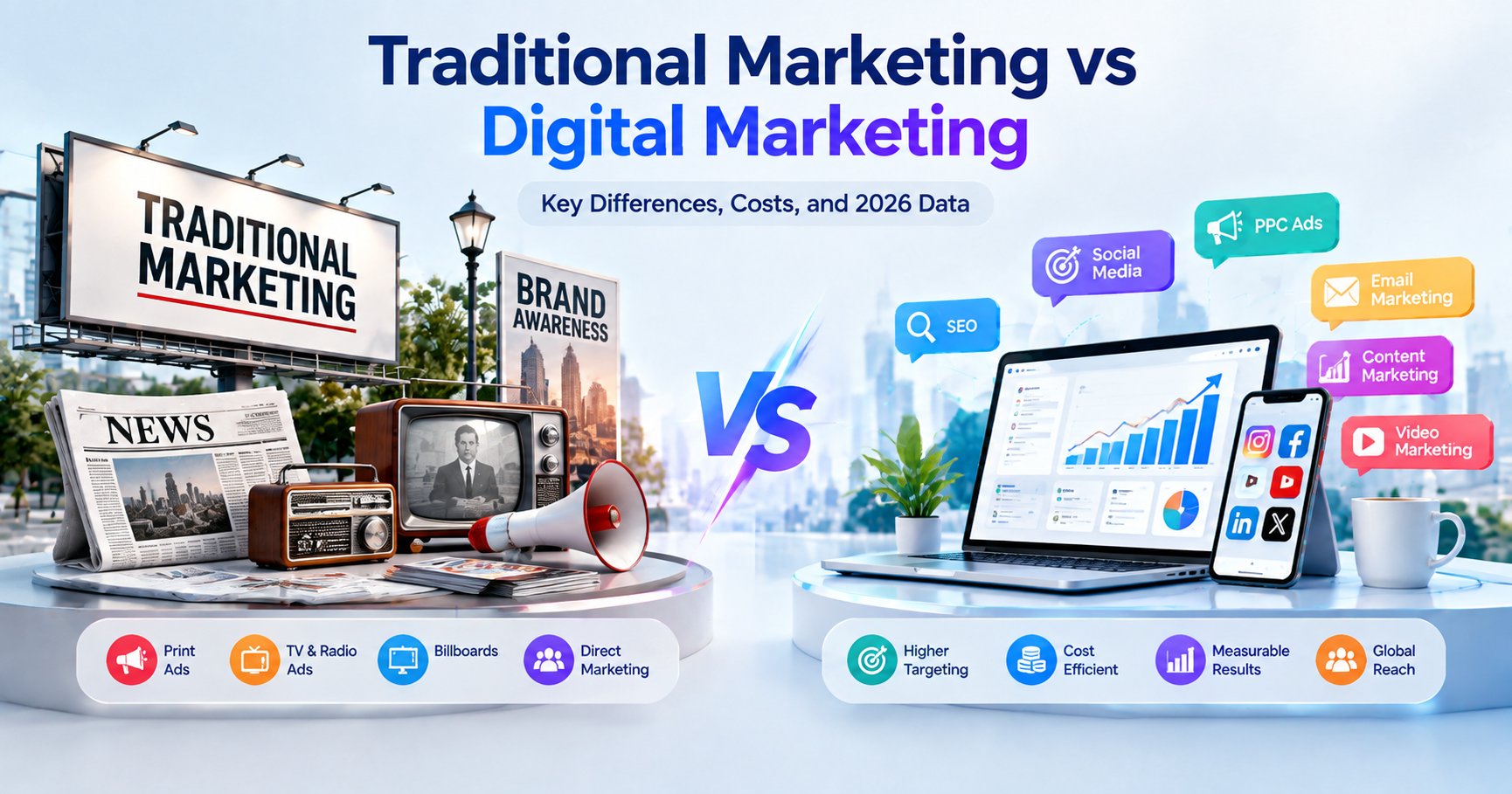
Traditional marketing uses offline channels such as television, radio, print, direct mail, billboards, and in-person events to reach broad, often local audiences, while digital marketing uses online channels such as search, social media, email, and video to reach audiences with precise targeting and real-time analytics. Digital marketing now accounts for roughly 82 percent of total U.S. ad spend, while traditional advertising has fallen to under 4 percent of average marketing budgets, according to Gartner's 2026 CMO Spend Survey. Neither approach is universally "better": traditional marketing still wins on broad reach, memorability, and trust with older audiences, while digital marketing wins on cost efficiency, targeting, and measurable ROI. Most successful brands now run an integrated strategy that blends both.
Key Highlights of Traditional Marketing vs Digital Marketing
- Digital ad revenue in the United States hit $294.6 billion in 2025, up 13.9 percent year over year, according to the IAB/PwC Internet Advertising Revenue Report.
- Total U.S. ad spend is forecast to reach roughly $500.98 billion in 2026, with digital channels representing about 82 percent of that figure.
- Gartner's 2026 CMO Spend Survey found traditional advertising has fallen to just 3.8 percent of marketing budgets, while digital media now accounts for more than two-thirds of total media investment.
- Traditional media still commands consumer trust in specific demographics: people 50 and older remain far more likely to get news from television and print than from social media, per Pew Research Center.
- Word of mouth remains the most trusted form of promotion of all, traditional or digital, with 92 percent of consumers trusting recommendations from people they know above any paid advertising, per Nielsen's Global Trust in Advertising study.
- The U.S. Bureau of Labor Statistics projects digital-oriented marketing roles will keep growing faster than the broader marketing management field, which itself is expected to add about 36,400 openings a year through 2034.
What Is Traditional Marketing
Traditional marketing refers to promotional activity delivered through offline, one-way broadcast channels that existed long before the internet became a mainstream commercial medium. It generally pushes a single message out to a wide, often undifferentiated audience rather than inviting two-way interaction. Common traditional marketing channels include:
- Television and radio advertising, including national spot buys, local cable inserts, and sponsorships.
- Print advertising in newspapers, magazines, trade journals, and directories.
- Direct mail such as catalogs, postcards, and personalized offer letters.
- Outdoor and out-of-home (OOH) advertising, including billboards, transit ads, and posters.
- Telemarketing and cold calling to prospect lists.
- Trade shows, conferences, and in-person events where brands interact with prospects face to face.
- Print collateral such as brochures, flyers, and business cards.
Traditional marketing's core strength has always been reach and repetition: a prime-time TV spot or a highway billboard is seen by large numbers of people regardless of whether they are actively looking for a product, which builds broad brand awareness over time.
What Is Digital Marketing
Digital marketing refers to promotion delivered through internet-connected channels that typically allow two-way interaction, real-time measurement, and audience targeting down to the individual or household level. Core digital marketing channels include:
- Search engine optimization (SEO), which earns organic visibility in search results.
- Paid search and pay-per-click (PPC) advertising on platforms such as Google Ads and Microsoft Advertising.
- Social media marketing, both organic posting and paid social advertising on platforms such as Facebook, Instagram, LinkedIn, and YouTube.
- Content marketing, including blogs, gated guides, and video content built to attract and educate an audience.
- Email marketing and marketing automation, used for nurturing leads and retaining customers.
- Affiliate and influencer marketing, where third parties promote a brand in exchange for commission or fees.
- Digital video and streaming (connected TV) advertising, which has grown fastest of all digital formats in recent years.
- Commerce media and retail media, ads placed directly on retailer websites and apps at the point of purchase.
According to the IAB/PwC Internet Advertising Revenue Report for Full Year 2025, search advertising generated $114.2 billion (38.8 percent of digital ad spend), display advertising brought in $81.6 billion (27.7 percent), digital video grew 25.4 percent year over year to $78 billion (26.5 percent), and commerce media rose 18 percent to $63.4 billion (21.5 percent). Creator-driven advertising, a category that barely existed a decade ago, reached $37 billion in 2025 and is projected to hit $44 billion in 2026, growing faster than the overall digital ad market.
Professionals looking to build these skills from the ground up often start with a structured curriculum; Simpliaxis's Generative AI for Marketing and Sales course covers how generative AI tools are now used across content creation, personalization, and campaign workflows in modern digital marketing teams.
Traditional Marketing vs Digital Marketing: Key Differences
The table below summarizes how the two approaches compare across the factors that matter most when planning a marketing budget.
| Factor | Traditional Marketing | Digital Marketing |
|---|---|---|
| Primary channels | TV, radio, print, direct mail, billboards, events | Search, social media, email, content, video/streaming ads |
| Typical audience targeting | Broad demographic or geographic targeting | Granular targeting by behavior, interest, device, and location |
| Cost structure | High fixed production and media buy costs | Flexible, often pay-per-click or pay-per-impression, scalable to small budgets |
| Measurability | Difficult to attribute sales directly; relies on surveys, coupon codes, or brand lift studies | Real-time analytics on clicks, conversions, cost per acquisition, and attribution |
| Speed to launch and adjust | Slow; ad slots and print runs are booked weeks or months ahead | Fast; campaigns can launch, be tested, and be adjusted within hours |
| Reach | Wide reach within a specific broadcast area or publication readership | Global reach, limited mainly by budget and platform targeting rules |
| Interactivity | Mostly one-way (broadcast) | Two-way; audiences can comment, share, and respond directly |
| Longevity of message | Can have long "shelf life" (a billboard runs for weeks; print is kept longer) | Often short-lived unless actively promoted or re-targeted |
| Trust levels | Historically high trust in TV and print among older demographics | Growing trust in online reviews and search, but skepticism toward paid social ads persists |
| Share of total ad spend (2026, U.S.) | About 18 percent | About 82 percent |
How Ad Spend Has Shifted from Traditional to Digital
The clearest evidence of the shift from traditional to digital marketing is where advertisers are actually putting their money. Total U.S. advertising spend is projected to reach approximately $500.98 billion in 2026, and digital ad spending alone is set to hit around $413 billion, growing at roughly 14.2 percent annually and accounting for close to 82 percent of the total. Industry forecasts point to digital's share climbing further, to roughly 82.2 percent of all ad spend by 2030, according to Statista's Digital Advertising in the United States research.
On the buyer side, Gartner's 2026 CMO Spend Survey, which polled 401 senior marketers across North America, the U.K., and Europe, found that digital media now represents more than two-thirds of total media investment, up 18 percent since 2024, while traditional advertising has fallen to just 3.8 percent of marketing budgets and is projected to decline by a further 1.5 percent in the year ahead. Marketing budgets overall have stayed roughly flat, rising only from 7.7 percent of company revenue in 2025 to 7.8 percent in 2026, meaning the digital share is growing largely by displacing traditional spend rather than by adding new total budget.
A separate, longer-running benchmark, the Deloitte/Duke Fuqua CMO Survey, reported marketing expenses at a mean of roughly 9 percent of company revenue in its January 2026 edition, with overall marketing spending growth slowing to just 1.7 percent over the prior 12 months, the weakest growth rate the survey has recorded since 2021. That slowdown in overall budgets makes the reallocation toward digital even more significant: companies are not simply adding digital spend on top of traditional spend, they are actively moving dollars out of traditional channels.
Government data backs this up from the supply side. The U.S. Census Bureau's Quarterly Services Survey tracks revenue for NAICS code 5418, "Advertising, Public Relations, and Related Services," a category that includes both traditional media buying and PR services; that data is publicly available through the Census Bureau's industry profile for NAICS 5418, alongside separate government tracking of digital ad revenue growth through the IAB/PwC series referenced above.
Advantages and Disadvantages of Traditional Marketing
Advantages
- Broad, passive reach. A single TV spot or billboard can be seen by tens of thousands of people without requiring them to seek it out.
- High perceived credibility. Older audiences in particular still associate TV, radio, and print with editorial standards and legitimacy.
- Tangibility and memorability. Physical mailers, print ads, and event swag create a sensory, memorable touchpoint that a banner ad cannot replicate.
- No dependence on algorithms. Traditional placements are not subject to sudden platform algorithm changes that can crater organic reach overnight.
Disadvantages
- High upfront cost. National TV production and media buys, print runs, and billboard rentals require significant capital before a single sale is made.
- Weak attribution. It is difficult to prove which specific ad drove which specific purchase.
- Slow iteration. Once a print ad is published or a commercial airs, it cannot be edited; testing variations is expensive and slow.
- Declining audience among younger demographics. Fewer than 40 percent of U.S. households now subscribe to traditional cable or satellite TV, down from about half just three years earlier, as streaming has taken a majority share of U.S. TV viewing.
Advantages and Disadvantages of Digital Marketing
Advantages
- Granular targeting. Campaigns can be aimed at specific behaviors, interests, job titles, or past purchase history rather than a whole broadcast area.
- Real-time measurement. Marketers can see clicks, conversions, and cost per acquisition as a campaign runs, and reallocate budget immediately.
- Lower barrier to entry. Small businesses can run effective campaigns on daily budgets of a few dollars, something impossible with a national TV buy.
- Two-way engagement. Audiences can comment, share, and interact directly with brand content, extending organic reach.
Disadvantages
- Rising cost per click in competitive categories. Popular keywords and audiences in paid search and social can become expensive as competition increases.
- Ad fatigue and blindness. Consumers are exposed to hundreds of digital ads daily, reducing individual ad recall.
- Platform dependency. A single algorithm update on a major platform can significantly reduce organic reach or increase paid costs overnight.
- Trust gaps with paid content. Skepticism toward paid social ads and influencer content persists even as trust in organic search results and reviews has grown.
Cost Comparison: Traditional vs Digital Marketing Channels
Direct dollar-for-dollar comparisons vary widely by market and industry, but the structural cost difference between the two approaches is consistent: traditional channels generally require a large fixed cost before a campaign reaches anyone, while digital channels allow spend to scale up or down in real time.
- Television: National TV production plus media buying typically requires budgets in the tens or hundreds of thousands of dollars before the campaign even airs once, with cost driven by time slot, network, and geographic reach.
- Print and direct mail: Costs scale with print run size and postage; a full print run is a sunk cost regardless of response rate.
- Out-of-home (billboards, transit): Priced by placement and duration (typically a set number of weeks), regardless of how many people actually notice the ad.
- Paid search and social: Priced per click or per thousand impressions, allowing a campaign to start with a budget as small as a few dollars a day and scale based on measured performance.
- Email marketing: Among the lowest incremental costs per contact of any channel, since sending to an existing list carries minimal marginal cost beyond the marketing automation platform's subscription fee.
This is why smaller businesses and startups with limited budgets have gravitated so heavily toward digital: it is the only category of channel where a company can start testing with a genuinely small budget, review real performance data, and only increase spend once a channel is proven to convert.
Measurability and ROI: Why Digital Marketing Has an Analytics Edge
The single biggest structural difference between the two disciplines is measurability. Digital channels are built on top of platforms (search engines, social networks, email service providers, ad exchanges) that log every impression, click, and conversion by default, and connect to web analytics tools that can trace a purchase back to the exact ad, keyword, or email that drove it. Traditional channels have no equivalent default instrumentation; marketers instead rely on indirect proxies such as unique coupon codes, dedicated phone lines, post-campaign brand awareness surveys, or matched-market tests that compare sales in regions with and without the campaign.
This measurability gap is a major reason Gartner found digital media climbing to more than two-thirds of total marketing media investment in 2026: budget owners can defend digital spend with hard conversion data in a way that is much harder to do for a billboard or a radio spot. It is also why AI now plays an outsized role in the shift, CMOs surveyed by Gartner allocate an average of 15.3 percent of their marketing budgets to AI initiatives, using it largely to personalize digital messaging and optimize channel mix, a capability that has no real traditional-media equivalent.
Consumer Trust: Which Channels Do People Actually Believe
Spend and trust do not always move in the same direction. Nielsen's long-running Global Trust in Advertising study, based on a survey of more than 28,000 internet respondents across 56 countries, found that 92 percent of consumers trust recommendations from people they know above any other form of advertising, more than any paid channel, traditional or digital. Among paid formats specifically, the same research found trust in television ads rising from 56 percent in 2007 to 62 percent in 2013, and trust in magazine ads rising four percentage points over the same period, showing that legacy media has not simply lost consumer confidence across the board.
Generational data reinforces that traditional channels still matter for specific audiences. According to Pew Research Center's Americans' Social Media Use 2025 report, 84 percent of U.S. adults use YouTube and 71 percent use Facebook, but adults aged 50 and older remain far more likely than younger adults to turn to television and print publications for news, and less likely to use social media or podcasts. Gen Z adults, by contrast, spend more than five hours a day on social media on average, a gap that has direct implications for channel selection depending on a brand's target demographic.
Real Campaigns That Blended Traditional and Digital
Some of the most studied marketing moments of the last two decades succeeded precisely because they combined a traditional media moment with real-time digital execution. During the 2013 Super Bowl, a stadium power outage in the Mercedes-Benz Superdome halted live TV coverage for roughly 34 minutes. Oreo's social media team, working from a live "command center" staffed by its agency 360i, published a single tweet within minutes: an image of an Oreo cookie captioned "You can still dunk in the dark." The tweet was retweeted almost 15,000 times, drew close to 20,000 Facebook likes, and generated more press coverage the next day than many brands' actual Super Bowl commercials, according to reporting from Forbes and other outlets covering the event. The campaign is still widely cited as a textbook example of real-time marketing: it worked only because a traditional broadcast moment (a nationally televised event with a live audience of tens of millions) was paired with the speed and shareability of a digital channel.
The broader lesson from campaigns like this is not that digital replaces traditional, but that the two can compound each other: a traditional broadcast event creates a large, simultaneous audience, and a digital channel lets a brand join the conversation happening around that event in real time, then extends the moment's reach far beyond the original broadcast.
Which Approach Is Right for Your Business
The right mix depends less on which channel is "better" in the abstract and more on a few concrete factors specific to a business:
- Target audience age and media habits. A business selling to retirees or a strictly local, older customer base may still see strong returns from local print, direct mail, or radio, given how much more likely older demographics are to consume those formats. A business targeting Gen Z or millennial buyers should weight budget much more heavily toward social and video.
- Budget size and risk tolerance. Traditional campaigns require committing to a large fixed cost before any performance data exists. Digital channels let a business test a hypothesis on a small budget first.
- Sales cycle and consideration length. High-consideration B2B purchases often benefit from content marketing, email nurture sequences, and account-based advertising that can track a buyer through a long research process; digital's attribution tools are especially valuable here.
- Geographic scope. A hyper-local business (a regional retailer, a local service provider) may get more efficient reach from local radio, local print, or direct mail than from broadly targeted digital campaigns, while a business selling nationally or globally usually gets more efficient reach from digital.
- Need for measurable attribution. If a business must justify marketing spend against specific revenue outcomes, digital channels are far easier to tie directly to conversions.
Building an Integrated Marketing Strategy
Rather than treating this as an either-or decision, most mature marketing organizations run an integrated strategy where traditional and digital channels reinforce each other:
- Use traditional channels for broad awareness and credibility where budget allows, particularly in categories (finance, healthcare, automotive) where legacy media still carries strong trust signals.
- Use digital channels for retargeting and conversion, capturing the audience that saw a traditional ad but did not act immediately, through search and social retargeting.
- Track cross-channel attribution as consistently as possible, using unique promo codes, dedicated landing pages, or call-tracking numbers on traditional channels so their performance can be compared, even approximately, to digital metrics.
- Reallocate budget on a regular cadence based on what the data shows, following the same logic that has pushed the industry-wide shift toward digital: channels that can prove performance tend to earn more budget over time.
- Build internal skills for both worlds. Marketing teams increasingly need staff who understand brand-building fundamentals from the traditional discipline alongside hands-on digital execution skills such as SEO, paid media management, and marketing automation. Teams already running structured marketing processes may also benefit from applying agile ways of working to marketing execution; Simpliaxis's Agile for Marketing course covers how agile principles can be applied to marketing workflows to move faster between planning and execution across both traditional and digital campaigns.
Career and Skills Outlook in Digital Marketing
The shift in spend is mirrored in the job market. The U.S. Bureau of Labor Statistics' Occupational Outlook Handbook projects employment of advertising, promotions, and marketing managers to grow 6.6 percent from 2024 to 2034, with about 36,400 openings projected each year on average over the decade, most arising from the need to replace workers who transfer to other occupations or leave the labor force. Within that broader category, demand is skewing toward roles with strong digital skill sets: employers increasingly look for marketing analytics specialists, content marketers, and social media managers who can operate the measurement and targeting tools that traditional media roles never required. For professionals building a career in this field, understanding both disciplines, the brand-building principles behind traditional campaigns and the execution skills needed for digital ones, remains valuable, since most employers now expect marketers to plan integrated campaigns rather than working in a single-channel silo.
Key Takeaways
- Traditional marketing (TV, radio, print, direct mail, out-of-home, events) still offers broad reach and strong trust with older audiences, but is expensive, slow to adjust, and hard to measure directly.
- Digital marketing (SEO, paid search, social, email, content, streaming/video ads) offers granular targeting, real-time analytics, and a low barrier to entry, but faces rising competition and ad fatigue.
- Digital now represents around 82 percent of total U.S. ad spend, and Gartner's 2026 CMO Spend Survey found traditional advertising has fallen to just 3.8 percent of marketing budgets.
- Word of mouth, not any paid channel, remains the single most trusted form of promotion, according to Nielsen.
- The strongest campaigns typically integrate both approaches rather than choosing one exclusively, using traditional channels for broad awareness and digital channels for targeted follow-up and measurable conversion.
- Career demand is shifting toward digitally skilled marketers, though the broader marketing management field continues to grow at a steady pace according to U.S. Bureau of Labor Statistics projections.









 Lowest-Price Challenge











 Personalized Path


.webp)


 USA
USA  Canada
  India
India  UK
UK  Australia
  Singapore


