


 Call Us



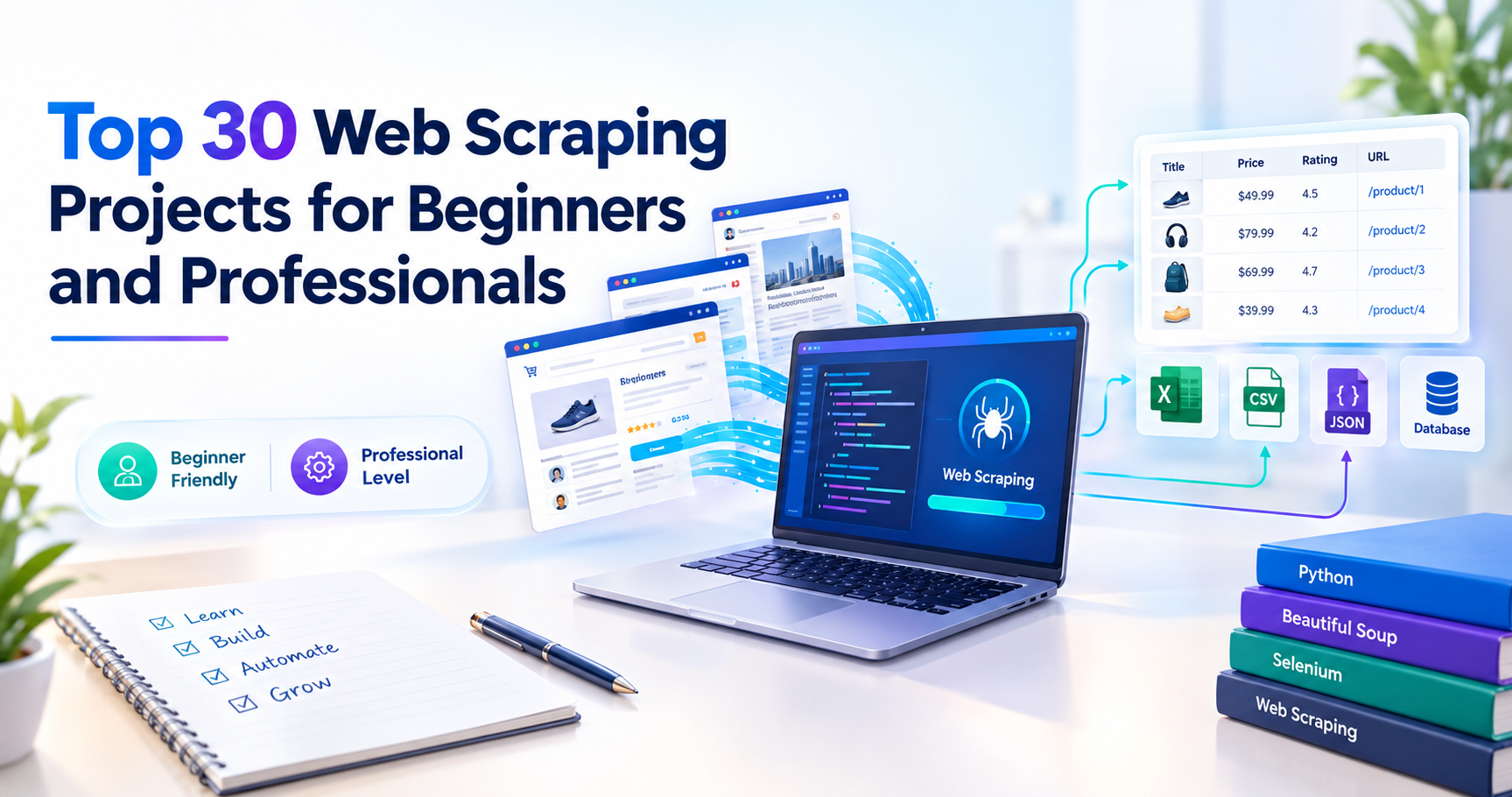
Say you want the price of every laptop on a retailer's site, updated each morning. You could copy them into Excel by hand, or you could write 40 lines of Python that do it while you sleep. That second option is web scraping: a script loads a page, reads its HTML, pulls out the bits you care about, like a name, a price or a date, and drops them into a table.
A few everyday examples:
- A student tracks five laptops across two stores and gets a message the day one of them drops below budget.
- A data analyst gathers a few thousand product reviews and counts which complaints keep coming up.
- A developer copies a product's public help pages into a database and builds a chatbot on top of it.
Most people learn web scraping using Python. Requests and Beautiful Soup handle a single page in a handful of lines, and when you outgrow them, Scrapy and Playwright are waiting. New to Python? Start with thePython for Beginners courseby Simpliaxis, then come back to project 1.
Key Highlights of Web Scraping Project Ideas
- 30 projects in three levels. The easiest takes an afternoon; the hardest is a two-week build with Scrapy, Redis and an LLM.
- A side-by-side table of Beautiful Soup, Scrapy, Playwright and Selenium, so you stop guessing which library to install.
- A plain walkthrough of what a scraper actually does, from the first request to a cleaned CSV.
- Practice sites that are built to be scraped, and open data portals that save you from scraping at all.
- For every project: what to focus on, what to hand in, and which skills it shows a recruiter.
- Straight answers on the questions people ask most, including whether scraping is legal and whether ChatGPT can do it for you.
Web Scraping Project Ideas: Quick Answer
Short on time? These four picks cover the most common goals.
1. Best Web Scraping Project for Absolute Beginners: Book Catalogue Scraper
Why it works:Books to Scrape exists so people can practise on it. Nobody will block you, the HTML is tidy, and there are 50 pages to paginate through.
Deliverables: A Python script, a CSV of 1,000 books with price, rating and stock status, and a short analysis of average price by rating.
2. Best Python Web Scraping Project for a Data Analyst Portfolio: Product Review Sentiment Analyser
Why it works: You scrape, clean messy text, run a little NLP and finish with one chart. A hiring manager gets the point in ten seconds.
Deliverables: A review dataset, sentiment scores, a top complaints summary and a dashboard.
3. Best Web Scraping Project for Data Science and Machine Learning: Job Market Skills Analyser
Why it works: Most data science portfolios reuse the same Kaggle datasets. Building your own from live job postings instantly sets yours apart.
Deliverables: A job postings dataset, a skill frequency table, trend charts and a written insight report.
4. Best Advanced Web Scraping Project for Professionals: LLM-Powered Extraction Pipeline
Why it works: More teams now hand messy pages to a language model and ask for JSON back. Doing it yourself, and measuring when it beats plain parsing on accuracy and cost, is a very current skill.
Deliverables: A pipeline that fetches pages, extracts fields with an LLM, validates them against a schema and logs errors.
Why Web Scraping Projects Matter for Data and Python Careers?
Course datasets arrive clean. Real data never does. Prices show up as text with currency symbols, dates come in three formats, and half the rows are duplicates. A scraping project shows you can deal with all of that and still answer the question you started with. Data analysts, data engineers and backend developers do exactly this every week.
It also gives you something to talk about in interviews. Telling someone how the site changed its layout halfway through and broke your scraper, and what you did about it, lands far better than reading out a list of libraries.
Best Web Scraping Tools in Python Compared
Picking the wrong library is the most common way beginners lose a weekend. Here is how the four usual choices compare.
| Feature | Requests + Beautiful Soup | Scrapy | Playwright | Selenium |
| Best for | Small static pages and quick scripts | Crawling many pages with pipelines | JavaScript-heavy and dynamic pages | Browser automation, often in testing teams |
| Handles JavaScript rendering | No | No (needs a plugin) | Yes | Yes |
| Speed | Fast for single pages | Very fast, asynchronous | Slower, runs a real browser | Slower, runs a real browser |
| Built-in throttling and retries | No, you write it | Yes | Partial | No |
| Learning curve | Beginner friendly | Intermediate | Intermediate | Intermediate |
| Scale | One to a few hundred pages | Thousands to millions of pages | Hundreds to thousands of pages | Hundreds of pages |
| Typical project | Quotes or book scraper | Multi-site price tracker | Infinite scroll scraper | Form-driven workflows |
| Official docs | Requests, Beautiful Soup | Scrapy | Playwright for Python | Selenium |
Whatever you scrape with, you will probably addpandas for cleaning and SQLite orPostgreSQLfor keeping history.
How to Build a Web Scraper: From Request to Clean Dataset?
A ten-line script and a production crawler do the same seven things. The big one just does them more carefully.
Stage 1: Check permissions
Before writing any code, open the site's robots.txt and skim the terms. The rules in that file follow RFC 9309, and Python's robotparser module will check them for you.
Stage 2: Send the request
Your script asks for the page the same way a browser does. Give it an honest user agent and pause a second or two between requests.
Stage 3: Parse the HTML
What comes back is a wall of HTML. Beautiful Soup turns it into something you can search, so you can ask for every price inside a given class.
Stage 4: Extract and clean the fields
Grab the fields you need, then tidy them. The rupee sign comes off the price, 1,299 becomes a number, and 3 Sept and 2026-09-03 end up as the same date.
Stage 5: Handle pagination and dynamic content
Most listings run over several pages, so follow the next link until it runs out. If the content only appears after JavaScript runs, open the Network tab in your browser first. Quite often the page is pulling a clean JSON file you can request directly.
Stage 6: Store and validate
Write the rows to a CSV or a database. Then check them: any duplicates, any blank prices, any dates in the future? Stamp each record with when you collected it.
Stage 7: Schedule and monitor
If the scraper runs daily, have it warn you when the row count suddenly falls. Most of the time, the site changed its layout overnight.
Is Web Scraping Legal? Ethical Rules Before You Build?
Plenty of companies scrape public data every day, but that does not make every scrape fine. We are not lawyers, and the rules change from country to country and site to site. These habits will keep you on safe ground for learning projects:
- Respect robots.txt and the terms of service. If a site says no bots, that is the end of it.
- Prefer APIs and open data. Portals such as India's Open Government Data Platform and services like the arXiv APIexist for reuse.
- Avoid personal data. Collecting names, contacts, or profiles brings in privacy law, including India's Digital Personal Data Protection frameworkand the EU's GDPR.
- Never bypass logins, paywalls or CAPTCHAs. If a site is working hard to keep scripts out, it does not want you there.
- Keep request rates low. Save pages you have already downloaded so you never fetch them twice, and be extra gentle with small sites.
30 Web Scraping Projects: Quick Comparison Table
| # | Project | Level | Main tools | Data source | Est. build time | Key output | Skills proved |
| 1 | Quotes Scraper | Beginner | Requests, Beautiful Soup | Practice site | 2 to 3 hours | CSV of quotes and tags | Selectors, pagination |
| 2 | Book Catalogue Scraper | Beginner | Requests, Beautiful Soup, pandas | Practice site | 3 to 5 hours | Cleaned book dataset | Data cleaning, type conversion |
| 3 | Wikipedia Table Extractor | Beginner | pandas | Public tables | 1 to 2 hours | Charts from tables | Tabular parsing |
| 4 | News Headline Aggregator | Beginner | feedparser, Beautiful Soup | RSS and HTML | 4 to 6 hours | Daily digest | Deduplication, dates |
| 5 | Country Data Scraper | Beginner | Requests, Beautiful Soup | Practice site | 2 to 4 hours | Country dataset | Nested HTML parsing |
| 6 | Weather Logger | Beginner | Requests, scheduler | Public API | 3 to 4 hours | Weekly weather chart | APIs, scheduling |
| 7 | Currency Rate Tracker | Beginner | Requests, SQLite | Public API or page | 3 to 5 hours | Rate history table | Storage, history |
| 8 | College Notice Monitor | Beginner | Requests, smtplib | College site | 4 to 6 hours | Email alerts | Change detection |
| 9 | Recipe Ingredient Parser | Beginner | Beautiful Soup, regex | Recipe site | 5 to 8 hours | Structured recipes | Text parsing |
| 10 | Course Catalogue Comparison | Beginner | Beautiful Soup, pandas | Education sites | 5 to 8 hours | Comparison table | Normalising layouts |
| 11 | E-commerce Price Tracker | Intermediate | Requests or Playwright, SQLite | Retail pages | 1 to 2 days | Price alerts | Scheduling, alerts |
| 12 | Review Sentiment Analyser | Intermediate | Scrapy, pandas, NLP library | Review pages | 2 to 3 days | Sentiment dashboard | NLP basics |
| 13 | Real Estate Listing Analyser | Intermediate | Scrapy, pandas, Folium | Property portal | 2 to 3 days | Price per area map | Geo analysis |
| 14 | Sports Statistics Dashboard | Intermediate | Beautiful Soup, Power BI | Stats pages | 2 days | Interactive dashboard | Visualisation |
| 15 | Research Paper Tracker | Intermediate | Requests, feedparser | arXiv API | 1 day | Weekly digest | API pagination |
| 16 | Job Market Skills Analyser | Intermediate | Scrapy, spaCy | Job boards | 3 to 4 days | Skill demand report | Text mining |
| 17 | City Event Aggregator | Intermediate | Scrapy, RapidFuzz | Venue pages | 2 to 3 days | Unified event list | Fuzzy matching |
| 18 | Company Announcement Monitor | Intermediate | Requests, SQLite | Exchange pages | 2 days | Keyword alerts | Monitoring |
| 19 | Infinite Scroll Scraper | Intermediate | Playwright | Dynamic pages | 1 to 2 days | Full page dataset | JS rendering |
| 20 | Open Data Tender Tracker | Intermediate | Requests, pandas | Open data portals | 2 days | New tender feed | Data pipelines |
| 21 | Distributed Crawler | Advanced | Scrapy, Redis, Docker | Multiple sites | 1 to 2 weeks | Scalable crawler | Distributed systems |
| 22 | Scheduled Pipeline with Validation | Advanced | Airflow, PostgreSQL | Multiple sites | 1 to 2 weeks | Validated warehouse tables | Orchestration |
| 23 | Website Change Detection Service | Advanced | Playwright, Django | Any public page | 1 to 2 weeks | Alerting web app | Full stack |
| 24 | Multi-Retailer Price Intelligence | Advanced | Scrapy, RapidFuzz | Retail pages | 2 weeks | Matched price history | Entity matching |
| 25 | Site Audit Crawler | Advanced | Scrapy, pandas | Your own site | 1 week | SEO audit report | Crawling logic |
| 26 | LLM-Powered Data Extraction | Advanced | LLM API, Pydantic | Messy pages | 1 week | Structured JSON | Prompting, validation |
| 27 | Documentation Chatbot (RAG) | Advanced | Scrapy, vector DB, LLM | Public docs | 1 to 2 weeks | Q and A assistant | Retrieval systems |
| 28 | Browsing Agent with Guardrails | Advanced | Playwright, agent framework | Approved sites | 2 weeks | Task-based agent | Agent design |
| 29 | Scraper as a Deployed API | Advanced | FastAPI, Docker | Any permitted site | 1 week | Live API endpoint | Deployment |
| 30 | Self-Healing Scraper | Advanced | Scrapy, monitoring, LLM | Multiple sites | 2 weeks | Resilient pipeline | Reliability |
Build times assume a learner who already knows the previous level and works a few hours a day.
Web Scraping Projects for Beginners (10 Projects)
Everything here runs on static pages and small datasets. Resist the urge to scrape more pages than you need; a clean script and a good README matter more at this stage.
1. Quotes Scraper Project Using Beautiful Soup
The classic first project.Quotes to Scrape lists quotes across several pages with authors and tags.
Focus: CSS selectors, loops and following the next page link.
Deliverables:
- A Python script that collects every quote, author and tag.
- A CSV file and a short count of the most used tags
Skills practised: HTML structure, Beautiful Soup navigation, pagination.
2. Book Catalogue and Price Scraper
Scrape all 1,000 books from Books to Scrape for title, price, star rating and stock status.
Focus: Turning messy text into usable numbers, e.g. star ratings expressed as words.
Deliverables:
- A clean CSV dataset, a chart of average price by rating.
Skills practised: Data cleaning with pandas, handling relative URLs, type conversion.
3. Wikipedia Table Extractor
Pull structured tables, such as population or GDP lists, straight into a DataFrame. The pandas read_html function handles most of the parsing, which makes it a quick early win. Follow Wikipedia's bot guidanceand keep requests light.
Focus: Reading HTML tables and cleaning footnote markers.
Deliverables: A tidy dataset and two or three charts.
Skills practised: Tabular parsing, visualisation with Matplotlib.
4. News Headline Aggregator
Combine headlines from several news sources into one daily digest. Use RSS feeds where available through feedparser, and scrape HTML only where no feed exists.
Focus: Merging sources and removing duplicate stories.
Deliverables: A daily digest file or email, grouped by topic.
Skills practised: Deduplication, date handling, multiple source integration.
5. Country Data Scraper
Scrape This Siteoffers practice pages with country data, hockey team statistics and more.
Focus: Parsing nested elements and handling forms and search pages.
Deliverables: A country dataset with capital, population and area, plus a sorted summary.
Skills practised: Nested HTML parsing, form parameters.
6. Weather Logger Using a Public API
Record temperature and conditions for your city every few hours through a public weather API, then chart a week of readings. This project shows why an API beats scraping whenever one exists.
Focus: Working with JSON responses and scheduling.
Deliverables: A log file or table and a weekly trend chart.
Skills practised: API calls, cron or Task Scheduler, time series basics.
7. Currency Rate Tracker
Log daily exchange rates for a few currencies and show the trend over a month.
Focus: Keeping history across runs.
Deliverables: A SQLite table of daily rates and a trend chart.
Skills practised: Database storage, incremental updates.
8. College Notice Board Monitor
Check your college or exam board website for new notices and email yourself when something changes.
Focus: Detecting what is new since the last run.
Deliverables: A script that stores seen notices and sends alerts for new ones.
Skills practised: Change detection, notifications with smtplib.
9. Recipe Scraper With Ingredient Parser
Scrape recipes from a site that permits it, then split each ingredient line into quantity, unit and item.
Focus: Parsing free text, which is harder than the scraping itself.
Deliverables: A structured recipe dataset and a shopping list generator.
Skills practised: Regular expressions, text normalisation.
10. Course Catalogue Comparison Scraper
Collect course names, durations and delivery formats from education sites that allow it, and build one comparison table.
Focus: Normalising data from pages that all use different layouts.
Deliverables: A unified comparison table in CSV or Excel.
Skills practised: Writing site-specific parsers, schema design.
Intermediate Python Web Scraping Projects (10 Projects)
Now the scripts start running on a schedule, pages load with JavaScript, and the data gets big enough to analyse properly. Any of these Python web scraping projects would sit comfortably in a data analyst or junior data engineer portfolio.
11. E-commerce Price Tracker With Alerts
Track the price of chosen products over time and alert yourself when a price drops below a target. Respect each retailer's terms and keep request rates low.
Focus: Scheduled runs, price history and alert logic.
Deliverables:
- A price history database.
- An alert by email or messaging app.
- A chart of price movement per product.
Skills practised: Scheduling, historical storage, handling layout changes.
12. Product Review Sentiment Analyser
Collect reviews for a product category and classify their sentiment.
Focus: Turning unstructured opinions into measurable insight.
Deliverables:
- A review dataset with ratings and text.
- Sentiment scores and the top five recurring complaints.
- A summary dashboard.
Skills practised: NLP basics, text cleaning, insight writing.
13. Real Estate Listing Analyser
Gather listing prices, area and location from a property portal that permits it, then calculate price per square foot by neighbourhood.
Focus: Geographic comparison.
Deliverables: A cleaned listings dataset and an interactive map built with Folium.
Skills practised: Geo data, outlier handling, map visualisation.
14. Sports Statistics Dashboard
Scrape match results or player statistics for a league and build an interactive dashboard. Loading the data into Power BI turns it into something recruiters can click through; theMicrosoft Power BI trainingcovers the dashboard side.
Focus: Presenting scraped data visually.
Deliverables: A season dataset and a published dashboard.
Skills practised: Data modelling, visualisation, storytelling.
15. Research Paper Tracker Using the arXiv API
Collect new papers in a field you follow and send yourself a weekly digest.
Focus: API pagination and summarising text.
Deliverables: A paper dataset and a weekly digest with titles, authors and abstracts.
Skills practised: API querying, feed parsing, basic summarisation.
16. Job Market Skills Analyser
Collect job postings for one role from a board that allows it and count how often each skill appears.
Focus: Extracting skills from free text with spaCy or keyword lists.
Deliverables:
- A job postings dataset.
- A ranked table of in-demand skills.
- A short report on what the data suggests you should learn next.
Skills practised: Text mining, frequency analysis, web scraping in data science.
17. City Event Aggregator
Combine events from several venue and ticketing pages into one searchable list.
Focus: Removing duplicates when the same event appears in several places.
Deliverables: A unified event feed with fuzzy-matched duplicates removed.
Skills practised: Fuzzy matching with RapidFuzz, date normalisation.
18. Company Announcement Monitor
Track official announcements published by listed companies on exchange or regulator pages that publish this data openly, and flag new ones by keyword.
Focus: Monitoring official sources reliably.
Deliverables: An announcement log and keyword alerts.
Skills practised: Incremental scraping, keyword filtering.
19. Infinite Scroll and Dynamic Page Scraper
Pick a practice page that loads content through JavaScript and extract data after scrolling or clicking.
Focus: Waiting for elements, intercepting network calls and knowing when a headless browser is needed.
Deliverables: A Playwright script and a comparison of browser scraping against calling the underlying JSON endpoint.
Skills practised: JavaScript rendering, network inspection.
20. Open Data Tender Tracker
Monitor public procurement or open government datasets for new entries in a sector you care about.
Focus: Combining direct downloads with light scraping.
Deliverables: A daily feed of new tenders with filters by value and region.
Skills practised: Data pipelines, filtering, public data sources.
Advanced Web Scraping Projects for Professionals (10 Projects)
At this level, the scraping itself is the easy part. The hard parts are keeping things running when sites change, spreading work across machines, and deciding when an LLM is worth what it costs. These advanced web scraping projects in Python are for developers, data engineers and anyone heading into AI work.
21. Distributed Web Crawler
Build a Scrapy project that shares its URL queue across several workers, with throttling per domain and automatic retries.
Focus: Scaling crawls without overloading target sites.
Deliverables:
- A multi-worker crawler using Redis as a shared queue.
- Containerised workers with Docker.
- Metrics on pages per minute and error rates.
Skills practised: Distributed systems, concurrency, polite crawling.
22. Scheduled Scraping Pipeline With Data Validation
Orchestrate several scrapers withApache Airflow, validate each run against a schema, and load clean data into a warehouse.
Focus: Monitoring and failure handling, not just extraction.
Deliverables: A scheduled pipeline, validation reports and warehouse tables.
Skills practised: Orchestration, data quality, PostgreSQL.
23. Website Change Detection Service
Let users register a page and receive an alert, with a visual diff, when a chosen section changes. A web framework such as Django, covered in the Python Django training, handles the user side.
Focus: Combining scraping, storage and a web interface.
Deliverables: A working web app with sign-up, watched pages and alerts.
Skills practised: Full stack development, diffing, background jobs.
24. Multi-Retailer Price Intelligence System
Match the same product across several retailers despite different names and formats, then compare prices over time.
Focus: Entity matching, which is the hard part of any price intelligence tool.
Deliverables: A matched product catalogue and a price comparison history.
Skills practised: Fuzzy matching, data engineering judgement, web scraping business ideas.
25. SEO Site Audit Crawler for Your Own Website
Crawl a site you own or manage to find broken links, missing titles, duplicate meta descriptions, and redirect chains.
Focus: Crawling logic and reporting.
Deliverables: An audit report with issues ranked by severity.
Skills practised: Link graphs, HTTP status handling, reporting.
26. LLM-Powered Data Extraction Pipeline
Feed messy HTML to a language model and ask it to return structured JSON, then compare its accuracy and cost against rule-based parsing. Validate every output with Pydantic. The Generative AI for Software Developerscourse covers the prompting and validation techniques involved.
Focus: Measuring when AI extraction is worth its cost.
Deliverables: An extraction pipeline, an accuracy and cost comparison, and an error log.
Skills practised: Prompt design, schema validation, evaluation.
27. Documentation Chatbot Using Retrieval-Augmented Generation
Scrape a product's public documentation, split it into chunks, create embeddings and build an assistant that answers questions and cites its sources.
Focus: The full retrieval pipeline, from crawl to answer.
Deliverables: A crawled knowledge base, a vector index and a chat interface.
Skills practised: Retrieval systems, embeddings, source citation.
28. AI Browsing Agent With Guardrails
Build an agent that navigates approved sites, extracts requested information and stops when it reaches a limit or an unfamiliar domain. For the concepts behind it, read how agentic AI differs from generative AI, or go deeper with the Agentic Software Development Engineer program.
Focus: Guardrails and logging, which matter as much as the agent itself.
Deliverables: An agent with an allow list, step limits and a full action log.
Skills practised: Agent design, safety controls, browser automation.
29. Scraper as a Deployed API
Wrap a scraper in aFastAPIservice with caching and rate limits, package it in a container and deploy it to the cloud. The Docker and Kubernetes training covers the deployment side.
Focus: Shipping a service, not just running a script.
Deliverables: A live API endpoint, documentation and a deployment guide.
Skills practised: API design, containers, cloud deployment.
30. Self-Healing Scraper With Monitoring
Detect when a site's layout changes and your selectors break, alert yourself, and fall back to alternative selectors or an LLM parser.
Focus: Reliability over time.
Deliverables: A monitored pipeline with success rate and freshness dashboards.
Skills practised: Observability, fallback design, maintenance planning.
Web Scraping Projects for Data Science and Machine Learning
A lot of good machine learning projects start with a scraper, because the dataset is what makes them original. Here is how some of the projects above turn into ML work.
| Scraping project | ML task it feeds | Example model | Portfolio value |
| Review Sentiment Analyser | Text classification | Sentiment classifier | Shows NLP and labelling skills |
| Job Market Skills Analyser | Topic modelling, trend analysis | Keyword clustering | Shows text mining on real data |
| Real Estate Listing Analyser | Regression | Price prediction model | Shows feature engineering |
| E-commerce Price Tracker | Time series forecasting | Price movement forecast | Shows temporal data handling |
| Documentation Chatbot | Retrieval and generation | RAG assistant | Shows applied generative AI |
For a structured path into modelling, Data Science with Pythonbuilds on the same libraries used in these projects, and this overview of big data tools shows where scraped data goes once it outgrows a laptop.
Websites to Scrape Data From for Practice
These sites either invite scraping or publish data for reuse, so they are the right places to practise.
| Website or source | What it offers | Best for |
| Books to Scrape | 1,000 fictional books across 50 pages | Pagination and cleaning |
| Quotes to Scrape | Quotes, authors and tags, including JavaScript variants | First scraper, JS practice |
| Scrape This Site | Country data, sports tables, forms and AJAX pages | Forms and dynamic content |
| Open Government Data Platform India | Public datasets from government departments | Open data pipelines |
| arXiv API | Research paper metadata | API practice |
| Wikipedia tables | Structured public lists | Quick table extraction |
Can ChatGPT and AI Tools Do Web Scraping?
Yes, up to a point. Ask ChatGPT or a similar assistant for a BeautifulSoup script, and you will usually get something that runs, and it is good at explaining why a selector returns nothing. Language model APIs can also read HTML you have already downloaded and hand back tidy fields, which is the idea behind project 26.
What AI does not do is take the responsibility off you. The site's rules still apply, you still need to go slowly, and you still have to check the output, because a model will sometimes misread a price or fill in a value that was never on the page. Use it to build faster, not to cut corners.
How to Showcase Web Scraping Projects on Your Resume and GitHub
Nobody hires you for a scraper. They hire you for what you did with the data, and how clearly you can explain it.
- Lead with the question. Open your README with the problem the data answers, not the libraries you used.
- Show the output. Include a sample of the dataset and one chart or dashboard screenshot.
- Explain the ethics. Note how you checked robots.txt, the terms and your request rate.
- Make it reproducible. List setup steps and a single command to run the project. Publishing web scraping projects with source code on GitHub, following the GitHub getting started guide, makes review easy.
- Quantify results. For example, collected 12,000 listings across 40 pages with a 98 per cent parse success rate, measured by your own validation checks.
In an interview, keep it simple: the question, how the pieces fit together, the thing that broke, and how you fixed it. If you are deciding which role to target with these projects, this comparison of business analyst vs data analystroles is a useful guide.
Common Web Scraping Mistakes to Avoid
- Scraping before checking for an API. Check the footer and the developer pages first. An API saves you hours and removes any doubt about permission.
- Ignoring robots.txt and terms. Apart from the risk, a reviewer who spots it will judge the whole project.
- No delays between requests. Firing hundreds of requests a minute gets you blocked and can slow the site for real users.
- Hard-coding fragile selectors. A selector like the third div inside the second span will break next month. Anchor on IDs or data attributes where you can.
- Skipping data validation. A scraper that quietly saves empty columns for a week is worse than one that crashes on day one.
- Collecting personal data. Leave out names, emails and profile details. You rarely need them, and they bring legal baggage.
- No documentation. If there is no README, most reviewers will not dig through the code to find out what it does.
Conclusion
You do not need all 30 of these. Pick one from the beginner list this week, get it working, write the README, and push it to GitHub. Then pick the next. Two or three finished projects, each a level harder than the last, say more about you than a folder of half-built scripts. And if a site says no to scrapers, take the hint and find one that says yes.
If you enjoy build-and-learn projects, you may also like theseIoT project ideas for students and project management project ideas.








 Lowest-Price Challenge











 Personalized Path


.webp)


 USA
USA  Canada
  India
India  UK
UK  Australia
  Singapore


