


 Call Us



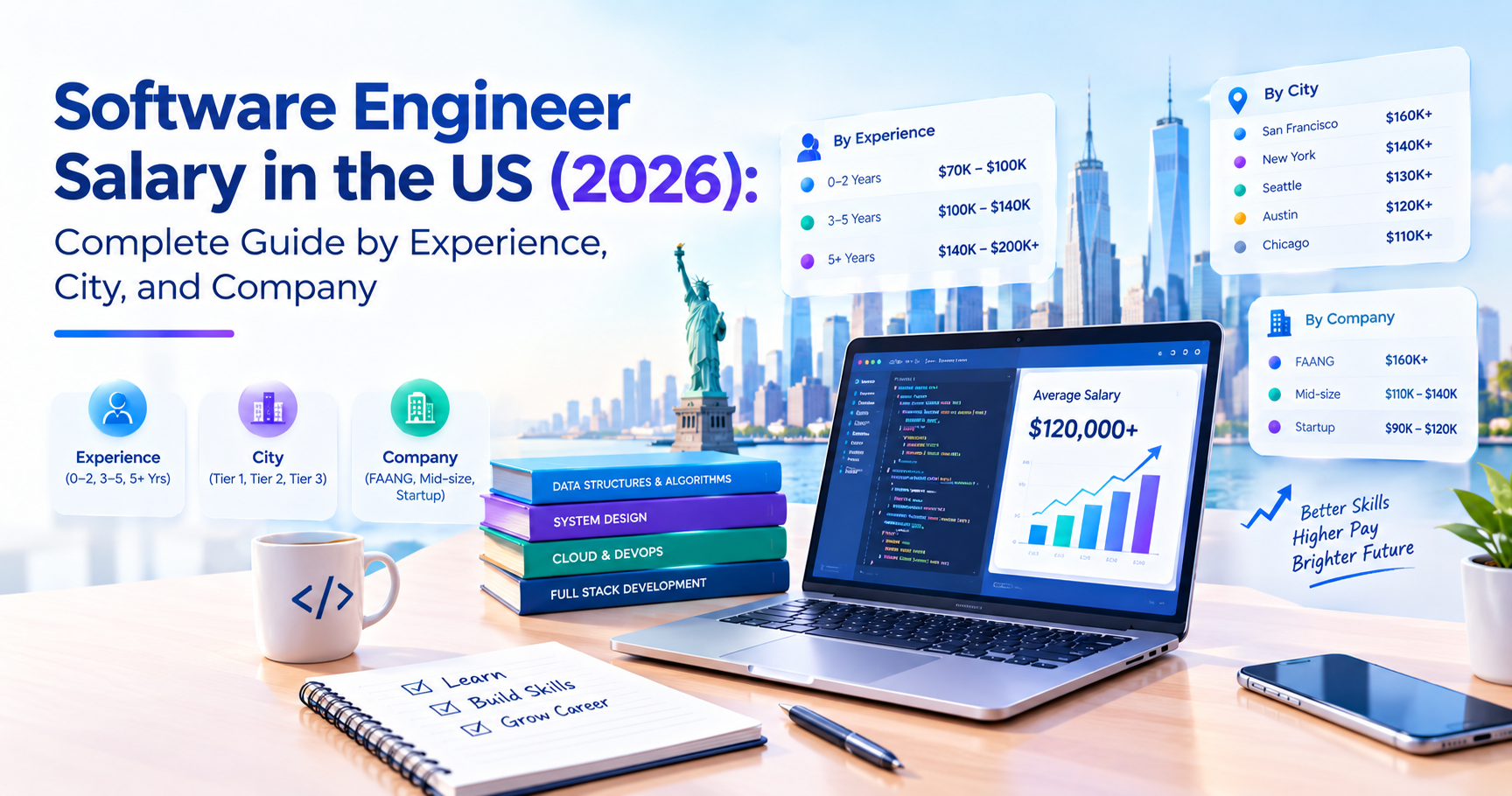
The average software engineer salary in the US for 2026 is between $130,000 and $150,000 in base pay. As of May 2024, theU.S. Bureau of Labor Statisticsreported a median annual wage of $133,080 for software developers. Entry-level engineers typically start in the $75,000 to $95,000 range, while senior engineers at large tech companies routinely make $200,000 to $400,000 or more once stock and bonus are included. Location, company size, programming stack, and certifications can swing real pay by tens of thousands of dollars around these averages.
Key Highlights of Software Engineer Salary in the US
- The median annual salary for software developers is $133,080 (as of May 2024) according to the BLS. The lowest 10 per cent earn less than $79,850, while the highest 10 per cent earn more than $211,450.
- Entry-level and new grad software engineers typically earn $75,000 to $95,000 in base pay at most employers, though FAANG-tier new grads can see total packages above $180,000.
- Senior engineers at large tech companies commonly earn $200,000 to $400,000-plus in total compensation once RSUs and bonuses are factored in.
- Location still matters enormously: California engineers average roughly $186,770 versus about $136,450 in Texas, though no-income-tax states narrow the real take-home gap.
- Specialized skills carry a real premium. AI and machine learning engineers, along with niche languages like Rust and Go, consistently out-earn general full-stack roles by 20 to 40 per cent.
- Cloud, DevOps and Agile certifications (AWS, Scrum, Azure) are tied to measurable pay premiums, frequently in the 15 to 25 percent range over non-certified peers in the same role
National Average Software Engineer Salary in the US
There is no one 'right' number for the average salary of a software engineer in the US, as different data providers have different definitions for the role and sample different populations. The most authoritative figure comes from theBureau of Labor Statistics Occupational Outlook Handbook, which groups software developers with quality assurance analysts and testers and reported a median annual wage of $133,080 in May 2024. This is a median, not an average, meaning half of all software developers in the country earned more and half earned less.
Job-board and salary-aggregator estimates tend to run higher because they skew toward self-reported roles at larger, better-paying employers and often blend in "software engineer" job titles that carry more seniority signaling than the broader "software developer" BLS category. Combining the BLS figure with data reported by Glassdoor, Payscale, and Built In, most software engineers in the US in 2026 fall into a realistic base salary band of $95,000 to $175,000, with a typical midpoint of roughly $130,000 to $145,000. Total compensation, once bonus, stock, and benefits are included, pushes the effective average meaningfully higher at mid-size and large technology employers.
It is worth separating base salary from total compensation early, because most public discussion of "software engineer salary" conflates the two. Base salary is fixed cash pay. Total compensation adds annual bonus (typically 10 to 20 per cent of base at most companies, higher in fintech), equity or RSU grants (common at public tech companies and well-funded startups), and sign-on bonuses. A senior engineer with a $160,000 base and a $150,000 total compensation might report either number depending on the source, which is a major reason salary figures across the internet appear to disagree. For a comparison with a lower-cost market, see our guide tosoftware engineer salary in India.
Software Engineer Salary by Experience Level
Experience is the single strongest predictor of software engineer pay in the US. The table below summarizes typical base salary ranges reported across Glassdoor, Payscale, Built In, and Salary.com for 2026.
| Experience Level | Years of Experience | Typical Base Salary Range | Notes
|
| Entry-level / New grad | 0 to 2 years | $75,000 to $95,000 | FAANG-tier new grads can reach $180,000+ total compensation |
| Junior | 1 to 3 years | $85,000 to $110,000 | Average often cited near $90,135 for 1 to 3 years |
| Mid-level | 3 to 6 years | $107,500 to $144,050 | Widest range; heavily influenced by company and stack |
| Senior | 6 to 10 years | $140,000 to $180,000 | Average around $146,169 base; total comp often higher |
| Staff / Principal | 10+ years | $180,000 to $260,000+ | Base plateaus; equity becomes the larger share of pay |
| 7+ years (general) | 7+ years | Up to $178,331 | Reflects broad developer population, not just big tech |
Two patterns are worth calling out. First, the jump from entry level to mid-level is the steepest percentage increase in a software engineer's career, often 30 to 50 percent within the first five years, because early experience closes the biggest skill and judgment gaps. Second, beyond the senior level, cash base salary tends to plateau while equity, bonus, and title-driven scope expand the real difference between a senior and a staff or principal engineer. This is a major reason two engineers with the same "senior" title can report wildly different total pay.
Software Engineer Salary by State and City
Location remains one of the largest single levers on software engineer pay, though the gap has narrowed since remote work became mainstream. Coastal tech hubs still pay the highest nominal salaries, but the picture changes once cost of living and state income tax are factored in.
| State / City | Typical Average Salary | Context
|
| California (statewide) | ~$186,770 mean / ~$174,410 median | Highest-paying state; also highest cost of living and state income tax |
| San Francisco Bay Area | $149,000 to $220,000 | Historically the top-paying metro for software talent |
| Washington State / Seattle | ~$171,040 mean; $135,000 to $210,000 metro range | No state income tax improves effective take-home pay |
| New York (state) / NYC | ~$163,820 (NYC average) | Fintech and finance-adjacent roles can pay 20 to 40 per cent above typical tech salaries |
| Massachusetts | ~$165,210 median | About 9 per cent above the national median, driven by Boston's biotech and tech cluster |
| Texas (statewide) | ~$136,450 mean / ~$132,150 median | No state income tax; Austin has grown rapidly as a tech hub |
| Austin | $115,000 to $175,000 | Beneficiary of major relocations and expansions since 2020 |
Cost of living adjustment changes the ranking meaningfully. An engineer earning $130,000 in Austin or Seattle can often keep more disposable income annually than a counterpart earning $160,000 in the San Francisco Bay Area, once housing costs, state income tax, and general living expenses are netted out. States with no income tax, including Texas, Washington, Florida, Nevada, and Tennessee, effectively add 3 to 9 per cent to take-home pay compared with high-tax states like California and New York for an identical gross salary.
Software Engineer Salary by Company
Company tier is at least as important as location for total compensation, especially at the senior level where equity dominates the pay mix. Reported 2026 figures put total compensation at large public technology companies well above the national median.
- Google: A mid-level (L4) engineer's median total compensation is reported around $305,712 (roughly $193,171 base, $86,837 annual stock, $25,704 bonus), rising to roughly $409,536 at the senior (L5) level.
- Meta: Reported to pay senior-equivalent engineers noticeably above Google's equivalent level, with E5 (senior) total compensation cited around $478,000.
- Amazon: Total compensation is reported to range from roughly $191,000 at L4 up to well over $1 million at the most senior technical tracks, with a reported median software engineer package near $267,000.
- Apple: Senior-level (ICT4/ICT5) total packages are typically reported between $280,000 and $400,000, with a base-conservative, RSU-heavy structure.
- Microsoft: Generally reported to pay roughly 30 to 35 per cent below the average of comparable "Big Tech" companies at the same level, trading cash compensation for greater role and schedule stability.
These company-level figures should be treated as directional rather than precise, since they are drawn from self-reported compensation platforms rather than official employer disclosures, and packages vary by specific team, location, and negotiation. Outside of large public tech companies, mid-size product companies, consultancies, and traditional enterprises (finance, healthcare, retail, manufacturing) typically pay base salaries closer to the BLS median with smaller or no equity component, but often with more predictable hours and slower-changing scope.
Software Engineer Salary by Programming Language and Specialization
Not all software engineering work pays the same, and the gap between the highest and lowest paying specializations has widened as AI-related roles have surged in demand. Based on 2026 market data, engineers who combine a mainstream language with a scarce, high-demand specialization command the largest premiums.
- AI and machine learning engineering: Among the best-compensated software specializations in 2026 (see our fullAI engineer salarybreakdown), production ML engineers working with frameworks like PyTorch commonly earn $175,000 or more, and engineers who pair Python with Rust or C++ for performance-critical ML infrastructure can see median total compensation above $200,000.
- Rust, Go, and Scala: Reported median salaries in the $150,000 to $170,000 range, reflecting relatively small talent pools relative to demand for systems and backend infrastructure work.
- Kotlin, Swift, and TypeScript: Mobile and modern web specializations reported in the $128,000 to $135,000 range, which makes aweb development careera solid mid-market option.
- Python: Broadly reported near $125,000, though this average is pulled up considerably by AI and machine learning use cases and pulled down by general scripting and data-analysis roles.
- Cloud and DevOps engineering: Usually reported at a premium to general application development, especially for engineers with professional-level AWS or Azure certifications or who have taken formal DevOps certification courses. The common theme in 2026 compensation data is that pay follows talent scarcity more than raw language popularity. A less common skill tied to high business impact, such as blockchain engineering or applied machine learning infrastructure, can out-earn far more widely used languages simply because qualified candidates are harder to find.
Remote vs Onsite Software Engineer Salary
The relationship between remote work and pay is more complicated in 2026 than it was during the pandemic-era remote hiring boom. Reported average remote software engineer salaries sit around $141,000 to $150,000, which is broadly comparable to onsite averages, but the aggregate figure hides real divergence by role and seniority.
Some 2026 studies say most remote tech jobs now pay somewhat less than onsite equivalents, with reported gaps of roughly 8 to 15 per cent depending on specialization, with back-end roles reported as the most affected. Other studies say the opposite for high-demand specialties such as AI engineering, where remote roles can command a premium because of a national, rather than local, hiring pool.
What most sources agree on is that the remote pay gap narrows or disappears at the senior level, where scope and impact matter more than physical location, whereas entry-level remote roles are more likely to be paid below their onsite equivalents. Given the conflicting figures in circulation, engineers should treat any single "remote pays X per cent more or less" claim with caution and instead compare specific, current job postings for their role and level.
Factors That Affect Software Engineer Salary
Beyond experience, location, and company, several other variables move software engineer pay in the US:
- Industry: Finance, fintech, and quantitative trading firms often pay 20 to 40 percent above general technology-sector rates for comparable engineering roles, reflecting the direct revenue impact of engineering work in those industries.
- Company stage: Well-funded, late-stage startups can match or exceed public company cash compensation to compete for talent, though with less liquid and higher-risk equity.
- Education and degree: A computer science degree remains the most common credential, but is increasingly one signal among several rather than a strict requirement, especially when weighed against demonstrated project experience, open-source contributions, or relevant certifications.
- Team and scope: Engineers on infrastructure, security, or revenue-critical systems are frequently levelled and paid higher than engineers on internal tooling teams at the same nominal seniority.
- Negotiation and competing offers: Because so much of senior compensation is discretionary (bonus, equity refresh, sign-on), a documented competing offer is consistently one of the most effective levers for increasing an offer.
How Certifications Boost Software Engineer Salary?
Certifications will not replace hands-on engineering skill, but 2026 market data shows a consistent, measurable pay association for the right credentials, particularly in cloud and Agile software delivery. AWS-certified professionals are reported to earn in the $120,000 to $180,000 range overall, with a reported 20 to 25 per cent premium over non-certified cloud engineers in comparable roles; speciality certifications such asAWS Certified DevOps Engineer Professional and AWS Certified Machine Learning- Specialty are associated with average salaries above $160,000.
For engineers working inside Agile delivery teams, certifications such as Certified Scrum Developer (CSD)are designed specifically to formalize the technical engineering practices used inside Scrum teams, which is increasingly relevant since most US software organizations now run Agile or Scrum-based delivery
For engineers looking to move toward cloud and platform engineering, where some of the highest specialization premiums in this article are concentrated, structured training such as a Cloud Computing with AWS certification courseor aMicrosoft Azure Developer Associate (AZ-204) certificationtargets exactly the skill gap employers are reportedly paying the most to close. Engineers exploring the AI specialization premium described earlier in this guide may also find a structured path such as Generative AI for Software Developers a faster route into AI-adjacent engineering work than self-study alone, since it is built around the applied skills (prompt engineering, AI-assisted testing, and code generation workflows) that are showing up in the highest-paying job descriptions.
Job Outlook and Demand for Software Engineers
Long-term demand for software engineering talent in the US remains strong. The BLS projects employment of software developers, quality assurance analysts, and testers to grow 15 per cent from 2024 to 2034, which it classifies as much faster than the average for all occupations, with about 129,200 openings projected each year on average over the decade from growth and the need to replace workers who leave the occupation.
This growth outlook is one reason software engineering has remained a resilient career choice even through periods of high-profile tech layoffs, since the BLS figure reflects the entire economy's growing dependence on software, not just employment at large technology companies.
Demand is not evenly distributed across specializations. Roles tied to artificial intelligence, cloud infrastructure, and cybersecurity are reported to be growing fastest and commanding the described skill premiums, while demand growth for narrowly scoped, easily automatable coding tasks is comparatively slower. Engineers who continually add adjacent skills, such as cloud platforms, DevOps practices, or applied AI tooling, and track thetop IT skills in demand, are best positioned to capture both the job security and the pay premium the 2026 market is rewarding.
How to Negotiate a Higher Software Engineer Salary?
- Use multiple sources (BLS, Glassdoor, Payscale and role-specific compensation platforms) to benchmark against rather than one number, as individual sources can vary by tens of thousands of dollars for the same role.
- Separate base salary from total compensation in every conversation, and ask recruiters directly for the bonus target percentage and equity vesting schedule rather than assuming they match public averages.
- Use a specific, verifiable competing offer where possible; unstructured requests for "market rate" are consistently less effective than a documented alternative offer.
- Time negotiation around a clear milestone, such as a completed certification, a shipped high-impact project, or a promotion cycle, so the request is tied to a concrete change in scope or capability.
- For engineers relocating for pay, run the comparison after tax and cost of living, not on gross salary alone, since a nominally lower offer in a no-income-tax state can be worth more in take-home terms than a higher offer in California or New York.
Key Takeaways
- The BLS median software developer salary of $133,080 (May 2024) is the most defensible baseline figure; job-board averages tend to run higher because they weight toward larger employers and more senior titles.
- Experience remains the single biggest driver of pay, with the steepest percentage gains occurring in the first five years of a career.
- Location still matters, but state income tax and cost of living can offset much of the nominal salary gap between high-paying and lower-paying states.
- Company tier drives some of the largest total-compensation differences, mainly through equity rather than base salary, at the senior level and above.
- Specialization, particularly in AI, cloud, and scarce systems languages, produces the largest pay premiums available to individual engineers today.
- Certifications in cloud platforms (AWS, Azure) and Agile engineering practices (CSD) are associated with measurable salary premiums and can be a faster path to a specialization premium than self-study alone.
- Long-term job growth for the occupation is projected well above the national average, supporting software engineering as a durable career choice.










 Lowest-Price Challenge











 Personalized Path


.webp)


 USA
USA  Canada
  India
India  UK
UK  Australia
  Singapore


