


 Call Us



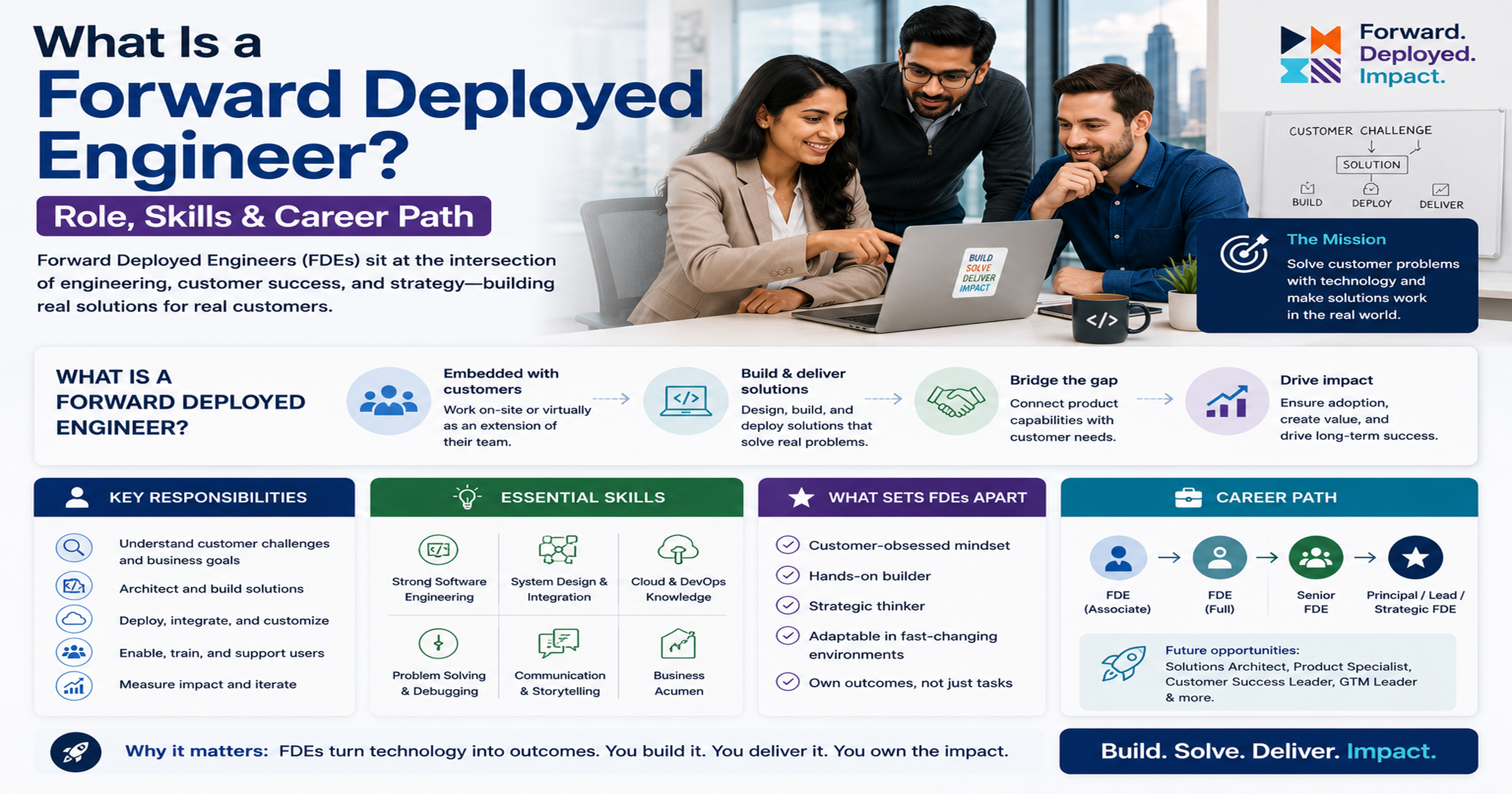
A forward deployed engineer (FDE) is a software engineer who works directly inside a customer's environment to build, customize, and deploy technical solutions, usually AI applications, rather than shipping features to an anonymous user base from a back office. The role blends hands-on coding with consulting, product thinking, and client relationship management, and it pays well because engineers who can do all three at once are rare.
Key Highlights of Forward Deployed Engineer
- Palantir pioneered the FDE title in the early 2010s; by 2026, OpenAI, Anthropic, Scale AI, and dozens of AI-native startups run their own forward deployed teams.
- Core stack: Python, one major cloud platform, REST/GraphQL APIs, and increasingly RAG frameworks like LangChain and LangGraph.
- Typical career ladder: FDE to Senior FDE to Principal FDE to Technical Solutions Architect or VP of Solutions Engineering.
- Most FDEs come from backend or full-stack backgrounds with 2 to 5 years of production experience, though some firms hire strong new grads directly.
- The most-cited soft skill across every source researched here is comfort with ambiguity: FDEs rarely get a finished spec from the client.
What Is a Forward Deployed Engineer?
A forward deployed engineer is a software engineer who embeds directly with a customer's team to build, integrate, and deploy a technical product inside that customer's environment. Instead of writing generic features for unseen users, an FDE tailors a working system to one organization's data and workflows, then stays close enough to fix what breaks.
The title started at Palantir, where FDEs were sent into government agencies and enterprises to make Palantir's data platform actually usable inside messy, real-world operations. Palantir's own careers page still describes the role in almost identical terms today. Since 2023, the model has spread fast through AI-native companies, because deploying a large language model inside a real enterprise workflow, with legacy systems, compliance rules, and incomplete data, needs the exact mix of skills Palantir first formalized. An AI agent that reads support tickets or automates a claims workflow rarely works out of the box. It needs custom prompts, a retrieval layer tuned to the client's documents, and constant adjustment as usage reveals edge cases. The forward deployed engineer is the person technical enough to build that and close enough to the customer to know what to build.
Inside Palantir's Forward Deployed Engineer Program
Palantir popularized the FDE title, and its own program still sets the template other companies now copy. A current Palantir Forward Deployed Software Engineer listing for its New York office sets a base salary range of 135,000 to 200,000 dollars. The role also offers RSUs and a possible sign-on bonus. The posting asks for at least one year of professional experience after college. It also expects a background in computer science, math, physics, or data science, plus working knowledge of Python, Java, C++, or TypeScript.
The listing states travel of up to 25 percent to client sites, described as flexible and based on personal circumstances. Palantir frames the job around owning "end-to-end execution and implementation of high-stakes projects." Recruiters across the industry now expect that same ownership from any FDE hire.
Wikipedia's entry on the role notes that similar functions exist elsewhere under different names. Google and OpenAI call theirs "customer engineer," while AWS uses "solutions architect" for a comparable customer-facing build role. The same entry notes that OpenAI launched an internal group called The Deployment Company in 2026. It was built specifically to embed forward deployed engineers inside large enterprises. That move signals Palantir's original model has become standard practice across the AI industry, not a one-company quirk.
What Does a Forward Deployed Engineer Do Every Day?
No two weeks look identical, but the work moves through the same loop:
- Understand the problem. Sit with the client's team and turn a vague goal like "we think AI could help our support team" into a concrete, buildable requirement.
- Design a working solution. Sketch which data sources feed it, which model or framework handles the logic, and how it fits the client's systems.
- Build and integrate. Write production code, usually in Python, connect APIs, set up a vector database, and wire it into the client's cloud environment.
- Deploy and observe. Ship the system, then monitor it with evaluation and observability tools to catch failures before the client does.
- Iterate with the client in the room. Demo early and adjust, since client environments rarely match what was scoped on day one.
- Hand off or scale. Document the solution, train the client's team where needed, then move to the next engagement or deepen the existing one.
Forward Deployed Engineer vs Software Engineer vs Solutions Engineer
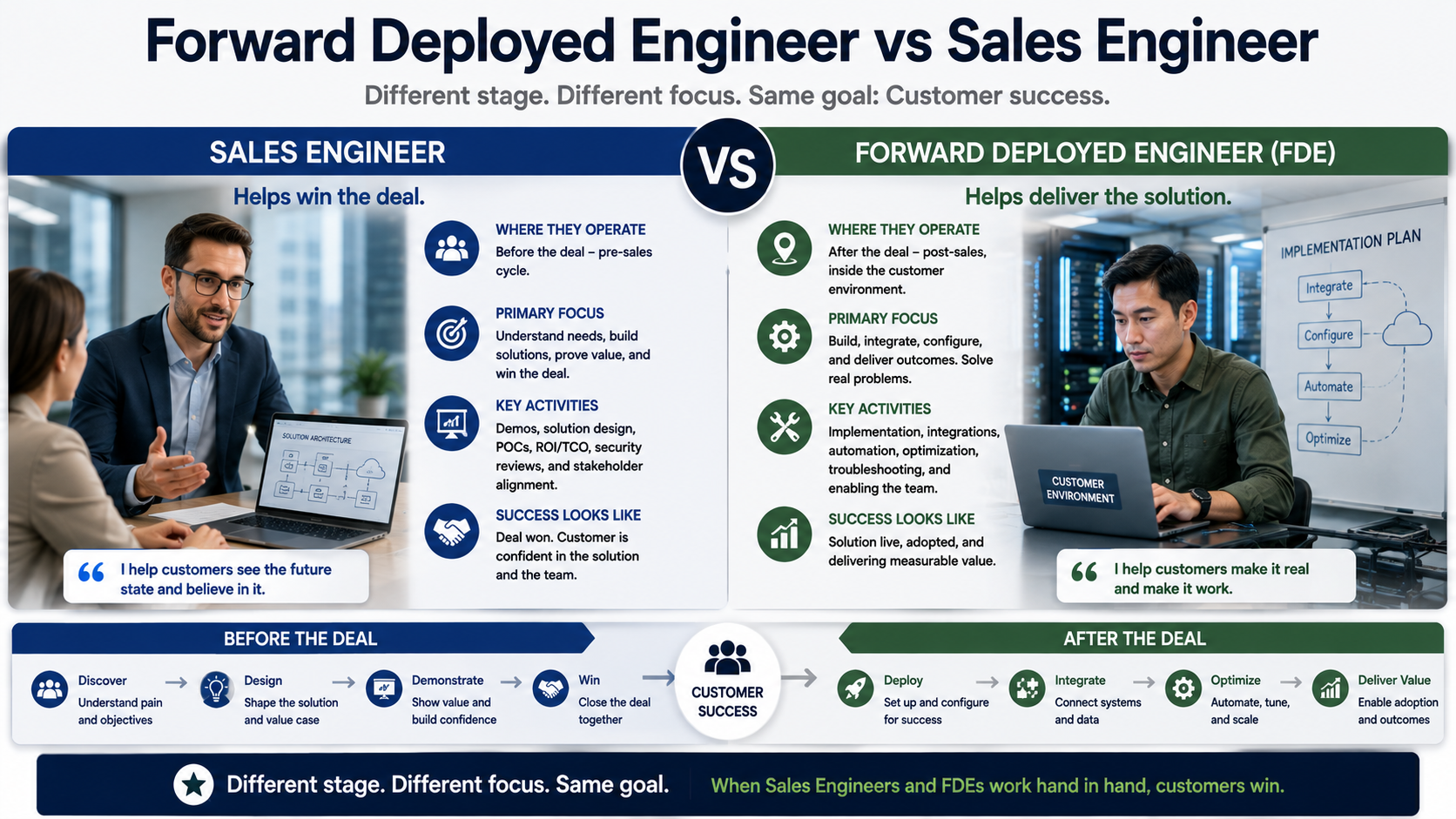
These titles get confused constantly. Here is how they differ:
| Dimension | Forward Deployed Engineer | Traditional Software Engineer | Solutions Engineer |
| Primary output | Custom, deployed system for one client | Generic product feature for all users | Technical demos and pre-sales support |
| Where they work | Embedded in the client's environment | In the product team, remote from end users | Alongside sales, before a deal closes |
| Codes in production? | Yes, regularly | Yes, always | Rarely, mostly prototypes and demos |
| Client contact | Constant, direct, ongoing | Little to none | High, but only pre-sale |
| Success metric | Client outcome and adoption | Feature shipped, product metrics | Deal won |
If you enjoy writing code but hate never seeing whether it solved a real problem, FDE work fixes that gap. If you would rather stay heads-down and skip client calls, this role will frustrate you.
Forward Deployed Engineer vs Applied AI Engineer: What Sets Them Apart
FDE gets confused with a newer, closely related title: applied AI engineer. FDE Academy's 2026 comparison separates the two mainly by customer base and pay ceiling, not by day-to-day skill set.
FDEs mostly work at companies like Palantir, OpenAI, Databricks, Adobe, and Salesforce, serving Fortune 500 enterprises, government agencies, and regulated industries. Their technical focus centers on system integration, APIs, distributed systems, and deployment reliability. FDE Academy puts mid-to-senior compensation at 200,000 to 550,000 dollars, with travel running up to 50 percent for large enterprise deployments.
Applied AI engineers, by contrast, tend to work at companies like Anthropic, Cohere, and Google Cloud. Their customers are AI-native businesses and software companies rather than traditional enterprises. Their focus leans toward machine learning, LLM behavior, prompt engineering, and model evaluation over infrastructure plumbing. FDE Academy reports comparable or slightly higher pay, 300,000 to 550,000 dollars at leading AI companies, with lower travel and more hybrid or remote options.
FDE Academy's own framing is useful here. Both roles share the same core mission: taking a powerful AI capability and making it work inside a real customer environment, end to end. The titles split mainly on which customer segment the company targets, not on a fundamentally different skill set.
You will also see recruiters use "AI implementation engineer," "customer-facing engineer," and "field engineer" for versions of this same work. None of these carry a standardized definition across the industry yet. Treat the job description, not the title, as the real source of truth when you evaluate an opening.
Skills You Need to Become a Forward Deployed Engineer
FDEs need a T-shaped skill profile: real depth in one core area, working competence across several others.
Technical Skills
- Strong Python fundamentals, including object-oriented programming and clean, production-grade code, not just scripting.
- One cloud platform end to end, most commonly AWS, with Azure and GCP also in demand.
- REST and GraphQL API development, plus authentication patterns like OAuth and JWT.
- LLM fundamentals and Retrieval-Augmented Generation (RAG) pipelines built with frameworks like LangChain or LangGraph.
- AI agent design, including tool calling, multi-agent workflows, and evaluation and observability for production trust.
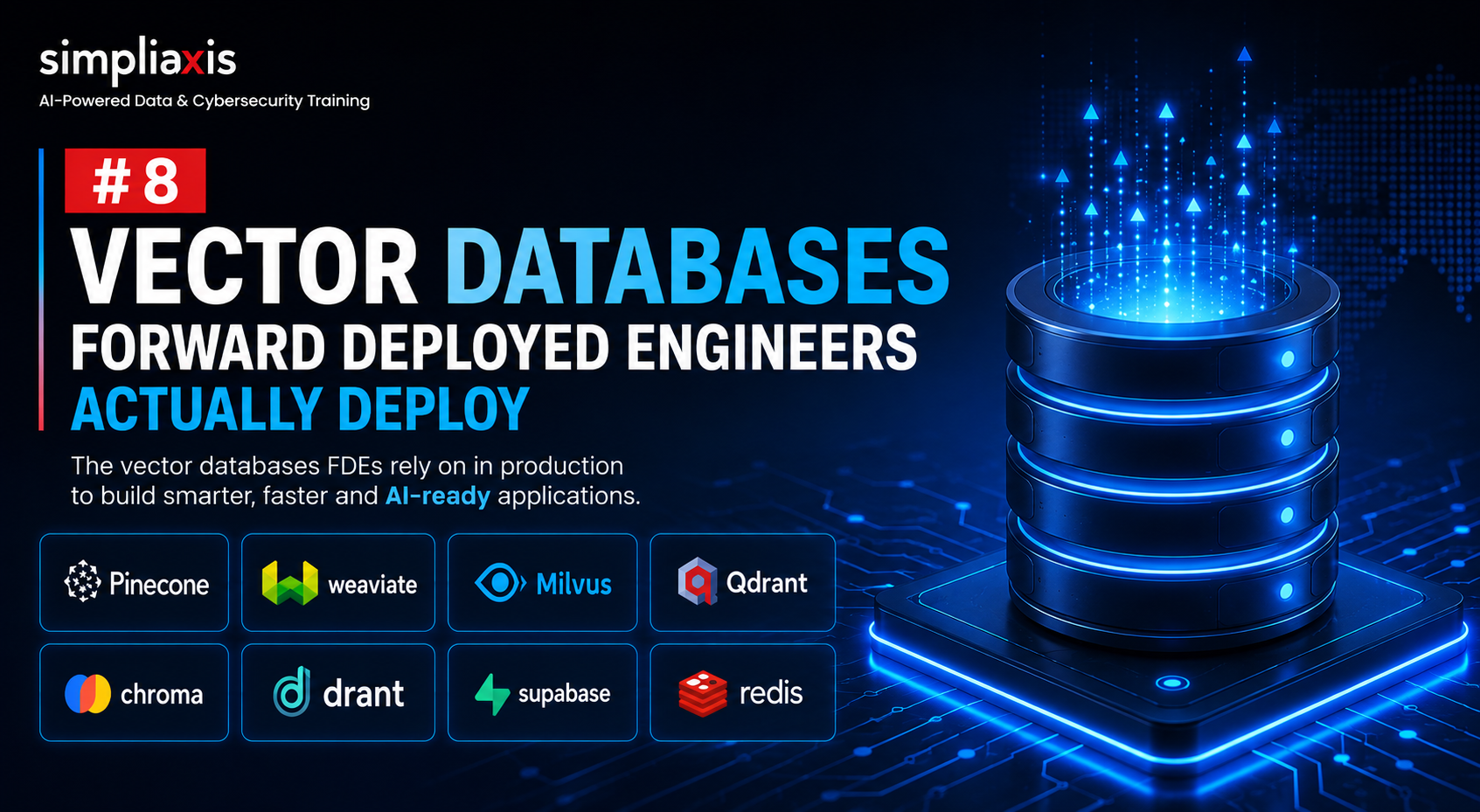
- Docker, FastAPI, and a vector database such as Pinecone, Weaviate, or pgvector.
Business, Delivery, and Communication Skills
- Structured problem framing: turning a vague business goal into a scoped, buildable requirement without a written spec.
- Comfort with ambiguity, since client environments change mid-engagement far more than internal product roadmaps do.
- Cross-audience communication. An FDE might explain infrastructure to engineers in the morning and demo a prototype to executives by evening, in the same day.
Sample Forward Deployed Engineer Job Description
Most FDE postings follow a similar structure, whether the employer is a giant like Palantir or a fast-growing startup. Here is what a typical listing includes, drawn from real 2026 postings across the industry.
Responsibilities usually cover:
- Own solution design and delivery for one or more enterprise client accounts.
- Write production code that integrates with the client's existing data and systems.
- Build and tune RAG pipelines or AI agents against real client data.
- Run demos, gather feedback, and iterate quickly inside live engagements.
- Document the solution and train the client's internal team before handoff.
Requirements usually cover:
- One to five years of professional software engineering experience.
- Strong Python skills, plus working knowledge of one major cloud platform.
- Comfort presenting technical tradeoffs to non-technical stakeholders.
- Willingness to travel to client sites, commonly cited between 10 and 25 percent.
- A portfolio or capstone project that shows deployed work, not just a prototype.
Compensation and travel expectations vary widely by company and geography. The salary section further down breaks those numbers out by market.
Common Mistakes New Forward Deployed Engineers Make
Even strong engineers stumble in this role during the first year, and the mistakes tend to repeat across companies. FDE Academy's list of common first-year errors offers a useful checklist before you start.
The most frequent mistake is treating the job like traditional software engineering. New FDEs expect clean sprints and defined tickets, when the work is closer to consulting, where client outcomes matter more than code elegance. Closely related is over-promising on timelines. Committing to a deadline before checking feasibility with your own team damages trust the moment a delay happens.
Writing code before understanding the client's actual workflow is another repeat offender. It produces technically correct solutions that do not fit how the client's team really works day to day. FDE Academy also flags ignoring the sales and customer success context. That gap leaves engineers confused about why a deal was scoped a certain way, or what was already promised before they arrived.
Weak documentation causes real damage too. Skipping handoff notes under delivery pressure creates a liability for whoever inherits the account next. FDE Academy's guide also warns against saying yes to every custom request. Unmanaged scope creep leads to missed commitments and codebases nobody can maintain later.
The last one matters most for career longevity: burning out from travel and on-call pressure. FDE Academy points to overcommitting early, without setting sustainable boundaries, as the top cause of first-year burnout in this role. Setting limits early protects both your output quality and your ability to stay in the role long enough to reach senior levels.
How to Become a Forward Deployed Engineer: A Practical Roadmap
There is no single accredited path in, but this sequence reflects how most professionals get there.
- Build a solid engineering base. Two or more years of production experience as a backend or full-stack engineer is the most common entry point.
- Learn the AI application stack deliberately: Python for ML, prompt engineering, RAG pipeline design, and agent frameworks are the core of the job in 2026.
- Get hands-on with deployment, not just notebooks, since interviewers test whether you can operate a system, not just prototype one.
- Build one end-to-end capstone: a RAG application or AI agent you designed, built, deployed, and can defend in an interview.
- Target structured training that mirrors the job, compressing months of scattered self-study into a guided track.
Simpliaxis runs a structured Forward Deployed Engineering Program that follows this exact lifecycle, from Python foundations through RAG, agent development, and cloud deployment, ending in a capstone project. For professionals aiming toward architecture-level ownership, the Forward Deployed Architect Program extends the same lifecycle with deeper system design coverage.
Forward Deployed Engineer Career Path and Progression
| Stage | Typical Focus | Years |
| Forward Deployed Engineer | Build and deploy solutions within one or two client engagements | 0-3 |
| Senior FDE | Own an engagement end to end; mentor junior FDEs | 3-6 |
| Principal FDE | Lead the most complex, highest-stakes accounts | 6-9 |
| Technical Solutions Architect | Design solution architecture across multiple accounts | 8+ |
| VP of Solutions Engineering | Own the entire forward-deployed function | 10+ |
Lateral moves are common too. Many senior FDEs move into product management or engineering leadership, since they already understand both the technology and the customer's real workflow.
Is Forward Deployed Engineering a Good Career in 2026?
What Makes It Worth Considering
- Direct, visible business impact. You see whether your work actually solved the client's problem, not just whether a feature shipped.
- Above-market pay, since engineers who combine strong coding with client-facing skill are rare.
- Fast skill compounding through forced exposure to new industries and constraints every few months.
What to Weigh Before Choosing It
- Heavier travel and client-facing time than a typical backend role, depending on the employer.
- Less predictable scope than a standard sprint cycle, since client priorities shift mid-engagement.
- Deep specialists in infrastructure or ML research remain just as valuable and are not obsolete because FDE roles exist.
Who Is Hiring Forward Deployed Engineers in India and Worldwide
Palantir remains the best-known employer of FDEs globally, with an engineering presence that includes India-based teams. OpenAI, Anthropic, Scale AI, and a growing list of enterprise AI startups now run similar forward-deployed or "applied AI" teams. Exponent's 2026 guide to the role notes most FDEs move in from backend or full-stack engineering rather than starting there. In India, GCCs of US-headquartered AI companies and fast-scaling domestic startups are the fastest-growing source of these openings, particularly in Bengaluru, Hyderabad, and Pune.
Conclusion:
If the skills above sound closer to where you already are than where you want to end up, the fastest way to close the gap is structured, hands-on training rather than scattered tutorials. Simpliaxis's Forward Deployed Engineering Program walks through the same lifecycle covered in this article, Python and ML foundations, RAG and agent development, and cloud deployment, ending in a capstone project you can talk through in interviews. If you are further along and aiming at architecture-level ownership of AI deployments, the Forward Deployed Architect Program is the natural next step.
For a broader look at how AI is reshaping engineering and product roles, see our guide on how to become an AI engineer.








 Lowest-Price Challenge











 Personalized Path


.webp)


 USA
USA  Canada
 India
India UK
UK Australia
 Singapore


