


 Call Us



Introduction
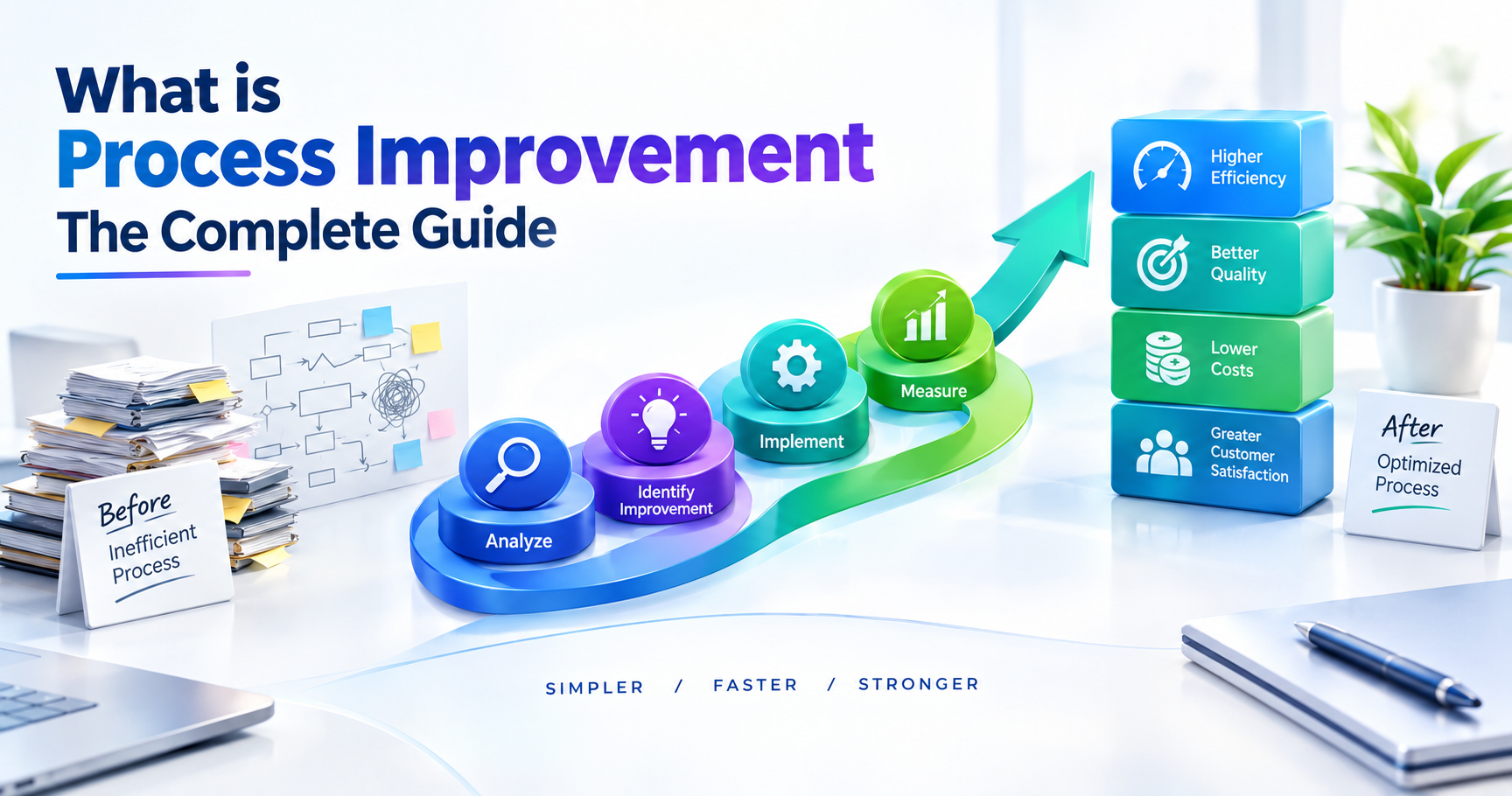
Process improvement helps organizations detect inefficiencies, reduce bottlenecks, and improve already established workflows in a systematic way. Organisations can learn how to reduce costs, increase productivity, improve quality, and bring a better customer experience by inspecting processes, measuring results, and looking for ways to implement changes.
This guide explores different improvement methods like Lean, Six Sigma, Kaizen, and PDCA. It also talks about the ways to map, implement, and measure process improvements and make sure they last. With practical examples, tools, metrics, and recommended courses of action, readers will have a thorough understanding of what process improvement is and how they can incorporate it into their businesses.
Key Highlights
- Learn what process improvement is and why it is important for better business performance.
- Explore different and popular improvement frameworks and techniques like Six Sigma, DMAIC, Lean, PDCA, and Kaizen.
- Understand the significance of process mapping and learn how to detect bottlenecks, redundancies, and the root causes for process inefficiencies.
- Discover realistic ways to incorporate and measure process improvements and how to make sure that they last.
- Learn about important key metrics to measure process improvements, relevant tools, and real-world examples of such implementations and the results that they bring.
- Identify commonly made mistakes related to process improvement and learn how to foster a culture of continuous improvement.
What Is Process Improvement?
Process improvement is a systematic method of identifying impediments and inefficiencies in already existing processes and addressing them to enhance workflow and enable teams to work more efficiently. It usually involves analyzing already existing processes, identifying points of hindrance like bottlenecks, and implementing and measuring improvements to examine outcomes for the improvements made, whether they are sustainable, and if they meet business goals and quality standards.
Process Improvement vs. Process Reengineering vs. Business Process Management (BPM)
Process improvement involves identifying specific workflows in a project process and identifying potential bottlenecks and impediments that can be affecting workflow quality. By doing so, they can identify the reasons for these issues, introduce solutions, and integrate them into the workflow to improve its performance. This implementation is then measured and monitored to determine whether genuine improvements are being made and if they can be sustained.
Business process reengineering (BPR) is a transformative management approach that fundamentally rethinks and redesigns business processes to achieve significant business performance, efficiency, and output. Unlike Process Improvement, which primarily focuses on refining already existing processes through the identification of hindrances, BPR challenges already established business process practices, analyzes them, detects and removes inefficiencies that are hindering business growth, and redesigns processes for better organizational workflow.
Business Process Management (BPM) uses several methods to identify, assess, measure, and improve processes within a business. While Process Improvement usually focuses on refining one particular process, BPM aims to ensure that all the processes prevalent in an organization work towards achieving the overarching goal of the business. It is a continuous system of discipline that continuously monitors processes and maintains consistency, compliance, and a definite structure that enables organizations to achieve their goals.
Business Process Improvement (BPI) is a subset of BPM; while the latter establishes a process guideline for an organization to follow, the former is enforced when processes fail to adhere to those guidelines, hence affecting or deviating from the original business objectives.
Process improvement vs. Continuous Improvement
Process improvement concentrates on specific process workflows, identifies the impediments that make them inefficient, and introduces specific targeted improvements to make the process better and hence improve process output, efficiency, and customer satisfaction.
Continuous improvement, on the other hand, approaches process improvement in an organization through the gradual introduction of improvements. These refinements are introduced in small, steady, and frequent batches instead of rapidly and all at once.
Usually associated with the Japanese business model called Kaizen continuous improvement, it aims to encourage all employees to engage with the enhancement process, which enables them to transform the way that they work. However, since Process Improvement usually focuses on a specific process workflow, it usually engages specific teams to work or approach their task differently for better productivity and results.
Why Process Improvement Matters?
Business process improvement is important for organizations looking to improve their processes and workflows and make them more efficient, which enables teams to work better and deliver output that is valuable and increases customer satisfaction.
The Cost of Inefficient Processes
Businesses need to have process improvement methods in place since the prolonged use of flawed processes can be harmful for organizations and their growth. Listed below are the ways that flawed processes can be consequential to enterprises:
Rework
Established processes may be filled with errors and flaws that are usually detected at the end of the process or if they are detected by the customer, which leads to reworks that are time-consuming and costly and damage the business's reputation.
Delays
Flawed processes may have excessive and irrelevant steps and formalities that hinder the workflow process with unnecessary delays. When the causes of delays are not identified and corrected, it can lead to extra effort, confusing steps and handoffs, and errors that would need reworking. This leads to the ultimate delay of deliveries, dissatisfied customers and stakeholders, and missed business opportunities.
Churn
Inefficient process workflow leads to outputs that are outdated, irrelevant, delayed, and defective. For customers, poor outputs result in poor experiences. When customers are dissatisfied with an organization's outputs, it can lead to disengagement. This reduces customer retention and affects business revenue.
Less Productivity
When work is delayed, requires constant rework and clarification, and fails to generate the output that was desired, it can lower employee productivity and morale. Employees are doing less work that contributes to efficient outputs and more on rectifying the processes themselves.
Core Business Benefits of Process Improvement
Process improvement can drastically improve the processes in an organization, which can affect the quality of business drastically. Listed below are the core business benefits of Process Improvement:
Reduced Costs
When inefficiencies and delays are detected in processes, it helps organizations save on finances that would otherwise be wasted on resources, materials, and time. Streamlining processes helps businesses save on money and resources that can either be used in tasks that drive valuable output or contribute profitably to business growth.
Better Customer Satisfaction
Smoother and more efficient processes lead to better and more valuable outputs that automatically translate to increased customer satisfaction. When organizations deliver products that are quick, relevant, reliable, and useful, it increases customer retention, engagement, and loyalty. This helps with business revenue and growth.
Increased Quality
Process improvement emphasizes quality management heavily. One of the most important goals of enhancing processes is to ensure that the output delivered is valuable. Streamlining processes and identifying hindrances and defects reduces errors and speeds up workflow, which ultimately leads to outputs that are better and more reliable. This leads to a better customer experience and an increase in business profits.
Better Employee Engagement
When employees have processes that are quick, coherent, efficient, and deliver measurable outputs of good quality, it boosts employee morale and productivity by reducing the frustration that might previously have been caused by unclear or inefficient processes.
Increased Business Revenue
When processes are streamlined, high costs are reduced, important tasks are prioritized, resources and time are used effectively, and the output delivered is valuable and relevant to customers. All these factors play a crucial role in boosting business performance and revenue. Quality output increases customer satisfaction and their engagement and retention with an organization’s products and services. This increases the profits and revenue of the business, thus enhancing its growth.
Good ROI (Return on Investment)
Process improvement helps make processes more efficient by helping to reduce waste, facilitating the better usage of resources, and getting rid of unnecessary processes, which help in bringing down operational costs and enable good ROI, which is estimated by comparing the benefits of an initiative to its costs.
To calculate the ROI for process improvement initiatives, follow these steps:
- Identify Costs: These costs include the cost of training, tools, software, or other fees.
- Estimate Benefits: Track the visible outcomes that arise from process improvement initiatives such as time reduction, increased revenue, and cost savings.
- Set a Timeframe: Measure the ROI over a defined period of time, usually 6-12 months after implementation.

Types of Process Improvement
There are several process improvement techniques that can be used to boost operations and management performance in a company. better effectiveness to the business processes.
Continuous/Incremental Improvement (Kaizen-style)
The continuous improvement process, also known as the Kaizen style of process improvement, is a Lean tool that helps boost productivity, quality, and workplace culture. It works on the principle of applying small, incremental changes daily, which accumulate into significant improvements over time.
This process improvement practice starts with recognizing an existing problem and acknowledging that there are opportunities to improve it. Once such problems are identified, the organizations set out to understand the underlying causes of them, which further prompts the proposal of solutions and their implementation on a small scale. Once adjustments are made to the solution, it is standardized and deployed across the organization.
Project-Based Improvement (DMAIC-style)
The DMAIC model is one of the most popular methods for business improvement initiatives. The acronym stands for the five phases that are present within the framework, including 'Define,' 'Measure,' 'Analyze,' 'Improve,' and 'Control.'
This methodology heavily relies on data-driven insights since it offers a detailed and more accurate way to handle existing business processes. It is also advantageous since it is useful across different domains, industries, and processes. However, it is best applicable in the Six Sigma and Lean Six Sigma frameworks.
Business Process Reengineering (BPR)—When to Use It Instead
Business Process Reengineering (BPR) is an excellent process improvement tool that can help fundamentally change business processes to enable the growth of revenue, improved customer service, faster processing time, and better employee engagement and retention.
However, unlike most typical process improvement techniques, which identify hindrances in a specific business process, BPR aims to restructure business processes completely; therefore, organizations will find this technique most effective during the following instances:
- Outdated Systems: When old procedures add more work than output value and making adjustments to those processes brings about nothing fruitful
- Inadequate Performance: When old processes and subsequent improvement initiatives to those processes fail to fix depleting profitability, poor market shares, and missed deadlines and opportunities.
- Increased Customer Complaints: When delays caused by elaborate processes lead to a spike in customer complaints that negatively affects user experience, satisfaction, and subsequently, business revenue.
- Adoption of Digital Tools: When there is a requirement to adopt digital tools into the workflow processes, BPR may be required to efficiently accommodate the necessary changes.
Process Improvement Methodologies
Listed below are some process improvement methods that can help businesses optimize their workflows in the best way possible. It is important to choose methods that best meet the unique needs of the organization.
Lean
Lean methodology helps systematically refine workflow processes by identifying irrelevant steps and repetitions, reducing such redundancies, and optimizing the appropriate resources to speed up processes and allow organizational teams to work effectively.
Six Sigma
Tracing back to a Motorola employee and engineer, Bill Smith, in 1986, the Six Sigma methodology involves reducing the amount of variation that is prevalent in the end products of processes. The ultimate goal of this method is to ensure that processes remain consistent and reliable and that delivery outputs of significant value are produced.
The method relies on statistical data, which helps organizational teams understand where processes lack and how they can be made better. By reducing the number of defects during process cycles and improving product quality, organizations can boost customer satisfaction and improve their experience while interacting with the product.
Lean Six Sigma
The Lean Six Sigmamethod combines the Lean and Six Sigma process improvement methods. This combination leads to effective process improvement that enhances how organizations carry out their workflow.
The Lean method helps remove excess and redundant activities, or 'waste,' from processes, thus streamlining them and making product execution a lot quicker. The Six Sigma method helps reduce product defects. When two techniques are combined, organizations are equipped with one of the most effective problem-solving techniques that ensure that they fulfill their objectives while simultaneously building credibility with customers and stakeholders.
Kaizen
The Kaizen, or continuous improvement, method of process improvement involves gradually introducing small, incremental changes into workflow processes that slowly lead to the improvement of quality, efficiency, and overall performance of processes. These changes, although implemented on a small scale, involve the contribution of employees across all organizational levels.
PDCA / PDSA (Plan-Do-Check-Act/Study)
The PDCA is an improvement methodology made popular by W. Edwards Deming, who introduced the concept in Japan during the 1950s to help businesses with quality management after the effects of the Second World War. It is a scientific method that has four phases:
- Plan: Determine the ultimate goal of the process and the steps and changes required to achieve it
- Do: Implement the plan and necessary changes
- Check/Study: Evaluate or study the effects of those changes to determine whether they make any significant and relevant improvement to processes
- Act: Make adjustments to the changes or steps till the help achieves the desired goal of the business, following which the changes can be standardized as normal procedure requirements.
Total Quality Management (TQM)
Total Quality Management serves more as a management principle that aims for quality and excellence throughout processes and calls for continual improvement throughout the organization and in every activity, decision, or interaction. It involves employees across all levels and uses data, strategy, and good communication to inculcate discipline across the organization's processes and actions.
At the core of it, the principle is rooted in the belief that quality and improvement are not the sole responsibility of a singular team or department but of the entire organization.
Theory of Constraints
The Theory of Constraints believes that every process has one apparent and important limiting factor that hinders organizations from achieving their desired goals. The methodology helps teams recognize the most apparent constraints, also known as bottlenecks, and assess them systematically, improving the constraint until it is no longer deemed a hindrance or a limiting factor to the organization’s process.
Agile/Scrum-based Improvement (Retrospectives)
The Agile or Scrum-based improvement methodology, such as Sprint Retrospectives, involves teams coming together to examine a finished sprint and identify the positive and negative aspects of it. This enables teams to better understand areas that require further improvement and further develop areas that have already brought success. It helps in identifying actionable measures for improvement by fostering team collaboration that helps them formulate measures to address identified issues and challenges.
Courses like the Certified Scrum Master Certification Training andCertified Agile Leader 1 (CAL 1) Certification Trainingare ideal for professionals looking to equip themselves with Scrum and Agile practices and apply them to their work environments.
Which Methodology to Choose: A Guide
While all the process improvement methodologies ensure that processes are streamlined and enhanced, it is important that organizations choose methods that best suit their unique needs and help achieve their objectives.
Methodology | What is it Best Suited For | Key Focus Area |
Six Sigma | Reducing the number of defects | Quality that is driven through data-driven insights |
TQM | Customer experience and satisfaction | Enhanced quality across the organization |
Lean Manufacturing | Elimination of waste such as unnecessary and excessive steps | Streamlining processes and improving output value |
Kaizen | Gradual, organization-wide changes | Continuous improvement and work enhancement across the organization |
PDCA | Experimenting and testing solutions | Iterative problem solving |
5 Whys | Identifying the underlying errors present in processes | |
BPM | Scaling Operations | End-to-end process management |
Process Improvement Tools & Techniques
Listed below are some helpful tools and techniques that organizations can use to improve their processes, streamline their workflows, and create better output value.
Process Mapping & SIPOC
Process mappingis usually a visual depiction of a process workflow; this helps teams to understand the different parts of a work process more clearly. The SIPOC diagram is one such visual depiction.
SIPOC, which stands for Suppliers, Inputs, Process, Outputs, and Customers, is a high-level process map that represents the following:
- Suppliers: Individuals, departments, or external organizations that provide the necessary inputs for the process
- Inputs: The resources, tools, and knowledge required to carry out the process effectively
- Process: The set of steps required to transform inputs into outputs
- Outputs: The products, services, or deliverables that are created from the processes
- Customers: Individuals, groups, and organizations internally or externally who benefit from the outputs created
Value Stream Mapping
This is a lean management tool that helps teams look at the current state of a process and improve it by identifying steps that are repetitive or cause unnecessary delays.
Value stream mappingshowcases how materials and information flow through the process, helping teams to better identify repetitive processes and hindrances that can be causing delays and complications in the workflow.
Fishbone (Ishikawa) Diagram & 5 Whys
The 5 Whys technique encourages teams to ask “Why” a certain incident or problem occurs and continue asking “Why” again and again until a root cause is discovered. While the tool itself is called ‘5 Whys,' it is to be noted that some problems might require 3 rounds of questioning, while others might require up to 9.
The Fishbone, or Ishikawa, diagram, much like its name, takes the structure of a fish, with the spine pointing towards the primary incident or problem that becomes the 'head,' with diagonal branches known as the ‘bones’ that represent the categories of major potential causes. Teams can use this method to brainstorm the causes of each category and develop an illustrated and elaborated framework that depicts the contributing factors in depth.
Pareto Analysis (80/20 Rule)
The Pareto principle, also known as the 80/20 rule, posits that 80% of the end results or outputs generated by a process are caused by 20% of the inputs. This principle enables organizations and teams to analyze the most significant factors, that is, the ones that generate the largest and most significant output, and prioritize the functioning and completion of those tasks over everything else.
Control Charts
Control Charts are graphical tools that help to understand the changes in the processes over a period of time. They have a central line average and upper and lower lines for the upper control limit and lower control limit, respectively. These limits are based on historical data and on the needs of the customers. Organizations can then compare current process data to these lines to make inferences about whether the process variation is consistent (in control) or unpredictable (out of control or caused by unique variations).
5S and Gemba walks
The 5S is a continuous process improvement methodology that is used to maintain a clean, ordered, and organized work environment. It consists of five steps:
- Sort: Remove unnecessary items from the work area.
- Set in Order: Organize the remaining relevant items in their designated spots.
- Shine: Practice regular cleaning and instrument inspection.
- Standardize: Create a coherent and consistent operating procedure for the first three steps (Sort, Set in Order, and Shine).
- Sustain: Maintain these habits of effective maintenance over time through discipline and regular surveys.
A Gemba walk is a planned visit made by leaders to ‘real workplaces’ like office areas or shops to observe processes in real life, engage with workers, and detect waste and hindrances in person. While the 5S is a set of habits that help in the continuous maintenance of workplaces, Gemba walks are scheduled during regular interventions, such as every alternate month.
A3 Problem-solving
The A3 report is an effective practice that was spearheaded by Toyota. It is the process of listing the problem, its analysis, possible solutions to the problem, and the mode of action on a single A3-sized paper. It often uses graphics to depict this.
Teams are encouraged to identify the current situation, the nature or type of issues it is, an array of solutions or countermeasures that can be undertaken and when they can be put into practice, and the evidence that the countermeasures implemented have helped address the problem.
Standard Work
Standard Work documents the best methods to approach a certain task or process, which ensures that everyone applies the same practices. This type of consistency helps in the creation of a stable foundation that helps make continuous improvement feasible.
This procedure believes that consistency is the way in which a future state of work can be achieved. When the current method of workflow keeps changing, it leads to discrepancies and confusion that cause more variability than direct progress. Standard Work gets rid of this variability by:
- Setting up a coherent and documented process for each task
- Ensuring that all team members follow the same method of working
- Establishing a baseline that can be used for comparison in measuring and improving processes
- Providing a strong base for continuous and lasting improvement
How to Map and Analyze a Process?
Although process improvement brings about considerable changes in the workflow and helps streamline it for quicker and more relevant results, tangible improvements cannot be made until organizations understand their existing workflows, particularly the causes of the flaws that are present within them.
Why Mapping Comes Before Solutions
Process mapping is important to lay out and establish the current state of a process, including the various stages, amount of resources and time, and the time it takes to complete the stages, thus mapping out the flow journey from the beginning to the end. This map enables teams to also envision their desired workflow state, identify the scopes of improvement, and determine what the ultimate goals of the improvement entail.
When organizations establish solutions without understanding where the problem exists, the solutions might fail to bring any type of significant improvement and can add extra steps to the already existing process and make it even more complex and time-consuming.
Mapping out a process also lets teams and stakeholders have a common understanding of how and why improvements must be made. This shared understanding establishes better transparency and communication between different groups, enabling smoother transitions of tasks.
Building a Process Map Step-by-Step
Creating a concise process map requires an organization to follow these steps:
- Select the Process: Choose a specific process, specifically one that has a significant or direct impact on the business and stakeholders.
- Define the Process and Its Scope: Define what the goal of the process is and what it aims to achieve. Also understand where the process begins and where it ends to ensure that there is a collective understanding.
- Gather Data About the Current Process: Collect empirical information pertaining to the process, including the time taken for the reach step, cost, error rates, customer satisfaction, and the number of people involved in the process.
- Set Improvement Goal: After understanding the current process, analyze what indicators need to be improved and refined, such as reducing the reduction of error rate or cost improvement.
- Map the Current Process: Create an extensive map of the current process, detailing the steps involved, the amount of time and resources needed for each step, who claims ownership of the different stages, and what type of information and tools are needed and used at each phase of the process.
- Compare Process Time and the Lead Time: Calculate the time spent during each step of the process with the overall duration of the process. Comparing both helps in uncovering inefficiencies and excessive waiting time
- Propose Solutions: Brainstorm possible improvement solutions that can be implemented within the processes.
- Map the Future State of the Process: Create a new process map that states the ideal workflow process that arises through the elimination of redundancies and the implementation of improvement processes.
- Establish Action Plan: Define the steps that will be taken and by whom to ensure that the desired results are achieved.
- Verify the Implementations Made: Validate the results brought by the incorporation of improvement solutions and observe whether they bring significant improvement. Iterate these improvements until they are satisfactory, and then standardize the new workflow process for all teams to follow across the organization.
How to Start a Process Improvement Program?
Process improvement begins by analyzing a current workflow process and identifying scopes of improvement through the detection of possible redundancies, hindrances, and stages that could be slowing down the process or making it difficult to complete, leading to delayed outputs and poor value creation. A process improvement program enables organizations to look beyond simply identifying problems to constructing a comprehensive plan to bring about initiatives for genuine improvements.
Define the "Why" and Identify Pain Points
It is important that organizations understand why process improvement is necessary for their workflows. This requires them to understand the challenges that could occur through excessively elaborate processes. For instance, one of the difficulties that can arise in an inefficient process is operational challenges such as
- Bottlenecks and delays: Excessive steps and the poor allocation of resources and work can lead to the continuous accumulation of work on a specific person or team and delays in tasks due to excessive approval steps.
- Lack of Visibility: Delays and confusion caused by the continuous accumulation of work make it difficult for teams to keep track of the work that has actually been completed. This creates communication gaps and hidden workloads.
- Complicated Handoffs: Poor communication caused by excessive steps in a process can make handoffs between different departments complicated and tedious to execute, leading to further delays in the completion of work.
In addition to this, it is important that organizations understand the difficulties faced by customers and stakeholders with regard to existing processes. Possible problems might include poor communication and service, delayed responses, and outputs that are irrelevant, outdated, and fail to address what the customer might truly be facing. Through feedback loops and the analysis of historical data pertaining to customer interactions, organizations can understand what their customers truly desire from certain products or services and analyze their own processes to observe where possible pain points may be originating from.
Furthermore, process improvements can help organizations achieve their business goals more effectively. Better processes and steps can increase the speed of execution, lead to more meaningful decisions, and improve output quality that helps in the rise and sustenance of revenue, enabling businesses to perform better.
Get Executive Sponsorship and Buy-in
While teams may understand why process improvement is required for their current processes, it is important that an organization’s leadership also understands its significance and supports the proposed changes. Approval from executive bodies helps in the smooth execution of process improvement initiatives, the availability of resources to ensure that such initiatives can take place, providing adequate funding, and ensuring that decisions are made more quickly.
Run a Pilot Before Scaling
Identify and establish improvement initiatives on a small scale or in a controlled environment and measure the impact that is made through their implementation, especially whether they bring any type of significant change to the existing process. Also gather feedback from employees and teams to better understand the implications of the initiatives. Understand whether the initiative makes the duration of the process shorter or complicates it further. Identify the possible errors or bugs that might be created when the initiatives are used in the process.
Build the Right Teams and Roles
While successful process improvement initiatives require a clear plan and defined objective, they also need to have the right type of ownership; that means it is important to build the right teams and roles. Assigning clear responsibilities ensures that the processes have the right support and corrective direction to be executed. Below are just a few roles that help support process efforts.
- Executive Sponsors
- Deployment Leader
- Process Owners
- Improvement Leaders
- Front-line Employees and Subject Matter Experts (SMEs)
How to Implement a Process Change?
The biggest challenge during the process improvement journey is implementing the changes without affecting an organization’s day-to-day operations. Therefore, it is important to have a defined and systematic way to prioritize the right improvements, measure their impact, test them, and then gradually integrate them across the organization.
Prioritize by Impact vs. Effort
A certain process may have the scope to be improved in different ways; however, not all those ideas need to be implemented at once. Ideas should be evaluated based on the change they bring to the business, cost, effort, and possible risks that are created.
Organizations can use tools like an impact-effort matrix that help sort out potential initiatives based on the intensity of their impact and the amount of effort that it might take to execute them. For example, tasks that have the greatest impact and require the least amount of effort can be prioritized first, while more complicated tasks might require additional planning and resource allocation and can be prioritized for later.
Define Success Metrics Before Starting
Before implementing or rolling out a change, organizations should establish what a successful improvement change will look like. This helps teams make the right decisions regarding the implementation of the changes.
To do this, establish a baseline using the current data of a process and use it to set desired yet measurable targets. Some of the metrics for the targets may include:
- Customer or employee satisfaction
- Cycle duration
- Cost per transaction
- Error rate
- Processing time
- Number of rework cases
Prototype On a Small Scale
Before implementing the process changes throughout the organization immediately, the proposed solution should first be tested with a small group, department, and location.
These pilot tests enable teams to observe how work changes under real operational settings while also reducing the potential consequences if anything goes wrong. Employees involved in the pilot testing can also provide their feedback and insights that could shed light on factors that may not have been apparent during the planning stage.
Evaluate, Adjust, & Roll Out
Understand the performance of the pilot testing and compare the results with the ones given by the baseline data. Judge whether the changes observed bring about the desired improvements and identify new problems that may have been created by the new processes. It is also important that employees are appropriately trained and equipped with the right knowledge and skills to use them effectively.
Once the results are positive and the remaining process gaps are addressed, the initiatives can be rolled out to the larger organization in gradual phases so as to help teams handle potential risks and make necessary adjustments as they spread across different departments and locations. Furthermore, it is important that these changes are standardized and clearly documented so that the methods are followed uniformly.
How to Measure Process Improvement?
Once a process change has been rolled out, it is important that the improvement is measured to see if it brings the desired results and improvements established during the planning phase. Here are a few important things to consider while measuring process improvement.
Key Metrics
Here is a table of some important key metrics that ought to be accounted for while measuring process improvement.
Metric | What Is It? | Formula | Example |
Cycle Time | The amount of time it takes to complete certain tasks, from the beginning of the process to the completion of the final step | Cycle Time: Completion Time/Date - Start Time/Date | If a process order begins at 10:00 AM and ends at 2:00 PM, the cycle time is 4 hours. |
Error Rate | It is the percentage of incorrect, failed, or defective outcomes that occur with respect ot the total number of events in a process | Error Rate: (Number of Errors ÷ Total Number of Attempts/Outputs) × 100 | If 60 defects were found in 1000 process outputs, the error rate would be 6% |
Cost Per Unit | The total amount of money a business spends to produce, store, and sell a single unit of product or service | Cost per Unit = Total Process Cost ÷ Number of Units Produced | If an organization spends $70,000 to produce 1,000 units of a product, the cost per unit is $70 |
Customer Satisfaction | The measure of how satisfied customers are with a product or service and the experience with it. | CSAT = (Satisfied Responses ÷ Total Responses) × 100 | If 50 out of 100 customers have a satisfactory product/service experience, the CSAT score is 50% |
Throughput | The amount of work done, or the number of products or services delivered by a process during a definite time period | Throughput = Total Output ÷ Time Period | If a team resolves 210 tickets in 7 hours, the throughput is 30 tickets per hour |
First-Pass Yield (FPY) | The percentage of units or outputs delivered correctly the first time without the presence of defects, reworks, or additional processes | FPY = (Units Completed Correctly on First Attempt ÷ Total Units) × 100 | If 700 out of 1000 products pass a quality inspection without rework, the FPY is 70% |
Set a Baseline
To observe whether a process improvement initiative brings about any type of measurable improvement, teams need to have a basic set of available performance data to compare their improvement initiatives with. Listed below are the ways that organizations can establish such a baseline:
- Gather Current Data: To establish a baseline, teams need to gather data pertaining to the performance of a process before any type of improvement initiative is made. The data collected ought to pertain to measurable key metrics like Error Rate, Customer Satisfaction, and Cost per Unit.
- Set a Definite Time Period: While gathering data regarding the pre-improvement performance of a process, it is important to choose a measurement period that lets data be captured accurately and not be affected by irregular or unusual spikes or dips in performance
- Ensure Reliable Data: It is important to use the right tools, environments, and consistent time periods to make sure that the data gathered for comparison is error-free and accurately reflects the performance quality.
Prove Return on Investment (ROI) with Before and After Data
Once a baseline is established, teams can roll out the improvement initiatives and measure the performance that they create. It is important that the metrics that are used in the measurements align with the ones that are used during the baseline data collection for better accuracy.
Compare the baseline data with the data gathered after the implementation to observe whether there have been any considerable changes made in the way the process was done. Ensuring that a process has been improved also means making sure that the costs incurred by the business to execute the process also reduce or bring a good return on investment through the output generated.
How to Sustain Process Improvement?
While process improvement is essential, it is also important that it last and not fade away after being implemented. When improvements fail to sustain, processes go back to being what they were before or are made more ineffective by the addition of extra steps. To prevent this, organizations ought to follow the measures below to ensure that their initiatives remain sustainable, even after they are implemented.
Documentation and Standardization
An ideal way to ensure that processes remain intact is by standardizing the improvement initiatives being made. This ensures that employees across the organization utilize the same techniques and methods for a specific process and that the output delivered also remains consistent.
Proper documentation that keeps track of new workflow methods and responsibilities, and the continuous refinement of standard operating procedures (SOPs), helps the organization and its employees have a clear understanding of tasks and how to execute them.
Training employees on the updated processes also enables them to be equipped with the latest knowledge pertaining to certain procedures and reduces the amount of variation that occurs and the time taken to adapt to new workflow methods.
Periodic Review and Control Plans
Once process changes are implemented, it is important to constantly monitor them to ensure that the improvements made remain intact and sustained over a period of time. Here are a few ways that organizations can do this:
- Monitor Key Performance Indicators (KPIs): Track relevant KPIs that are related to the improvement initiatives; this can include measurements like Throughput, Error Rate, and Cycle time. Such measurements become even more valuable when they can be compared to a set of predefined targets that help in understanding whether the changes are measurable and relevant.
- Arrange Review Schedules: Having regular review cycles to measure the performance of initiatives helps track or monitor a potential decline in the quality of an outcome before it accumulates or considerably affects the outcomes. Depending on the nature of the process, review can occur weekly or monthly.
- Use Control Plans: Control plans determine how a certain process needs to be executed, how it is measured, the acceptable criteria, and who takes ownership of reviewing the results. For example, if a process requires 2 days for completion but instead takes 3 days, the control plan can flag the irregularities.
- Define Corrective Measures: It is important to establish corrective measures that can be executed in case deviations occur in the performance. This may include identifying root causes, addressing issues present within the systems or machines, adjusting workflows, and retraining employees.
Change Management for Scaling
It is important to make sure that the employees across the organization are equipped with the right tools and skills and also have a thorough understanding of the new changes being implemented to make sure process improvements are sustained. Teams need to make sure that the reason behind the change is clearly explained. Providing the right resources, such as tools, training, and technology, to employees is also key to ensuring they are able to adapt to the new way of working.
Giving employees a chance to speak up about their concerns or share insights can help teams understand the quality of change, especially what works and what doesn’t. These problems can highlight real implementation challenges, and highlighting them gives the space to address them for better adoption and a reduction of the disruption caused.
Another way to ensure that sustainability is secured is to always adapt to improvement changes based on the changing demands of the business, stakeholders, technology, and the market. Teams can ensure that outputs remain consistent in terms of quality and relevance by regularly reviewing the impact made by the changes and adapting them according to different shifts.
Roles & Culture in Process Improvement
While process changes themselves can bring significant changes into the way that organizations work, it is equally important to ensure that the people facilitating the change are properly trained and equipped to help implement these changes into the system effectively.
Executive Sponsor/Champion
These professionals are responsible for providing a strategic and systematic direction towards process improvement initiatives. They help in reducing and removing organizational barriers that can slow down the progress of these improvement measures. The Executive sponsor also supports process changes by giving teams the appropriate resources (such as time, technology, and funding) and holding project leaders accountable for the results provided.
Deployment Leader
The deployment leader takes primary ownership of the improvement program and helps in planning different improvement activities across the organization based on their priority and relevance. They also ensure that the improvement projects and efforts of a specific process or a team align with the bigger, overarching goals of the organization and address business problems in a meaningful way.
The deployment leader also tracks the performance of the improvement initiatives, their benefits, the duration, and potential risks to understand whether the overall program is delivering the desired results.
Black Belts, Green Belts, and Process Owners
Lean Six Sigma specialists provide the relevant expertise required to implement improvements effectively into processes.Black Beltprofessionals usually lead complicated and cross-functional programs and use advanced improvement techniques such as data analysis to help bring significant changes to existing processes. Green Belt professionals, on the other hand, support or lead smaller and less complex projects and apply Lean Six Sigma tools within their areas of responsibility.
Process Owners are responsible for the operational side of the improvement process. They are responsible for the continuous process, know how improvements work in real workflows, and remain responsible for maintaining improvements after an improvement project has been completed.
Front Line Employees and Subject Matter Experts (SMEs)
Employees involved in the day-to-day operations of processes can provide important insights about how improvements function in real work circumstances. They flag concerns, give feedback, and determine whether implementations are practical. SMEs can provide a deeper and more thorough understanding of how certain processes can be improved and can provide valuable insights during the design of an improvement plan.
Building a Culture of Continuous Improvement
Ensuring that improvements sustain over a period of time requires employees to inculcate improvement into each working day instead of viewing it as a one-time initiative. Here are some ways organizations can build such a culture:
- Encourage employees to give their input: Create discussion channels for employees to give their insights and feedback regarding certain processes and let them suggest improvements based on their experience.
- Make data-driven decisions: Base improvement decisions on measurable evidence rather than assumptions or inconsistent observations
- Promote Testing: Create a culture of experimentation where all failed tests are seen as learning opportunities to refine future approaches.
Common Process Improvement Mistakes
Trying to Fix Everything at Once
While a certain process may have various scopes of improvement, it is important to prioritize the tasks that have the greatest impact on the process while requiring the least amount of resources and planning. When organizations attempt to execute all their ideas simultaneously, it stretches out the amount of available resources that affect the way that the initiatives are undertaken, the quality of output, and can lead to burnout and overall inefficiencies.
By focusing on too many improvement plans at once, the focus on tasks that are most pressing gets diluted. When a team has too many directions to work on, the main objectives of the initiatives get lost.
Skipping the Mapping Step
Organizations make the mistake of skipping process mapping during their improvement plans, which leads to the implementation of solutions that only address surface-level symptoms reflected by ineffective processes. Mapping helps organizations visualize every aspect of the process, which helps highlight underlying systematic problems and enables teams to assess them accordingly.
While surface-level changes may address problems temporarily, they will not bring any significant improvement to the process itself and can exhibit other symptoms later on.
No Executive Buy-in
When improvement teams focus too much on identifying process improvement initiatives, they might underestimate the organizational and leadership support required to implement the solutions. This leads to poor execution of solutions due to a constraint or resources, time, budget, delays in decision-making, and organizational barriers.
When teams effectively communicate their business problems, proposed solutions, expected benefits, and the resources required for proper implementation to an executive sponsor, they will be able to help remove organisational barriers, acquire resources, realign priorities, and help maintain accountability for results.
Failing to Involve Front-line Employees
If process improvement plans are developed without input from the employees who manage or work with the processes on a daily basis, the result will be solutions that are difficult to use, unrealistic, or do not fit the reality of how work actually gets done. Employees may, therefore, find it difficult to deal with such changes.
As improvement plans develop, be sure to include frontline employees and SMEs and use the learnings from their observations, issues, and feedback to understand how the processes really work. It is also advisable to pilot the proposed solutions with the people who will be using them before rolling them out on a wider scale.
Not Measuring or Sustaining Results
Another mistake organizations make when implementing improvement changes is failing to understand how the changes will be measured to determine whether they bring the results that were desired of them. Most teams fail to establish assigned responsibilities for monitoring or any baseline measurements to compare progress with. Without measurements, they cannot understand whether the changes implemented make any significant difference and might not be able to track when performance declines or goes back to its previous levels.
Real-World Process Improvement Examples
Artis Matriz (Manufacturing)
Artis Martiz is a Brazilian company that designs and manufactures moulds for thermoplastic and thermosetting materials. They used production scheduling software to enhance how manufacturing work was planned and how internal resources were allocated.
Once this improvement was implemented, the company reported these changes:
- Reduction in production planning from 4 days to 1 (Reduction by 75%).
- Increased usage of internal resources by 24% (from an initial 65% to 85%).
- Better compliance with delivery deadlines, showing a 50% improvement (from 60% to 90%)
- By using internal resources better, the company was able to reduce its dependency on outsourcing.
Central Hospital (Healthcare)
In a case documented by the US Agency for Healthcare Research and Quality (AHRQ), Central Hospital utilized lean methodologies for the better management of procedure cards used in surgical services.
These are the results that their initiatives brought:
- Reduction of procedure cards by 57%, that is, from 15000 to 8000.
- Nurses had to leave their surgical rooms a lot less frequently to retrieve supplies and equipment
- Physicians reported having enough supplies available in their surgical rooms
- Central Hospital reported a Lean savings amount of about $1.5 million in 2009.
Interestingly, the AHRQ noted that the hospital’s IT systems created hindrances for the initiative, which highlights that technology and infrastructure can also slow down improvement.
MG Motor India (Automotive Manufacturing)
MG Motor India (MGI) is a subsidiary of the SAIC Motor Corporation Limited (proprietary owner of Morris Garages (MG)). SAIC specializes in automotive manufacturing, with most of its operations being primarily situated in India. MGI primarily manufactures automotive parts and vehicles, including a paint shop that concentrates on the surface treatment of vehicle bodies and the PTED (pre-treatment electrolytic deposition) stations.
MGI’s paint shop used performance visualization and IoT data analytics to look into production losses and search for their underlying causes. The company used production data and digital means to detect bottlenecks and enhance the production process.
The process change that emerged as a result of this investigation and subsequent optimization led to a boost in paint-shop throughput by 15%.
Reducing Wait Time and Costs per Call (Contact Center)
A 2017 study from The Journal of Business Inquiry documents the use of the Six Sigma methodology by a medical education company to improve the operations of a call center run by them.
Through its implementation, the company reported the following improvements:
- The cost per call fell from $16.70 to only $3.50.
- The annual savings incurred through this implementation exceed $125,000
Process Improvement Software & Tools
While process improvement may look like a tedious and extensive process, teams can use an array of software and tools to assist them with their improvement tasks. Such tools help in automating, streamlining, and speeding up tasks that might take more time if done manually.
What to Look for in a Process Improvement Platform
- Process Mapping and Workflow Visualization: Look out for tools that can help document tasks and help teams to visualize their workflows to identify bottlenecks, hindrances, and other redundancies that bring inefficiencies to a process
- Task and Project Tracking: A good process improvement platform should let teams assign tasks, keep track of deadlines, and monitor progress all in one place.
- Data Collection and Reporting: The platform chosen by the team for process improvement should make the collection of data easier and should be capable of generating reports to help in comparison a lot more quickly.
- Performance Dashboards: Platforms with integrated performance dashboards help visualize and quantify important KPIs such as Error Rate, Throughput, and Cycle Time.
- Collaboration and Approvals: Platforms should have notification, feedback, and messaging systems to allow teams to communicate, raise concerns, and ask for approval easily and quickly. A common platform also provides visibility and transparency so that everyone is on the same page with the same tasks.
- Integration with Existing Business Systems: A platform that is capable of integrating itself with the currently existing business systems, such as financial or Customer Relationship Management (CRM) systems, can reduce the chances of duplicate entries and provide a better view of the whole system.
Manual vs. Software-Driven Tracking
Spreadsheets and other manual methods of tracking are fairly useful for smaller process improvement initiatives; they are affordable, familiar, and can be adopted by organizations easily. But larger organizations and more complex improvement initiatives may require software-driven tracking that can automate tasks such as monitoring progress and can help generate reports quickly.
Read below to look at the key differences between the two modes of tracking:
Factors | Manual Tracking | Software-driven Tracking |
| Cost and adoption | Usually affordable and familiar | May need subscription, implementation, and training costs |
| Data accuracy and visibility | Greater risk of duplication. Can provide outdated or inconsistent data | Centralized data can improve consistency and visibility. |
| Scalability | Can become difficult to manage as projects grow and become more complex | Can handle larger quantities of data, users, and workflows |
| Automation | Relies heavily on manual updates and calculations | Can automate notifications, workflows, reporting, and data collection |
| Reporting | Reports may require manual consolidation. | Dashboards and automated reports can provide faster insights. |
| Collaboration | Sharing and version control can become challenging. | Multiple users can work together within a common platform. |
Conclusion
Process improvement requires organizations to not only learn how to fix individual problems but also to learn how to improve existing workflows, detect root causes, and implement changes that are significant and can be sustained through constant monitoring. By using appropriate improvement methods, metrics, and tools, organizations can create more efficient and lasting solutions.
When improvement is included in everyday operations, organizations can learn to improve quality, reduce waste, control costs, and give better value to customers and stakeholders.





 Lowest-Price Challenge











 Personalized Path


.webp)


 USA
USA  Canada
 India
India UK
UK Australia
 Singapore


