


 Call Us




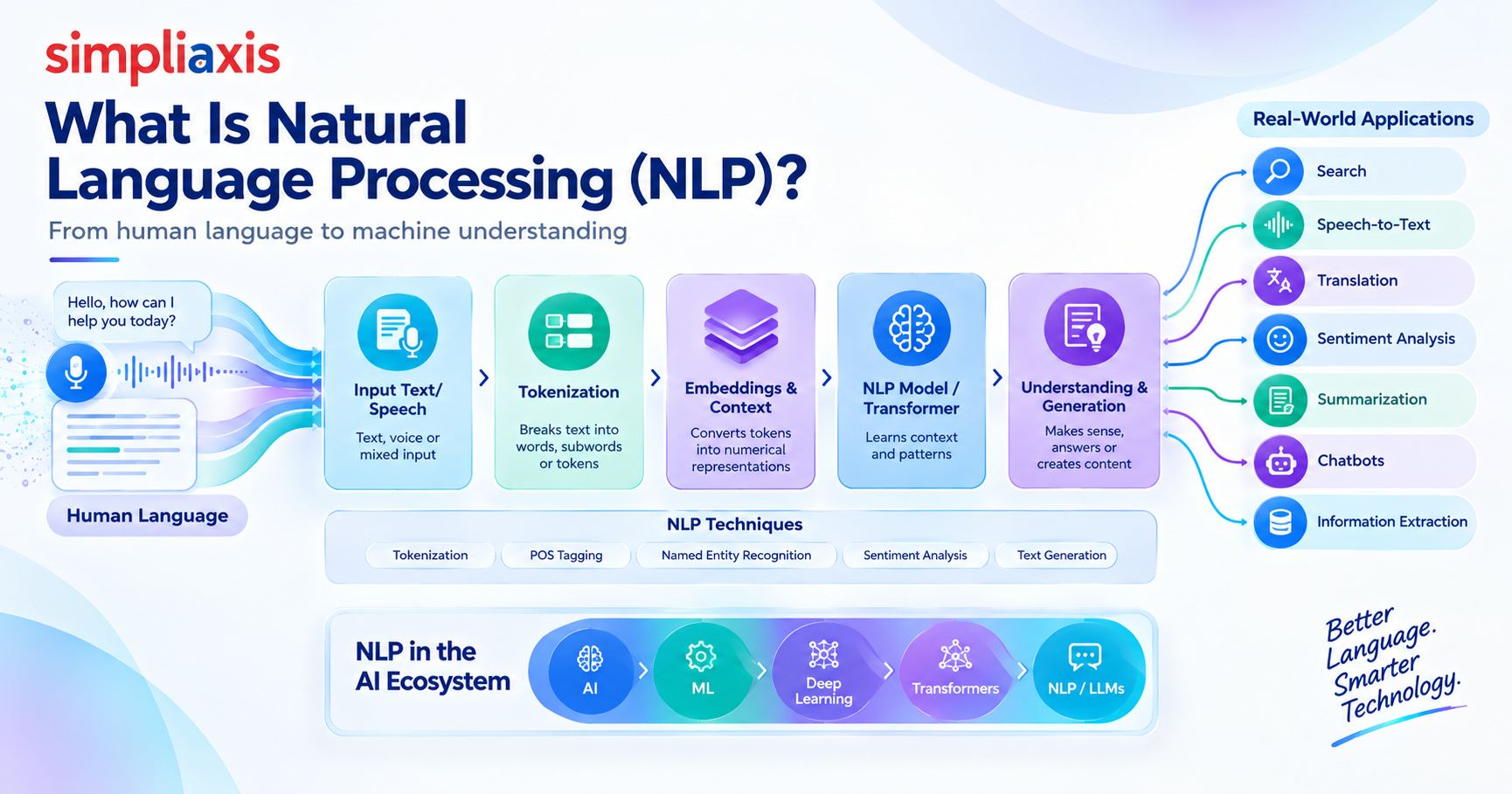
Natural Language Processing (NLP) is a subfield of AI that enables computers to comprehend human language. It helps computers to understand, comprehend, and produce natural language.
Language is inherent in humans. We can read a sentence and know what it means; we can hear the tone and use the circumstances around it to figure out what someone means. This is significantly harder for a machine. A computer does not perceive statements in the same manner that a person does. It needs methods for turning language into information that a machine can process.
NLP is a mix of ideas from several domains, including computer science, linguistics, statistics, machine learning, and deep learning. NLP finds applications in translation, voice recognition, sentiment analysis, text categorization, search, summarization, question answering, and text production. Moreover, it is also a critical component of modern generative artificial intelligence (AI) andlarge language models (LLMs).
You already use NLP in many circumstances in your everyday life. When you convert audio to text, filter out spam, anticipate the next word you’re typing, translate a phrase, categorize customer interactions, or answer a natural-language question, it’s definitely NLP in action.
The sector has witnessed several changes throughout the years. Early systems were heavily dependent on human-written rules. Later methods used machine learning and statistics. Transformer-based models are widely used in NLP applications nowadays.
How Does Natural Language Processing Work?
There is no one method that fits all for every application in NLP. The stages depend on the issue, the data, and the model. But a typical NLP system begins with linguistic input, prepares it, converts it into a form that a model can handle, applies a model or rules, and outputs results.
1. Language Data Collection
The first stage is to receive the text or speech that the system needs to work on. This includes documents, emails, reviews, support messages, transcripts, search queries, social media posts, and other text sources. In speech applications, the input might be an audio recording instead of text.
This data is critical for quality. Incomplete, poorly prepared, biased, or improperly labelled data may influence the ultimate result.
2. Data Preprocessing
Raw language is not always model-ready. The text may include punctuation, spelling changes, extra spaces, numerals, symbols, repetitive sentences, and other elements that may need to be cleaned up.
The most common preprocessing steps are tokenization, lowercasing, stop-word elimination, stemming, and lemmatization. Not all of these methods are employed in all modern NLP systems. Many transformer-based systems in particular employ their own tokenization and don’t fully conform to the usual preprocessing approaches.
Tokenization breaks a piece of text into smaller sections called tokens. A token may be a whole word, a fragment of a word, or any other chunk of text depending on the tokenizer.
For example:
"NLP helps computers comprehend language.
may be divided into smaller parts before further processing.
Stemming takes the word and cuts bits off of the word to reduce it to the root form. Lemmatization attempts to bring a term back to its appropriate dictionary form. For example, terms such as “running,” “runs,” and “ran” may be related to the concept of “run,” albeit the specific nature of this relationship varies by approach.
3. Words Into Numbers
Machine learning algorithms operate on numeric data. So language has to be expressed in numbers. Bag of Words and TF-IDF were employed in older NLP systems. These algorithms count words or assign them weights according to their importance in a manuscript.
Embeddings are common in modern NLP. An embedding is a way of turning language into a vector, or collection of numbers. Words or tokens that are semantically connected might have similar representations.
Context matters. The term “bank” denotes something different in “I deposited money in the bank” and “We sat beside the river bank." Modern models may utilize the words around the word to assist in deciding what it is supposed to convey.
4. Building an NLP Model
Once the input is represented in an appropriate way, an NLP model may be applied to it. The model may have been trained on a particular task. It might, for example, determine whether a piece of text is good or bad, identify people and locations, summarize a document, answer a question, or translate material. Broader models may do several jobs, depending on how they are taught and employed.
5. Generating an Output
The last phase is task-specific. The outcome for sentiment analysis might be favourable, negative, or neutral. For instance, the output for named entity recognition may be a person, location, organization, date, or other thing.
The result for summarization is a condensed form of the original text. Based on some input and the patterns the model acquired during training, the model generates new text.
NLP systems are frequently assessed according to an appropriate quality metric. It is contingent upon the task and the correct measure. For example, a translation system requires different assessment techniques than a sentiment classifier.
What Are the Main NLP Techniques?
There are various NLP techniques. Some are basic ways of processing language, and others employ complicated models of machine learning.
Tokenization
Tokenization splits text into smaller parts. These units may be words, subwords, characters, or other tokens.
This is one of the primary phases in many NLP systems, because models require a tractable representation of the input.
Today’s language models often incorporate subword tokenization. This helps students cope with words they may not have encountered as whole words in training.
Stemming
Stemming cuts words down to a common basis by chopping off bits.
For instance, terms like "connect," "connected," and "connecting" may be reduced to a similar stem.
Stemming is really straightforward, but the stem that you end up with isn’t always a valid word.
Lemmatization
Lemmatization seeks to get the right base or dictionary form of a term.
It often employs more linguistic information than mere stemming. This may make it more beneficial when the precise form of a term is important.
Part-of-speech tagging
Part-of-speech tagging is the process of assigning a grammatical function to a word in a sentence.
It may be used for numerous things based on its use. For example, the word "book" is a noun in the sentence "I read a book" and a verb in the sentence "I will book a room."
Part-of-speech tagging assists a system in determining the function of a word by looking at the context around it.
Named entity recognition
Named entity recognition (NER) detects key entities in text.
These might include:
- Humans
- Locations
- Companies
- Dates
- Products
- Money values
For instance, an NLP system may recognize the name of a person, Paris as a place, and June as a date in a phrase describing a person going to Paris in June.
Sentiment analysis
Sentiment analysis (sometimes called opinion mining) involves determining the attitude or opinion represented in a piece of text.
A simple approach may categorize text as good, negative, or neutral. More powerful systems might detect certain emotions or attitudes.
This might be handy for processing large quantities of feedback from customers, since reading every message manually can take a lot of time.
Text Categorization
Text categorization is the process of assigning text to predetermined categories.
For example, an email system may categorize messages as spam, billing, technical assistance, or general queries.
Topic modeling
Topic modeling is the discovery of common topics from a collection of texts.
Rather than manually labeling every text, a document may be analyzed in an unsupervised manner to find patterns and groupings of words that tend to occur together.
One well-known technique for topic modeling is Latent Dirichlet Allocation (LDA).
Machine translation
Machine translation is the translation of language from one language to another.
Modern translation systems don’t just substitute individual words; they utilize machine learning and deep learning to analyze phrases and their context.
Automatic speech recognition
Speech recognition is the process of converting spoken words into text.
The system must cope with variations in pronunciation, accents, background noise, pace of talking, and casual language.
Text generation
Text generation is the process of generating fresh text from an input or activity.
Modern language models may create several types of texts, including responses, summaries, drafts, etc. Much of the current work in generative artificial intelligence is on text generation.
What Are the Different Approaches to NLP?
NLP has grown in several ways. These techniques are not necessarily fully disjoint, and current systems sometimes include concepts from diverse approaches.
Rule-based NLP
Rule-based NLP employs rules that are written by humans. The system may be provided with grammatical rules, dictionaries, patterns, or if-then instructions. For example, the system may be taught that a specific word pattern is a date or that a particular phrase should be categorized in a particular manner.
Rule-based systems are good for predictable languages and tasks. But human language is always changing, and there are many exceptions. As the system becomes bigger, it becomes hard to provide rules for every potential scenario.
Statistical NLP
Statistical NLP employs statistical approaches in an effort to detect patterns in linguistic data. Instead of spelling out all the rules, the system learns from data the likelihood of certain patterns in a language.
This technique was useful for improving text categorization, tagging, prediction, and other language applications.
Machine learning-based NLP
Machine learningrefers to a process by which a model learns patterns from instances. In supervised learning, the training data has responses, or labels, that are known. For example, you may train a model on messages that have already been tagged as favorable or bad. The model then applies what it learned to forecast fresh messages."
Deep learning-based NLP
Deep learning involves neural networks with several layers to capture intricate patterns. Deep learning has altered NLP by enabling the learning of richer representations from very vast volumes of linguistic data. Recurrent neural networks and other sequence models were heavily employed for language problems until transformer models took over in many domains.
Transformers-based NLP
The attention mechanism in Transformers relates tokens in a sequence to each other. The Transformer architecture was introduced in 2017. The original work demonstrated that an attention-based architecture might be effective for machine translation while also permitting greater parallelization than previous recurrent techniques.
Transformers subsequently constituted the foundation for many current language models and are now crucial to a substantial portion of NLP research and applications.
What Are NLP Models?
An NLP model is a computer system that has been taught or engineered to handle language. Different models have different capabilities. Some models are for one job only. For example, a sentiment model may be intended largely to classify the meaning of a sentence. Other models are more general. They are trained on enormous quantities of text and then prompted or fine-tuned for a plethora of various activities.
Earlier NLP models generally rely on hand-crafted features and statistics. Later systems used neural networks such as recurrent neural networks and convolutional techniques. Transformer models transformed the field by giving us a mechanism to represent interactions between tokens via attention.
Currently, transformer-based models are frequently utilized for categorization, question answering, summarization, translation, text creation, etc. Supported tasks include text, audio, vision, and multimodal systems, which are also included in the documentation of the Transformers library.
Language models
A language model is trained to understand patterns in language and, depending on how it is designed, assign probabilities to sequences of words or anticipate what will come next. Earlier language models tended to function on relatively short sequences. Modern models may take on considerably larger quantities of context.
Pre-trained models
A pretrained model is trained before it is utilized for a specific application. Developers are able to use an existing model and customize it to their requirements, rather than constructing and training a model from scratch. This may decrease the training effort required for a particular NLP activity.
Large language models
Large language models are language models that are trained on extremely large data sets and that frequently include many parameters. They acquire broad patterns from their training data, which allows them to execute a wide variety of linguistic tasks.
What Is the Difference Between NLP, AI, ML, Generative AI and LLMs?
The words are roughly comparable, yet they do not signify the same thing.
AI and NLP
Artificial intelligence (AI) is the name for systems designed to do tasks that would normally need a person to do. Tasks include reasoning, sensing, predicting, planning, and understanding language. NLP is a branch of AI that focuses on human language. So NLP is a component of the broader area of AI.
Machine Learning and NLP
A machine-learning system is a technique for designing systems that can learn patterns from data. In NLP, machine learning is capable of analyzing language. But NLP is more than just machine learning. It has also employed rules, linguistic approaches, statistical methods, and other strategies.
Deep Learning & NLP
Deep learning is a kind of machine learning that employs multi-layered neural networks. Many recent NLP systems include deep learning, specifically transformer-based models.
Gen AI and NLP
Generative AI is a generic name for artificial intelligence systems that can generate fresh content. This information may be in the form of text, photographs, audio, video, or other data. NLP is important because the substance being generated is language. So NLP is the backbone of a lot of generative AI applications, but the two phrases are not synonymous.
NLP and LLMs
An LLM is a kind of language model. The approaches, activities, research, and systems that deal with human language are all included under the umbrella term NLP. LLMs may be utilized for NLP tasks; however, NLP is considerably wider than LLMs. NLP is the discipline that deals with human language and so crosses various fields.
What Are Some Real-World NLP Examples?
Through many of the regular digital encounters you have every day, you already know what NLP is.
Search
Language comprehension may be used by search algorithms to comprehend what someone is looking for, instead of only relying on precise keyword matches. This helps when users use lengthy, conversational, or vague questions. NLP may be used to discern intent and connections of words.
Speech to text
Speech recognition is the process of converting spoken words into printed text by a device. The system processes audio and transforms speech into text.
Spam detection
Email and messaging systems may use language and other indications to filter out undesirable communications.
Bots
Chatbots employ NLP to interpret user messages and provide answers. Simple chatbots could employ fixed rules. More sophisticated systems might include machine learning and language modeling.
Auto-complete
Text prediction systems propose words or phrases based on what has been input so far. The systems analyze patterns of language to forecast probable continuations.
Translate
Translation systems take one language and produce another. Modern machine translation utilizes models that include context rather than translating each word by itself.
Summary of the document
NLP can take large papers and summarize them in simpler forms. This may be beneficial when individuals want to skim over enormous quantities of material.
Sentiment analysis
A system may look at a customer remark or review and infer whether the wording indicates a good, negative, or neutral impression.
Information Extracting
NLP can extract particular pieces of information from documents, such as names, dates, sums, and other pertinent information.
What Are the Applications of NLP by Industry?
NLP is beneficial when businesses have vast quantities of language data or require humans to interact with software in natural language.
Healthcare
Healthcare companies generate vast volumes of textual material. NLP may be used for document processing, information extraction, search, classification, and other language-based activities. It may also be used to analyze clinical material and assist in organizing information.
Healthcare information is often delicate, and errors may be severe; therefore, NLP systems in this domain require extensive testing, strong privacy restrictions, and proper human review.
Finance
Financial institutions handle reports, client communications, papers, news, and other text. NLP may aid in categorizing documents, information extraction, sentiment analysis, searching large bodies of text, and automation of document processing.
Retail
Retail organizations may use NLP to analyze product evaluations, client communications, search inquiries, and help requests. Sentiment analysis may be used to detect prevalent complaints or favorable responses. Language comprehension may also be used by search engines to allow consumers to locate items using natural language.
Legal
A lot of text is involved in legal practice.
NLP can assist in document searching, categorization, information extraction, summarizing, and examining vast bodies of documents. This does not mean there is no place for lawyers. Language is imprecise, and judicial judgments are frequently based on facts and context that a model may not completely comprehend.
Education
NLP may help language learning, automatic feedback, question answering, summarization, text categorization, and other educational applications. It may also assist in digesting enormous amounts of instructional material.
Customer Support
Customer support workers get a lot of inquiries and complaints. NLP may be used to classify incoming conversations, identify intent, route requests, summarize conversations, and assist with automated responses. This will eliminate repetitive activities and enable human agents to focus on more complex concerns.
Media & Publishing
NLP may be useful in organizing massive sets of articles and documents. It can help with things like summarization, topic categorization, search, translation, transcription, and content analysis.
Human Resource
NLP can process job descriptions, applications, surveys, and employee feedback. However, systems that are used to make recruiting or other employee-related decisions need additional consideration, since language models might duplicate patterns or biases that exist in the data used to train them.
Government
Government agencies manage vast volumes of public information, forms, papers, requests, and communication. NLP can categorize, search, summarize, and arrange this information.
What Are the Benefits of NLP?
When utilized and implemented effectively, NLP may provide a range of practical advantages.
Quicker processing
A human can’t handle that much text as quickly as a machine can handle it. This is helpful when an organization has to evaluate thousands or millions of papers.
Automatization
NLP may be used to automate language-based repetitive processes. It may, for example, categorize messages, extract information, provide summaries, or redirect requests.
Enhanced search
Making computers comprehend the context and purpose behind inquiries might make search more effective for natural-language questions.
Easier access to information
Rather than going through a whole text, a person may ask a question, look up a concept, or get a summary.
Customer Service
NLP may process basic consumer inquiries and assist support staff in managing incoming requests.
Unstructured data analysis
“A lot of useful information is in text, not in nice rows and columns. NLP can help transform this unstructured language into information that can be sorted, searched, or analyzed.
Better human-computer interaction
NLP allows for interaction with software in natural language instead of having to go via a set interface for every activity.
What Are the Challenges and Limitations of NLP?
NLP has progressed a lot, yet it is not flawless. Language is hard for humans since meaning relies on context, culture, tone, previous knowledge, and occasionally the speaker’s purpose.
Unclear language
A single word may signify several things. The system must have adequate context to know the meaning correctly.
Humor and sarcasm
People can easily tell when someone is being sarcastic by their tone and the circumstances. A text-based system may not have enough information to recognize it accurately.
Slang and colloquialisms
People utilize acronyms, slang, variances in spelling, emoticons, and unfinished phrases in normal conversation. A system that is mostly trained on formal text could have trouble with this kind of language.
Several languages and dialects
Language varies from country to country and from community to community. Some languages have more training data and resources accessible than others. Dialects and mixed language communication may also cause difficulties.
Context
A statement might signify various things based on what was said before it. Understanding lengthy context is a fundamental task in current NLP research.
Prejudice
Models learn from the data. If the training data includes unfair or biased patterns, a model may replicate some of the patterns. This makes data selection, review, testing, and monitoring critical.
Visions
Generative language models might create output that sounds good but is really inaccurate. This is one of the reasons not to blindly trust material created by others as true.
Privacy Policy
Data in the language may include personal, private, or sensitive information. Therefore, organizations must think about the collection, storage, processing, and sharing of data.
Cost and computational expense
Running large current models may be compute-intensive (and so can training them, depending on the application).
No real human insight
A language model may generate very plausible language without human experience or comprehension. It generates outputs depending on the patterns it has learnt and the way the model processes its input.
This difference is significant, particularly in high-stakes applications.
What Tools and Libraries Are Used for NLP?
There are several tools for developers to create NLP applications. “What’s right depends on the work, the language, the model, the data, and the needs of the project.
Natural Language Toolkit
NLTK stands for Natural Language Toolkit; it is a Python library for processing textual data. It comprises tasks such as classification, tokenization, stemming, tagging, parsing, and semantic reasoning. NLTK is helpful for understanding NLP topics and for using traditional language-processing techniques.
spaCy
spaCy is an NLP library for practical applications. It offers named entity recognition, part-of-speech tagging, text categorization, and other natural language processing procedures. It also has support for more transformer pipeline components.
Hugging Face's Transformers
The Transformers library offers pretrained models for NLP and other machine learning tasks. It has models for text classification, question answering, summarization, text creation, token classification, and more. It also supports models from JAX, TensorFlow, and PyTorch.
Scikit-learn: scikit-learn is a broad-purpose machine learning package that may be used for standard NLP tasks such as text categorization. It may be used to textual numbers and for many machine learning algorithms.
PyTorch and TensorFlow
TensorFlow and PyTorch are machine learning tools to create and train neural network models. These are useful if developers desire additional control over the model training process or wish to build bespoke solutions. The tool you choose depends on the project. You don’t need a large language model if you have a small text classification task.
What Programming Languages Are Used for NLP?
Python
Python is one of the most popular NLP programming languages. A big factor is its enormous library of machine learning and NLP tools. For example, NLTK and spaCy are NLP tools accessible in Python, and Transformers also offers processes for Python.
Python is the most used language for data preparation, model training, assessment, experimentation, and deployment.
Java
Java may be utilized as well for NLP applications, especially if Java is already part of the technological stack of bigger software systems.
R is a very popular tool for statistics and data analysis. It is also useful for text analysis and NLP, particularly when language processing is a step in a broader statistical workflow.
Javascript & Typescript
When NLP features need to be run in web apps or JavaScript services, JavaScript and TypeScript might be handy. Some recent model libraries also offer running models based on machine learning in the browser or JavaScript environments.
The appropriate programming language relies on the application, the current system, the libraries available, and the competence of the team.
How Is NLP Used in Generative AI and LLMs?
Text-based generative AI is partly based on NLP. A generative language system has to handle a user’s language input, represent that language in a way that the model can use, recognize connections between words, and generate language.
Modern LLMs use transformer-based topologies. The initial Transformer article established an attention-only architecture, and subsequent transformer-based research produced numerous popular language models.
Tokenization
Given text as an input, a language model first tokenizes the text.
Tokens may be words, sections of words, punctuation, or other textual elements.
The model doesn't operate with raw human language as a person does; it works with these tokens.
Representations and Embeddings
Tokens are represented as numbers so the model may do mathematical computations on them. They allow the model to learn links between words and other tokens.
Attention
Attention enables a transformer model to attend to relations between distinct portions of an input. For instance, the meaning of a word toward the end of a phrase could rely on something much earlier in the text. The attention mechanism lets the model assign different weights to various sections of the input.
Trainier
Large language models are trained on extremely large data corpora. The model learns patterns in language during training by adjusting its parameters. A popular training procedure is to anticipate tokens based on their surrounding environment. It depends on the particular model. The training method is different.
Fine Tuning
Sometimes a pretrained model may be fine-tuned (with further training) to a specific task/data type. Fine-tuning may help a model perform better for a certain use case.
Prompting
Users may also direct a model with instructions. A prompt is a set of instructions or context for the model that informs it what type of output you want. Prompting does not alter the basic parameters of the model. It modifies the input into the model.
Retrieval and External Information
Some generative artificial intelligence systems link language models to external sources of information. This may offer a model access to information that is not in its initial training data. One example of this method is termed retrieval-augmented generation, or RAG.
NLP is engaged in many phases of this process, from analyzing the user’s inquiry to searching, ranking, extracting, and producing language.
Key Takeaways
- NLP (Natural Language Processing) is a subfield of AI that enables computers to interpret, comprehend, and produce human language.
- NLP deals with text and voice.
- NLP often includes methods such as tokenization, stemming, lemmatization, part-of-speech tagging, named entity identification, sentiment analysis, and text classification.
- NLP has evolved from rule-based and statistical approaches to machine learning, deep learning, and transformer-based systems.
- Typical NLP tasks include translation, summarization, question answering, voice recognition, sentiment analysis, information extraction, and text production.
- NLP is bigger than LLMs. LLMs are one sort of language model that is utilized for numerous NLP tasks.
- NLP, AI, machine learning, deep learning, generative AI, and LLMs are separate but related topics.
- Industries that employ NLP include healthcare, banking, retail, legal, education, customer service, media, and government.
- The key advantages of NLP include automation, quicker text processing, improved search, simpler access to information, and analysis of enormous volumes of unstructured data.
- NLP still has the issues of ambiguity, sarcasm, slang, context, prejudice, privacy, linguistic disparities, processing costs, and wrong model outputs.
- Popular NLP tools include NLTK, spaCy, Transformers, scikit-learn, TensorFlow, and PyTorch.
- Python is one of the most popular languages for NLP since it offers an extensive ecosystem of NLP and machine learning packages.
- Transformers are the heart of contemporary NLP and the core of many state-of-the-art language models.
- The reason why NLP is an active and vital science is that humans continue to produce and convey vast quantities of information in the form of language.








 Lowest-Price Challenge












 Personalized Path



.webp)


 USA
 Canada
 India
 UK
 Australia
 Singapore


