


 Call Us



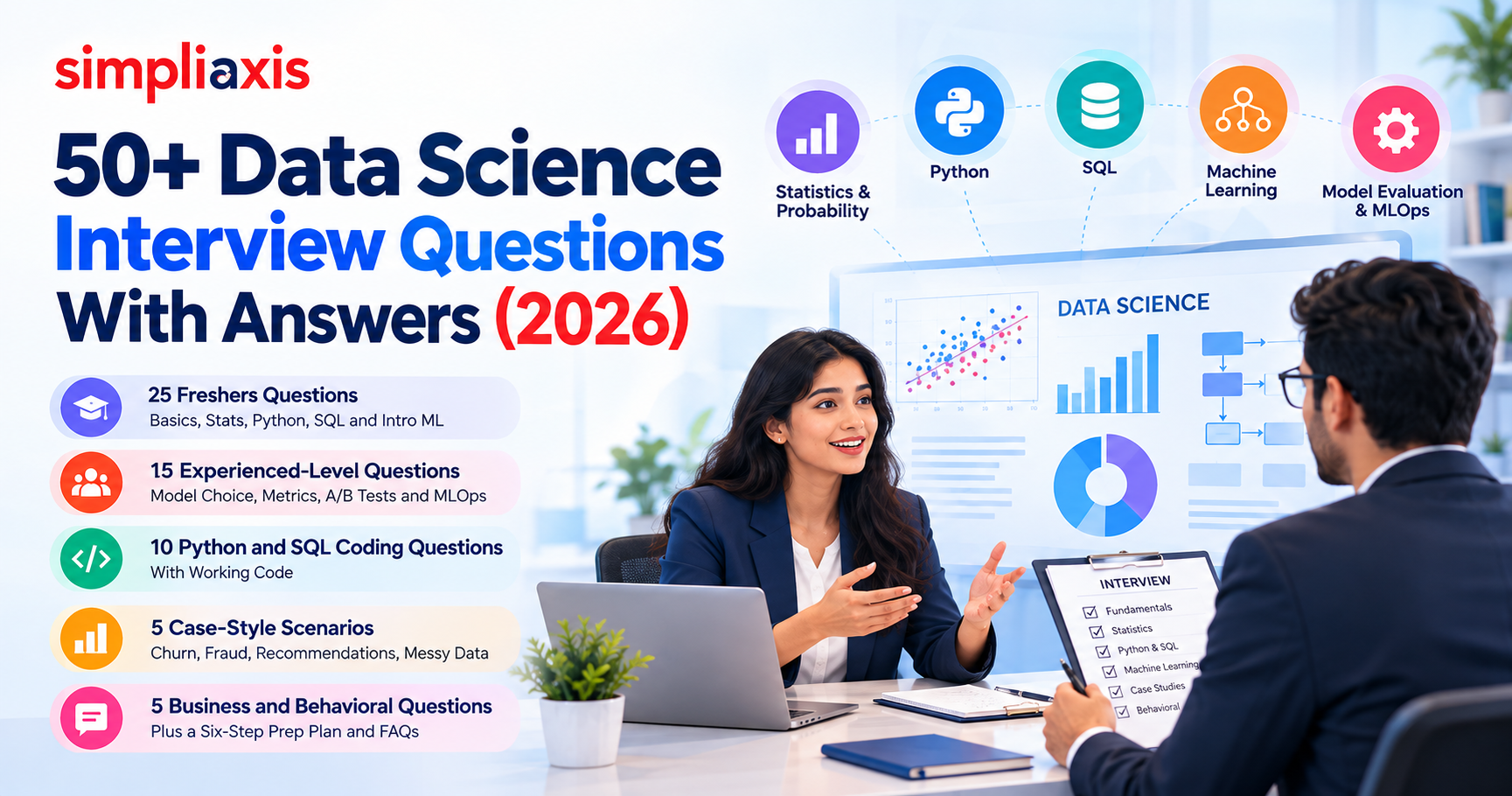
Here are 60 data science interview questions with short, practical answers you can actually say out loud in a 2026 interview. They're split by level: freshers, experienced folks, coding rounds, case studies, and behavioral rounds. You'll need fundamentals, stats, Python, SQL, ML, and model evaluation. But don't stop there. Most companies hire based on how well a candidate explains their thinking and ties it back to the business.
Key Highlights of Data Science Interview Questions
• 25 fresher questions, basics, stats, Python, SQL, and intro ML
• 15 experienced-level questions on model choice, metrics, A/B tests, and MLOps
• 10 Python and SQL coding questions, each with working code
• 5 case-style scenarios (churn, fraud, recommendations, messy data)
• 5 business and behavioral questions
• A six-step prep plan and answers to common FAQs
Introduction
Suppose a candidate defines gradient boosting perfectly. Then the interviewer asks, "Why not logistic regression here?" and the room goes quiet. That's the real gap. Interviews care less about what you've memorized and more about whether you can use it. Use these data science interview questions based on where you are:
What Do Data Science Interviews Test?
Strip away the format and every round is asking the same thing: can you take a fuzzy business question and turn it into something reliable and useful? That’s one of the core roles and responsibilities of a data scientist.
Data Science Fundamentals Interview Questions
Think project lifecycle, EDA, cleaning, and feature engineering. The trap here is reciting steps. Interviewers would rather hear why a step exists and what goes wrong when you skip it.
Statistics and Probability Interview Topics
Almost every modelling or experiment decision rests on stats. You'll get asked about spread, distributions, hypothesis tests, and correlation versus causation. Get the p-value wrong and you'll feel the mood shift. It's a common stumble.
Python and SQL Skills Tested in Data Science Interviews
Can you clean and summarize a dataset in pandas without Googling every line? Can you write a join, a GROUP BY, and a window function under time pressure? Plenty of companies test exactly that, live or as a take-home.
Machine Learning Fundamentals Tested in Interviews
Nobody's impressed that you can name fifteen algorithms. They want to know if you understand overfitting, can pick a metric that fits the problem, and can defend your model choice. A few ideas understood deeply beat a long list skimmed. If you want to know from the basics, start with: what is machine Learning?
Data Science Interview Questions for Freshers
If you're a fresher, the interviewer isn't expecting magic. They're checking your foundation's knowledge. Can you reason through basic stats, write simple Python and SQL, and explain what a model does? Get these right and you're already ahead of a lot of applicants. A structured data science training course can help you cover these basics in order.
Basic Data Science Interview Questions
1. What is data science?
Basically, it's data that makes people better decision makers. Think of a bank spotting fraud or an app guessing which users might leave. Add one real example like that in your answer. It shows you get the point of the job. If you are asked how it’s different from analytics, you should compare data science vs data analytics.
2. What are the main steps in a data science project?
Most of the data science projects define the problem, gather data using the right data collection methods, clean and explore it, build features, train and evaluate models, then deploy or present what you found, and keep an eye on it afterwards. In practice it's messy. A weak model often sends you straight back to cleaning or feature work, and that's normal.
3. What is exploratory data analysis?
EDA is getting to know your data before you model anything, and it’s the first stage in most data analysis methods and processes. You look at distributions, missing values, odd outliers, and how variables relate, usually with quick summaries and plots. A histogram can reveal a broken column in five seconds. That's the kind of thing you want to catch early, not after training.
4. What is data preprocessing?
Real data looks messy. Data Preprocessing is the cleanup: fixing missing values, dropping duplicates, correcting data types, encoding categories, and scaling numbers. Skip it and your model happily learns from typos and junk.
5. What is Feature Engineering?
Feature Engineering refers to reshaping raw data into inputs a model can actually learn from. Say you have a signup_date. On its own it's not very useful, but days_since_signup might predict churn nicely. Good features often help more than swapping to a fancier algorithm.
Statistics and Probability Interview Questions
6. What is the difference between mean, median, and mode?
Mean is the average. Median is the middle value once everything's sorted. Mode is whatever shows up most. When data is skewed, go with the median. Picture ten salaries where one person earns 100 times the rest. The mean jumps; the median barely moves.
7. What is variance and standard deviation?
Both tell you how spread out the data is. Variance averages the squared gaps from the mean. Standard deviation is just its square root, which brings it back to the original units. That's why people quote it more. "Delivery takes 30 minutes, give or take 5" is a standard deviation in plain English.
8. What is probability?
It’s a number between 0 and 1 that tells you how probable something is. Zero means it is not happening, one means it is, and a fair coin landing heads is 0.5. This is all over data science, from classifier scores to hypotheses.
9. What is a p-value?
Imagine the null hypothesis is true. The p-value is the chance of getting a result at least as extreme as the one you saw. If it's small (say under 0.05), your data looks unlikely under the null, so you may reject it. Careful, though. It is not the probability that the null is true, and a tiny p-value doesn't mean the effect is big. The American Statistical Association makes the same point in its statement on p-values.
10. What is the difference between correlation and causation?
Correlation just means two things move together. Causation means one actually drives the other. Ice cream sales and drownings both climb in summer, yet nobody thinks ice cream causes drowning. Hot weather is behind both. If you want to claim a cause, you usually need an experiment or proper causal analysis.
Python Data Science Interview Questions
11. Why is Python used in data science?
Easy to read, easy to write, and the libraries are awesome. Pandas and NumPy for data. Scikit-learn for ML. Matplotlib and Seaborn for charts. PyTorch for deep learning. The community is huge, so someone has usually solved your problem already. And the same code can move from a notebook into production without a rewrite. That’s also why most Python programming training for analysts starts with pandas and NumPy.
12. What is the difference between a list, tuple, set, and dictionary?
| Type | Ordered | Mutable | Duplicates | Example |
| List | Yes | Yes | Allowed | [1, 2, 2] |
| Tuple | Yes | No | Allowed | (1, 2) |
| Set | No | Yes | Not allowed | {1, 2} |
| Dictionary | Yes (3.7+) | Yes | Unique keys | {"a": 1} |
13. What are pandas used for?
Pretty much anything involving tables. You load a CSV into a DataFrame, then filter, clean, merge, group, and reshape it. If you're doing EDA in Python, you're almost certainly doing it in pandas.
14. What is NumPy used for?
Quick calculations. NumPy gives you arrays and vectorized math that runs in optimised C so it is a lot faster than looping over Python lists. pandas and scikit-learn both sit on top of it, which is why you'll bump into NumPy even when you didn't import it directly.
15. How do you handle missing values using Python?
First, identify them using df.isnull().sum() What you do next depends on the context. If only a handful of rows are affected, dropna() is fine. For more, you might fill gaps with the median or mode using fillna(). Sometimes the fact that a value is missing is itself useful, so you add a flag column. Before any of that, ask why it's missing.
SQL Interview Questions for Data Science
16. What is the difference between WHERE and HAVING?
WHERE filters individual rows before any grouping happens. HAVING filters the groups afterwards.
| SELECT department, AVG(salary) AS avg_salary FROM employees WHERE status = 'active' GROUP BY department HAVING AVG(salary) > 60000; |
17. What are SQL JOINs?
A JOIN takes rows from two tables and links them based on some common column like customer_id. INNER JOIN keeps only the matches. LEFT JOIN keeps everything from the left table and leaves NULLs where there's no match. RIGHT JOIN flips that, and FULL OUTER JOIN keeps the lot.
18. What is GROUP BY used for?
Summarizing. You bundle rows that share a value, then run COUNT, SUM, or AVG on each bundle. Group orders by region, sum the amount, and you've got revenue per region.
19. What is a subquery?
It’s a query within a question. Here the inner query computes the average salary and the outer query uses it as a filter:
| SELECT name, salary FROM employees WHERE salary > (SELECT AVG(salary) FROM employees); |
20. What are window functions?
when you calculate across related rows while keeping every row in the output. That's the big difference from GROUP BY, which squashes rows together. You'll use ROW_NUMBER() to number rows, RANK() to rank them with ties, and SUM() OVER() for running totals. Expect at least one of these in any SQL round. The PostgreSQL window functions tutorialwalks through RANK() and running totals with examples.
Machine Learning Interview Questions for Freshers
For a deeper set of ML-only questions, see our machine learning interview questions and answers.
21. What is machine learning?
Instead of writing rules by hand, you show a model lots of examples and let it figure out the pattern. A spam filter is the classic case. Feed it thousands of emails marked spam or not spam, and it learns to sort new ones on its own.
22. What is the difference between supervised and unsupervised learning?
It comes down to labels. Supervised learning trains on data where you already know the answer, like past house sales with their prices. Unsupervised learning has no answer key; it looks for structure, such as grouping shoppers into segments. Ask yourself: is there a target column?
23. What is the difference between classification and regression?
Both are supervised. Classification predicts a category, like "will this loan default, yes or no?" Regression predicts a number, like next month's sales. One small gotcha interviewers love: logistic regression is actually used for classification.
24. What is overfitting and how can you prevent it?
Overfitting is when the model learns the training data, including the noise, and then does not perform well on new data. To fight it: Use cross-validation. Keep the model simpler or add L1/L2 regularisation. Get more data. Drop features that do not help. Stop training early for models that learn in rounds.
25. What is the difference between training and testing data?
The model learns from the training set. The test set stays locked away until the end. So, you can see how it handles data it's never met. Testing on training data is like grading students on questions they've already seen the answers to. An 80/20 split is common, often with a validation set for tuning.
Data Science Interview Questions for Experienced Professionals
Once you have a few years behind you, nobody will ask you to define regression. They'll ask what you'd do, and why. Expect questions about model choice, metrics, experiments, and keeping models alive in production.
Advanced Machine Learning Interview Questions
At this level, interviewers expect the depth covered in an applied artificial intelligence course: model choice, tuning and ensembles.
26. How do you select the right machine learning algorithm for a problem?
I'd start with the problem, not the algorithm. Is it classification, regression, ranking, or forecasting? How much data is there, and is it tabular or text and images? A few thousand rows of tabular data rarely need deep learning.
Then come the constraints. In lending or healthcare, you may need a model you can explain. A real-time app has strict latency limits. And training budgets are real.
My usual move: get a simple baseline working, then only add complexity if it clearly earns its place.
27. What is cross-validation and when should you use it?
Rather than trusting one train/test split, you rotate. In k-fold cross-validation the data is cut into k chunks, and each chunk takes a turn as the validation set. You get a steadier estimate of performance. It's especially handy with small datasets and when comparing models. One exception: with time series, always split by time, or you'll end up training in the future. For implementation details, see scikit-learn’s guide to cross-validation, including TimeSeriesSplit for time-ordered data.
28. How does hyperparameter tuning work?
Hyperparameters are the control knobs that you turn before training, like tree depth, or learning rate. Tuning means trying different settings and keeping what works best on validation data. Grid search checks every combination, which gets slow fast. Random search samples combinations and often finds something good sooner. Bayesian optimization is smarter still; it learns from earlier tries to pick the next one. Whatever you use, keep the test set out of it.
29. How do ensemble methods improve model performance?
The idea is that a group of models makes fewer mistakes than one alone. Random Forest works this way. Boosting builds models one after another, each fixing what the last one got wrong, which mostly cuts bias. Gradient Boosting, XGBoost, and LightGBM are the usual favourites for tabular data.
30. How would you handle an imbalanced dataset?
First, forget accuracy. If only 1% of cases are positive, a model that always says "no" scores 99% and catches nothing.
I'd look at precision, recall, F1, or PR-AUC instead. Then I'd try class weights so mistakes on the rare class cost more, or resample the training data (undersampling, or oversampling with something like SMOTE). Moving the decision threshold often helps a lot too. Boosted tree models tend to cope well with imbalance, so they're a sensible place to start.
Model Evaluation and Experimentation Questions
31. When would you use precision instead of accuracy?
When false alarms are expensive and one class is rare. Take a spam filter. If it dumps a real job offer into spam, that's a big problem. You want anything it flags to really be spam, which is what precision measures. Accuracy won't show you this, because most emails are fine anyway.
32. What is the difference between precision, recall, and F1 score?
Precision asks: of everything the model flagged, how much was right? That's TP / (TP + FP). Recall asks: of all the real positives, how many did we catch? That's TP / (TP + FN). F1 is the harmonic mean of the two, a single number when you care about both. Push one up and the other usually drops, so the right balance comes down to which mistake costs more.
33. When should ROC-AUC be used?
ROC-AUC tells you how well a model ranks positives above negatives, across every possible threshold. 0.5 is a coin flip, 1.0 is perfect. It's great for comparing models when the classes are fairly balanced. With heavy imbalance, though, it can look better than it should, since the false positive rate stays small even with lots of false alarms. PR-AUC usually tells a more honest story there.
34. How would you choose an evaluation metric for a business problem?
Ask what each kind of mistake costs. Missing a sick patient is far worse than a false alarm, so screening leans on recall. A marketing campaign with a small budget might care more about precision. For forecasts, MAE is easy to explain, while RMSE punishes big misses harder. Most importantly, agree on the metric with the business before you start building.
35. How would you design an A/B test?
I'd walk through it in order:
1. Start with a clear hypothesis, example: "a new checkout button raises conversion".
2. Create a control (existing design) and treatment (new design) group.
3. Randomly assign users to make the groups comparable.
4. Pick one main metric and guardrails such as revenue per user.
5. Use power analysis to calculate sample size based on the smallest effect worth detecting.
6. Fix the duration upfront and cover full weekly cycles.
7. Run the planned statistical test at the end, and don't keep peeking.
8. Decide in advance what result means "ship it."
Machine Learning Deployment and MLOps Questions
These questions test whether you understandMLOps, the practice of deploying, monitoring and retraining models in production.
36. How would you deploy a machine learning model?
Bundle the model with its preprocessing so nothing gets out of sync, and version both. Then serve it, either as a REST API for real-time predictions or as a scheduled batch job. Docker keeps environments consistent, and knowing howDocker and Kubernetes work together helps when models need to scale. Test it, roll it out gradually with a shadow or canary release, and switch on logging and monitoring from day one. Batch or real-time depends on how fast the business needs answers.
37. What is data drift?
Data drift happens when the data your model encounters in production begins to deviate from the training data. A credit model built in good times might suddenly see very different income and spending patterns during a downturn. Teams usually catch it with statistical tests or a metric like the Population Stability Index (PSI).
38. What is model drift?
It's when a model slowly gets worse at its job. Often the cause is concept drift, meaning the link between inputs and outcome has changed. Fraud is the textbook example: fraudsters change tactics, so yesterday's patterns stop working. Shifting input data can play a part too.
39. How would you monitor a model in production?
I'd watch a few layers at once. Once true labels come in, track prediction quality. Keep an eye on data quality too, such as missing values, schema changes, or numbers out of range. Then check for drift in the inputs and in the predictions. On the engineering side, watch latency, error rates & don't forget the business KPI the model was meant to move. Set alerts on all of it so you hear about problems before users do.
40. When should a machine learning model be retrained?
When there's a reason to, not just because a calendar says so. Good reasons include strong drift, a measurable drop in performance, business changes like new products or pricing, or a fresh batch of labelled data. Some setups do retrain on a schedule, like weekly demand forecasts, and that's fine. Either way, test the new model against the current one before you swap it in.
Python and SQL Technical Interview Questions
In a coding round, clean and correct beats clever every time. The tasks below come up again and again, live and in take-homes. Try writing each one yourself before you peek at the answer.
Python Coding Questions for Data Science
41. How would you remove duplicate values from a dataset using Python?
| df = df.drop_duplicates() # full-row duplicates df = df.drop_duplicates(subset=["customer_id"], keep="last") # by column |
I'd run df.duplicated().sum() first. It's good to know how many rows you're about to lose.
42. How would you identify and handle missing data using pandas?
Count the gaps column by column, then deal with each one on its own terms:
| print(df.isnull().sum()) df["age"] = df["age"].fillna(df["age"].median()) df["city"] = df["city"].fillna("Unknown") df = df.dropna(subset=["target"]) |
Rows with no target value usually just get dropped. You can't train on them.
43. How would you group and aggregate data using pandas?
Reach for groupby() with agg():
| summary = df.groupby("region").agg( total_sales=("sales", "sum"), avg_order=("sales", "mean"), orders=("order_id", "count"), ).reset_index() |
44. How would you merge two datasets using pandas?
pd.merge() is basically a SQL join. The how argument picks the type:
merged = pd.merge(orders, customers, on="customer_id", how="left")
Always check the row count afterwards. If it suddenly balloons, one table probably has duplicate keys.
45. How would you optimize a Python data-processing operation?
First, I would profile the code using %timeit or cProfile to find the actual bottleneck. Then I would replace row-by-row loops or apply() with vectorized Pandas or NumPy operations where possible. I would also use efficient built-ins like merge, groupby, and isin, optimize data types, and process large files in chunks. For very large datasets, I may use tools like Polars, Dask, or Spark.
SQL Coding Questions for Data Science
46. How would you find duplicate records using SQL?
Group on whatever columns define "the same record," then keep groups with more than one row:
| SELECT email, COUNT(*) AS occurrences FROM customers GROUP BY email HAVING COUNT(*) > 1; |
47. How would you find the second-highest value in a table?
This version copes with ties and runs on nearly any database:
SELECT MAX(salary) AS second_highest If they follow up with "what about the fifth highest?", switch to DENSE_RANK() |
48. How would you rank records using a window function?
| SELECT name, department, salary, RANK() OVER (ORDER BY salary DESC) salary_rank FROM employees; |
RANK() gives the same rank to tied rows and skips the next number (1, 1, 3). ROW_NUMBER() does not repeat a number. DENSE_RANK() allows ties and does not have gaps. It's a nice bonus point to know all three.
49. How would you calculate a running total using SQL?
| SELECT order_date, amount, SUM(amount) OVER (ORDER BY order_date) AS running_total FROM orders; |
Want it per customer? Add PARTITION BY customer_id inside the OVER() clause.
50. How would you identify the top-performing records within each category?
Rank within each category using PARTITION BY, then filter on the rank:
| WITH ranked AS ( SELECT category, product_name, revenue, ROW_NUMBER() OVER (PARTITION BY category ORDER BY revenue DESC) AS rn FROM products ) SELECT category, product_name, revenue FROM ranked WHERE rn <= 3; |
That gives the top three products in each category. If ties should all show up, use RANK() instead.
Scenario-Based Data Science Interview Questions
There's no answer key for these. The interviewer wants to see how you break down a vague problem, what you ask before diving in, and which trade-offs you notice. So talk through your thinking, even the parts you're unsure about.
Business Problem Scenarios
51. How would you build a customer churn prediction model?
I'd begin by pinning down what churn actually means for this business. For a subscription app, maybe it's "didn't renew within 30 days of expiry." That definition shapes everything else.
Next comes the data: usage logs, billing, support tickets, plan details. I'd build a yes/no target over a fixed time window, and I'd be careful that no future information sneaks into the features. Useful signals tend to be things like falling logins, short tenure, recent complaints, and failed payments.
For modelling, logistic regression makes a good baseline, then gradient boosting. I'd judge it on precision and recall for churners and on how well it ranks the riskiest customers. Once it's live, scores could go to the CRM every week.
The part people forget is action. Give retention offers to high-risk, high-value customers, and keep a holdout group so you can prove it worked. A prediction no one acts on is worth nothing.
52. How would you approach a fraud detection problem?
Start by asking how fraud gets confirmed. Chargebacks can take weeks, so labels arrive late. Then expect heavy imbalance, often well below 1% fraud.
The features that usually pull their weight are how fast transactions are happening, amounts that are unusual for that user, new devices or locations, and risky merchants. Gradient boosting is a strong pick for tabular data, and anomaly detection can catch new patterns nobody has labelled yet.
I'd evaluate with precision, recall, and PR-AUC, then set the threshold based on cost. Blocking honest customers annoys them, but missed fraud loses money. And monitor closely, because fraudsters adapt. Drift is basically guaranteed.
53. How would you build a recommendation system?
I'd ask what we're optimizing first: clicks, purchases, or people coming back next month? The answer changes the design.
Then there are three broad routes. Collaborative filtering recommends what similar users liked. It's powerful, but it struggles with brand-new users and items, the cold-start problem. Content-based methods match item attributes to what someone liked before, which helps new items get seen. Most real systems are hybrids of the two. I'd test offline with precision@k or NDCG, then confirm it with a live A/B test.
Data and Model Decision Scenarios
54. What would you do if your model performs well on training data but poorly on test data?
That smells of overfitting, but I'm not going to jump to fixes right away. First, I’d rule out data leakage, a bad split, or a test set that comes from a different population. “If it’s really overfitting, I would simplify the model, add regularisation, drop noisy features, get more data, or use early stopping. I would then run cross-validation again to see if the gap has really closed.
55. How would you approach a dataset with significant missing or inconsistent data?
- Profile the data: How much is missing or inconsistent, and in which columns or segments?
- Understand why data is missing: A random gap is very different from a field that only started being collected last year.
- Validate inconsistencies: Check units, formats, impossible values, and duplicates, and talk to whoever owns the data.
- Select an appropriate treatment: Drop, impute, flag, or get it fixed at the source.
Business and Behavioral Data Science Interview Questions
Plenty of strong technical candidates get turned down at this stage. Senior interviewers want to know if you can work with non-technical people, defend a call, and connect your models to money, time, or risk. Some of these practices overlap with HR interview questions and answers. So, it’s important to prepare for both.
Business Understanding Questions
56. How would you explain a machine learning model to a non-technical stakeholder?
Leave the algorithm out and talk about their problem. Something like: "This model picks out customers likely to cancel next month. The biggest warning signs are dropping usage and recent complaints. It catches about seven in ten customers who leave, though it's less reliable for people who signed up recently. Practically, your team could call the top 500 at-risk customers each week."
That covers the goal, the drivers, the results, the limits, and what to do next, all without jargon. A simple chart or one real example usually lands better than any metric.
57. How would you determine whether a data science project has delivered business value?
Compare against what would have happened without it. Ideally that means a holdout group or a proper experiment, not a before-and-after guess. Then look at the KPI the project was meant to move, whether that's churn, conversion, or fraud losses. Turn it into money where you honestly can. Count operational gains like hours of manual review saved. And check adoption. A brilliant model sitting unused hasn't delivered anything.
Behavioral Questions
58. Tell me about a challenging data science project you worked on.
The STAR format works well here: Situation, Task, Action, Result. Pick something real, whether from a job, an internship, or a solid personal project.
Set the scene quickly. Say what you were responsible for. Then spend most of your time on the action: the decisions you made, the messy data or changing requirements you ran into, and why you chose one path over another. Close with the result, using numbers if you have them, and one thing you'd do differently next time. That last bit shows maturity.
59. How would you handle disagreement with a stakeholder about your analysis?
Get curious before you get defensive. Stakeholders often know something the data doesn't. I'd ask what's bothering them, recheck my assumptions, and go through the evidence together.
60. What would you do if your analysis produced unexpected results?
Don't celebrate yet, and don't panic either. Verify first:
1. Data quality. Is a pipeline broken? Any duplicates, bad filters, or changed definitions?
2. Assumptions. Do they still hold?
3. Methodology. Recheck joins, aggregations, and code logic.
4. Statistical significance. Could it just be noise?
5. Reproducibility. Rerun it, ideally with someone else looking over your shoulder.
6. Alternative explanations. Seasonality, a product change, or a hidden confounder.
If the result still holds up after all that, you may have found something genuinely worth sharing.
How to Prepare for a Data Science Interview?
1. Review data science fundamentals: Go back over the project lifecycle, EDA, cleaning, and feature engineering. For each idea, write two sentences in your own words. If you can't, you don't know it well enough yet.
2. Strengthen Python and SQL: Do a few pandas and SQL problems every day for two or three weeks. Joins, group-bys, window functions, and cleaning tasks matter most. Put a timer on so you get used to the pressure.
3. Revise statistics and machine learning: Prioritize p-values, distributions, overfitting, the bias-variance trade-off, and metrics. Focus on when you'd use each one, not just the formula.
4. Practice scenario-based questions: Take a problem like churn or fraud and sketch a full solution in 15 minutes. Then go back and see what you missed.
5. Review projects and past work: Pick two or three projects you can talk about in depth: the problem, your choices, the trade-offs, the outcome. If you need ideas, start with these machine learning project ideas. Anything on your resume is fair game for follow-ups.
6. Practice explaining technical concepts clearly: Explain a model to a friend who doesn't work in tech. If they follow you, you're in good shape for the stakeholder round.
Conclusion
Memorizing definitions will only get you so far. What interviewers really look for is someone who can explain ideas clearly, write working Python and SQL, use statistics properly, think through ML problems, judge a model honestly, care about business impact, and talk to stakeholders like a colleague.
You won't know every answer, and nobody expects you to. A calm, structured attempt at an unfamiliar question often impresses more than a perfect textbook line. Work through these steadily, practise out loud, and treat each interview as practice for the next one, whether you’re targeting data science or the wider job opportunities with AI.








 Lowest-Price Challenge











 Personalized Path


.webp)


 USA
USA  Canada
  India
India  UK
UK  Australia
  Singapore


