


 Call Us




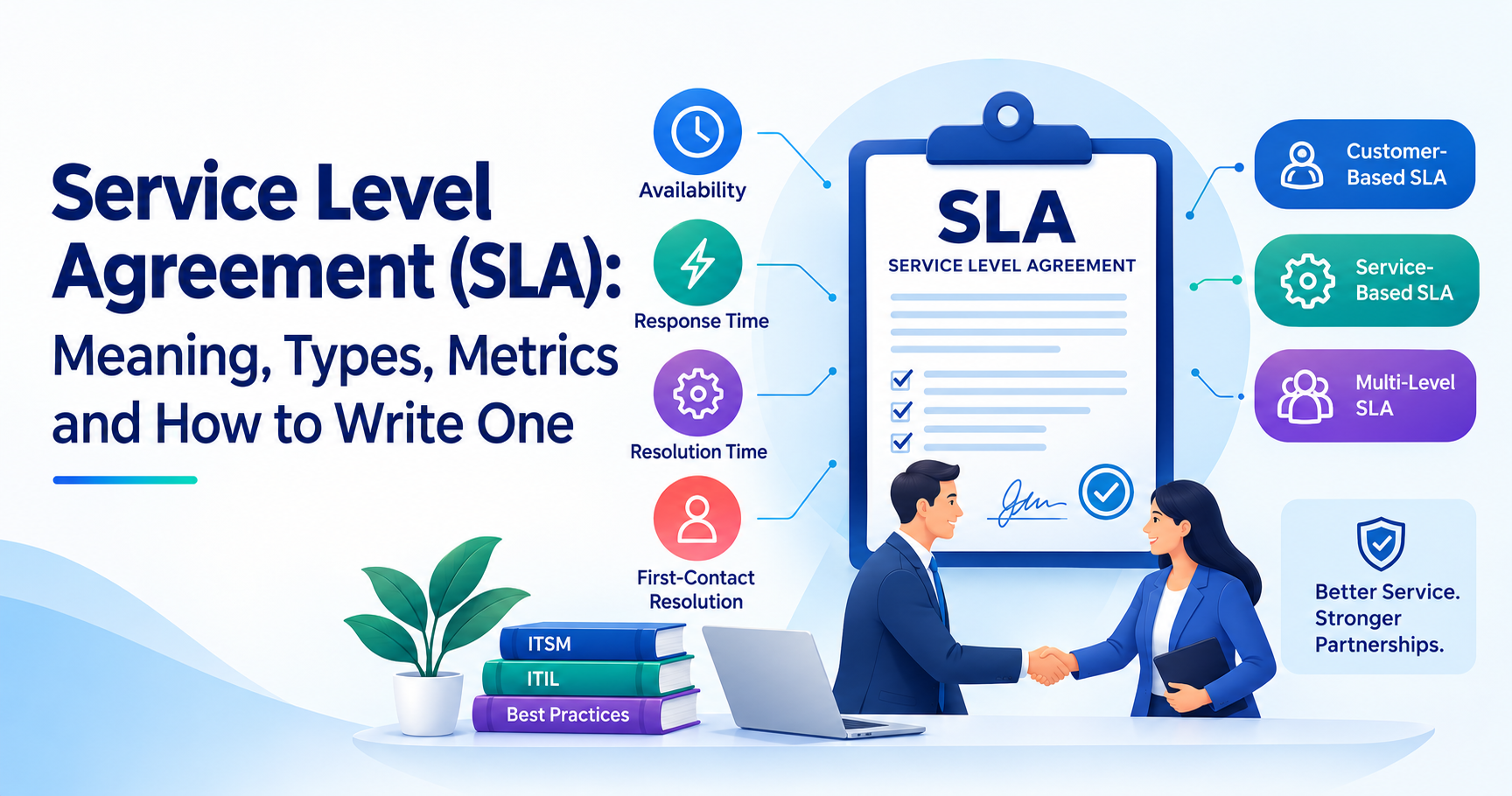
A Service Level Agreement (SLA) is an agreement between a service provider and a customer that defines the level of service expected, including measurable targets, responsibilities, and consequences if the targets are not met. An SLA doesn’t just promise good service, it sets clear expectations on availability, response times, issue resolution and accountability.
An SLA will typically define the scope of the service, metrics for performance, reporting mechanisms, escalation procedures, exclusions and remedies for service failures. It is widely used in IT support, cloud computing, telecom, software-as-a-service (SaaS) and managed services.
Key Highlights
- An SLA defines the service standards a provider agrees to deliver to a customer.
- The three main types of SLA are customer-based, service-based, and multi-level.
- Common SLA metrics include availability, response time, resolution time, and first-contact resolution.
- An SLA differs from an SLO, SLI, OLA, and KPI in its purpose and level of accountability.
- ITIL practices help organizations establish, monitor, and improve service level agreements.
- A well-written SLA specifies measurable targets, reporting procedures, escalation paths, and remedies for breaches.
- Regular reviews help keep service commitments aligned with changing business requirements.
Introduction
When a business outsources its cloud hosting, IT support, cybersecurity or software applications to an external provider, one question is paramount: what level of service can it realistically expect?
The answer to these questions is a Service Level Agreement (SLA). It converts expectations into measurable commitments.
SLAs are critical as organizations increasingly rely upon interconnected technology services and third-party vendorsThe report, Annual Outage Analysis 2024, finds that large outages continue to cost companies more than $100,000 per incident based on the Uptime Institute’s annual outage survey and incident research (Uptime Institute – Annual Outage Analysis). This points to the importance of concentrating on availability commitments, incident management and clear responsibility. This is not a universal outage cost estimate, but it does show the potential business risk.
What Is a Service Level Agreement?
A Service Level Agreement (SLA) is a formal contract between a service provider and a customer that specifies service expectations, performance goals, responsibilities, and remedies for failing to meet agreed-upon standards.
A typical SLA includes service scope, availability, response and resolution times, and monitoring and reporting. For example, a software provider might commit to 99.9% uptime per month and respond to critical incidents within 15 minutes, offering service credits for any qualifying breaches.
SLA meaning is more than simply setting targets. It also explains how performance is measured, including maintenance exclusions and reporting methods. External vendors or internal teams can benefit from SLAs to promote transparency, accountability, and consistent service quality.
Why SLAs Matter for Providers and Customers
SLAs help both sides by replacing assumptions with measurable expectations. Their value is most evident when a service fails or when business requirements change.
SLAs provide for customers:
- Predictability: Customers know what to expect and when to escalate an issue.
- Accountability: Performance goals enhance the capacity to detect and fix service deficiencies.
- Risk Management: Organizations prepare for disruptions with availability and recovery commitments.
- Transparency: Periodic reports indicate if the provider is meeting its obligations.
- Contractual protections: Appropriate remedies may include service credits or other agreed relief for breach of commitments.
SLAs offer for providers:
- Clear scope: When you know who is doing what, there is less disagreement about what is in and what is out.
- Operational priorities: Response and resolution targets allow teams to prioritize incidents.
- Improved resource planning: Staffing decisions are based on anticipated levels of service and support.
- Performance visibility: Consistent metrics let you spot recurring problems and areas for improvement.
- Better customer relationships: Transparency in reporting fosters trust and enables productive conversations.
Assume an organization relies on an external IT help desk. In the absence of a SLA the provider could process each ticket based on their own priorities. For example, an SLA might specify that critical incidents are responded to within 15 minutes, and low-priority requests are responded to within one business day.
These targets lay out expectations explicitly. But an SLA has to be realistic – aggressive commitments can add cost, encourage rushed solutions or penalties that neither side can realistically manage.
Types of SLA
The three commonly recognized types of SLA are customer-based, service-based, and multi-level. The right choice depends on how services are delivered and how many customers, departments, or service categories the agreement needs to cover.
Customer-Based SLA
A customer-specific SLA is developed for a particular customer and covers the services provided to that customer by a provider.
For example, a company may have a single contract with an IT services provider for help desk support, employee device management, email administration and network monitoring.
The agreement may actually have different performance targets for each service, yet have the responsibilities and reporting requirements in one document.
Best for: Companies that get several services from the same provider and need a consolidated agreement that is customized for them.
Service-Based SLA
Service-based SLA sets consistent service standards for a given service that is provided to multiple customers.
For example, a SaaS provider may offer the same 99.9% availability guarantee per month to all customers on a standard subscription plan.
This simplifies the administration because the provider only has to maintain one core set of service commitments, rather than negotiate each operational detail on a case-by-case basis.
Best for: Cloud platforms, telecom providers, SaaS companies and other organizations providing standardized services.
Multi-Level SLA
A multi-level SLA divides service commitments into different layers, allowing general standards to coexist with customer-specific and service-specific requirements.
A typical structure includes:
- Corporate level: General standards that apply across the organization, such as security policies and communication procedures.
- Customer level: Requirements specific to an individual customer, such as dedicated support hours.
- Service level: Performance targets associated with a particular service, such as application availability or incident response.
For example, a managed IT provider may apply a company-wide security policy to every customer, offer extended support hours to a particular enterprise customer, and maintain separate response targets for network and application incidents.
Best suited for: Large organizations and providers managing multiple customers, services, and operational requirements.
Key Components of an SLA
A good service level agreement should be specific enough to guide day-to-day operations, and clear enough to resolve disputes.
A practical SLA is based on the following components.
- Parties and Purpose: Identify the provider, the customer, the covered services and the business objectives that the agreement supports.
- Scope of service: Describe what is included, what is not included, where/what systems are covered and if third-party services are involved.
- Service performance goals: Establish measurable standards for uptime, response time, resolution time, support availability and other relevant metrics.
- Measurement methodology: Specify the data source, reporting frequency, measurement window, calculation methodology, and rules for scheduled maintenance or excluded events.
- Roles and responsibilities: Detail what the provider is required to do and what the customer must supply, such as access permissions, accurate incident details or timely approvals.
- Service hours and severity levels: Define service hours, incident types, priority rules, and the right way to deal with each type.
- Monitoring and reporting: Describe how performance monitoring is done, how often reports are shared, and who reviews the results.
- Escalation Procedure: Identify escalation contacts, timelines, communication channels and management responsibilities for unresolved incidents
- Remedies and penalties: Identify any service credits, corrective action plans or other remedies that may be applicable if contractual commitments are not met.
- Review and termination: Establish the schedule for review, amendment, renewal conditions, dispute resolution and termination rights.
The agreement should also include security, confidentiality, data protection, disaster recovery and business continuity insofar as these are applicable to the service.
The goal is not to create the longest possible document. It is to ensure that every important commitment can be understood, measured, and acted upon.
Common SLA Metrics
SLA metrics turn service expectations into measurable performance indicators. The metrics chosen should reflect the service's purpose and the impact of failure on customers.
| Metric | What It Measures | Example Target Format |
| Availability | Percentage of time a service is operational and accessible | 99.9% monthly uptime |
| Response time | Time between an incident being reported and the provider acknowledging or responding to it, as defined in the SLA | Critical incidents: 15 minutes |
| Resolution time | Time taken to restore service or resolve an issue according to the agreed definition | Critical incidents: 4 hours |
| First-contact resolution | Percentage of eligible support issues resolved during the initial interaction | At least 70% monthly |
These targets are illustrative, not universal industry standards. Organizations should set them according to business impact, service design, staffing, and contractual requirements.
Availability
Availability measures the proportion of a defined period during which a service is operational.
A common calculation is:
Availability (%) = (Total agreed service time − Unavailable time) ÷ Total agreed service time × 100
For a 30-day month containing 43,200 minutes, 99.9% availability permits approximately 43.2 minutes of downtime if the entire period is included in the calculation and no exclusions apply.
For comparison:
| Availability Target | Approximate Downtime per 30-Day Month |
| 99% | 7 hours, 12 minutes |
| 99.9% | 43 minutes |
| 99.99% | 4 minutes, 19 seconds |
Actual downtime allowances vary with the calculation period, scheduled maintenance exclusions, and contractual definition of availability.
Response Time
Response time is the time it takes for the provider to acknowledge an incident, or to initiate the specified response activity.
Response does not necessarily mean the issue has been fixed. An acknowledgment could be just to say the ticket was received and assigned.
For example, a critical production outage might have a 15-minute acknowledgment target, while a routine software request might have a four-business-hour response target.
Resolution Time
Resolution time – the time it takes for the provider to fix an issue or restore the affected service. SLA should define when the clock starts, when it stops and whether waiting times that depend on the customer are excluded.
For example, a network outage might have a four-hour restoration goal. If a permanent fix takes longer, the agreement should state whether temporary restoration meets the target or if a full resolution is required.
First-Contact Resolution
First-contact resolution (FCR) measures the proportion of eligible support issues resolved during the first interaction, without requiring a follow-up contact or escalation.
FCR (%) = Issues resolved on first contact ÷ Total eligible issues × 100
If a support desk resolves 350 of 500 eligible tickets during the initial interaction, its FCR is 70%.
A high FCR is a good indicator of good troubleshooting and support staff that know their stuff. But it shouldn’t push agents to close tickets too fast or shy away from escalating tough cases.
In addition to these four metrics, organizations may also measure incident recurrence, customer satisfaction, service request fulfillment, recovery time, and adherence to scheduled maintenance commitments.
SLA vs SLO vs SLI
SLA, SLO, and SLI are closely related reliability concepts, but they serve different purposes. Understanding SLA vs SLO is particularly important for teams managing cloud platforms, APIs, and digital services.
| Term | Meaning | Who Owns It | Example |
| SLA | Agreement defining service commitments and potential consequences for failing to meet them | Provider and customer jointly agree; each party has defined responsibilities | 99.9% monthly availability with service credits for eligible breaches |
| SLO | Service Level Objective: a specific target for a service's performance or reliability | Usually the service-owning organization or engineering team | Maintain 99.95% successful API requests over 30 days |
| SLI | Service Level Indicator: the measurement used to evaluate service performance | Operational or engineering teams measure and monitor it | Percentage of successful API requests during a rolling 30-day period |
How Do They Work Together?
An SLI measures performance as it is. An SLO states the desired level of performance, and a SLA captures the commitments between provider and customer (Google SRE Book – Service Level Objectives).
For example, a payment platform might define its SLI as successful transactions, set a SLO of 99.95% successful transactions, and provide its customers with a contractual SLA that includes availability and service credits.
The SLO may be tighter than the external SLA so as to leave an operating margin before the breach of a contractual commitment. The precise relationship depends on how the organization defines reliability and contractual performance.
So, in short, SLA vs SLO vs SLI – the SLI is the measurement, the SLO is the target and the SLA is the agreement for service expectations and remedies.
SLA vs OLA vs Underpinning Contract
An SLA does not operate in isolation. Providers often depend on internal teams and third-party suppliers to meet their commitments.
An Operational Level Agreement (OLA) defines how internal teams support one another to deliver the service promised to customers. An underpinning contract (UC) establishes relevant obligations between the service provider and an external supplier.
| Aspect | SLA | OLA | Underpinning Contract |
| Parties | Service provider and customer | Internal teams or organizational units | Service provider and external supplier |
| Main purpose | Define customer-facing service commitments | Coordinate internal operational support | Establish supplier obligations that support service delivery |
| Example | Customer-facing availability commitment of 99.9% | Infrastructure team investigates a qualifying alert within 10 minutes | Hosting supplier commits to defined infrastructure availability |
| Primary focus | Service quality and customer accountability | Internal coordination and operational delivery | Supplier performance and contractual obligations |
For example, a managed IT provider may promise its customer a four-hour restoration target. Its network team may have an OLA that says critical incidents need to be escalated immediately, and its connectivity supplier may have a different contract that says the obligations for responding to and fixing faults are as follows.
These agreements should align. If the supplier takes longer to respond than the provider can afford under its customer-facing SLA, the provider may struggle to meet its own commitment.
SLA vs KPI
The difference between SLA and KPI is basically contractual service commitments versus performance measurement.
A Service Level Agreement defines the level of service expected and, if applicable, what happens when the commitment is not met. KPI (Key Performance Indicator) is a measure of progress toward an operational, service or business objective.
For instance, a help desk could have an SLA that says critical tickets must be answered within 15 minutes. Its KPIs might include customer satisfaction, ticket backlog, average handling time, and first-contact resolution.
Some measures are both KPIs and SLA measures. It all depends on how they are used. A metric included in an SLA is formally defined as a service commitment in the agreement, including the rules of measurement and the penalties that apply.
KPIs help managers see how they are doing over time. SLAs describe the agreed levels of service for which the provider is responsible.
SLA in ITIL and IT Service Management
SLAs in IT service management (ITSM) help link service deliveryto customer requirements, operational processes, and business priorities.
The Information Technology Infrastructure Library (ITIL) offers guidance for the systematic management of IT services. Service level management is a management practice in ITIL 4 that provides an approach to setting clear business-based targets for service utility, warranty and overall service quality. It ensures that delivery is assessed against agreed expectations.
This work is underpinned by an SLA that sets measurable commitments. Operational teams track the results, investigate gaps and put in place improvements.
Organizations that adopt service management practices may benefit from an understanding of the broader ITIL framework and how these practices interact.
The following ITSM concepts are included:
- ITIL service desk: The ITIL service desk is a single point of contact for users and provides assistance in the management of incidents, requests and communications.
- ITIL process: A good ITIL process ensures consistent handling, measurement, escalation and improvement.
- ITIL roles and responsibilities: Clear roles and responsibilities in ITIL help to identify who is responsible for service targets, monitoring of performance and escalation management.
- ITIL vs ITSM: Understanding the difference between ITIL vs ITSM helps distinguish a framework of guidance from the broader discipline of IT service management.
If you are a professional who wants to build foundational knowledge, you can explore ITIL 4 Foundation certification training.
To conclude, SLA in ITIL is more than simply documenting the targets. It’s about having meaningful commitments, checking what actually happens and improving services as business needs change.
SLA Examples
The structure of an SLA will be based on the service being provided, the consequences of service failure and the operational needs of the customer. Here are some SLA examples that show how organizations can turn general expectations into measurable commitments.
Example: IT Support SLA
An IT support SLA defines how a service desk handles incidents and service requests from employees or customers.
Imagine a company with 500 employees that outsources its IT support. The agreement could establish the following targets:
| Priority | Example Incident | Response Target | Resolution Target |
| P1 – Critical | Company-wide network outage | 15 minutes | 4 hours |
| P2 – High | Business-critical application failure affecting a department | 30 minutes | 8 hours |
| P3 – Medium | Individual employee cannot access a non-critical application | 4 business hours | 2 business days |
| P4 – Low | Routine software installation request | 1 business day | 5 business days |
These are illustrative targets, not mandated standards. A real SLA will include criteria for prioritization, hours of support, escalation requirements and if the target resolution is for a permanent fix or just a restoration of service.
For example, if there is a P1 incident that impacts the entire organization, the service desk should acknowledge the incident and notify the correct technical team, communicate progress and escalate when necessary. The agreement should also specify if the clock stops when waiting for customer input.
Example: Cloud Hosting SLA
A cloud hosting SLA establishes expectations for the availability, performance, and recovery of hosted applications or infrastructure.
A sample agreement might include:
- Availability: 99.95% monthly uptime.
- Incident acknowledgment: Critical incidents acknowledged within 15 minutes.
- Incident communication: Updates every 30 minutes during a major outage.
- Recovery: A defined recovery time objective for specified workloads.
- Remedies: Service credits when eligible availability commitments are missed.
Consider a business running an e-commerce website on a cloud platform. If the platform promises 99.95% monthly availability, the theoretical downtime allowance for a 30-day month is approximately 21.6 minutes, assuming all minutes are included in the calculation.
Availability and recovery, however, are not the same thing. Availability commitment refers to the service’s uptime and the recovery time objective (RTO) refers to the time within which the service should be restored after a disruption.
The agreement should also specify exclusions, dependencies, maintenance windows, monitoring methodology, and the process for requesting service credits.
Example: Managed Service SLA
A managed service SLA covers services delivered continuously by an external provider, such as network administration, endpoint management, cybersecurity monitoring, or infrastructure support.
For example, a company outsourcing network operations may agree to the following targets:
| Service Area | Illustrative Target |
| Network monitoring | 24/7 monitoring of covered infrastructure |
| Critical incident response | Within 15 minutes |
| Security alert triage | Within 30 minutes for defined high-priority alerts |
| Monthly reporting | Report delivered within five business days after month-end |
| Service review | Monthly performance and improvement meeting |
The provider might have responsibility for monitoring systems, investigating alerts, managing incidents and reporting performance. The customer may be required to provide system access, maintain accurate asset records and approve specific changes.
This example shows why a managed service SLA must clearly delineate the provider’s responsibilities from the customer’s. Otherwise, delays because of missing approvals or unavailable customer resources can cause disagreements about performance.
How to Write an SLA Step by Step
To create a successful service level agreement you need to get business stakeholders, service owners and technical teams, and, where relevant, legal and procurement professionals working together.
These are the steps to build a practical and measurable SLA.
Step 1: Explain the service and what it covers
Outline the service being offered, the users it will serve, the environment in which it will operate and the activities included in the agreement.
For instance, an employee IT support SLA might cover business applications and employee devices but not personal devices or unsupported legacy systems.
Step 2: Determine Stakeholder Expectations
Run a quick stakeholder analysis to find out what customers consider acceptable service and which failures would cause the most disruption.
A manufacturing company may focus on plant network availability and an online retailer may focus on website uptime and transaction processing. These differences should factor into the service targets.
Step 3: Choose measurable SLA metrics
Choose metrics that are in line with the intent of the service. Availability, response time, resolution time and first contact resolution are common choices; however, not all services need all four.
Avoid vague statements like “provide prompt support.” Make measurable commitments, e.g., “acknowledge critical incidents within 15 minutes during covered support hours.”
Step 4: Set realistic goals.
Establish targets based on historical performance data, customer requirements, staffing capacity, technical dependencies and cost of service delivery.
A team shouldn’t commit to a 10-minute resolution time for every critical incident if fixing those incidents routinely involves investigation across multiple systems.
Step 5: Establish measurement and reporting guidelines
How each metric is calculated, the reporting systems used, the frequency of reporting and the exclusions that apply.
This step removes any argument about whether the provider met a target.
Step 6: Assign roles and responsibilities
Who is monitoring performance, receiving incidents, approving changes, communicating during outages, managing escalations?
If service delivery depends on the customer taking action, include the customer’s responsibilities.
Step 7: Define remedies for breach
“If you don’t hit a target, there are consequences. Depending on the agreement, remedies could be service credits, corrective action plans, escalation meetings or termination rights for repeat failures.
Step 8: Send agreement to stakeholders for review
Involve service owners, operational teams, procurement and legal advisers in reviewing proposed terms. Ensure targets are measurable, achievable and are aligned with relevant supplier contracts.
Step 9: Set up monitoring and reporting
Establish dashboards, ticket systems, alerts and reports prior to the agreement going live. Without reliable performance measurement, it is hard to enforce a SLA consistently.
Step 10: Review and improve the SLA
Review performance regularly and revise targets if the scope of the service, the technology, customer expectations or business risks change.
The end product should be a workable management document rather than an agreement that is signed and then forgotten.
Service Level Agreement Template
A service level agreement template provides a starting point for documenting service commitments. The following outline can be adapted for internal IT teams, external providers, cloud services, and managed service arrangements.
Basic SLA Agreement
1. Agreement details
- Provider: [Provider name]
- Customer: [Customer name]
- Effective date: [Date]
- Review date: [Date]
- Services covered: [Description]
2. Service scope
Describe the services included, covered systems, operating hours, supported locations, exclusions, and dependencies.
3. Service level targets
| Metric | Target | Measurement Period | Reporting Frequency |
| Availability | [e.g., 99.9%] | Monthly | Monthly |
| Critical incident response | [e.g., 15 minutes] | Per incident | Monthly |
| Critical incident resolution | [e.g., 4 hours] | Per incident | Monthly |
| First-contact resolution | [e.g., 70%] | Monthly | Monthly |
Replace these example values with targets appropriate to the service. Define exactly how each metric is measured before signing.
4. Support and escalation
- Support hours: [Business hours or 24/7]
- Contact channels: [Portal, email, phone]
- Incident priorities: [P1, P2, P3, P4 definitions]
- Escalation contacts: [Names, roles, or contact details]
- Major incident communication frequency: [Agreed interval]
5. Roles and responsibilities
Document the provider’s responsibilities and the customer’s responsibilities, including access, approvals, data accuracy and incident reporting.
6. Surveillance and reporting
Identify monitoring tools, data sources, reporting format, report recipients and process for disputing inaccurate results.
7. Dependencies and exclusions
Specify Scheduled Maintenance, third-party outages, customer-caused incidents, force majeure clauses and other exclusions as applicable. Don’t issue blanket exclusions that make service commitments meaningless.
8. Remedies for non-conformity
Identify applicable service credits, required corrective actions, claim periods and contractual rights of escalation or termination.
9. Review and changes
Set up a review schedule and record the process by which changes will be proposed, approved and recorded through a formal change control process.
10. Approval
Names and titles of authorized representatives and their signatures, and dates .
This template is a practical starting point, not a replacement for legal review. Agreements concerning regulated data, critical infrastructure, significant financial exposure or cross-border service delivery may require additional provisions
Common SLA Mistakes and Penalty Clauses
Even a detailed SLA can fail if its targets are unrealistic, its measurement rules are vague, or its remedies are difficult to enforce. Avoiding common mistakes helps both parties maintain a workable agreement.
Common SLA Mistakes
- Be vague: Say things like “high availability” or “quick response”. Set targets and specify how you will measure progress.
- Setting unrealistic targets: Being too aggressive with your commitments can increase your costs without improving the customer experience. Base targets to operational capacity and business needs.
- Confusing response with resolution: Recognizing an incident is not the same as solving it. Track these measures individually.
- Exclusions not considered: Vague maintenance windows or dependence on third parties can cause disagreements about whether a breach has occurred.
- Too many metrics: An abundance of indicators can cause teams to lose sight of the most important outcomes. Focus on metrics related to customer needs and service risks.
- Not defining ownership: Identify who will track performance, report incidents, and approve corrective actions.
- Don't forget to review service requirements regularly: An outdated SLA may not be reflective of current technology, business priorities or staffing arrangements.
- Dependence on penalties only: Financial remedies do not automatically mean service quality improvement. Match them with root cause analysis, corrective action plans and follow-up reviews.
Understanding SLA Penalty Clauses
An SLA penalty clause specifies the consequences of failing to deliver a service commitment. Such provisions may include service credits, financial remedies, obligations to take corrective action or rights to terminate commercial IT agreements.
For example, a cloud provider may provide a service credit if the monthly availability falls below the contractual threshold (Amazon Compute SLA). The agreement should state how the credit is calculated and whether the customer has to make a claim. The credit has a monthly limit.
A well-drafted clause should address:
- The specific performance target that triggers a remedy.
- The method used to calculate the shortfall.
- Any applicable exclusions and claim deadlines.
- The remedy available and any financial limits.
- The procedure for recurring or material service failures.
The terms should be proportionate to the service risk and commercially reasonable. Whether a clause is legally enforceable depends on the contract, the governing law, and the circumstances.
Conclusion
A Service Level Agreement provides a common framework for providers and customers to define service expectations, measure performance and manage accountability. Learning what an SLA is means more than learning its definition. It means understanding how service commitments affect operational decisions, customer trust and business continuity.
The best agreements set a clear scope, realistic targets, measurable SLA metrics, reporting procedures and responsibilities and remedies for non-compliance. They also make a distinction between contractual commitments and internal objectives and operational indicators, which helps teams to understand the link between SLA, SLO, SLI, OLA and KPI.
If you are running an IT service desk, buying cloud hosting or working with a managed service provider, start with the right template and tailor the contract to your real needs.
Finally, have the SLA be a living document. Regular performance reviews, transparent reporting and corrective action help to ensure that service commitments remain relevant as business needs evolve.






 Lowest-Price Challenge












 Personalized Path



.webp)


 USA
 Canada
 India
 UK
 Australia
 Singapore


