


 Call Us



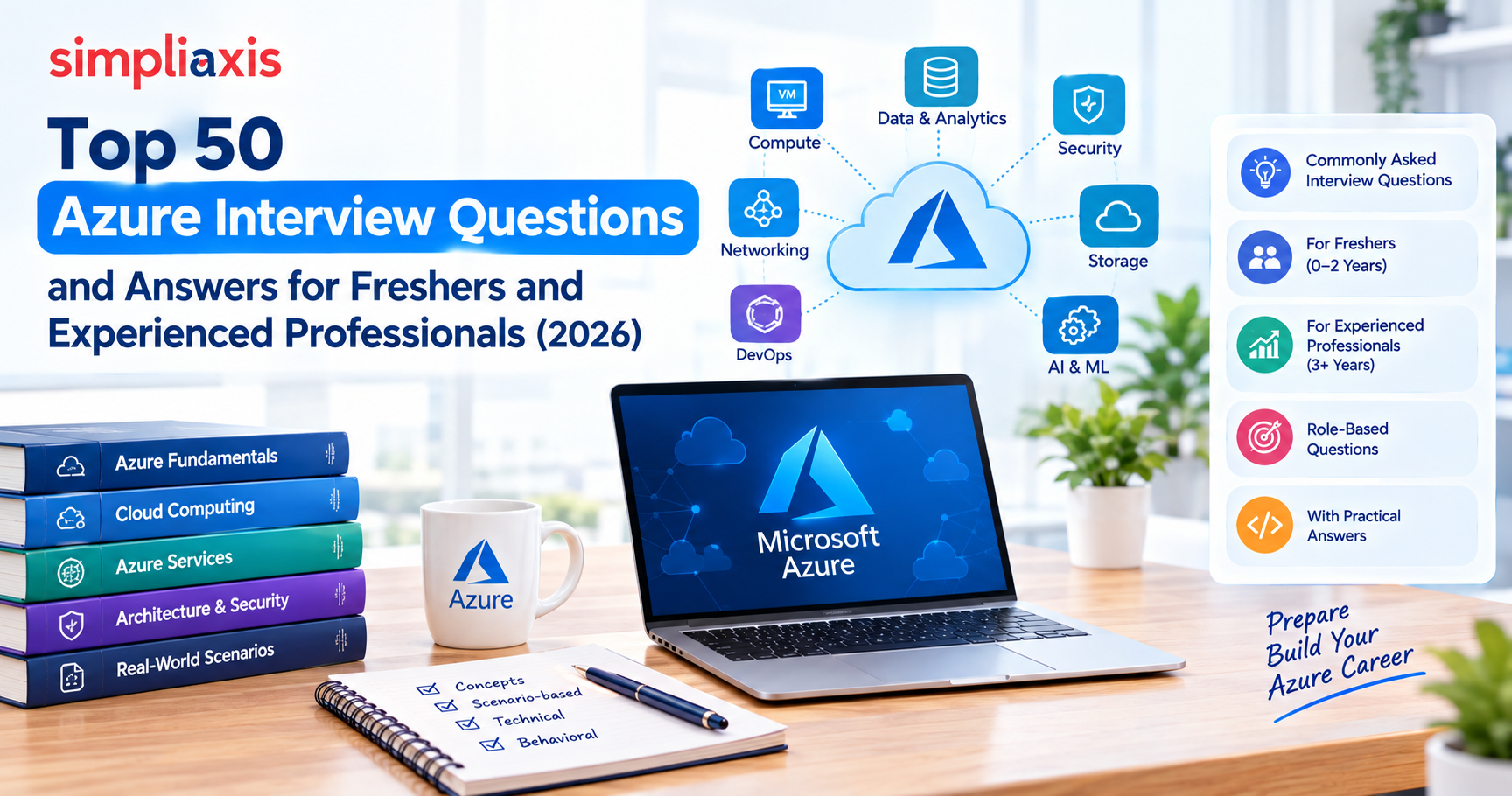
Most Azure interview questions in 2026 fall into five areas: core concepts like regions, subscriptions and resource groups; identity and governance with Microsoft Entra ID, RBAC and Azure Policy; networking (VNets, NSGs, load balancers, Private Endpoints); application services such as App Service, Functions, Cosmos DB and messaging; and design trade-offs around high availability, disaster recovery and cost. Freshers mostly get asked for definitions. Experienced candidates get scenarios, and they're expected to pick the services and defend the trade-off out loud.
Key Highlights of Azure Interview Questions
- 50 Azure interview questions and answers, numbered and grouped by role: fresher, administrator, developer, architect and security engineer.
- Eight scenario-based questions that lay out the situation, the approach, the services and the trade-off, which is how a senior interviewer expects to hear them.
- Current product names throughout, including Microsoft Entra ID (formerly Azure AD), Microsoft Foundry (formerly Azure AI Foundry) and the Flex Consumption plan for Azure Functions.
- A certification status check: AZ-204 retired on July 31, 2026 and AZ-500 on August 31, 2026, so each question set is mapped to what Microsoft offers now.
- Ready-to-run Azure CLI snippets for peering, locks, slots and managed identities that you can practise in a free account before the interview.
Introduction to Azure Interview Preparation
Very few Microsoft Azure interview questions are designed to trip you up. What the panel wants to find out is whether you can explain why a service exists, when you'd avoid it, and what goes wrong if someone configures it badly. Take a fresher who says, "Azure Policy and RBAC are both about permissions." That answer stalls the conversation. Another fresher says "RBAC controls who can act, and Policy controls what can be deployed," and gets the next question.
Hiring panels in India and the US tend to run Azure rounds in a similar order. Round one checks fundamentals, round two goes deep on the role you applied for (administration, development, architecture or security), and senior rounds drop definitions almost entirely in favour of scenarios. If you're also deciding which credential to work towards, the Microsoft Azure certification path guide explains how the exams stack.
A word on naming before you start. Microsoft renames products often, and while saying an old name won't sink you, using the current one tells the interviewer you work with the platform today. Every name in this article matches how it appears on Microsoft Learn in October 2026.
Azure Interview Questions for Freshers
Expect some version of these 12 questions in almost every entry-level or campus round. Keep each answer under a minute, then add one example from something you built in your own lab.
1. What is Microsoft Azure and how is it organised?
Azure is Microsoft's public cloud, covering compute, storage, networking, databases, analytics and AI services, all billed on consumption. Anything you create is a resource, managed through Azure Resource Manager. The hierarchy runs upwards from there: resources sit in resource groups, resource groups in subscriptions, subscriptions under management groups, and the whole tree belongs to a single Microsoft Entra tenant.
2. What are Azure regions and availability zones?
A region is a set of datacentres in one geography, Central India or East US for example. Inside a region, an availability zone is a physically separate location with its own power, cooling and networking. Spreading VMs or zone-redundant services across zones means one datacentre failing doesn't take your app down with it. Zones cover you against a datacentre failure, while a second region is what protects you from a regional disaster.
3. How do IaaS, PaaS and SaaS map to Azure services?
With IaaS you get raw infrastructure and manage it yourself; Azure Virtual Machines is the standard example. PaaS gives you a managed runtime such as Azure App Service, Azure SQL Database or Azure Functions, and Microsoft patches the OS. SaaS is a finished application, Microsoft 365 being the obvious one. Interviewers almost always follow up with "who patches the OS in each?" You do in IaaS; Microsoft does in PaaS and SaaS. Thecloud computing reference modellays out all three layers if you want the full picture.
4. What is a resource group and what rules apply to it?
Think of a resource group as a logical container for resources that share a lifecycle. Each resource belongs to exactly one group, although it can still talk to resources in other groups. The group has a location, but that only applies to its metadata, so the resources inside can live in any region. Delete the group and everything in it goes too, which is why production groups often carry a delete lock.
5. What is the difference between subscriptions and management groups?
Subscriptions are billing and access boundaries: costs, quotas and RBAC assignments attach at that level. Management groups sit above them so you can apply Azure Policy and RBAC across many subscriptions in one go. A typical company might have management groups named Platform, Corp and Online, with separate dev, test and prod subscriptions underneath.
6. When would you choose an Azure VM over Azure App Service?
Go with a VM when you need control at the OS level, say for custom drivers, legacy software, a specific Windows Server build or software licensed per machine. App Service suits web apps and APIs on supported stacks like .NET, Java, Node.js or Python, where you'd rather have autoscale, deployment slots and managed TLS than patch servers yourself. You're trading control against operational effort.
7. What storage account types and access tiers does Azure offer?
Microsoft recommends Standard general-purpose v2 as the default account, and it supports blobs, files, queues and tables. Premium accounts exist for block blobs, file shares and page blobs when latency matters. Blob data can sit in the hot, cool, cold or archive tier. The hotter the tier, the more you pay to store and the less you pay to read, and archive, though cheapest to store, has to be rehydrated before you can read anything.
8. What is the difference between Azure Blob Storage, Azure Files and Azure Disk Storage?
Blob Storage holds unstructured objects like images, backups and logs, which you reach over HTTP or through the SDK. Azure Files gives you managed file shares over SMB or NFS, handy for lift-and-shift apps that expect a mapped drive. Managed disks are block storage attached to a single VM (or shared in specific cases) as an OS or data disk. A quick way to remember it: is the thing an object, a share or a volume?
9. What is Azure Resource Manager?
Every request you send, whether from the portal, Azure CLI, PowerShell, Bicep, Terraform or the REST API, goes through Azure Resource Manager (ARM). ARM is the deployment and management layer: it authenticates the request, checks RBAC and Azure Policy, and then hands it to the resource provider. That single path is why you get consistent tagging, locks, templates and an Activity Log entry for every change.
10. What is Microsoft Entra ID?
Microsoft Entra ID is Microsoft's cloud identity and access management service, which used to be called Azure Active Directory. Only the name changed; login URLs, APIs and MSAL libraries all stayed the same. It handles users, groups, app registrations, single sign-on, MFA and Conditional Access. Don't confuse it with Windows Server Active Directory, which still runs on-premises domains.
11. What is the difference between the Azure Pricing Calculator and the TCO Calculator?
You use the Pricing Calculator to estimate the monthly cost of the specific Azure services you plan to run, such as two D-series VMs plus a SQL database. The TCO Calculator answers a different question: what does your current on-premises estate cost compared with running it in Azure, once hardware, power and labour assumptions are included? One is for a project estimate, the other for a migration business case.
12. What is an Azure SLA and how do you calculate a composite SLA?
An SLA is Microsoft's financially backed commitment to a monthly uptime percentage for a service, with service credits paid out if it misses. When your app depends on several services in series, you multiply their SLAs together. As an illustration, a web tier at 99.95% and a database at 99.99% give 0.9995 x 0.9999, which is roughly 99.94%. Adding redundancy across zones or regions pushes the figure back up.
If you want structured revision of these fundamentals before your first round, Simpliaxis has afree AZ-900 Microsoft Azure Fundamentals coursethat walks through them.
Azure Administrator Interview Questions (AZ-104 Focus)
Azure admin interview questions follow the AZ-104 skill areas closely: identity and governance, storage, compute, virtual networking and monitoring. Since AZ-104 is still an active exam on Microsoft Learn, preparing for these AZ-104 interview questions doubles as exam revision.
13. What is the difference between Azure RBAC and Azure Policy?
RBAC decides who can perform which actions at which scope, for example "the app team can restart VMs in rg-orders". Azure Policy decides which configurations are allowed at all, whoever is deploying, such as "no public IPs" or "only Central India and South India". Even a user with Owner rights gets blocked by a Deny policy, so most environments need both.
14. How does VNet peering work and what are its limits?
Peering links two virtual networks over the Microsoft backbone so their resources can talk on private IPs, either within one region or globally. The limit that catches people out is that peering isn't transitive. If the hub peers with spoke A and spoke B, A still can't reach B unless you add a firewall or route in the hub. Address spaces also must not overlap.
az network vnet peering create --name hub-to-spoke1 \
--resource-group rg-net --vnet-name vnet-hub \
--remote-vnet vnet-spoke1 --allow-vnet-access --allow-gateway-transit
15. What is the difference between a Network Security Group and Azure Firewall?
An NSG is a free, stateful filter at layer 3 and 4, made up of allow and deny rules on IP, port and protocol, and you attach it to a subnet or NIC. Azure Firewall is a paid managed service that adds FQDN filtering, threat intelligence, NAT and central logging, and it usually lives in a hub VNet. Most designs use NSGs for micro-segmentation inside every subnet and Azure Firewall for central egress control.
16. How do you choose between Azure Load Balancer, Application Gateway, Front Door and Traffic Manager?
Ask two things first. Is the traffic HTTP(S), and is it global or regional? Microsoft's load balancing decision guide frames the choice the same way.
| Service | Scope | Traffic | Typical use |
| Azure Load Balancer | Regional or cross-region | Layer 4 TCP and UDP | Spreading traffic across VMs or scale sets |
| Application Gateway | Regional | Layer 7 HTTP(S), plus TCP and TLS proxy | Path-based routing, TLS offload and WAF inside a region |
| Azure Front Door | Global | Layer 7 HTTP(S) | Global entry point with caching, acceleration and WAF |
| Traffic Manager | Global | DNS-based, any protocol | DNS failover between regions; slower than Front Door because of DNS caching |
17. What do Azure Backup and Azure Site Recovery each protect against?
Azure Backup takes point-in-time copies of VMs, SQL databases, file shares and blobs and keeps them in a Recovery Services or Backup vault, so you can restore after accidental deletion, corruption or ransomware. Site Recovery is a different tool. It continuously replicates VMs to another region and orchestrates failover when a region goes down. If the question is "can we get yesterday's data back?", that's Backup; "can we run the app somewhere else right now?" is Site Recovery.
18. What are Virtual Machine Scale Sets and when do you use them?
A scale set manages a group of identical or flexible VMs that scale out and in based on metrics such as CPU, or on a schedule. You can spread instances across availability zones and put them behind Load Balancer or Application Gateway. They're a good fit for stateless tiers with variable load. Keep any state outside the instances, because scale-in deletes VMs.
19. How do Azure Monitor and Log Analytics fit together?
Azure Monitor is the umbrella for metrics, logs, alerts and dashboards, and Log Analytics workspaces are where the log data actually lives, queried with Kusto Query Language (KQL). Resource logs reach the workspace through diagnostic settings, while VMs send data via the Azure Monitor Agent using data collection rules. Don't be surprised if you're asked to write a KQL query on the spot that counts failed sign-ins or HTTP 500s per hour.
20. What are managed identities and when do you use system-assigned versus user-assigned?
A managed identity is an identity in Microsoft Entra ID that Azure creates and rotates on behalf of a resource, so your code can get tokens for Key Vault, Storage or SQL without any stored credentials. System-assigned identities live and die with a single resource. A user-assigned identity is a standalone resource you can attach to many VMs or apps, which is useful when a whole scale set needs the same permissions.
21. What is the difference between LRS, ZRS, GRS and GZRS?
All four are storage redundancy options. According toMicrosoft's storage redundancy documentation, LRS keeps copies in one datacentre (at least 11 nines durability), ZRS spreads them across three or more zones (12 nines), and GRS and GZRS add asynchronous copies in a paired region (16 nines). RA-GRS and RA-GZRS also let you read from the secondary. Choose ZRS for zone resilience and GZRS when regional DR matters too.
The AZ-104 Azure Administrator training from Simpliaxis follows the exam's five skill areas, so it's a reasonable place to practise these tasks hands-on if you haven't done them at work.
Azure Developer Interview Questions (AZ-204 Focus)
Start with the exam status. Microsoft's exam retirement pagelists AZ-204 as retired on July 31, 2026, and the developer-focused successor on Microsoft Learn is AI-200, which leads to the Azure AI Cloud Developer Associate certification. The topics haven't gone anywhere, though. They still dominate developer rounds, and many of the Azure Functions interview questions you'll hear come straight from this material.
22. What are triggers and bindings in Azure Functions?
Every function has exactly one trigger, the event that starts it: an HTTP request, a timer, a queue message, a blob upload, a Cosmos DB change and so on. Bindings are declarative input or output connections to other services, so you can, say, write a document to Cosmos DB without SDK boilerplate. They save code, although complex retry logic sometimes pushes you back to the SDK.
23. Which Azure Functions hosting plans exist in 2026, and how do they differ?
There are five options in the Azure Functions hosting documentation, which now marks the classic Consumption plan as legacy.
| Plan | Billing | Default / max timeout | Notes |
| Flex Consumption | Per execution and active memory | 30 min / unbounded | Recommended serverless plan; Linux only; VNet integration; always-ready instances |
| Premium | Core seconds and memory of warm instances | 30 min / unbounded | Prewarmed workers, no cold start, VNet |
| Dedicated (App Service plan) | Fixed App Service rates | 30 min / unbounded (Always On) | Predictable cost, shares a plan with web apps |
| Container Apps | Container Apps billing | 30 min / unbounded | Containerised functions next to microservices |
| Consumption (legacy) | Per execution and GB-seconds | 5 min / 10 min | Linux hosting retiring on 30 September 2028 |
One limit applies regardless of plan: an HTTP-triggered function has to respond within 230 seconds.
24. What are Durable Functions and which patterns do they support?
Durable Functions is an extension for writing stateful workflows in code. An orchestrator function calls activity functions, and the framework checkpoints state to storage so the workflow survives restarts. You'll be expected to name the common patterns, which are function chaining, fan-out/fan-in, async HTTP APIs, monitors and human approval with timeouts. Orchestrator code has to be deterministic, so keep DateTime.Now and random calls out of it.
25. How do App Service deployment slots work?
A slot is a live copy of your app with its own hostname. You deploy to staging, warm it up and then swap it with production. Because the swap moves the already-warm instances, users never hit a cold start. Any setting marked as a slot setting stays put with its slot, and if the release goes wrong you simply swap back.
az webapp deployment slot swap --name app-orders \
--resource-group rg-app --slot staging --target-slot production
26. What are the Cosmos DB consistency levels?
Azure Cosmos DB offers five consistency levels. From strongest to weakest they are Strong, Bounded staleness, Session, Consistent prefix and Eventual. Session is the one most teams use, since it gives each client read-your-own-writes at close to eventual cost. Strong and Bounded staleness read from two replicas, which doubles the RU cost of reads, and Strong isn't available with multiple write regions.
27. When do you use Service Bus, Event Grid or Event Hubs?
| Service | Model | Use it for |
| Azure Service Bus | Message broker with queues and topics | Business commands that must not be lost: orders, payments; supports sessions, dead-lettering and transactions |
| Azure Event Grid | Push-based event routing | Reacting to state changes, such as "blob created" or "resource deleted", with filtering |
| Azure Event Hubs | Partitioned streaming log | Millions of telemetry or clickstream events, read by many consumers with replay |
If you need a one-line version for the interview, Service Bus carries commands, Event Grid carries notifications, and Event Hubs carries streams.
28. What is Azure Key Vault and how should applications access it?
Key Vault stores secrets, keys and certificates, with access control, soft delete, purge protection and audit logs. Apps should reach it through a managed identity rather than a stored client secret, and permissions should come from Azure RBAC roles like Key Vault Secrets User. App Service and Functions can also reference Key Vault secrets directly in app settings, so your code never sees the raw value.
az role assignment create --assignee \
--role "Key Vault Secrets User" --scope
29. How do you choose between AKS, Azure Container Apps and Azure Container Instances?
For a single container or a small group run on demand, such as a batch job or build agent, Azure Container Instances is enough. Azure Container Apps runs microservices on managed Kubernetes without exposing the cluster to you, and adds scale to zero, Dapr and revisions. Teams that need custom networking, operators or node pools pick Azure Kubernetes Service (AKS) for full Kubernetes control. If those Kubernetes terms are unfamiliar, read this introduction to Kubernetes first. Our Docker vs Kubernetes comparison also helps when you're asked where containers end and orchestration begins.
Even with the exam retired, the hands-on skills in this section (Functions, Cosmos DB, messaging and containers) are what developer panels test, so build at least one small project that uses three of them together.
Azure Solutions Architect Interview Questions (AZ-305 Focus)
Architect rounds test judgement more than recall. AZ-305 is still an active exam, and Microsoft requires the Azure Administrator Associate certification before you can earn Azure Solutions Architect Expert. Nearly every answer you give should end with "it depends on" and then name a specific requirement.
30. What are the five pillars of the Azure Well-Architected Framework?
The Well-Architected Framework is built on Reliability, Security, Cost Optimization, Operational Excellence and Performance Efficiency, and each pillar comes with design principles and documented trade-offs. A strong answer names a conflict between two of them. Adding a second region, for instance, improves reliability but raises cost, and the business requirement decides where the balance lands. Azure Advisor groups its recommendations by these same pillars.
31. What is an Azure landing zone?
A landing zone is the Cloud Adoption Framework architecture Microsoft recommends for governing, securing and scaling an environment with many subscriptions. It splits into a platform landing zone, which holds the management group hierarchy, shared networking, identity and security monitoring, and workload landing zones where application teams deploy inside those guardrails. Subscription vending automates handing new, pre-governed subscriptions to teams.
32. How do you design a highly available web application on Azure?
Work through the stack removing single points of failure one layer at a time. Run the web tier on App Service or scale sets across availability zones, and put Application Gateway with WAF or Front Door in front of it. Use zone-redundant Azure SQL Database or Cosmos DB for data and ZRS for files, then add health probes and autoscale. To survive a regional failure, deploy a second region and let Front Door route traffic between them.
33. What are RTO and RPO, and how do they shape a disaster recovery design?
Recovery Time Objective (RTO) is how long the business can tolerate being down, and Recovery Point Objective (RPO) is how much data, measured in time, it can afford to lose. An RPO of zero needs synchronous replication. With an RPO of an hour, asynchronous geo-replication or backups are acceptable. The design options range from backup and restore, which is cheap but slow, to active-active multi-region, which is fast and expensive.
34. When do you use a VPN Gateway versus ExpressRoute?
A site-to-site VPN Gateway connects your on-premises network to Azure through encrypted IPsec tunnels over the public internet, and it's quick to set up and cheaper. ExpressRoute uses a private connection through a connectivity provider that never touches the internet, giving you predictable latency and higher bandwidth. Plenty of enterprises run ExpressRoute as the primary link with a VPN as backup.
35. How do you approach cost optimisation in an Azure architecture?
Right-sizing comes first, and Azure Advisor will flag underused VMs and idle resources for you. After that, match the pricing model to the usage pattern: reservations or savings plans for steady workloads, Spot VMs for interruptible batch jobs, autoscale and scale to zero for spiky traffic, and lifecycle rules that push old blobs to cool or archive tiers. Finish by making cost visible with tags, budgets and per-team views in Cost Management.
Azure Security Interview Questions (AZ-500 Focus)
The same retirement page shows AZ-500 retired on August 31, 2026. On its Microsoft Learn training course page for SC-500, Microsoft announced SC-500 and the Cloud and AI Security Engineer Associate certification as the new security credential. The interview topics below are the same as they were.
36. What does Microsoft Defender for Cloud do?
Defender for Cloud handles cloud security posture management and workload protection. Its free foundational tier scores your configuration against the Microsoft cloud security benchmark and lists recommendations, and the paid Defender plans add threat detection for servers, storage, SQL, containers, Key Vault and more. It can also cover AWS and Google Cloud accounts once you connect them. Interviewers increasingly connect these tools to cloud-native security and DevSecOps, so be ready to talk about shift-left checks too.
37. What is the difference between a Private Endpoint and a Service Endpoint?
With a Service Endpoint, the PaaS service keeps its public IP, but traffic from a chosen subnet travels over the Azure backbone, and the service firewall admits only that subnet. A Private Endpoint goes further by giving the service a private IP inside your VNet through Azure Private Link. You can then switch off public access entirely and still reach the service from peered networks or on-premises, provided the private DNS zones are configured correctly.
38. What is Microsoft Entra Conditional Access?
Conditional Access is the policy engine inside Microsoft Entra ID. At sign-in it evaluates signals such as user, group, device compliance, location, application and sign-in risk, and then either grants access, requires MFA or blocks. A sensible baseline requires MFA for all admins, blocks legacy authentication and requires compliant devices for finance apps. Run any new policy in report-only mode before you enforce it.
39. What is Microsoft Sentinel?
Sentinel is Microsoft's cloud-native SIEM and SOAR service. Data connectors pull in logs from Azure, Microsoft 365, Defender products, firewalls and third-party sources, and analytics rules turn suspicious patterns into incidents. Playbooks built on Logic Apps automate the response, for example disabling a compromised account. Because the data sits in a Log Analytics workspace, your KQL skills matter here as much as in monitoring.
Azure Scenario-Based Interview Questions for Experienced Professionals
Once you have three or more years of experience, most panels move to scenarios like the ones below. Structure each answer around the situation, your approach, the services you'd use and the trade-off. Release pipelines and CI/CD get their own treatment in our DevOps interview questions and answers.
40. A spoke VNet cannot reach on-premises after you peered it to the hub. What do you check?
Approach: Make sure the hub side of the peering has "allow gateway transit" enabled and the spoke side has "use remote gateways". Then confirm that on-premises advertises routes back to the spoke address range, and that no NSG or route table in the spoke is blocking the traffic.
Services: VNet peering, VPN Gateway or ExpressRoute, Network Watcher (next hop, IP flow verify).
Trade-off: Gateway transit centralises connectivity in the hub. You save on gateway cost, but the hub becomes critical.
41. A storage account must not be reachable from the internet, but an App Service app needs it. How do you design this?
Approach: Create a Private Endpoint for the blob service in a dedicated subnet and link the privatelink.blob.core.windows.net private DNS zone to the VNet. Turn on VNet integration for the App Service, then set public network access on the storage account to disabled.
Services: Azure Private Link, Private DNS zones, App Service VNet integration.
Trade-off: You get stronger isolation, but DNS misconfiguration becomes the most common cause of outages, so document the setup.
42. Someone deleted a production resource group. How do you recover and stop it happening again?
Approach: Use the Activity Log to find out who deleted it and when. Restore from Azure Backup and soft-deleted items where they exist, and redeploy the infrastructure from Bicep or Terraform. To prevent a repeat, add a CanNotDelete lock and tighten RBAC to least privilege, with Privileged Identity Management for elevated roles.
az lock create --name no-delete --lock-type CanNotDelete --resource-group rg-prod
Trade-off: Locks block legitimate clean-up as well, so your pipelines need a documented way to remove them.
43. The monthly Azure bill has doubled with no new projects. How do you investigate?
Approach: Open cost analysis in Cost Management and group by service, resource group and tag until the jump shows up. The usual suspects are forgotten VMs, unattached premium disks, heavy Log Analytics ingestion and egress traffic. Then set budgets with alerts, enforce cost-centre tags through Azure Policy, auto-shutdown dev VMs and act on Azure Advisor's cost recommendations. Steady workloads can move to reservations or savings plans.
Trade-off: Commitments lower the unit cost, but you lose flexibility if workloads shrink.
44. A developer committed a database connection string to Git. What do you do?
Approach: Rotate the credential straight away, because Git history keeps the secret even after the file is fixed. Move the secret into Key Vault, give the app a managed identity and reference the secret from app settings. Better still, switch the database to Microsoft Entra authentication so there's no password to leak at all.
az webapp identity assign --name app-orders --resource-group rg-app
Trade-off: Entra authentication needs code and driver support, and older apps may not have it.
45. Users in the US complain that an app hosted in Central India is slow. What do you propose?
Approach: Measure before changing anything. Application Insights will show whether the latency comes from the network or the backend. Put Azure Front Door in front to terminate TLS close to users and cache static content. If dynamic calls turn out to be the bottleneck, deploy a second region in the US and replicate data with Cosmos DB multi-region or read replicas.
Trade-off: A second region roughly doubles infrastructure and raises data consistency questions.
46. How do you force every team to deploy only in Indian regions and tag resources with a cost centre?
Approach: At the management group, assign the built-in "Allowed locations" policy with a Deny effect alongside a "Require a tag" policy, so every current and future subscription inherits both. A Modify policy can inherit tags from the resource group, and genuine exceptions get exemptions with expiry dates.
az policy definition list --query "[?displayName=='Allowed locations'].name" -o tsv
Trade-off: Deny policies can break existing pipelines, so run them in Audit mode first.
47. A queue-triggered function sometimes processes the same order twice. How do you fix it?
Approach: Assume at-least-once delivery and make the handler idempotent, for instance by storing processed order IDs and checking them before acting. Use Service Bus with peek-lock, set the lock duration longer than processing time, and send poison messages to the dead-letter queue. If the processing has several steps, move it to Durable Functions.
Trade-off: Each message now costs an extra database read for the idempotency check, but a duplicate payment costs far more.
Azure Data and AI Interview Questions
Even general Azure rounds now include a few data and AI questions. The three below overlap with Azure data engineer interview questions, though a data engineering role deserves its own, deeper preparation.
48. What is Azure Data Factory and what are its core building blocks?
Data Factory is Azure's managed data integration service for building ETL and ELT pipelines. Pipelines contain activities such as Copy and Data Flow. Linked services hold connection details, datasets describe the shape of the data, triggers schedule runs, and integration runtimes supply the compute, including a self-hosted runtime for on-premises sources. A favourite follow-up asks when you'd need that self-hosted integration runtime, and the answer is whenever the source sits on a private network. It's also worth knowing how Data Factory compares with thebest ETL tools on the market.
49. How do Azure Synapse Analytics and Microsoft Fabric differ?
Synapse is a PaaS analytics service that combines dedicated and serverless SQL pools, Spark and pipelines inside your own Azure subscription. Microsoft Fabric is SaaS: it unifies data engineering, warehousing, real-time analytics and Power BI on OneLake and stores warehouse data in Delta format. Microsoft Learn now publishes migration guides from Synapse to Fabric, so new projects often start on Fabric.
50. What are Microsoft Foundry and Azure OpenAI, and how are they related?
Microsoft Foundry is Microsoft's platform for building AI agents, models and apps; it was previously Azure AI Studio and then Azure AI Foundry. According to Microsoft Learn, it offers more than 10,000 models from Microsoft, OpenAI, Anthropic, Meta and others, along with Foundry Agent Service, tracing, evaluations and unified RBAC. Azure OpenAI serves OpenAI models through Azure endpoints with Entra ID authentication and private networking, and it now sits inside Foundry. Microsoft guides Azure OpenAI customers to upgrade to a Foundry resource while keeping their endpoint and keys. If you need a refresher on the basics first, read what generative AI is.
Follow-ups usually cover tokens, rate limits, content filters and retrieval-augmented generation with Azure AI Search, so be ready to sketch a simple RAG flow.
Azure Interview Questions by Role and Certification
Match the job description to a row in this table and spend most of your time on those sections. Exam statuses are as listed on Microsoft Learn in October 2026.
| Target role | Relevant exam (status) | Question sections to master | Simpliaxis course |
| Fresher, cloud support, presales | AZ-900 (active) | Freshers 1 to 12 | AZ-900 Azure Fundamentals |
| Azure administrator, cloud engineer | AZ-104 (active) | Freshers, Administrator 13 to 21, Scenarios 40 to 43 | AZ-104 Azure Administrator |
| Azure developer | AZ-204 (retired July 31, 2026); successor AI-200 | Developer 22 to 29, Scenarios 44 and 47 | AZ-204 Azure Developer Associate |
| Solutions architect | AZ-305 (active, requires AZ-104 certification) | Architect 30 to 35, all Scenarios | AZ-305 Azure Solutions Architect Expert |
| Security engineer | AZ-500 (retired August 31, 2026); successor SC-500 | Security 36 to 39, Scenarios 41, 42, 44, 46 | AZ-500 Azure Security Technologies |
| Data or AI engineer | Varies by role | Data and AI 48 to 50 | Agentic AI with Azure AI Foundry |
Starting from zero? Work through the fresher row before anything else, because every other row assumes that vocabulary.
How to Prepare for an Azure Interview?
Interviewers keep probing until they find the edge of what you've actually done, so reading answers only gets you so far. Build a small lab and break it on purpose.
- Week 1: Foundations. Open an Azure free account and set a budget alert on day one. Use Azure CLI to build a resource group, a VNet with two subnets, a Linux VM and a storage account, then delete the lot and rebuild it from a Bicep file.
- Week 2: Identity and networking. Create Entra ID users and groups, assign RBAC at resource group scope, apply an "Allowed locations" policy, peer two VNets and test your NSG rules with Network Watcher.
- Week 3: Applications. Deploy a small API to App Service with a staging slot. Add a Flex Consumption function triggered by a Service Bus queue, put a secret in Key Vault and read it through a managed identity.
- Week 4: Scenarios and mock rounds. Answer the eight scenario questions aloud, under three minutes each, and record yourself. Then go through the Microsoft Learn modules; many of them include a free sandbox subscription, so practising doesn't eat into your credit.
Two habits make a difference in the room. Bring up the trade-off before the interviewer has to ask for it. And when a service is new to you, explain how you'd find out, whether that's the Microsoft Learn docs page, the pricing page or a quick lab test.
Conclusion
The candidates who do well in Azure interviews sound like people who have run workloads rather than memorised service lists. Learn the current names, get comfortable with the CLI, and for every service know when you'd pick something else. Between the fresher basics, the four role tracks and the scenarios, these 50 questions cover what most panels ask.
If design and trade-off questions are where you feel weakest, the AZ-305 Azure Solutions Architect Expert training at Simpliaxis works through architecture case studies and is a sensible next step.







 Lowest-Price Challenge










 Personalized Path


.webp)


 USA
USA  Canada
 India
India UK
UK Australia
 Singapore


