


 Call Us




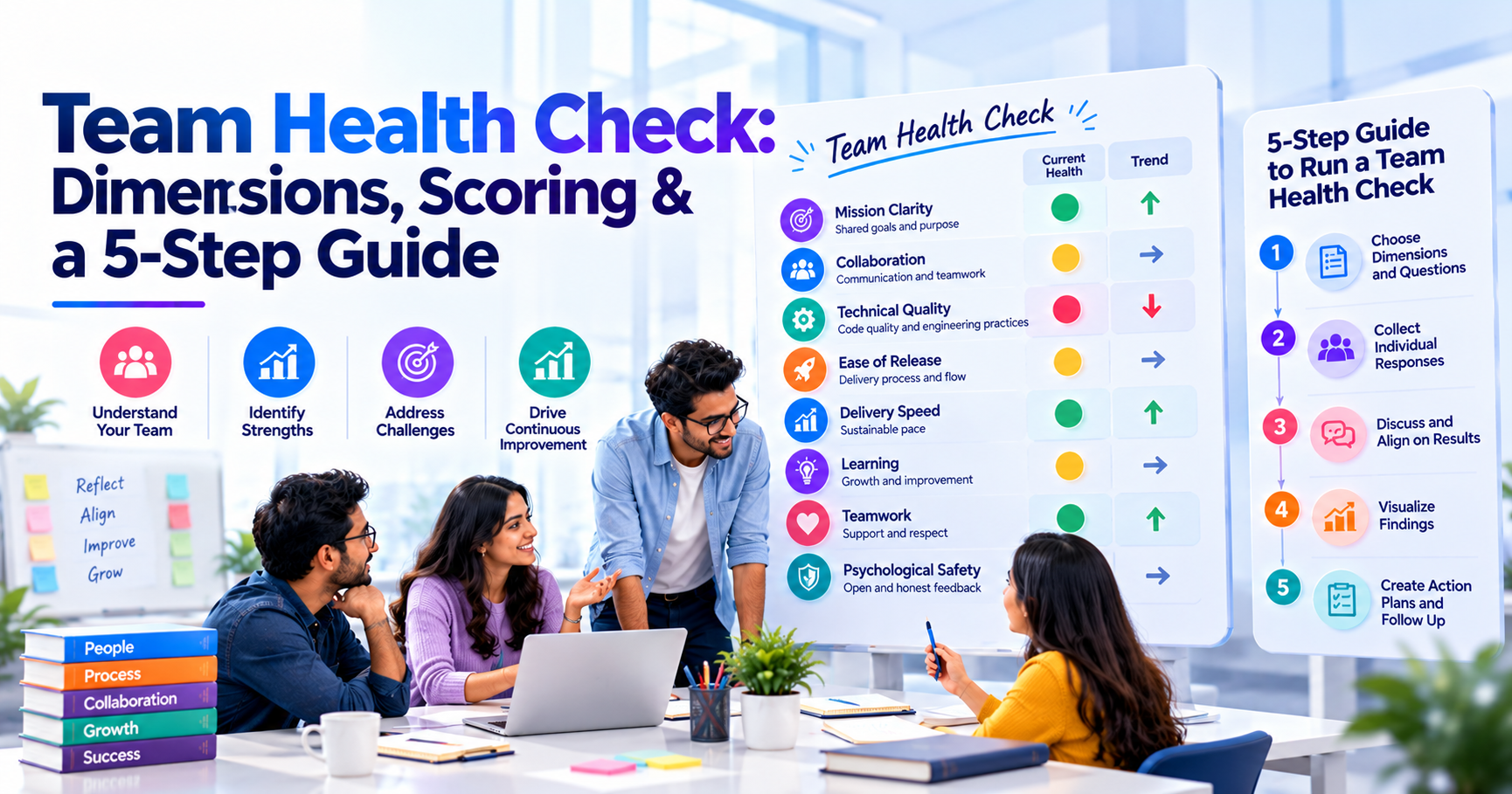
A team health check is a type of self-assessment that helps teams see how well they work, where they need to improve, and what holds them back. The assessment looks at areas like collaboration, technical quality, delivery, psychological safety, and shared goals.
The visual approach to health checks was popularized by Spotify in 2014. This involves addressing different areas using green, yellow, and red indicators. Teams can also keep track of areas that are improving, remaining stable, or declining.
Usually, a health check has these five steps:
- Choose the right health dimensions and questions
- Ask team members to individually rate each dimension
- Talk about differences and establish the team’s position
- Make the results visual to identify strengths and concerns.
- Set up improvement plans and owners and set up dates for the same.
The goal isn’t to grade employees or prove that a team is performing well. Instead, it’s to make sure that the team has an honest conversation that leads to improvements that are practical.
Key Highlights of Team Health Check
- A team health check helps teams assess their collaboration, delivery practices, technical quality, and working environment.
- Common team health check dimensions include mission clarity, ease of release, speed, learning, teamwork, and psychological safety.
- Traffic-light scoring makes team health visible, while trend indicators show whether conditions are improving or deteriorating.
- A useful team health check survey encourages honest feedback and discussion rather than simply collecting ratings.
- Running health checks quarterly can provide enough time to identify patterns without creating survey fatigue.
- Scrum masters help teams turn assessment results into focused improvement actions with clear owners and follow-up dates.
Introduction
Even when teams seem to be getting work done on time and delivering quality, they could still face problems beneath the surface. Some team members might be reluctant to flag concerns, developers can be struggling with technical debt, and priorities might change so often and priorities might be changing so frequently that it becomes hard to make meaningful progress.
Such problems aren’t always apparent in delivery reports. And by the time they actually affect quality, deadlines, or morale, the problem might have already been building up for weeks or months.
A team health check is a structured way for teams to find out about these problems before they become more difficult to tackle. This check doesn’t just see the number of task that completed, it examines how people work, how well they deliver value, and if the practices they follow currently help with sustainable progress.
They’re especially beneficial for Agile teams, since the process of continuous improvement is built on regularly looking at working methods and the results delivered as a result.
But health checks only make a difference if they lead to some type of action. Simply collecting ratings without discussing them or addressing routine problems can make this exercise just another administrative task.
Read below to know what a team health check is, the dimensions that it measures, and how to conduct one so as to produce meaningful improvements.
What Is a Team Health Check?
Definition and Purpose
A team health check is a structured assessment where team members get to measure different areas of their shared practices and work environment.
The areas that the assessment measures depend on what the team needs. Take these examples:
- Clarity of goals and priorities
- Collaboration and communication
- Ability to deliver work at a sustainable pace
- Opportunities for learning and improvement
- Trust, support, and psychological safety
The results of the assessment give teams a better understanding of what works and what needs attention.
Let’s take the example of a development team. The team might rate its collaboration as green but its ability to release software as red. These outcomes hint at the fact that while people work well together, technical and process-related obstacles make delivery difficult.
Understanding where the team lacks lets them investigate the reason behind it and understand what practices might need to be changed.
The concept of a team health check shouldn’t be limited to just software development. Marketing teams, product teams, and even cross-functional teams can use the same methods by using the dimensions that define their work the best.
A Self-Assessment, Not a Performance Review
The aim of a team health check isn’t to measure the performance level of employees; it's to help make a team’s working condition better.
Knowing the difference between the two is important to make sure people don’t give misleading answers in fear that the assessment will influence their performance reviews or promotions.
So, to prevent this, it’s important to explain how and what the results will be used for before collecting responses. Also, ensure that the discussion is focused around team practices, shared challenges, and organizational blame and not assigning blame to people.
So, if a team finds it tough to complete work during a sprint, discussions should be around factors like unclear requirements, dependencies, interruptions, or unrealistic expectations. It should simply assume that individuals are working too slowly.
Where It Came From (Spotify Squad Health Check)
The concept of a team health check was popularized through Spotify’s engineering culture and how it was helping their squads reflect on how effective they were. Spotify introduced the approach in its 2014 post, Squad Health Check model - visualizing what to improve.
The concept was to use visual health indicators for teams to evaluate areas like mission, speed, learning, fun, and teamwork. Team codes discuss their ratings and look for areas to improve in.
Although the model is linked with the Spotify engineer model, it shouldn’t be treated like a universal blueprint for organizations to blindly copy. The practices that Spotify used were based on the contexts that were specific to the organization and its squads and aren’t a prescribed Agile standard.
However, its central concept is useful: Visualize team health, discuss the results together, and use them to guide improvement.
Why Run Team Health Checks
Surfacing Issues Before They Escalate
When people become used to working around problems rather than finding ways to solve them, they can stay hidden and become more complicated.
Developers may spend extra time correcting recurring defects. A team member might not challenge a decision because previous concerns were dismissed.
Team health check surveys give the perfect opportunities to detect such patterns.
Take this example:
A low rating for ease of release could reveal that the team depends on length approval processes. When problems like this are realized early on, it gives them an opportunity to make releases better before they affect a major delivery.
Sparking Honest Improvement Conversations
Team health checks are starting points for teams to discuss uncomfortable and difficult issues.
Rather than bluntly saying, “Our process is terrible," team members can use team health checks to point out specific dimensions to have more diplomatic discussions like
“We’re having some evident delays with our approval processes.”
Having different ratings can also give insights on how employee experiences differ. So if half a team believes priorities are clear while the other half disagrees, the discussions can help in finding gaps in communication or understanding.
The aim of team health checks isn’t to get everyone to agree immediately. It’s to understand why perceptions are different and find out what the team can improve.
Tracking Trends Over Time
Repeated assessments help teams identify patterns that might not be as easy to determine by only assessing one.
Let’s say a team rates its workload as red in January, yellow in April, and green in July. This change can imply that there’s an improvement being made to how the team handles its workload or prioritization.
The reverse, like seeing a dimension changing from green to yellow, is also important. It could indicate that there’s a new problem slowly growing.
Measuring trends makes it easier to judge if previous actions have worked or whether they need extra attention.
Common Team Health Check Dimensions
There aren’t any team health dimensions that are mandatory to follow. The categories mentioned below are just a few that can be adopted by the Agile team based on what they need.
Delivering Value and Mission
This dimension helps examine if teams understand their purposes and whether they’re able to connect the work to meaningful outcomes.
Some team health check questions to ask:
- Do we understand the problem our team is trying to solve?
- Are our goals and priorities clear?
- Do we have enough information to make the right decisions?
Low ratings for these questions could imply that there are unclear directions, competing priorities, or constant changes being made without sufficient evidence.
Teams can improve this by making objectives clear, reviewing priorities, and documenting how individual work contributes to overall goals.
Easy to Release and Tech Quality
This area looks at how equipped the team is to deliver work reliably and without unnecessary technical obstacles.
Some questions can include:
- Is technical debt manageable?
- Can we identify and solve defects quickly?
- Can we release work without having to put excessive effort?
Teams that struggle with complicated deployments or regressions might rate this dimension poorly.
Some improvement actions include better automated testing, improved continuous integration, and a simpler DevOps pipeline.
Speed and Ways of Working
Speed isn’t just how fast a team completes tasks; it’s how easily work moves from idea to usable outcome, which is reflected in lead time and cycle time.
Consider these questions:
- Can we finish work without unnecessary delays?
- Can we maintain a sustainable pace?
- Are dependencies identified early?
A low score could indicate problems like too much work in progress or frequent interruptions.
To solve this, the team should look at the underlying causes rather than simply push employees to work faster.
Learning, Fun, and Support
Healthy teams need to have the space to develop the right skills, experiment, and have a positive work environment
You can determine this by asking these questions:
- Are we regularly learning from our successes and failures?
- Can we look at better ways of working?
- Does our work feel engaging and meaningful?
Having a poor rating might imply that opportunities to learn are limited or that there’s not enough support from other teams.
Teamwork and Psychological Safety
This dimension looks at whether teams can collaborate, flag concerns, and ask for help without the fear of being embarrassed or receiving retaliation. Google’s Project Aristotle found psychological safety to be the most important factor in team effectiveness.
Some questions include:
- Do people feel comfortable talking about their mistakes?
- Are concerns taken seriously?
- Can people disagree with each other respectfully?
If people are reluctant to speak openly, the team might face problems with identifying risks and improving their practices.
Establishing clear Team Norms can help set shared expectations for communication, decision-making, feedback, and conflict resolution.
Having a well-defined Agile Team Charter can also help make the team’s purpose, responsibilities, and working agreements a lot more clear.
The Scoring System
The Green, Yellow, Red Traffic Lights
A traffic light system can give a simple visual representation of the team’s assessment:
| Rating | Meaning | Typical Response |
| Green | The team is satisfied with this area and can continue its current practices. | Maintain the practice and share what works. |
| Yellow | The area has some concerns or could improve. | Discuss the issue and identify a manageable improvement. |
| Red | The area is causing significant difficulty or needs urgent attention. | Investigate the causes and agree on a focused action. |
The team should be able to define what each color means before the assessment. Or else it could lead to confusion; one person’s yellow might be a minor inconvenience, while another’s might signify a serious issue.
Green shouldn’t just mean "perfecting," the same way red shouldn't signify failure. These colors are meant to be starting points for meaningful discussions, not grading tools.
A good tip is to ask each person to independently rate each dimension before discussing them as a group. This brings down the risk of having early opinions influencing everyone else’s answers.
Adding a Trend (Improving, Stable, Declining)
While current situations can be signified through traffic-light ratings, they won’t be able to depict if there’s anything changing.
This can be helped by adding a trend indicator tool to give more context:
| Trend | Meaning | Example |
| Improving | The team is seeing positive changes. | Release problems are becoming less frequent. |
| Stable | Conditions are broadly unchanged. | Collaboration remains strong. |
| Declining | The problem is becoming more significant. | Workload concerns are increasing. |
So if a team rates its technical quality as yellow but marks the trend as improving, it shows that while the team still has work to do, the recent changes appear to be helping.
How to Run a Team Health Check Step by Step
Step 1: Choose Dimensions and Cards
Choose a realistic set of dimensions that actually reflect the work environment of the team.
You can begin with areas like mission, delivery speed, learning, teamwork, and psychological safety.
Try not to include too many topics. Having a long assessment can discourage thoughtful responses and make results difficult to discuss.
The best way to go about it is to prepare a short set of questions for each dimension. Elaborate on what areas the assessment covers, how the responses will be used, and if the individual responses are anonymous.
Step 2: Rate Each Dimension Individually
Ask each team member to rate the dimensions independently before having the group discussion.
It's also important to let team members explain their ratings. Such comments can give insights that can’t only be captured through colors alone.
Step 3: Discuss and Reach a Team View
Bring the team together to review the individual responses.
Start with the dimensions where ratings vary significantly or where several people have flagged concerns. Let people explain their perspectives without pressurising them to defend their choices.
Some prompts include:
- What’s working well in this area
- What's in our control
- What is working well in this area?
- What support do we need from the outside team?
The goal is to understand the situation of the team, not to force a conclusion. Record the overall opinion of the team while still acknowledging the differences in each person’s experience.
Step 4: Visualize the Results
Visually depict the results using tables, color-coded bars, or dashboards.
Visual representations make patterns easier to recognize. The team can easily identify dimensions that are strong, the ones that require attention, and those changing over time.
It's also important to make sure that the dashboard is easy to follow. Having a dashboard with too many metrics can be distracting.
If you are repeating the assignment, make sure to keep records of previous results so that the team can compare changes and evaluate any improvement actions made a difference.
Step 5: Agree Actions and Owners
Choose a few improvements that the team can realistically address before the next health check.
For each improvement action, specify the following:
- What needs to improve?
- What the team needs to do
- Who coordinates the work
- When will the team review progress
- What changes indicate improvement?
So, if releases are delayed by manual testing, the team might agree on automating a frequently repeated testing method within the next month.
Try not to create a long list of actions just because several dimensions have a yellow or red rating. Having a small number of completed improvements is far better than a backlog of forgotten commitments.
Team Health Check Example (Worked)
Consider a Scrum team that completes a quarterly health check after completing several sprints that had delayed releases and changing priorities.
The team decides to assess these five dimensions during the team health check.
| Dimension | Rating | Trend | Finding |
| Mission clarity | Green | Stable | Goals are understood. |
| Technical quality | Red | Stable | Regression defects continue to delay releases. |
| Delivery speed | Yellow | Declining | Dependencies are taking longer to solve. |
| Learning | Yellow | Improving | Retrospective actions are receiving more attention. |
| Teamwork | Green | Stable | Members collaborate and ask for help. |
The assessment seems to imply that the team had a strong collaborative environment but had difficulties in its delivery flow and technical quality.
Team members identified two contributing factors for this during the discussion. First, the number of tasks that are automated is insufficient. Second, dependencies on another team are usually discovered late.
Instead of trying to fix everything at once, the team agrees on these two actions:
Action 1: Automate a high-priority regression test within four weeks. The developer coordinating the work will report progress during the next sprint review.
Action 2: Look for cross-team dependencies during backlog refinement and assign responsibility for following them up.
The Scrum Master usually keeps track of the actions and checks progress during the team’s regular workflow.
During the next quarterly assessment, the team relooks into defect patterns, release delays, and previous ratings. If technical quality improves but delivery speeds remain the same, the team can look into the remaining dependencies.
This example shows how team health checks can use collected opinions to create measurable improvements and make working environments better.
How Often to Run Health Checks
Why Quarterly Beats Every Sprint
Having quarterly assessments is a great way to start for teams. This is because they give time for meaningful changes to take place.
Having assessments ever sprint can create unnecessary repetitions. Especially if the team doesn’t have a lot of new information to discuss.
Quarterly team health check assessments give teams enough time to implement improvement actions and observe their effects.
But this shouldn’t become a universal rule. Having checks more often is justifiable in newly formed teams, during major organizational changes, or if there’s a serious team concerns.
Teams should choose how often to have their checks based on their needs.
Avoiding Survey Fatigue
Team health checks can become frustrating when people continuously answer questions but see no improvement measures being taken afterwards.
Avoid this by
- Keeping the survey short and relevant
- Discuss the results with the team
- Follow through on agreed actions
- Explain why the assessment is being conducted
- Get rid of questions that no longer give any useful insights.
You don’t have to repeat an entire assessment to check progress. Having short follow-up conversations can help teams review improvement actions between formal health checks.
Team Health Check vs Related Tools
Health Check vs Agile Maturity Assessment
Atlassian offers a similar self-assessment, the Team Health Monitor.
Team health check tools should look into how the team currently experiences their work. It usually focuses on factors like trust, collaboration, and workload.
Agile maturity assessments, on the other hand, look at how consistently a team or organization applies Agile practices in a specific framework or set of criteria.
So, a team health check could reveal that team members hesitate to take risks. Agile maturity assessments would examine how effectively the organization implements feedback into its delivery process.
While these tools can complement each other, they might answer different questions. Even though a team follows Scrum events correctly, they could still face low trust and ambiguous priorities.
Health Check vs Retrospective
Retrospectives are Scrum events in which teams examine their interactions, processes, and tools to look for ways to improve them.
A team health check is an assessment that helps the areas that might need attention.
These two concepts can go hand-in-hand. A health check can indicate a red rating for technical quality, while a retrospective gives an opportunity to investigate a recent incident of this and agree on a practical way to improve this.
This doesn’t mean that team health checks replace retrospectives. It can only help direct retrospective conversations on recurring concerns and track whether improvements truly make a difference over time.
The Scrum Master's Role
Facilitating Honest, Blameless Conversations
As part of their wider Scrum Master roles and responsibilities, the Scrum Master creates an environment where team members can discuss their experiences openly.
This means explaining what the assessment is for, allowing different perspectives, and stopping the conversation from becoming personal critiques.
So, if a team rate their collaboration as red, the Scrum Master should help in finding out the reason behind it. Are responsibilities unclear? Have disagreements been ignored? Practical conflict management skills help the team work through them constructively.
Scrum masters should also be able to discern if problems lie outside of the team’s scope. Things like organizational policies, resource constraints, and dependencies could require assistance from managers or other stakeholders.
Turning Red Areas Into Improvement Actions
Scrum masters need to help teams transform the problems that they detected into achievable action items.
So, if a team member flags an issue about priorities that keep changing, the team can work together on better criteria for urgent work and have a conversation about how new requests can affect existing commitments.
Another aspect that Scrum masters can help in is documenting actions, identifying an owner, tracking progress, and revisiting the result during the next assessment.
For professionals looking to build their facilitation and team improvement skills, enrolling in the SAFe Scrum Master Certification Training is a great way to gain knowledge of what Scrum masters do in scaled Agile environments.
It isn’t the Scrum master’s duty to fix every issue by themselves. Their duty is to help the team identify problems, take ownership of improvements, and see the support of the organization whenever required.
Conclusion
A team health check is a practical way for teams to see how they collaborate, deliver value, and maintain support one another.
Teams can use the checks, their relevant dimensions, consistent scoring, and regular discussions to detect problems that may have otherwise remained hidden. Traffic-light ratings shed light onto situations, while trend indicators help determine whether conditions are improving or not.
But the real value lies in what happens after the assessment. Teams need to talk about their findings, choose improvement actions that are achievable, and review progress.
Here, Scrum Masters have the duty of creating spaces for honest conversations without blame and helping the team turn problems into conversations about meaningful change.
Elaborate dashboards or dozens of questions don’t make a good team health check. It's the inclusion of honest inputs, focused discussions, and follow-through that makes an impact.






 Lowest-Price Challenge












 Personalized Path



.webp)


 USA
 Canada
 India
 UK
 Australia
 Singapore


