


 Call Us
_1789473710.jpeg)


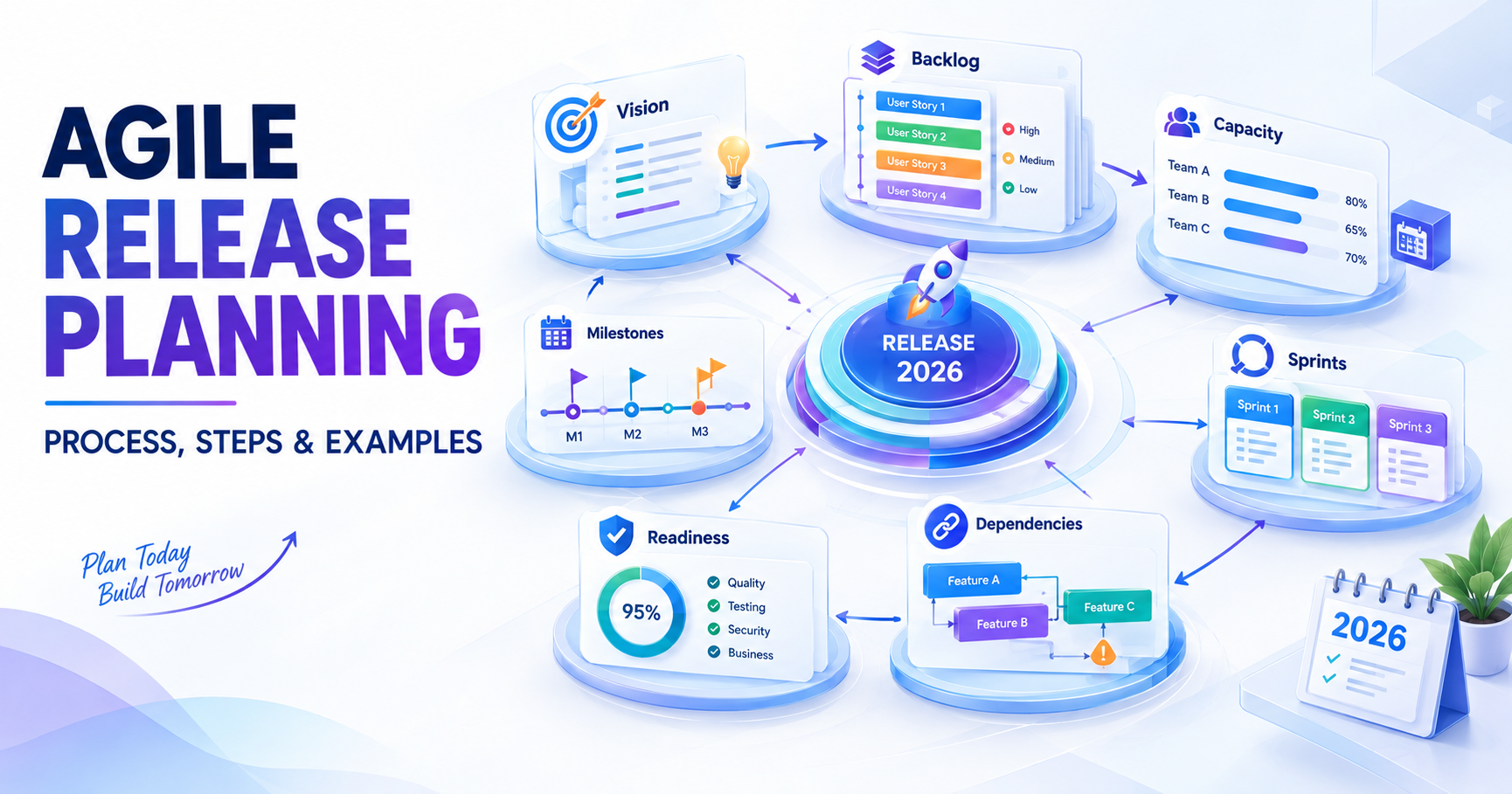
Releasing new products and features swiftly is the need of the hour. This is where agile release planning is effective. It helps SaaS companies manage and plan their release cycles seamlessly, helping in delivering new products and features in a timely manner.
Key Highlights of Agile Release Planning:
- Agile release planning sits between the product roadmap and sprint planning, turning vision and backlog into structured, incremental releases while staying flexible as priorities shift.
- The process follows six steps: define the release goal, prioritize and estimate the backlog, forecast team capacity and velocity, map stories to sprints, identify dependencies and risks, then review and replan continuously.
- Release planning, sprint planning, and PI planning differ mainly in time horizon and scope: sprint planning covers 1 to 2 weeks for a single team, release planning spans 1 to 3 months for a product, and PI planning coordinates multiple teams across 8 to 12 weeks under SAFe.
- Kanban and continuous delivery teams still need release planning, but they rely on throughput, cycle time, and Monte Carlo based flow forecasting instead of sprint boxed story points.
- Best practices include planning around outcomes rather than fixed feature lists, using rolling wave planning, documenting dependencies early, updating forecasts every sprint, and communicating changes clearly, since treating the plan as a fixed commitment is one of the most common mistakes teams make.
Agile Release Planning: What It Is and Why It Matters
The success of a project depends on a well-laid plan. However, even the best yet carefully drafted plan will need suitable changes. As a helping hand, knowing the basics of agile project management can be very useful. In 2021, agile was used widely by 86% of software development teams. Soon, it became a practice in industries where flexibility and iteration was essential.
As project managers and development teams, they have clarity on how sprints, story points, and launch dates can slip if there isn’t a proper approach towards coordinating releases. Agile release planning builds a unique structure to this problem by transforming the roadmap into incremental and realistic releases, which keep customers and stakeholders aligned.
In this guide, we will understand what agile release planning is, the purpose of a release plan, and process to create one. We will also take you through some agile release plan examples, talk about its differences with sprint planning and PI planning. A step-by-step process on how to create an agile release plan in scrum and then throw light on agile release planning best practices.
What is Agile Release Planning?
A product management approach within the Agile methodology where teams map out a series of incremental product releases is known as agile release planning. It is placed between the high level product roadmap and the day-to-day sprint planning.
Agile release planning turns your vision, roadmap, and backlog into clear release goals, organizing stories and features into iterations that deliver value while staying flexible as needs change.
What is the Purpose of a Release Plan?
The primary purpose of an agile release plan is to connect stakeholders, teams, and customers on a shared timeline, product vision, and a collection of high-value deliverables. According to a 2020 McKinsey study, companies that go agile tend to improve their operational performance by 30% to 50%, employee engagement by 20% to 30%, and financial performance between 20% to 30%.
Let’s look at it in detail
- Improves predictability: By using team velocity and sprint data, the release plan helps in balancing long-term goals with short-term flexibility.
- Manages risks early: Prior to development, a release plan identifies dependencies and potential hurdles.
- Aligns priorities: Here, the customers, development team, and business leaders are on the same page. This is with respect to what features come next and why.
- Better results: From customers to executives, there’s growth in product improvements and higher new feature adoption.
What is included in a release plan?
A release plan includes the following:
1. Product backlog:
A product backlog represents a set of to-do items like new features, bug fixes, user stories, change requirements, etc. With this list, you’ll understand which items are crucial and need to be worked on next.
2. Product scope:
The scope and objectives for a product release are specified here. It helps you in estimating accurate timelines and budget required to start the project. Also, the team is informed regarding the work process and what needs to wait for another release. The expected goals to be achieved are also mentioned here.
3. Release schedule:
A detailed timeline with start and end dates are provided here. Milestones like task due dates are also mentioned.
4. Resource allocation:
To complete the project, outline key resources you’ll need. This includes technology, budget, materials, and equipment.
5. Risks and dependencies:
Identify potential risks and challenges like resource constraints, scope creep, and technical issues which can impact the release cycle. You need to outline the strategies to mitigate the risks.
Agile Release Planning Process: 6 Steps to Create a Release Plan
To create a successful agile release plan, you’ll need careful planning that’s prior to even beginning with scheduling product releases.
Step 1: Define the Release Goal and Product Vision
Defining the product vision is one of the key steps in the agile release planning process. You will be guided on which features to prioritize, where to channelize efforts, and ways to adapt if the project requires further development.
Take the support of executives or high-level stakeholders who shall ensure that your vision connects with the market and organisation’s objectives.
Step 2: Prioritize and Estimate the Product Backlog
In the next step, we review the product backlog by using user stories to rank its features. However, it is advised to keep in mind that not all items are valuable. The scrum product owner or the product manager needs to rank these backlog features.
If you’re using the Scrum framework, you will have the planned features listed as backlog items. To determine the product’s priorities, the input from stakeholders will be useful.
Step 3: Forecast Team Capacity and Velocity
The current team availability and by using the historical velocity, you can estimate how much work you can complete per sprint. Later, you can group backlog items into a sequence of sprints, helping support the release goal. It is advisable to keep sprints realistic and small so that there won’t be any bugs.
Step 4: Map User Stories to Sprints
With a prioritized backlog and a capacity estimate in hand, the team maps user stories to individual sprints. Each sprint gets a slice of backlog items that fit within the team's forecasted velocity.
This step turns an abstract backlog into a concrete sprint-by-sprint plan. It also surfaces sequencing questions early. Some stories may need to happen before others because of technical dependencies or shared components.
Teams should leave some buffer in each sprint. A plan that assumes 100 percent of capacity goes to planned work leaves no room for defects, support requests, or unplanned discovery work that shows up mid-sprint.
Step 5: Identify Dependencies, Risks and Constraints
No release plan is complete without a clear view of what could go wrong. This step focuses on identifying dependencies between teams, external vendors, or shared infrastructure.
Risks might include unclear requirements, unproven technology, or reliance on a third-party API that has not been tested yet. Constraints could involve compliance deadlines, budget limits, or fixed external commitments like a trade show launch date.
Writing these down early gives the team a chance to build mitigation plans before they become blockers. A dependency spotted in week one is a planning item. The same dependency discovered in week five is a crisis.
Step 6: Review, Communicate and Replan the Release
A release plan is never final. It is reviewed at regular intervals and adjusted as new information arrives.
Stakeholders should see the plan, understand the assumptions behind it, and have a chance to raise concerns before work starts. Communication should include the release goal, the timeline, known risks, and what happens if priorities shift midway.
Replanning is not a failure. It is the mechanism that keeps the release plan aligned with reality. Teams that treat the original plan as fixed usually end up missing deadlines or cutting corners to hit an arbitrary date.
Teams that want a structured way to build this muscle across their organization often start with formalAgile Release Planning Training, which walks through each of these six steps with practical exercises.
Agile Release Plan Example: From Backlog to Release
An agile release plan example makes the process easier to visualize. Here is a simplified walkthrough using a fictional product team building a customer loyalty feature.
Example Product Backlog and Story Points
The team's backlog for this release includes the following items, each estimated in story points.
| Backlog Item | Story Points |
| Loyalty points calculation engine | 13 |
| Points balance display on account page | 5 |
| Redemption flow for rewards | 8 |
| Email notification for points earned | 3 |
| Admin dashboard for reward configuration | 8 |
| Fraud detection rules for point abuse | 5 |
The total backlog for this release comes to 42 story points. The team's average velocity across the last four sprints is 15 points per sprint.
Sprint-by-Sprint Release Allocation
Based on a velocity of 15 points per sprint, the release will take roughly three sprints. The allocation might look like this.
Sprint 1 covers the loyalty points calculation engine at 13 points, plus the email notification feature at 3 points, totaling 16 points. Sprint 2 covers the redemption flow at 8 points and the points balance display at 5 points, totaling 13 points. Sprint 3 covers the admin dashboard at 8 points and fraud detection rules at 5 points, totaling 13 points.
This sequencing puts the highest-risk item, the calculation engine, first. That order gives the team more time to catch issues before dependent features like the redemption flow are built on top of it.
Release Scope, Timeline and Dependencies
The release scope includes all six backlog items above, targeted for delivery across three two-week sprints, or six weeks total. The redemption flow depends on the calculation engine being complete and tested, which is why it is scheduled for sprint 2 rather than sprint 1.
Fraud detection rules depend on real usage data from the calculation engine, so they sit at the end of the release. This dependency chain is documented in the release plan so stakeholders understand why certain features cannot be pulled forward without risk.
How the Release Plan Changes When Priorities Change?
Suppose halfway through sprint 1, a stakeholder flags a compliance requirement that mandates fraud detection be live before the redemption flow launches. The team would need to resequence.
Fraud detection rules move from sprint 3 to sprint 2, and the admin dashboard shifts to sprint 3 or gets pushed to a future release entirely. The team communicates this change immediately, along with the reasoning, so stakeholders are not surprised by the new timeline. This is rolling wave planning in action. Near-term sprints stay detailed while later sprints stay flexible enough to absorb changes like this one.
Agile Release Planning vs Sprint Planning vs PI Planning Comparison
Sprint planning vs release planning is a common point of confusion for teams new to agile. Add PI planning into the mix, and the distinctions can get murky fast.
Here is a clear breakdown.
| Aspect | Sprint Planning | Release Planning | PI Planning |
| Time horizon | One sprint, typically 1 to 2 weeks | Multiple sprints, often 1 to 3 months | 8 to 12 weeks, aligned to a Program Increment |
| Participants | Single team | Product owner, team, key stakeholders | Multiple Agile teams across an Agile Release Train |
| Output | Sprint backlog and sprint goal | Release goal, timeline, and sprint allocation | Program board with team objectives and dependencies |
| Scope | Detailed, item-level tasks | Feature-level, medium detail | Cross-team features and dependencies |
| Frequency | Every sprint | Once per release cycle | Once per Program Increment |
| Framework origin | Scrum | Generic Agile practice | SAFe |
Sprint planning answers what the team will do in the next two weeks. Release planning answers what the team will deliver over the next few months. PI planning answers how multiple teams will coordinate delivery across a quarter, with a formal event structure defined by SAFe.
Understanding pi planning vs release planning matters most for organizations scaling beyond a single team, since PI planning adds cross-team synchronization that standalone release planning does not require.
How to Create an Agile Release Plan in Scrum?
Scrum teams follow a slightly different rhythm than scaled frameworks, since there is no formal PI planning event. Here is how the release planning process works in a Scrum context.
1. Define the Release Scope
The product owner works with stakeholders to define what the release should include. This draws directly from the product backlog and the overall product roadmap.
Scope should be tied to a clear business outcome, not just a bundle of features. A well-defined scope makes every later step in the process easier, since the team knows what "done" looks like for this release.
2. Estimate Backlog Items
The team estimates each backlog item using story points, planning poker, or another relative sizing technique. This gives the product owner a rough sense of total effort before committing to a timeline.
Estimates should be revisited as the team learns more about each item. Early estimates are directional, not final, and should be refined during backlog refinement sessions leading up to each sprint.
3. Calculate Available Team Capacity
Capacity accounts for the number of working days in each sprint, minus planned leave, holidays, and any partial allocation to other projects. This is different from velocity, which measures historical output.
Combining capacity with velocity gives a more accurate forecast than using either number alone. A team might have high historical velocity but reduced capacity in an upcoming sprint due to holidays, which would lower the realistic forecast for that sprint specifically.
4. Forecast Sprint and Release Dates
Using velocity and capacity, the team calculates how many sprints the release will likely take. This produces a target release date, which should always be communicated as a range rather than a fixed guarantee.
Forecasting works best as a rolling exercise. The team updates the forecast after every sprint based on actual velocity, rather than relying only on the original estimate made before work started.
5. Validate the Plan With Stakeholders
Before the plan is finalized, it goes back to stakeholders for review. This step catches misaligned expectations early, before the team commits real sprint capacity to the plan.
Stakeholders should understand the assumptions behind the forecast, including known risks and dependencies. This transparency reduces the chance of disputes later if the release timeline shifts.
Agile Release Planning for Kanban and Continuous Delivery
Release planning looks different for teams that do not use fixed-length sprints. Kanban and continuous delivery environments require a flow-based approach instead of a sprint-based one.
Does Kanban Need Release Planning?
Kanban teams still need release planning, even without sprints. The difference is in how the plan gets built. Instead of allocating story points to sprint boxes, kanban release planning relies on throughput and cycle time data pulled from the team's flow metrics.
Teams track how many items they complete per week or month, then use that historical throughput to forecast how long a given batch of backlog items will take. This approach works well for teams handling a mix of planned features and unplanned support work, since it does not require a fixed sprint boundary to function.
Release Planning Without Sprint Boundaries
Release planning without sprint boundaries relies on continuous flow rather than fixed iterations. Work items move through the system as capacity allows, and releases are triggered by completion of a specific scope rather than the end of a sprint.
This model suits teams practicing trunk-based development or feature-flag-driven releases, where code ships to production frequently and release timing decouples from any planning calendar. The release plan in this context becomes a rolling forecast, updated continuously as throughput data comes in.
Release Triggers and Flow-Based Forecasting
Flow-based forecasting uses probabilistic methods, often built on Monte Carlo simulation, to predict when a set of backlog items will likely be finished. Instead of a single date, teams get a range with associated confidence levels, such as an 85 percent chance of completion by a given week.
Release triggers can be based on a completed feature set, a fixed calendar date, or a business event like a marketing campaign. Whatever the trigger, the forecasting method stays grounded in actual historical data rather than optimistic estimates.
Agile Release Planning in Continuous Delivery Environments
In continuous delivery, code is deployable at any time, which shifts release planning away from date-driven releases and toward capability-driven ones. The question becomes less about when a release happens and more about when a specific capability is ready and validated for production use.
Teams in this environment still plan, but the plan focuses on sequencing feature flags, coordinating rollout stages, and managing risk through canary releases or phased rollouts. Continuous delivery release planning overlaps closely with deployment strategy here, since the technical release and the business-facing release are no longer the same event.
Agile Release Planning at Scale With SAFe
Large organizations running multiple agile teams need a coordinated approach to release planning. The Scaled Agile Framework, or SAFe, provides that structure through the concept of the agile release train.
How Release Planning Connects With an Agile Release Train?
An agile release train (ART) is a long-lived team of agile teams, typically made up of 5 to 12 teams and 50 to 125 people, organized around a shared value stream. The ART plans, commits, and delivers together on a synchronized cadence.
Release planning at this scale cannot happen team by team in isolation. Dependencies between teams are too significant, and misalignment at this level creates costly delays. The ART model solves this by bringing all relevant teams into a shared planning rhythm. Teams exploring this model in more depth can reviewWhat is an Agile Release Train for a closer look at how the train structure functions.
Release Planning and Program Increment Planning
Within SAFe, release planning is formalized through Program Increment, or PI, planning. This is a structured, typically two-day event held every 8 to 12 weeks, where all teams on the ART come together to plan their work for the upcoming increment.
PI planning produces a program board that shows team objectives, cross-team dependencies, and key milestones for the increment. This is a more rigorous version of release planning, built specifically for environments where multiple teams must stay synchronized.
Role of the Release Train Engineer in Release Planning
The release train engineer, or RTE, is the servant leader responsible for facilitating ART events and keeping the release train running smoothly. During PI planning, the RTE coordinates the agenda, helps resolve cross-team dependencies, and ensures the final plan reflects a realistic and achievable commitment.
The RTE also tracks execution after planning ends, flagging risks as they emerge and helping teams adjust without derailing the broader program commitment. This role is often compared to a scrum master operating at the program level rather than the team level.
Professionals who want a deeper grounding in this framework, including the RTE role and ART mechanics, often pursue aLeading SAFe Certification to build practical, framework-aligned skills.
Coordinating Releases Across Multiple Agile Teams
Coordination across teams depends on visibility. Shared dashboards, a common program backlog, and regular sync points like Scrum of Scrums help keep teams aligned between PI planning events.
Dependencies identified during PI planning are tracked on the program board throughout the increment. Teams that surface blockers early, rather than waiting for the next formal planning event, tend to hit their program objectives more consistently.
Agile Release Planning Best Practices
Strong release plans share a few common traits. These practices apply whether a team runs Scrum, Kanban, or a scaled framework like SAFe.
1. Plan Around Outcomes Instead of Fixed Feature Lists
A release plan built around a rigid feature list becomes fragile the moment priorities shift. Planning around outcomes gives the team flexibility to adjust which features deliver the goal, without abandoning the goal itself.
This mindset also makes it easier to cut scope when needed. If the goal is improving checkout conversion, the team can drop a lower-impact feature without derailing the release, since the outcome remains achievable through other means.
2. Use Rolling Wave Planning
Rolling wave planning keeps near-term sprints detailed while leaving later sprints at a higher level of abstraction. This reduces wasted planning effort on work that is likely to change before it starts.
As each sprint completes, the team adds detail to the next wave of work. This approach handles uncertainty better than trying to plan every sprint in full detail from day one.
3. Account for Dependencies and Technical Risks
Dependencies and technical risks should be documented as part of the release plan, not treated as an afterthought. This includes dependencies on other teams, third-party services, and infrastructure that has not yet been validated.
Teams that map these risks early can build contingency time into the plan. Teams that skip this step often discover the same risks mid-sprint, when there is far less room to respond.
4. Update Release Forecasts as New Information Emerges
A release forecast made in week one should not be treated as gospel by week six. Actual velocity, discovered risks, and changing priorities all affect the forecast, and the plan should reflect that.
Regular forecast updates, ideally after every sprint, keep stakeholders informed and prevent the kind of late surprises that damage trust in the planning process.
5. Communicate Changes Clearly With Stakeholders
Every change to the release plan should come with a clear explanation. Stakeholders need to understand what changed, why it changed, and what the new expectation is.
Silence around changes creates more frustration than the changes themselves. A short, honest update is almost always better received than no update at all.
Common Agile Release Planning Mistakes
Even experienced teams fall into familiar traps during release planning. Recognizing these patterns early helps avoid the disruption they cause later.
1. Treating the Release Plan as a Fixed Commitment
A release plan is a forecast, not a contract. Teams that treat it as an unchangeable commitment often make poor tradeoffs, like cutting quality or skipping testing, just to hit a date that no longer reflects reality.
2. Planning Without Considering Team Capacity
Plans built purely on backlog priority, without checking actual team capacity, tend to be overly optimistic. This leads to consistently missed sprint goals and a release timeline that slips further with every sprint.
3. Ignoring Dependencies and Technical Debt
Dependencies that are not identified early become blockers later. Technical debt that is deprioritized indefinitely eventually slows down every future release, making this one of the more expensive mistakes to leave unaddressed.
4. Confusing Release Planning With Sprint Planning
Sprint planning and release planning solve different problems. Treating release-level decisions as something to work out during a sprint planning meeting usually results in a shallow discussion that lacks the context needed for good decisions.
5. Failing to Replan When Priorities Change
Priorities change. Markets shift, competitors launch, and customer feedback surfaces new needs. A release plan that does not get updated to reflect these changes quickly becomes disconnected from what the business actually needs.
Conclusion: How to Build an Effective Agile Release Plan
Agile release planning works best when it is treated as a living process rather than a one-time exercise. The six-step process, from defining a release goal to reviewing and replanning, gives teams a repeatable way to turn a backlog into a realistic delivery timeline.
Whether a team runs Scrum, Kanban, or a scaled framework like SAFe, the fundamentals stay consistent. Plan around outcomes, respect actual capacity, track dependencies honestly, and keep communication open when things change.
Teams that want to build these skills in a structured, hands-on way can exploreAgile Project Management Training from Simpliaxis.
The program covers release planning, backlog management, and cross-team coordination in detail, giving teams and individuals the practical skills needed to plan releases that actually hold up under real-world pressure.







 Lowest-Price Challenge











 Personalized Path


.webp)


 USA
USA  Canada
  India
India  UK
UK  Australia
  Singapore


